


More news on this day
U.S. travelers heading home at the end of the 2026 Thanksgiving break are facing lingering delays after a coastal nor’easter disrupted key East Coast hubs on Thursday, November 26, and a Saturday morning earthquake off Manhattan Beach, California, shook Los Angeles International Airport just as airlines were working through one of the year’s heaviest travel weekends.
Get the latest news straight to your inbox!
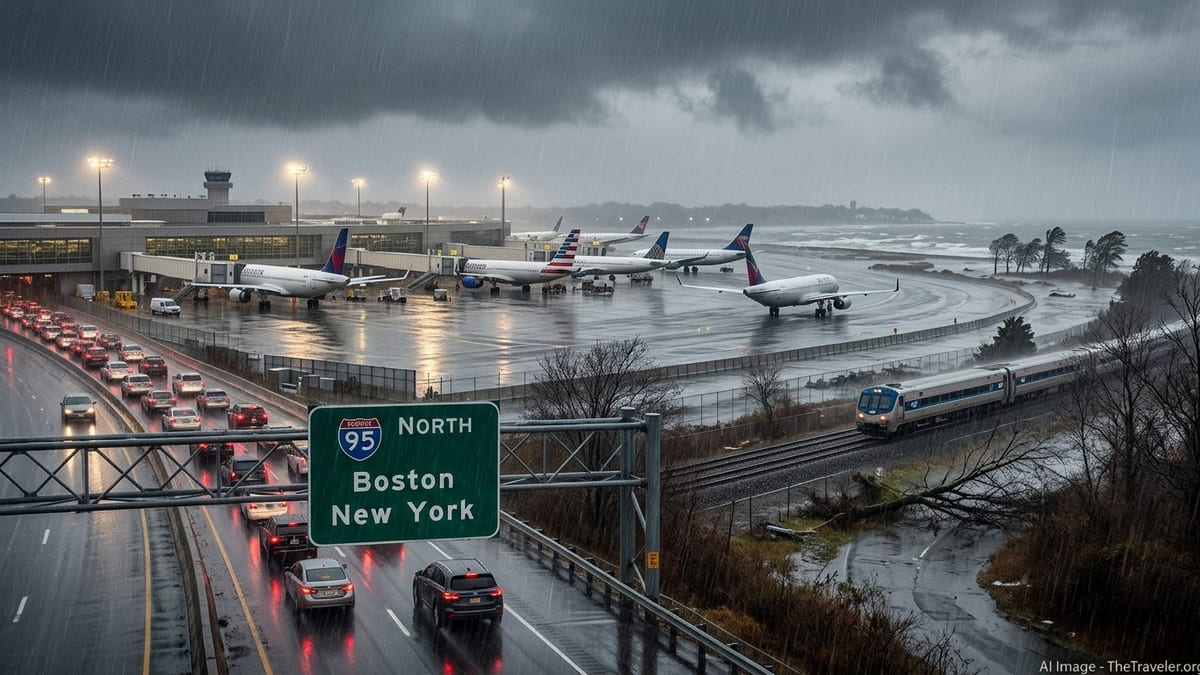
Coastal nor’easter brings high winds, flooding and East Coast delays
The week’s travel disruptions began with a fall nor’easter that moved up the Eastern Seaboard on Thanksgiving Day, November 26, bringing strong winds, heavy rain and coastal flooding from the Carolinas into New England. Forecast discussions from the National Weather Service in the days leading up to the holiday highlighted the risk of wind gusts over 45 miles per hour along parts of the I‑95 corridor, low cloud ceilings and pockets of coastal inundation at high tide, conditions that can significantly constrain airport capacity.
On Thursday, the system delivered on that forecast. In New York City, official observations recorded gusts in excess of 50 miles per hour in the afternoon, with even stronger gusts at area airports. LaGuardia registered peak winds in the mid‑60 mile per hour range, while bands of heavy rain reduced visibility and contributed to urban and coastal flooding in low‑lying neighborhoods. Those conditions were mirrored to varying degrees from New Jersey through Long Island and into southern New England, where some shoreline communities reported flooded roads and scattered power outages as the storm coincided with high astronomical tides.
The Federal Aviation Administration responded by instituting ground delay programs at major Northeast hubs, including the three New York area airports and Boston Logan. These programs slowed the rate of arrivals and departures to match what controllers could safely handle in the gusty, low‑visibility conditions, increasing average delay times even though runways remained open. Airlines cancelled a portion of their schedules in the region on Thursday to prevent more severe gridlock, and live tracking data on Saturday still showed knock‑on delays tied to aircraft and crews displaced by the storm rather than to new weather problems.
Limited slack in record Thanksgiving schedules magnifies impact
The nor’easter struck at a time when there was little margin in the system. Ahead of the holiday, the U.S. Department of Transportation and the FAA projected that Thanksgiving 2026 would bring the busiest holiday skies in more than a decade, based on scheduled flights filed by airlines and security screening forecasts derived from Transportation Security Administration throughput. Transportation officials framed the period from Sunday, November 22, through Monday, November 30, as a sustained peak with multiple days above 50,000 domestic and international departures.
Carriers scheduled near‑record numbers of flights to meet that demand. American Airlines, for example, said in a pre‑holiday operational update that it expected to operate nearly 85,000 flights between November 21 and December 2, including more than 7,000 services on Sunday, November 29, its single busiest day since the pandemic. Other major U.S. airlines released similar guidance, pointing to tight schedules and high load factors across their networks during the Thanksgiving window.
Preliminary operational statistics compiled by federal transportation agencies and independent trackers indicate that weather has been responsible for a large share of delay minutes since early in the week, particularly along the East Coast and parts of the Midwest. Because schedules were so dense, even moderate restrictions at a single hub have at times propagated widely, leaving passengers with missed connections and rebookings far from any active storms. Average delays at the height of Thursday’s nor’easter and into Friday generally sat around the half‑hour mark at heavily affected airports, but individual flights faced substantially longer waits while airlines repositioned equipment.
Ripple effects from Northeast to Midwest as networks recover
By Saturday, November 28, the worst of the coastal storm had shifted offshore, but residual cloud, gusty winds and congestion kept pressure on key hubs. At the New York area airports and at Boston Logan, controllers continued to use arrival and departure spacing to manage occasional low ceilings and crosswinds, and airlines were still working passengers through backlogs created on Thanksgiving Day. Most flights were able to depart, yet many left late, and travelers reported periods of extended gate holds and occasional tarmac delays when traffic flow briefly slowed.
In the Midwest, Chicago O’Hare International Airport experienced a high volume of delayed departures at several points on Saturday. Some of these delays reflected earlier regional weather systems that moved through before the nor’easter, but many were the result of late inbound aircraft and crews from the East Coast. O’Hare’s role as a major connecting hub for both domestic and international routes meant that schedule disruptions there were quickly felt in cities with otherwise benign local conditions, illustrating how concentrated the U.S. air network has become around a small number of pivotal airports.
Other large connecting hubs, including Atlanta and Dallas Fort Worth, also saw localized pockets of cancellations and rolling delays as carriers adjusted aircraft routings and staffing plans. Following the nationwide ground stop related to an FAA technology issue earlier in November, regulators have avoided broad systemwide restrictions this week, instead applying targeted ground delay programs at individual airports when crosswinds, low visibility or temporary runway constraints required. Those measures, which can be activated and lifted on short notice, have contributed to an uneven travel experience in which some flights operate close to schedule while others experience substantial holdups.
Offshore quake near Manhattan Beach jolts LAX during busy return rush
As airlines worked through the weather‑related backlog, Southern California experienced a new and unrelated disruption on Saturday morning when an earthquake struck beneath Santa Monica Bay, a few miles off the coast from Manhattan Beach. Initial automatic readings from the U.S. Geological Survey placed the magnitude close to 5.0 at a depth of around 10 to 12 kilometers, with shaking felt across the Los Angeles Basin and particularly strongly in the South Bay communities and neighborhoods adjacent to Los Angeles International Airport.
Passengers and staff at LAX reported noticeable shaking in terminals around 9:30 a.m. Pacific time. Local broadcast footage and eyewitness accounts described ceiling tiles shaken loose in at least one terminal, broken or cracked glass along parts of the terminal frontage and short interruptions as check‑in and security lines paused while the tremor passed. Some travelers posted images of debris near ticketing kiosks and mentioned emergency alarms and announcements, though there were no immediate reports of serious injuries.
The Los Angeles Fire Department implemented its standard citywide earthquake response protocol, dispatching crews to inspect critical infrastructure, including airports, ports, bridges and key freeway interchanges. LAX management confirmed that runways and taxiways remained open while engineers carried out structural and systems checks in terminals, concourses and parking structures. Flight‑tracking services showed that aircraft movements continued during and after the event, but at least one inbound flight conducted a go‑around and several departures appeared to experience timing adjustments as controllers and pilots verified the status of pavements and lighting.
By early afternoon in Los Angeles, city officials and airport authorities were reporting only minor damage at LAX and other inspected facilities, primarily limited to cosmetic issues such as dislodged tiles and broken windows. There was no tsunami warning associated with the offshore quake, and no major structural problems had been attributed to the shaking. However, any temporary gate closures required to facilitate inspections added to crowding in the terminals at a time when passenger volumes were already high, compounding the effect of ongoing weather‑related disruptions elsewhere in the network.
Knock‑on effects for other transport modes and what travelers should do next
The effects of the Thanksgiving nor’easter have not been confined to aviation. Passenger rail services in the Northeast, including key electrified corridors through New Jersey and southeastern Pennsylvania, reported weather‑related slow orders and delays where saturated ground, ponding water and downed tree limbs interfered with overhead power systems. In some coastal areas, local rail and commuter lines also faced temporary speed restrictions or minor suspensions while crews assessed track conditions following the combination of heavy rain and high tides.
On the roads, transportation departments along the I‑95 corridor have continued to warn drivers about residual standing water in underpasses and on low‑lying stretches through the weekend, particularly at coastal chokepoints that experienced tidal flooding on Thursday and Friday. While main interstate routes have remained open, some secondary roads in shore communities were still subject to detours on Saturday as local authorities worked to clear debris and pump out flooded sections. These conditions have added variability to journey times for travelers relying on rental cars, airport shuttles and ride‑hailing services to reach flights.
Looking ahead to the remainder of the Thanksgiving travel window, from Sunday, November 29, through Tuesday, December 1, meteorological outlooks call for additional disturbances moving across the central United States and into the Northeast. Forecasters are monitoring the potential for renewed episodes of rain, low cloud and gusty winds affecting some of the same regions already hit by the Thanksgiving Day nor’easter, along with early‑season snow at higher elevations in the Rockies and parts of the interior Northwest. These are currently framed as forecasts rather than certainties, and the exact timing and intensity of any new impacts will depend on how those systems evolve.
For passengers, the combination of unsettled weather, residual congestion and ongoing inspections around Los Angeles after the quake means that building extra margin into travel plans remains prudent through at least Tuesday. Airlines and regulators are advising travelers to monitor flight status closely via airline apps and airport information boards, pay attention to gate or departure‑time changes that may be announced on short notice, and arrive early for security screening at large hubs such as the New York area airports, Boston, Chicago O’Hare, Atlanta, Dallas Fort Worth and LAX. Travelers with tight onward connections may wish to consider earlier departures where possible or identify contingency options in case of missed links.
Consumer advocates also note that when an airline cancels a flight or makes a significant schedule change, U.S. Department of Transportation rules generally entitle passengers who choose not to travel to a cash refund rather than a voucher, regardless of the cause of the disruption. Because official delay and cancellation statistics for the peak Thanksgiving period will only be finalized in the coming days, prospective passengers are encouraged to rely on real‑time data from airline channels and FAA status pages rather than preliminary tallies circulating on social media. With storms still influencing parts of the country and aftershocks a possibility near Southern California’s coast, travelers heading home at the close of the long weekend will be best served by staying informed, allowing extra time and remaining flexible as conditions evolve.