


The Dodecanese look close together on the map, but once you start checking timetables the network can feel bewildering. Routes are seasonal, ships vary from huge overnight ferries to tiny island boats, and not every island has an airport. This guide explains the main ways to reach and move between the islands as of the 2025–2026 seasons so you can plan realistic journeys rather than rely on outdated assumptions.
Get the latest updates straight to your inbox!
Big-picture access: how the Dodecanese network works
The Dodecanese chain runs along the southeastern edge of the Aegean, with Rhodes and Kos acting as the main transport hubs. Most visitors reach the region either by long-distance ferry from Piraeus, by domestic flight from Athens into one of several island airports, or on a seasonal international flight into Rhodes or Kos. From there, a web of regional ferries and small planes links smaller islands.
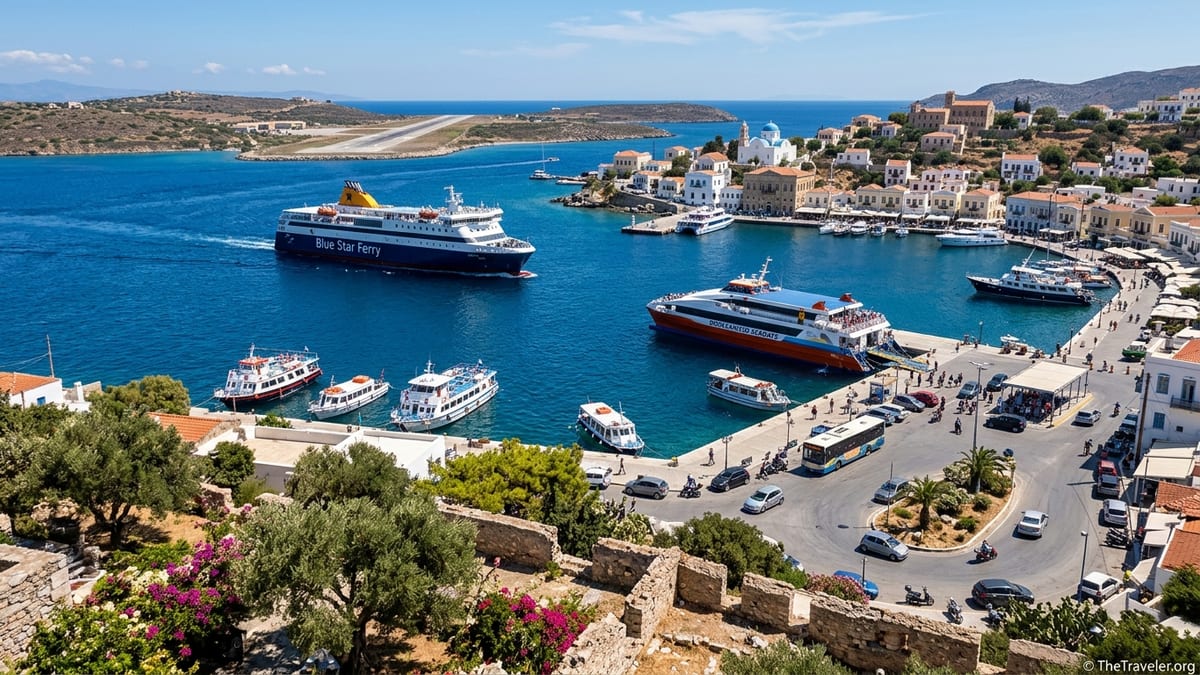
There are three broad layers to the ferry system. First are the large conventional ferries operated by companies such as Blue Star Ferries on year-round routes connecting Piraeus with major Dodecanese islands including Rhodes, Kos, Kalymnos, Leros, Patmos, Nisyros, Tilos, Symi, Karpathos and Kastellorizo, usually in long multi-stop itineraries. Second are regional high-speed catamarans and smaller ferries, notably those run by Dodekanisos Seaways between Rhodes or Kos and islands such as Symi, Halki, Tilos, Nisyros, Leros, Lipsi and Patmos. Third are local boats and occasional water-taxis that serve short hops or remote beaches.
Flights layer on top of this maritime network. Rhodes and Kos have busy international airports with frequent domestic connections from Athens and other Greek cities, while Karpathos has a smaller airport that handles both domestic and some international seasonal services. A second tier of domestic-only airports serves Astypalaia, Kalymnos, Leros, Kasos and Kastellorizo, typically with subsidised “public service obligation” routes from Athens or from regional hubs such as Rhodes. In practice, this means many itineraries combine a flight into a main island and onward ferries.
Because schedules change each year and can shift mid-season, planning in the Dodecanese is less about memorising set routes and more about understanding patterns. Long-distance ferries tend to be year-round but less frequent in winter, regional high-speeds ramp up from roughly April to October, and smaller islands may only see a few ferries per week outside peak summer. Always verify routes for your exact travel dates before locking in accommodation.
Long-distance ferries from Piraeus to the Dodecanese
For many travellers, the classic way into the Dodecanese is the overnight ferry from Piraeus, the main port of Athens. Blue Star Ferries operates large conventional vessels such as Blue Star Patmos and Blue Star 2 on routes that typically run Piraeus to Astypalaia, Patmos, Lipsi, Leros, Kalymnos, Kos, Nisyros, Tilos, Symi and Rhodes, with extensions some days to Karpathos, Kasos and Kastellorizo. The exact sequence of ports and which days each island is served vary by season, so treat examples as indicative only.
These ships are essentially floating hotels with vehicle decks, indoor lounges, open decks and a range of cabins. Journey times are long: Piraeus to Rhodes usually takes around 15 to 17 hours depending on intermediate stops, while Piraeus to Kos is typically in the 11 to 13 hour range. As of the 2026 fare tables, an economy deck ticket on a Piraeus to Rhodes sailing on a Blue Star ferry commonly sits somewhere in the tens of euros rather than single digits, with a wide spread depending on demand, day of week and whether any promotional fares are available. A private two-berth cabin can cost several times the deck fare. Prices are dynamic, so always check current fares for your date and sailing.
Ticketing for these long routes is increasingly digital, but procedures still vary. Some operators issue true e-tickets that you can board with directly using a QR code. Others require you to exchange your booking confirmation for a physical ticket at the company kiosk in Piraeus or at a partner travel agency in town. Check your booking conditions carefully and arrive at the port early enough to complete any formalities; for a major Piraeus departure it is sensible to be landside at least one hour before the stated departure time, and longer if you still need to print tickets or are boarding with a vehicle.
When reading timetables, pay close attention to the specific Piraeus gate and to whether your island is served daily or only on specific days each week. In winter, some smaller Dodecanese islands see only two or three calls per week on the long-distance route, and rough weather can lead to cancellations or diversions. Rather than planning around an assumed minimum frequency, work backwards from published schedules, allow at least one night’s buffer before any onward flight, and consider booking cabin accommodation on overnight sectors to arrive rested.
Regional ferries and high-speed links between islands
Once you are in the Dodecanese, regional ferries do the work of moving you between nearby islands. Dodekanisos Seaways is the main high-speed operator, running catamarans such as Dodekanisos Express and Dodekanisos Pride on routes radiating from Rhodes and Kos to islands including Symi, Halki, Tilos, Nisyros, Kalymnos, Leros, Lipsi, Patmos and Agathonisi. These services are particularly important from late spring to early autumn when timetables can include daily or near-daily links on key routes, while shoulder seasons see fewer sailings and some lines pause in winter.
High-speed catamarans are faster and more expensive than conventional ferries. For example, 2026 published passenger fares from Dodekanisos Seaways indicate that a Rhodes to Kos ticket typically runs in the few tens of euros range in economy, with a higher tier for more flexible or business class options. Shorter hops, such as Lipsi to Patmos, are usually cheaper, often around the low tens of euros or less in basic economy according to current fare bands. By contrast, a conventional local ferry between Symi and Rhodes can be slower but somewhat cheaper, at the cost of more time on the water and greater vulnerability to sea conditions.
On these regional services, online booking is standard and true e-tickets are increasingly common, but again there are exceptions. Many travellers still collect printed boarding passes from small island agents, especially when connecting to other routes. Check-in times are usually shorter than in Piraeus, yet arriving 30 to 45 minutes early is wise, more so in midsummer when quays can be crowded and boarding is brisk. Luggage is often stacked in communal racks on deck rather than individually tagged, so label bags clearly and keep valuables with you.
Seasonality matters even more on regional routes than on the trunk Piraeus sailings. Connections that are daily in July and August might drop to two or three times per week in May or October and disappear entirely in winter. When planning a chain of islands, build in flexibility. Use current-year timetables rather than old blog posts, avoid last-boat-of-the-season assumptions, and on smaller islands always confirm your return ferry as soon as you arrive, especially if you are attempting a same-day out-and-back trip.
Flights into the Dodecanese: when flying makes sense
Several Dodecanese islands have operational airports, but the scale and type of service vary. At the top tier are Rhodes International Airport “Diagoras” and Kos “Hippocrates”, both busy airports with year-round domestic flights from Athens and other Greek cities, plus extensive seasonal international services from across Europe in summer. Karpathos Airport also handles domestic flights from Athens and seasonal international charters, though on a much smaller scale.
A second group of Dodecanese airports provides domestic-only connectivity. Astypalaia, Kalymnos, Leros, Kasos and Kastellorizo each have small national airports, typically linked to Athens or Rhodes via subsidised public service obligation routes on turboprop aircraft. Schedules on these routes are limited, sometimes only a few flights per week depending on the season, and aircraft are small, so seats can sell out quickly around holidays or during peak summer weeks.
Flying can save significant time compared with a long overnight ferry, particularly on the Athens to Rhodes or Athens to Kos sectors. A flight from Athens to Rhodes usually takes about one hour, whereas the ferry from Piraeus can be a 15 hour journey or longer with intermediate stops. However, flying introduces other trade-offs. Fares can be higher on a per-hour basis than ferries, checked baggage may incur extra fees on low-cost carriers, and change or cancellation fees are common on cheaper tickets. Environmentally, frequent flights add to carbon emissions, while ferries, although far from impact-free, consolidate many passengers into a single sailing.
When comparing modes, consider your wider itinerary. If you are short on time or arriving late into Athens, flying directly to Rhodes, Kos or Karpathos and then using ferries onwards often makes the most efficient use of days. If you prefer slow travel, want to avoid airport queues and are less sensitive to journey time, an overnight ferry with a cabin can be an enjoyable part of the experience. In both cases, check the current year’s flight and ferry schedules together, and build margins in case of weather-related cancellations, which can affect both planes and boats in the Aegean.
Local transport on Rhodes and Kos
Rhodes and Kos are the main entry points to the Dodecanese and both have relatively developed local transport networks by island standards. On Rhodes, the island’s capital and resorts are connected by a mix of urban and intercity buses operated from central terminals in Rhodes Town, with routes running to popular areas such as Faliraki, Lindos and the airport. Frequencies on main corridors are fairly good in summer, though less reliable late at night and in the off-season, so you should always verify the latest timetables either online or at the bus stations shortly before travel.
Taxis are widely available on both Rhodes and Kos, particularly around ports, airports and major resorts. Official taxi ranks operate with posted base charges and surcharges; long-distance trips are usually priced by the meter or by fixed tariff tables. Organized excursions and private transfers are common, which can make sense if you are a small group planning to visit several sights in one day without hiring a car. Ridesharing apps are less developed than in large cities, so do not rely on being able to summon a car at short notice in remote areas.
Rental cars, scooters and quad bikes are easy to find on the larger islands, especially during the May to October season. Kos in particular has a reputation as a bike-friendly island, with some dedicated cycle paths in and around Kos Town and relatively flat terrain in parts of the island, although conditions still mix cyclists with traffic and this should be seen as a general impression rather than a guarantee of safe infrastructure. On both Rhodes and Kos, driving involves a mix of main roads and narrower rural lanes; parking can be tight in historic centres and near popular beaches in high season, so factor in walking from parking spots.
If you plan to drive or ride, ensure your licence is valid in Greece. Travellers from many non-EU countries are advised to carry an International Driving Permit alongside their home licence, and rental firms often set minimum ages of around 21 for cars and higher or with extra surcharges for younger drivers. Scooters above 50cc usually require a motorcycle or specific scooter endorsement, and reputable agencies will not rent powerful machines to those without the correct licence class. Basic insurance is typically included in the rental price, with optional collision-damage waivers extra. Always inspect vehicles carefully for existing damage and photograph them before departure.
Local transport on smaller islands
On the smaller Dodecanese islands, transport is simpler but less frequent and more informal. Symi, for instance, has a small bus network linking Yialos (the harbour) with settlements such as Chorio and Pedi, as well as seasonal boats that run from the main harbour to popular beaches. Walking is feasible for fit visitors, although gradients can be steep and summer heat intense. Taxis exist but in small numbers, so booking ahead or arranging pick-up times is advisable.
Tilos and Nisyros tend to have one or a handful of buses that connect the main port with villages and beaches, often timed around ferry arrivals and departures. However, specific timetables can change from year to year and sometimes mid-season, so avoid relying on second-hand schedules. Small car or scooter rental outfits operate on many of these islands, though fleets are limited and can be fully booked in peak weeks. Fuel stations may be sparse or concentrated near the main port; on very small islands there might be a single pump with restricted opening hours.
On Leros, Lipsi, Patmos and Kalymnos, patterns are similar: modest bus networks connecting ports to key villages and beaches, supplemented by taxis and rentals. Patmos, for example, usually has buses linking Skala (the port) with Chora and other settlements, but with frequencies that are aimed at residents rather than tourists. Kalymnos, which is larger and known for climbing, has more traffic and a somewhat more developed bus and taxi scene, yet you should still expect gaps in service during the day and quieter schedules in winter. Walking is practical in and around main settlements but long distances between some beaches or climbing sectors often push visitors toward rented vehicles.
Kastellorizo, one of the remotest inhabited islands in Greece, illustrates the extremes of limited local transport. The port village, airport and main settlements are close together by island standards, and many visitors get around largely on foot or by boat. There may be a small number of taxis or informal rides, but you should not count on regular scheduled public transport. Across all small islands, the golden rule is to confirm local options once you arrive, use recent local information boards and ask accommodation hosts about current bus times, taxi contacts and fuel availability.
Driving, rental rules and safety considerations
Driving in the Dodecanese combines the pleasures of scenic coastal roads with the challenges of island infrastructure. Outside the main towns, roads are often narrow, winding and sometimes without substantial shoulders or guardrails. Night driving can be demanding due to limited lighting, livestock on the road and sharp bends, especially on islands like Karpathos or interior Rhodes. If you are uneasy with mountain driving, consider limiting car use to shorter daylight trips or relying on organised tours for more remote excursions.
Rental conditions vary by company but share broad patterns. Car rentals usually require a valid licence held for at least one year, a credit card in the driver’s name, and a minimum age that often starts around 21 to 23 for basic categories, with surcharges or higher age thresholds for powerful vehicles. Scooter and quad rentals can look tempting for short distances, but do not underestimate the risk: island roads are often exposed to crosswinds, and loose gravel in corners is common. Only rent a scooter or motorbike if you have the proper licence category and recent riding experience, and consider that some travel insurance policies exclude injuries from riding without the appropriate licence or helmet.
Fuel planning is essential on smaller islands. While Rhodes and Kos have numerous fuel stations, others might have only one or two. Opening hours can be shorter than on the mainland, particularly on Sundays and holidays. Before heading on a long loop, especially on islands such as Karpathos, Tilos or Nisyros, check where the last fuel stop is and top up earlier than you would at home. On very small islands reached by regional ferries, some vehicles are provided with a full tank and instructions on when and where to refill or settle fuel charges.
Safety on the water and under the sun is as important as safety on the roads. Summer temperatures in the Dodecanese often climb well above 30 degrees Celsius from late June through August, with strong sun even on breezy days. Dehydration, heat exhaustion and sunburn are real risks when waiting on exposed quays or walking uphill with luggage. Carry water, wear hats and sunscreen, and try to schedule the heaviest movements early or late in the day. At sea, the Meltemi winds and local weather systems can produce rough crossings; those prone to seasickness may want medication and should book lower-deck seats toward the centre of the vessel when possible.
Combining modes and using passes
Many travellers find that the most efficient Dodecanese itineraries combine flights and ferries. A common pattern is to fly from Athens to Rhodes, Kos or occasionally Karpathos, spend a few days, then use regional ferries to hop to islands such as Symi, Tilos, Nisyros, Leros, Lipsi or Patmos. Another is to fly into one hub and out of another, for example arriving on Rhodes and departing from Kos, stitching together a logical island chain in between. This reduces backtracking and exposure to single-point failures if a ferry back to your original hub is cancelled by weather.
Rail-and-ferry products can help some travellers, though they are not a universal solution. The Interrail Greek Islands Pass, for instance, remains on sale in 2026 and offers a defined number of ferry travel days on participating operators, mainly linking mainland Italy with Greece and providing domestic Greek island trips on specified ferry companies. These passes can represent value if you plan multiple longer segments on the included operators, such as Blue Star Ferries, but they do not cover every ferry company in the Dodecanese and still require seat or deck reservations. If you hold such a pass, read its conditions carefully to understand which routes are fully covered and where only discounts apply.
When combining modes, the main planning principle is to avoid tight connections. Never schedule a same-day flight out of Greece that depends on a morning ferry from a distant island, especially outside high summer. Even in July and August, weather or technical issues can delay or cancel sailings. Build at least one buffer night on a major hub island such as Rhodes, Kos or Athens before any important onward flight. Similarly, if you are flying into a small island airport and connecting to a ferry that day, choose a later sailing in case your flight is retimed.
For day trips, such as visiting Symi from Rhodes or Nisyros from Kos, confirm the outward and return sailings on the same day from current timetables, and buy both tickets where possible before you leave. Pay attention to which port you sail from and into; for example, on Rhodes some services to nearby islands depart from secondary ports such as Kamiros Skala rather than from Mandraki or the main commercial harbour, and reaching these smaller ports involves a road transfer that you must factor into your timing.
Key islands at a glance
The following summary highlights the main ports, airports and local transport patterns for some of the best-known Dodecanese islands. It is not exhaustive and should be cross-checked against current timetables, but it can help you choose realistic arrival and departure points.
Rhodes has the principal port at Rhodes Town and a secondary ferry pier at Kamiros Skala for some services to islands such as Halki. It has an international airport with extensive domestic and seasonal international flights. Local transport includes urban and intercity buses, plentiful taxis, organised tours and widespread car, scooter and bike rental. Kos centres on Kos Town and its nearby port, with an international airport inland. The island has a reasonably developed bus network, taxis, and a strong presence of rental bikes and scooters, along with car rentals serving beach resorts.
Among the smaller islands, Symi’s main port is Gialos, served by regional ferries and excursion boats from Rhodes. There is no airport. Local options are limited to a small bus route, taxis, water-taxis and walking. Tilos and Nisyros are linked primarily by ferries from Rhodes and Kos, including stops on long-distance routes and regional high-speeds. They have no airports. Local transport typically consists of a small bus or two, some taxis and modest rental fleets. Patmos, Lipsi, Leros and Kalymnos lie along routes from Piraeus and from Rhodes or Kos; only Leros and Kalymnos have airports, with limited domestic flights. On all four, local buses, taxis and rentals exist but with modest frequencies.
Farther south, Karpathos and Kasos sit between Rhodes and Crete. Karpathos has both port facilities at Pigadia and an island airport with domestic and some international summer flights. Kasos has a small port and a domestic airport with flights to Rhodes, Karpathos and Crete. Kastellorizo at the eastern edge of Greece is reached primarily via long multi-stop ferries and a few domestic flights from Rhodes. On these southern islands, buses are sparse and many visitors rely on rental cars, scooters or organised boat trips to reach remote beaches and villages.
Use this overview to sketch a skeleton itinerary. For example, flyers might plan Athens to Rhodes, then island-hop via Symi and Tilos to Kos, and return to Athens from Kos. Those preferring ferries might sail Piraeus to Patmos, continue through Lipsi and Leros to Kalymnos and Kos, then either sail onward to Rhodes or fly home. In all cases, confirm each leg individually against current schedules, check for weather-related notices shortly before departure, and keep your plans flexible enough to cope with the living, changing nature of the Aegean transport network.