


More news on this day
U.S. Transportation Secretary Sean Duffy says early Federal Aviation Administration figures from the first days of the 2026 Thanksgiving travel period show that weather and record holiday traffic, rather than a fresh wave of federal system failures, are responsible for most flight delays so far, even as a major telecommunications outage earlier in November keeps the resilience of U.S. air travel in the spotlight.
Get the latest news straight to your inbox!
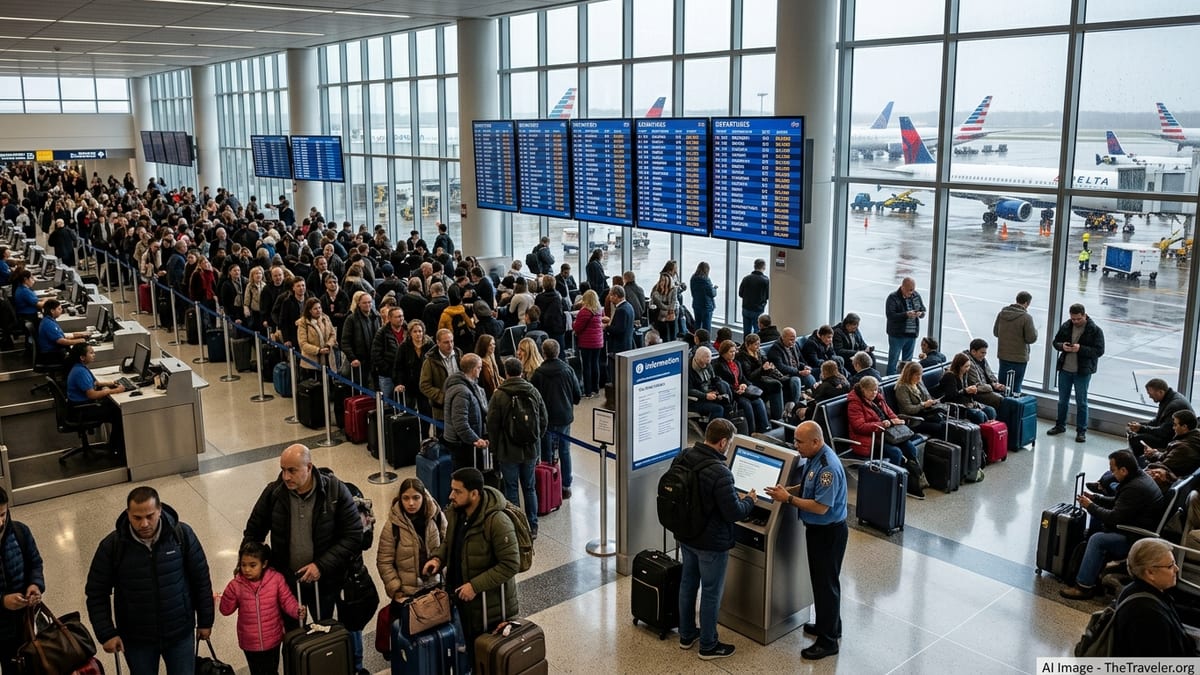
Preliminary FAA Data Point To Weather And Volume
Speaking ahead of the Thanksgiving holiday, Duffy said initial operational data from the Federal Aviation Administration for Tuesday 24 November through Friday 27 November indicate that roughly four in five U.S. flight delays during that span were linked to either adverse weather or congestion in the air and on the ground. According to his breakdown, about 45 percent of delays were associated with storms, low visibility and high winds, while congestion in busy airspace and at crowded airports accounted for a further 35 percent. Those shares are broadly in line with patterns seen in the Department of Transportation’s regular airline performance reports, which long show weather as the single largest driver of delays when traffic is heavy.
The figures cover the first four days of the nine-day Thanksgiving travel window, which federal forecasts define as running from 23 November through 1 December. During that opening stretch, around 167,000 flights operated nationwide, according to Duffy’s summary of FAA operations data. That volume coincided with a series of coastal storms, heavy rain bands and pockets of turbulence across several regions, which prompted arrival rate reductions, airborne holding and, in some cases, temporary ground stops at major hubs as visibility and crosswinds deteriorated.
Forecasters had warned in advance that parts of the Eastern Seaboard could see strong winds, coastal flooding and 1 to 2 inches of rain on Thanksgiving Day itself, with gusts in some coastal cities potentially reaching 40 to 45 miles per hour. Those conditions translated into air traffic flow programs along key corridors, reroutes around active weather and speed restrictions that accumulated into measurable delays for passengers, even where departure and arrival airports were not experiencing the worst of the storms at ground level.
Record Holiday Traffic Follows Nationwide Ground Stop
The 2026 Thanksgiving rush is unfolding in the shadow of a rare nationwide ground stop that brought U.S. departures to a halt on Friday 13 November. Despite that disruption, the FAA’s own forecast, released on 24 November, projected that this year’s holiday period would see the busiest skies since at least 2010, with more than 417,000 flights scheduled between 23 November and 1 December and peak days above 50,000 flights. That forecast framed the early delay numbers cited by Duffy and set expectations for pressure on capacity across the system.
FAA Administrator Bryan Bedford and Duffy have both characterized the 2026 forecast as slightly higher than Thanksgiving 2025, echoing airline schedule data that show seat capacity and flight volumes at or above last year across the week. Some large hubs, including Dallas–Fort Worth and Atlanta, have issued their own passenger projections, anticipating multi-million traveler totals over extended Thanksgiving windows that encompass the weekends before and after the holiday. Those local forecasts align with national expectations that domestic and international demand would remain strong despite airfares and ancillary travel costs that are still elevated compared with many pre-pandemic years.
Duffy said that, even with that record activity and the passing storm systems, average delays during the first four days of the official Thanksgiving window remained around 30 minutes. Real-time tracking data from airline and flight-status providers have shown delay spikes at particular hubs when storms passed through but have not indicated a prolonged nationwide gridlock similar to the worst holiday disruptions of recent years. Federal officials have credited air traffic controllers, airline operations teams and front-line airport staff with limiting knock-on effects as weather moved through Florida, the Gulf Coast, the Southeast, the Mid-Atlantic and the Northeast.
Local Technology And Staffing Problems Add Strain
Although national data so far point to weather and congestion as the main sources of delay, localized technology and staffing issues have added strain at some of the country’s busiest airports in the days leading into Thanksgiving. These incidents have been relatively contained compared with the mid-November FAA outage, but they offer a window into how sensitive high-volume operations can be when key systems falter or staffing is tight.
In Chicago, flights bound for O’Hare International Airport were briefly held earlier in Thanksgiving week after the FAA issued a ground stop linked to a problem with airport surveillance or related navigation equipment. The agency replaced the broad measure with a more targeted ground delay program while technicians worked on the systems and controllers slowed arrival flows into O’Hare and nearby Midway. At the same time, staffing limitations at the Chicago Terminal Radar Approach Control facility prompted additional flow restrictions, increasing congestion for some flights as pre-holiday traffic built through the region.
In Atlanta, Delta Air Lines experienced a separate, airline-specific outage involving its automated system for calculating aircraft weight and balance on Sunday 22 November. According to statements by the airline and multiple news outlets, the technical issue forced ground crews and dispatchers to switch to manual procedures for performance calculations that are normally handled by Delta’s automated load-instruction tools. As a result, more than 1,000 Delta flights were delayed that day, with about half of the carrier’s schedule running at least 15 minutes late as operations slowed at Hartsfield–Jackson Atlanta International Airport and across the network.
Delta said the system was restored later on 22 November and emphasized that it did not release any flights without verified weight and balance information, in line with standard safety procedures. Federal regulators echoed that assessment, framing the disruption as a carrier-side automation issue rather than a failure of FAA systems. Still, passengers reported long waits at gates, on taxiways and at baggage claim as the airline worked through a backlog of aircraft and crews out of position. Delta’s recovery efforts continued into 23 November as it sought to bring its operation back to normal ahead of the peak outbound travel days.
Inside The November 13 FAA Telecommunications Failure
The Thanksgiving travel period comes less than two weeks after one of the most significant technological failures to hit the federal air traffic system since 9/11. On the afternoon of Friday 13 November, the FAA ordered a nationwide ground stop that halted most U.S. departures for roughly four hours and 45 minutes after instability emerged in its telecommunications infrastructure. While arrivals were allowed to continue, the pause on new takeoffs produced widespread cancellations and delays that took days to unwind.
According to public statements from the FAA and a subsequent analysis by congressional researchers, the disruption originated during modernization work on the agency’s Federal Telecommunications Infrastructure network, which carries radar feeds and controller voice communications. Investigators have focused on the interaction between newly installed Internet protocol routers and older time-division multiplexing equipment at multiple facilities, including a radio communications site in El Dorado, Arkansas and a radar site in Amarillo, Texas. When a new router came online, it began sending traffic in a way that overwhelmed legacy systems at 17 of the country’s 22 en-route air traffic control centers, prompting operators to impose the nationwide ground stop while they worked to stabilize the network.
In a detailed question-and-answer document, the FAA has said that approximately 12,000 flights were canceled on 13 November because of the telecommunications failure, with elevated levels of disruption persisting on 14 and 15 November as airlines repositioned aircraft and crews and rebooked passengers. The agency and its network contractor, L3Harris Technologies, have since removed the problematic hardware from service, replicated the failure scenario in a controlled environment and halted further installations of the router model in question. They have also disabled a broadcasting function on similar devices in the system as a mitigation measure while the technical investigation continues.
Duffy has stressed that there is no evidence at this stage that the November 13 incident involved a cyberattack or intentional interference. Instead, officials have described a complex interaction between generations of equipment that testing did not fully anticipate. Even so, the fact that a configuration problem at one or two facilities could propagate into a nationwide ground stop has drawn criticism from lawmakers and raised fresh questions about the resilience of an aging communications backbone at a time when air traffic volumes are increasing.
Modernization Push And What Travelers Should Watch Next
The combination of a high-profile federal outage in mid-November and record Thanksgiving traffic has intensified debate in Washington over how quickly and comprehensively the FAA should modernize its communications and air traffic control infrastructure. Congressional committees overseeing transportation policy have requested detailed briefings from the FAA and L3Harris on the sequence of events that led to the nationwide ground stop, the safeguards that failed to contain the problem to a smaller part of the network and the near-term mitigation steps now in place. Lawmakers have also asked for clearer lines of accountability between the agency and its contractor, along with timelines for permanent fixes.
Duffy and Administrator Bedford have used public appearances since the outage to argue for a multi-year funding increase dedicated specifically to telecommunications upgrades, added redundancy and other technology improvements. While exact figures remain under negotiation, transportation officials have referred to needs on the scale of tens of billions of dollars over several years. They point to the November 13 event as evidence that partial upgrades layered on top of decades-old copper-based networks and legacy switching technology can create new points of failure if not fully tested and backed by robust backups.
For travelers moving through the system during the remainder of the Thanksgiving window, the most immediate implications remain practical rather than political. Federal forecasts show daily flight counts staying elevated through the main return days from Sunday 29 November through Tuesday 1 December, with more than 50,000 flights expected on the busiest days and ongoing weather systems influencing key corridors. Even without new federal technology failures, passengers are likely to encounter pockets of delay when storms cross busy routes or when localized airline and airport issues intersect with near-capacity operations.
Officials and airlines continue to advise travelers to closely monitor weather forecasts along their route, pay attention to real-time updates from their carrier and allow extra time at the airport, particularly when connecting through hubs such as Chicago O’Hare, Atlanta, Dallas–Fort Worth or the New York area airports. Because storms can require reroutes and speed reductions far from departure and arrival cities, delays may develop later in the day as traffic adjusts to conditions aloft. Travelers with tight connections may wish to consider earlier departures or longer scheduled connection times to reduce the risk of missed onward flights as the 2026 Thanksgiving travel period enters its busiest final stretch.