


More news on this day
The FAA temporarily halted incoming flights to Newark Liberty International Airport on Monday, September 21, 2026, after an equipment and communications outage disrupted air traffic control services used to manage arrivals in the busy New York metro region, setting off hours of delays and cancellations across the Northeast.
Get the latest news straight to your inbox!
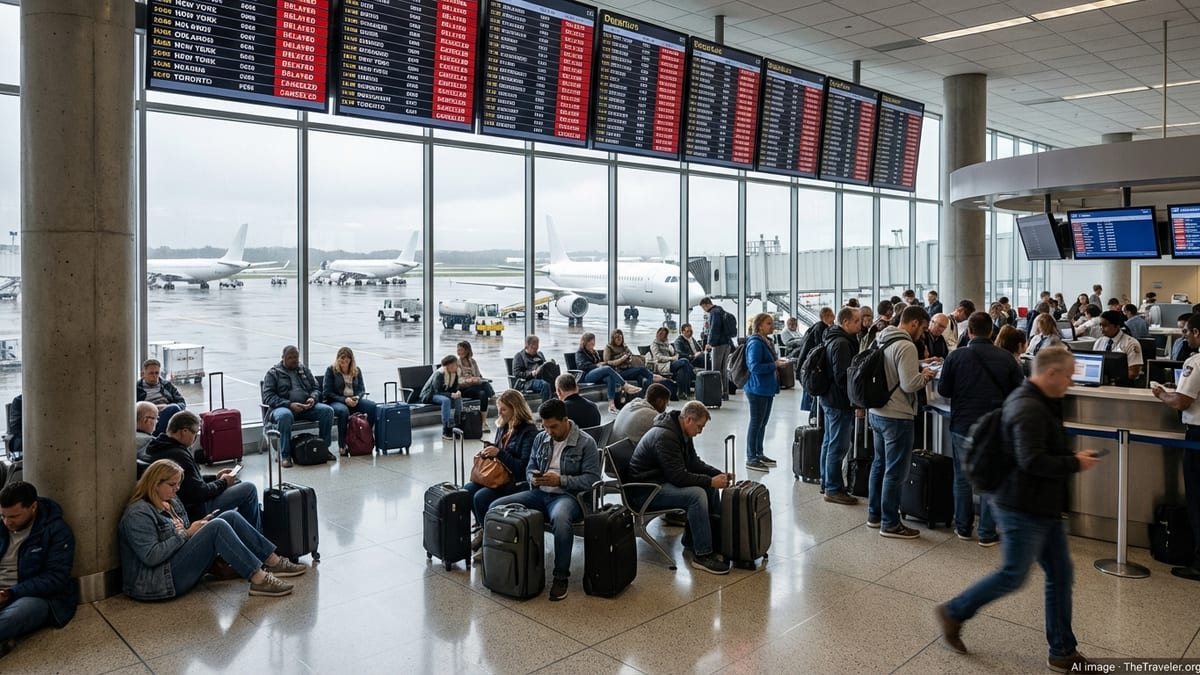
What happened and how long the disruption lasted
Published coverage indicates the disruption was linked to problems at the Philadelphia TRACON facility, a regional radar approach control center that sequences and separates aircraft for multiple airports, including Newark. The outage triggered FAA traffic management actions that paused or restricted arrivals into Newark while controllers worked through the failure and shifted to backups.
Flight-tracking data cited in national reporting showed Newark went for much of the day with few to no commercial arrivals, with normal arrival flows only gradually returning later in the afternoon. Even after service was restored, the backlog of aircraft and crews out of position meant delays continued well beyond the initial repair window.
Several reports also tied the failure to a cascading chain of issues: an initial equipment problem at the Philadelphia facility and complications affecting backup connectivity, described as involving telecommunications lines serving the air traffic system. That combination reduced the ability to use certain communications frequencies and related systems needed to safely manage dense arrival banks.
Why an outage in Philadelphia affects Newark so quickly
Newark’s airspace is among the most complex in the United States, sitting alongside John F. Kennedy International and LaGuardia. In this tightly packed corridor, approach-control facilities and telecom links underpin the constant handoffs between sectors and the timing required to keep aircraft safely spaced.
When a TRACON facility experiences a communications or radar-display disruption, the impact can spread rapidly. Ground stops, which hold flights at their departure airports rather than having them circle in congested airspace, are a standard tool used to reduce risk and prevent airborne gridlock.
Coverage of Monday’s disruption also noted the event echoed earlier reliability concerns in the same region. Public FAA materials in recent years have discussed staffing and equipment challenges affecting operations into and out of Newark, and broader federal reviews have highlighted the vulnerability of legacy telecommunications and air traffic systems to single-point failures.
Ripple effects across the Northeast travel network
Reports showed the disruption was not isolated to Newark. Ground stops and significant delays spread to other airports, including Philadelphia International and Teterboro, with knock-on impacts across New York-area airports as airspace managers tried to rebalance traffic flows.
For travelers, the practical effect often came in waves: initial departure holds, then missed connections, then aircraft and crew rotations falling behind schedule into the evening. Because Newark functions as a major hub for United Airlines and also supports significant international service, delays there frequently cascade to other cities as aircraft cannot arrive, turn, and depart on time.
The timing also compounded pressure on the system. Published coverage pointed to heavy regional demand tied to events in New York City, adding to already tight runway and airspace capacity during peak periods.
What travelers should do if flying through Newark this week
Passengers traveling through Newark should check their flight status frequently, not just the scheduled departure time. On days with major air traffic flow disruptions, a flight can appear on time and then be delayed significantly as the airline waits for an inbound aircraft, a crew that has timed out, or an updated departure slot from the FAA.
It can also help to review rebooking options early. During large-scale disruptions, many airlines publish travel waivers that allow a one-time change without a fee for impacted cities and dates. Travelers booked into Newark may also find better availability by switching to nearby airports in the region when seats open up, though routing depends on the airline and ticket rules.
For those who must travel on a fixed schedule, consider building in extra time for airport arrival and connections, and keep ground-transport alternatives in mind for short distances in the Northeast corridor. When airspace constraints persist, rail and car options sometimes become more predictable than short-haul flights, particularly for same-day travel between nearby metro areas.
What comes next for Newark operations
Flights resumed gradually after the outage was addressed, but published reporting emphasized that clearing the backlog can take many hours, especially when disruptions occur during the middle of the operating day. Even a temporary halt to arrivals can ripple into the next morning as aircraft, crews, and gates reset.
The outage also renewed attention on the resilience of the region’s air traffic control infrastructure. Federal documents and past FAA statements have described efforts to manage Newark congestion through operational limits and modernization initiatives, while outside reviews have underscored the ongoing challenge of upgrading aging systems without introducing new vulnerabilities.
For now, travelers can expect airlines and the FAA to keep using traffic management tools such as ground stops, ground delay programs, and arrival rate controls as needed. The most immediate indicator of improving conditions will be whether inbound aircraft begin arriving on a stable cadence and whether departure banks recover without repeated rolling delays.