


Ask for a small hatchback in Rome and drop it in Florence, and your quote may look reasonable. Change the drop-off to Vienna or Paris, and the price can jump by several hundred euros. One-way car rental fees in Europe are among the least understood travel costs, and the gap between domestic and international drop-offs can make or break a carefully planned itinerary.
Get the latest updates straight to your inbox!
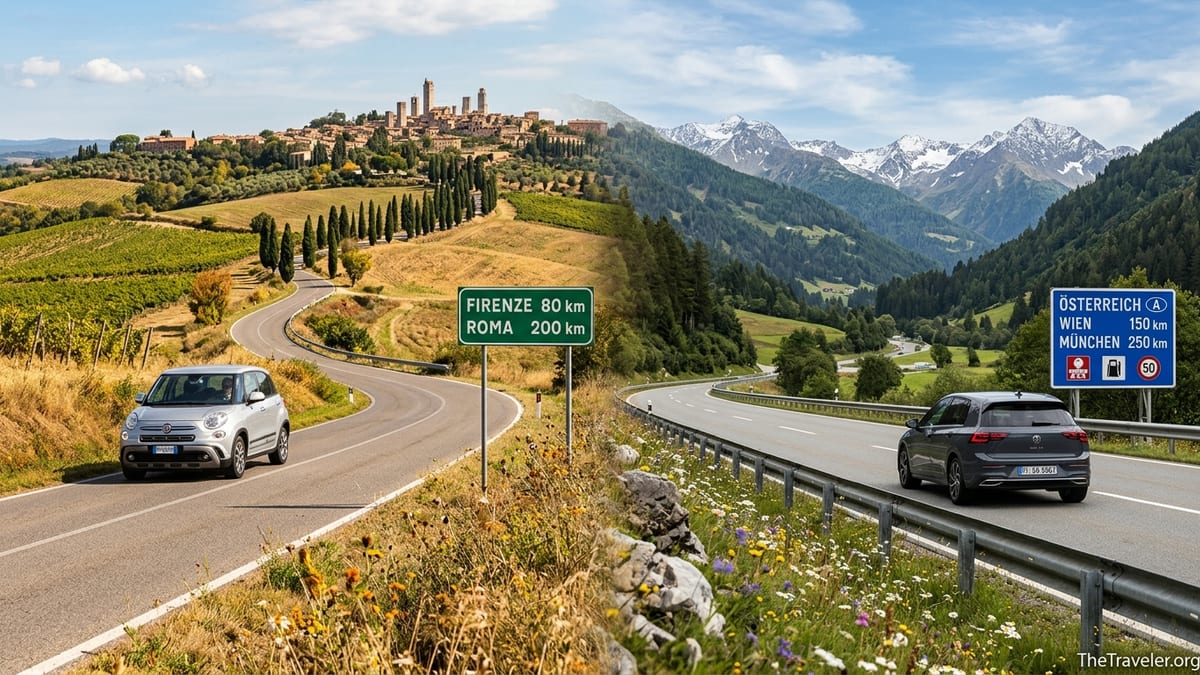
Domestic one-way vs cross-border drop-offs
The first distinction European rental companies make is between domestic one-way rentals and international drop-offs. A domestic one-way simply means collecting your car in one location and returning it to another branch in the same country, for example picking up in Rome and dropping in Florence. An international one-way adds a country change, such as picking up in Milan and returning in Zurich. Both are completely different from the more modest question of whether you are allowed to drive the car across a border and bring it back to the original country.
Every major agency treats these three concepts separately. Permission to drive into another country is typically handled through cross-border or “foreign use” rules and, if required, a daily surcharge. One-way returns are then priced with either a flat or route-based “drop fee,” which compensates the company for repositioning the car. The result is that a rental that looks cheap in the base rate can become very expensive once you change the drop-off city or country.
Avis Italy’s published conditions are unusually transparent about how wide these ranges can be. In its Italy-specific terms, Avis notes that picking up in one Italian location and dropping in another “can be between €14.64 and €1354.74” including taxes, while collecting in Italy and returning in another country “can be between €576.45 and €2667.40.” These are policy ranges rather than specific prices for every booking, and the actual fee is calculated at pay-at-location rates on the day the vehicle is returned. Still, they illustrate just how large the relocation component can be compared with the underlying daily hire.
Other brands are less explicit in public documents but follow the same logic. Europcar’s Italy tariff guide states that one-way fees within Italy or abroad range from just above €12 to more than €2600, depending on car category and distance between stations. Enterprise explains in its European fee schedules that a one-way or “drop” fee applies whenever the vehicle is not returned to the rental location on the contract, domestic or international. Sixt and Hertz flag one-way availability on specific routes at the quote stage, with the fee baked into the overall price travelers see.
What the major brands actually allow across borders
For many trips the key question is not only price but whether the itinerary is even allowed. Avis, Hertz, Europcar, Sixt and Enterprise all publish cross-border policies that distinguish between countries fully permitted, countries that require a special surcharge or “green card,” and countries where their cars are not allowed at all. These rules are often stricter for high-value or luxury categories, and they can differ from one pick-up country to another even within the same brand.
Europcar’s pan-European conditions describe a “Territory” of allowed countries, including Austria, Belgium, Denmark, France, Germany, Italy, Luxembourg, Netherlands, Portugal, Spain, Switzerland and others. Driving into these countries is usually permitted but can require a separate cross-border coverage product or surcharge noted on the rental contract. A Swiss Europcar contract, for example, allows use in neighboring EU states but obliges renters to buy a cross-border surcharge before driving into certain Central European countries and to ensure the vehicle returns to Switzerland with its Swiss registration plates.
Sixt’s European guidance takes a similar approach. Its help center for UK customers notes that most Sixt cars can travel into mainland Europe with a cross-border authorization, listing popular destinations such as France, Belgium, Germany, Switzerland, Austria, Italy, Spain, Portugal, Denmark, Sweden and Norway. Country-specific terms can still be narrower. In Slovenia, for instance, a Sixt contract permits entry to a long list of European states, but explicitly forbids one-way rentals that end outside Slovenia, even when cross-border driving is allowed.
Enterprise’s European information emphasizes that domestic one-way rentals are often free or low cost within the same country, but that cross-border travel always requires advance approval from the rental branch. It lists a core set of countries where cars rented in Spain, for example, may be driven with written permission, including France, Portugal and several Western European neighbors. Vehicles must be returned in the rental country, and customers who leave a car in another country without authorization face both a drop fee and collection costs.
Real-world price comparisons on key European routes
To see how these policies translate into traveler-facing prices, it helps to compare realistic routes in November and early winter shoulder season rather than peak August. Meta-search tools and agency sites show that for basic economy or compact cars, the daily rate itself often stays similar whether you book a round-trip or one-way. The difference lies in the added one-way component, which is sometimes itemized and sometimes folded into the overall quote.
On a Rome to Florence routing in late November, for instance, aggregator searches combining major brands show economy cars from around the mid €30s per day when booked as a standard three-day Rome round-trip. Switch to a Rome pickup and Florence drop with the same brands, and the visible daily rate may still sit in the €35 to €45 range, but the total jumps by roughly €80 to €140 over three days once one-way fees are factored in. Forum reports from recent Italy travelers renting through Avis or affiliated brands in similar periods often describe one-way supplements near €100 between those cities, which aligns with the lower end of Avis Italy’s domestic one-way range.
Milan to Venice in the same season shows a similar pattern. A multi-supplier search from a Milan city location to Venice over three days lists offers starting around €18 to €25 per day for small cars, but with total prices for one-way rentals that are €70 to just over €100 higher than equivalent Milan round-trips of the same length. This gap reflects the included drop fee. A Venice-focused rental guide published in November 2026 highlights that three-day one-way packages into Venice from regional cities show domestic drop components in that band for mainstream suppliers.
Cross-border examples demonstrate how sharply fees can increase when a country change is added. A Munich to Vienna comparison in autumn 2026 using German broker data shows that a compact car for three days might cost around €40 per day on a simple Munich round-trip, yet the same car on a one-way Munich to Vienna itinerary can run €150 to €250 more in total. A German one-way rental guide that tracks these routes notes that for German residents, Europcar’s one-way fee on Germany to Austria trips often falls in a relatively moderate range of about €30 to €50, whereas some competitors charge significantly more or restrict international returns to airport locations or premium categories.
Short international hops such as Paris to Brussels also bring a cross-border premium, even within the Schengen zone. Searches for a midweek, two-day rental from Paris to Brussels for a compact automatic show base daily rates that are comparable with Paris round-trips, but totals that are often €120 to €200 higher when one-way availability exists at all. In contrast, Barcelona to Madrid within Spain behaves more like the Italian examples: a three or four day domestic one-way often adds €60 to €120 to the total compared with a pure round-trip, with some Spanish Enterprise guidance suggesting that many domestic one-ways inside the country are priced competitively to encourage network flexibility.
Why international returns cost so much
The large jumps in cost for international one-way rentals come from several underlying factors. The first is physical relocation. When you drop an Italian-plated car in Austria or France, the rental company must get it back to its home fleet area. That requires either sending an employee, outsourcing to a transporter, or hoping for back-to-back one-way demand in the reverse direction. Long-distance repositioning across borders can be hundreds of kilometers, which is reflected in Avis Italy’s international ranges starting in the high €500s and stretching to more than €2600 for long routes and higher categories.
Insurance and legal compliance are the next major pieces. Cross-border rentals must remain compliant with the insurance regimes of both the registration country and the destination country. Some rental companies respond by limiting higher-risk destinations or excluding specific countries for premium brands. Others sell an additional cross-border coverage product, as Europcar does in some markets, or a foreign use surcharge that explicitly funds extended roadside assistance and expanded liability coverage in the permitted territory.
Local road taxation also plays a role. Many European countries rely on motorway vignettes or electronic toll systems that are tied either to a vehicle’s license plate or an on-board unit. A Swiss vignette, Austrian digital vignette or Portuguese transponder might be required for even short trips on expressways. When a car is frequently moved between countries, the rental company may need to bear these recurring costs, install and manage toll devices, or risk fines if the car is driven on tolled sections without proper coverage. These obligations are built into fee structures even when they are not itemized.
Finally, operational imbalances matter. French, Italian and Spanish fleets are heavily seasonal, with summer demand in coastal and island locations and winter demand in ski regions. If every visitor asked to start in Barcelona and finish in Geneva, or to pick up in Naples and drop in Munich, fleet planners would quickly face large pools of cars sitting in places with little outbound demand. High international drop fees act as both a cost-recovery mechanism and a deterrent, steering travelers either toward domestic loops or toward rail-plus-local-rental combinations that keep vehicles within one national network.
Penalties for unauthorized drop-offs and contract breaches
Because these costs are significant, agencies are strict about unapproved drop-offs. Standard rental agreements from Avis, Hertz, Europcar, Sixt and Enterprise all specify that the car must be returned to the agreed place and time on the contract. If you leave a vehicle at a different branch or in another country without written confirmation, the company typically treats this as an unauthorized return and charges both the appropriate one-way fee and an additional recovery or administrative charge.
Older but still illustrative Avis terms explain that returning a vehicle to an unauthorized location without written consent triggers an extra charge calculated based on the distance from the planned drop-off plus a fixed minimum penalty. Enterprise’s European fee schedules also mention that whenever a car has to be collected from a location different from the one on the contract, a one-way or collection fee becomes payable in addition to normal rental charges. These clauses give the company broad discretion to recover towing or staff travel costs if a car is abandoned or left outside network boundaries.
Unauthorized international driving can be even more serious than an unapproved domestic drop. Many contracts specify that insurance coverage may become void or heavily restricted if the vehicle is taken into a forbidden country or across borders without the required cross-border authorization noted on the agreement. Some brands reserve the right to bill substantial contractual penalties listed in their tables of fees when cars are found in restricted territories, on top of any local fines or recovery expenses.
This is why it is essential to confirm both the right to cross borders and the exact return location before locking in an itinerary. The cheapest quote on a comparison site is not helpful if it quietly excludes cross-border use or assumes a return to the pickup city. Travelers should always read the country-specific rental conditions and verify that any border crossings and drop-off changes are reflected in the confirmed booking, not just requested informally at the counter.
Scenario 1: Domestic Italian road trip with and without one-way
Consider a four-day road trip in late spring, starting in Rome, exploring Umbria and Tuscany, and ending in Florence. For a compact manual reserved a few weeks ahead, aggregators and major-brand sites often show Rome round-trip rentals from roughly €35 to €45 per day in shoulder season, for a four-day total around €140 to €180 before fuel and extras. Fuel for 500 to 600 kilometers of mixed motorway and regional roads might add €70 to €90 at current prices, bringing the self-drive loop to somewhere between about €210 and €270 overall.
If you keep the same dates and car class but change the drop-off to Florence, the visible daily rate may not change much, yet the quote total might rise to something like €300 to €380, implying a domestic drop fee of €90 to €180 in the background. That bracket is consistent with both customer anecdotes and the lower end of Avis Italy’s domestic range. At that point the traveler has to compare alternatives. A high-speed train from Florence back to Rome typically costs around €25 to €50 per person in advance fares. For two travelers the rail return might total €50 to €100, plus a half-day of travel, which could be comparable to or cheaper than the one-way charge depending on the exact quote.
On the other hand, making the car rental round-trip to Rome would likely require a final driving day back down the autostrada, extra fuel and a Rome-area hotel night before an early flight. If that combination adds another €120 to €180 in rooms and fuel, a one-way rental that costs €120 more than a round-trip can still be the better value, especially if it frees a full vacation day. The purely financial comparison depends on how many travelers are splitting train tickets and whether the itinerary genuinely avoids backtracking days.
Vehicle class and features also influence the calculus. Automatic transmission cars in Italy command a premium that can be substantial in peak periods, sometimes increasing daily rates by 30 to 50 percent over manuals. When stock is limited in smaller towns, agencies may also attach higher one-way fees to automatics because they are harder to reposition. Travelers who are comfortable driving manual can often keep both the base price and the drop fee lower, though availability for one-way routes still depends on the fleet at each station.
Scenario 2: Cross-border Germany–Austria itinerary
Now imagine a traveler landing in Munich, planning a five-day trip through Bavaria and western Austria, then flying home from Vienna. A straightforward five-day Munich round-trip for a compact automatic booked in advance might be quoted in the region of €45 to €60 per day in shoulder season, for a base rental cost of roughly €225 to €300. Additional fuel for a loop Munich–Salzburg–Hallstatt–Vienna–Munich of around 900 to 1000 kilometers could easily reach €100 to €130.
Choosing a one-way Munich to Vienna rental instead removes the need to drive all the way back. Broker data and specialist German one-way guides indicate that for this route, total one-way supplements between Germany and Austria can range from about €30 to €50 with some providers up to well over €150 with others, and higher again for premium classes. In practice this might push the total rental for five days to anywhere from the high €200s up toward €450 for a compact, depending on provider and booking channel.
When one-way costs are moderate, this option can be compelling. Skipping the Vienna to Munich return leg saves 4 to 5 hours of driving, extra fuel and potentially an additional night’s hotel. If those savings amount to €150 to €200, then even a €100 one-way fee can be justified. If the only available cars offer international drop fees in the €200-plus range, travelers may instead prefer a hybrid plan: keep the rental as a Munich round-trip focused on Bavaria and Salzburg, then travel Munich to Vienna by high-speed train in about four hours, often for €40 to €80 per person on advance fares, and rely on Vienna’s public transport or a short local hire for day trips.
Cross-border insurance and vignettes are also considerations. A German-plated car driven into Austria needs a valid motorway vignette, which many rental companies include or sell as part of a cross-border package. Travelers should verify whether this is already on the vehicle or has to be purchased at the border. Taking the car deeper into Eastern Europe can trigger additional restrictions or surcharges in some contracts, so those planning to continue beyond Austria should pay close attention to allowed territories and any cross-border coverage requirements.
Scenario 3: Longer multi-country trip split into two rentals
For a more complex itinerary, such as a three-week journey from Barcelona through southern France and northern Italy to end in Milan, the temptation is to book a single long one-way rental. However, international drop charges between Spain, France and Italy for a three-week, multi-country booking can easily run into several hundreds of euros, especially when a car crosses multiple national fleets with different registration rules. In these cases it can be more economical to design the trip around rail segments and shorter, country-specific rentals.
One workable pattern is to begin with a three or four day rental based in Barcelona to explore Catalonia, returning the car to its original station. The traveler then uses a fast train from Barcelona to a French hub such as Avignon or Lyon. High-speed services on this corridor can often be found for under €100 per person if booked in advance, and they avoid tolls and parking in congested cross-border corridors. A second rental can then be taken in France for a week of regional driving, returned to the same city, followed by another train into northern Italy for a final Italian-focused rental segment.
Splitting the car hire in this way replaces one large international drop fee with two or three much smaller domestic one-way fees or even pure round-trips if the rail legs link conveniently placed cities. It also aligns better with how fleets are structured, reducing the chance that higher-value vehicles will attract punitive one-way pricing. The trade-off is extra effort in luggage handling between rentals and the need to schedule train times, but for itineraries that cross two or more borders, the savings can be substantial, and rail segments often cut hours of driving.
Planning multi-country trips in discrete sections also helps with electric vehicles. Many European rental brands now offer EVs in city and airport locations, but long-distance international one-ways with electric cars are complicated by different charging networks, motorway toll devices and the need to return the car with sufficient charge. Some providers apply specific conditions to EV returns, including fees for returning with a low battery. Designing trips as country-focused loops where charging infrastructure is well understood can make electric rentals more attractive without large international drop penalties.
Other variables: vehicle class, timing and branch logistics
Beyond geography, several operational factors influence one-way pricing. Vehicle category is among the most important. Across Europe, published tariff tables show that one-way fees are typically banded by SIPP code or class, with small economy cars at the bottom of the range and luxury SUVs, convertibles and vans at the top. Europcar Italy’s tariff, for example, sets one-way prices from just over €12 up to more than €2600 depending on class and distance. Specialist German analyses observe that Hertz often charges one-way fees of around €120 to €200 for premium sedans on certain domestic routes where an economy car might incur a fraction of that cost.
Transmission type and seasonal availability also matter. Automatics, minivans and large SUVs are in shorter supply in many European markets, especially outside major airports. During peak months such as July and August, companies may either restrict one-way availability for these categories to certain trunk routes or raise the fees. Guides to Munich one-way rentals note that fees on popular summer corridors can increase by 15 to 20 percent in high season compared with off-peak, reflecting both demand and the cost of repositioning vehicles back to tourist gateways.
Branch logistics introduce further wrinkles. Late-night or out-of-hours returns may only be available at airports or major stations, limiting where one-way drop-offs can occur. Some brands state in their terms that vehicles rented in a country must be returned to a location in that same country, even if cross-border driving is permitted. Enterprise, for instance, notes that cars taken from Spain to neighboring countries with written permission must still be brought back to mainland Spain rather than being left abroad. These constraints can effectively rule out some otherwise appealing one-way ideas.
Refundable deposits and payment methods, while not directly part of one-way fees, can still influence planning. Larger deposits are often required for higher categories and for cross-border use, particularly when the car is allowed into countries with higher perceived risk. Travelers who split their itinerary into shorter, simpler rentals may find it easier to manage credit card holds and avoid extended periods with large amounts tied up as security.
Alternatives: rail plus local rentals at each stop
For many European trips, the most cost-effective and least stressful approach combines long-distance rail with local car rentals at specific points. High-speed networks now link Rome with Florence and Milan, Munich with Vienna, Paris with Brussels, and Barcelona with Madrid in a matter of hours, often at predictable advance-purchase prices. Using trains for these trunk legs sidesteps motorway tolls, parking challenges in historic centers and the highest tiers of one-way drop fees.
In practice, this could mean taking a morning train from Rome to Florence, spending several days car-free in the city, then picking up a rental at Florence airport or a suburban location for a short loop through Tuscany and Umbria, returned to Florence. Another high-speed service from Florence to Milan or Venice takes over for the intercity segment. In Central Europe, travelers might ride from Munich to Vienna by rail, then hire a car in Vienna only if they plan regional day trips beyond the reach of public transport.
This strategy works particularly well for couples or solo travelers, where per-person train fares remain competitive with a shared car and its associated fees. For families or groups of four or five, a single vehicle remains attractive on some routes, but only if domestic one-way charges are modest. Once international relocation fees approach several hundred euros, rail plus local rentals tends to be cheaper even when multiplied by several passengers, and it avoids the legal complexities of cross-border insurance and toll systems.
Travelers who prefer the flexibility of driving should still price these alternatives, especially on itineraries that cross more than one national border or finish far from the starting airport. Comparing a quote for a single multi-country one-way rental with the combined cost of rail tickets and two or three shorter hires often reveals that the apparent convenience of the single contract hides a much higher relocation premium.
How to minimize one-way costs without breaking the rules
One-way car rentals in Europe are not inherently bad value. They can save days of backtracking and extra hotel nights, and for some routes, domestic drop fees are low enough that the time saved is clearly worth the price. The challenge is identifying when a cheap base rate has been overwhelmed by an oversized relocation charge, or when a multi-country dream drive would be better restructured around national loops and rail links.
To keep costs under control, travelers should first distinguish clearly between cross-border driving permission and international drop-offs. It is usually easier and cheaper to take a car across a nearby border and return it to its country of origin than to abandon it abroad. Checking brand-specific conditions for the pickup country, including lists of allowed countries and any cross-border fees, helps avoid both surprises at the counter and the much larger penalties that come with unauthorized foreign use or unapproved returns.
Second, it pays to test alternative structures for the same itinerary. For Rome to Florence, Milan to Venice, Munich to Vienna, Paris to Brussels or Barcelona to Madrid, travelers should obtain matched quotes for pure round-trips, domestic one-ways and rail plus local rental combinations. They should pay particular attention to the total price rather than the advertised daily rate, since Avis, Europcar, Sixt, Hertz and Enterprise often roll one-way charges into the final figure instead of listing a separate line item.
Finally, a simple booking checklist can help. Travelers should confirm that the rental contract explicitly lists the correct drop-off city and country, that any planned border crossings are allowed and recorded, that vehicle class and transmission are appropriate for the route and season, and that branch hours and return procedures align with flight times. With these safeguards in place, one-way rentals become a powerful tool rather than a financial trap, enabling ambitious European road trips that respect both budgets and the fine print of rental agreements.