


More news on this day
Once a niche product for loyal cruisers, New England and Canada fall foliage sailings are rapidly emerging as a mainstream alternative to the classic autumn road trip, buoyed by longer seasons, new ships and expanding itineraries along the U.S. Northeast and Atlantic Canada coasts.
Get the latest news straight to your inbox!
Longer Seasons and Growing Demand at Northeastern Ports
Industry data indicate that Canada and New England itineraries now run from roughly May through October, with September and early to mid-October positioned as the prime window for leaf-peeping at sea. Cruise sellers highlight fall departures during this period as the most popular, noting that sailings track the progression of color from New England north into Quebec and the Canadian Maritimes.
The Cruise Lines International Association reports that the broader Canada East Coast and New England cruise market is on a growth trajectory, with a record-length regional season projected from March through November in recent years. This expanded calendar is designed to capture early shoulder-season demand while preserving the core fall foliage weeks when landscapes shift to red, orange and gold.
On the U.S. side, Boston’s Flynn Cruiseport has become a major embarkation point for Canada and New England routes. Publicly available port figures describe a busy early-fall period as multiple cruise lines deploy ships on itineraries north along the Maine coast and into Atlantic Canada, reinforcing the city’s role as a hub for foliage-focused voyages.
In Quebec, authorities have emphasized a deliberate strategy to stretch the cruise season while maintaining the autumn peak. Port of Quebec reporting on recent seasons cites nearly 155,000 passengers and multiple embarkation and debarkation operations, noting that most visitors still arrive in the fall even as spring and winter operations grow.
From Roadside Scenic Byways to Coastal Cruise Corridors
For many U.S. travelers, classic New England leaf-peeping has long meant driving state routes through Vermont, New Hampshire and Maine. Cruise-focused travel guides now describe an increasingly popular alternative: sailing a corridor that links major U.S. home ports such as New York and Boston with Montreal or Quebec City, while threading in smaller coastal stops along the way.
Specialist cruise trackers summarize a broadly similar pattern across most fall foliage sailings. Shorter seven-night itineraries often operate roundtrip from Boston or New York, calling in Maine and the Maritimes at ports such as Portland, Bar Harbor, Saint John and Halifax. Longer 10- to 14-night voyages typically run one way between a U.S. city and Quebec or Montreal, adding calls along the St. Lawrence River and further into Atlantic Canada.
Travel analysis from outlets focused on cruise planning notes that this style of trip offers a parallel to road-based touring, with passengers waking to new views of forested headlands, lighthouses and harbor towns rather than logging highway miles. Shore excursions commonly include drives into national parks, historic districts and countryside viewpoints, replicating many of the visual highlights of a traditional fall road trip while removing the need to self-navigate or change lodgings nightly.
Advisers also point out that these cruises allow travelers to follow the wave of color north. Guidance compiled from cruise line and independent resources suggests that late September to mid-October is typically the sweet spot for combined New England and Canada sailings, when ports from Bar Harbor to Quebec City are most likely to be framed by peak foliage.
New Ships and Curated Itineraries Target Autumn Travelers
As demand increases, cruise brands are adding capacity and tailoring itineraries specifically around fall foliage. Norwegian Cruise Line, for example, promotes a range of seasonal routes between August and October, sailing from Boston, New York, Quebec City and Philadelphia to New England and Canadian ports with marketing that centers on viewing changing leaves from the ship and ashore.
Premium and luxury operators are similarly positioning longer voyages as immersive leaf-peeping journeys. Planning guides highlight 11- to 12-night Canada and New England cruises on lines such as Seabourn, Regent and others that trace a one-way path between New York, Boston, Montreal and Quebec City, often including smaller ports in Nova Scotia and Prince Edward Island alongside marquee cities.
New entrants are also reshaping the market. Virgin Voyages is promoting its Brilliant Lady sailings with autumn-focused itineraries between New York and Quebec, featuring calls at destinations such as Halifax, Eastport in Maine and Charleston. According to the line’s published information, the program is marketed as a dedicated fall foliage experience, reinforcing how cruise operators are explicitly targeting travelers who might otherwise opt for a driving tour.
Online brochures from major lines show that these itineraries are concentrated in late September and October, timed to coincide with typical color peaks. Industry comparison sites point out that seven- to 12-night sailings dominate the category, providing enough time to combine New England coastal scenery with inland river segments like the St. Lawrence.
Ports Blend City Escapes, Coastal Parks and River Scenery
Travel coverage of Canada and New England cruising highlights a mix of urban and natural settings that mirror the variety many travelers seek on fall road trips. Quebec City and Montreal offer historic districts, riverfront promenades and access to surrounding countryside, while Halifax and Saint John provide gateways to coastal trails and viewpoints in Nova Scotia and along the Bay of Fundy.
In Maine, Bar Harbor is repeatedly cited as a marquee stop for foliage cruises, serving as the entry point to Acadia National Park. Guides describe the park’s combination of shoreline, wooded hills and carriage roads as a signature setting for autumn colors, accessible through ship-organized excursions or independent touring. Portland and other New England ports add lighthouses, working harbors and compact downtowns to the mix.
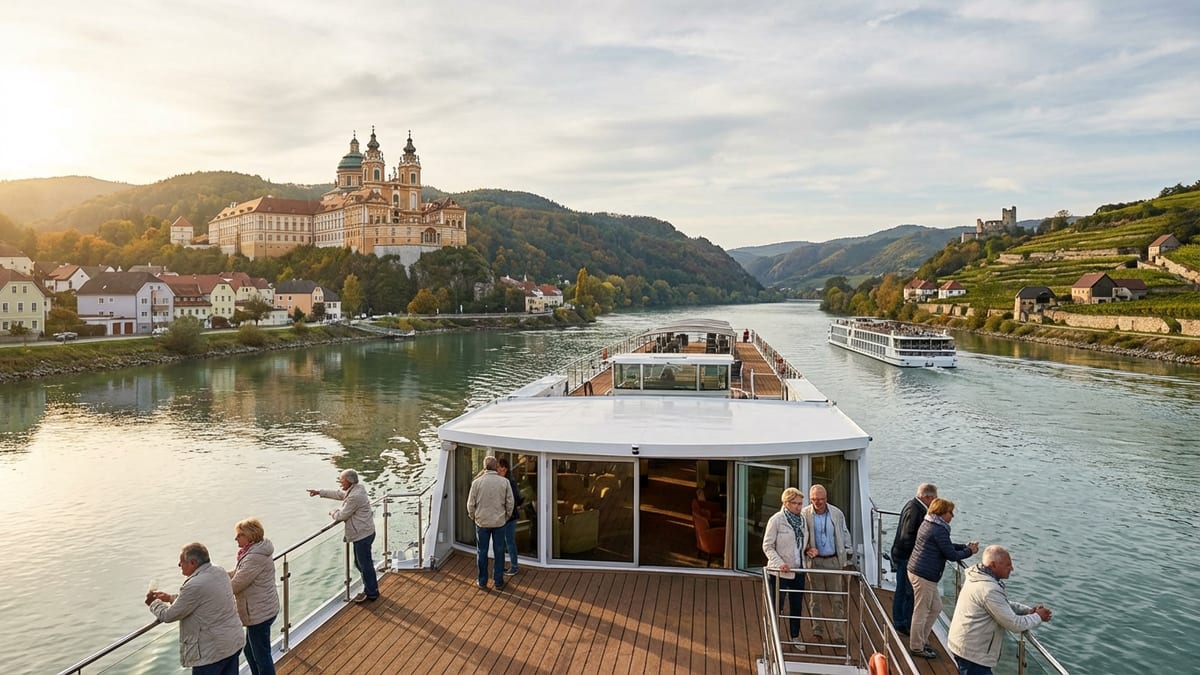
On the water, itineraries that extend up the St. Lawrence River emphasize the shifting scenery as ships move from the open Atlantic past forested islands and riverbanks toward Quebec and Montreal. Cruise commentators note that passengers often treat sea days in this region as moving viewpoints, spending time on deck as the coastline changes color day by day.
For many travelers, this blend of cities, national parks and river landscapes approximates the variety of multi-state driving loops while reducing logistical complexity. Because ships often remain in port for a full day, passengers can still pursue activities commonly associated with road trips, such as countryside drives, farm visits or photography outings, before returning to the ship each evening.
Practical Considerations for Choosing a Cruise Over the Car
Advisory pieces aimed at first-time foliage cruisers emphasize a few planning points for travelers weighing a cruise against a self-drive itinerary. Timing is central: cruise sellers and independent guides converge around late September through mid-October as the most reliable period for New England and Canada color, though the exact peak varies by latitude and year.
Travel planners recommend looking closely at embarkation and disembarkation ports in relation to home airports and potential pre- or post-cruise stays. Boston, New York, Quebec City and Montreal are frequently mentioned as logical bases for extending a trip on land, either to explore inland foliage regions or to spend time in urban neighborhoods before or after sailing.
Another consideration is sea and weather conditions. Commentators observe that autumn on the North Atlantic can bring cool temperatures and occasional rough seas, in contrast with the more controlled environment of a car trip. However, they note that for travelers who prefer unpacking once and letting an itinerary unfold without long drives, the trade-off can be attractive, particularly for multigenerational groups.
Finally, cost comparisons vary depending on cabin category and driving distances, but cruise-focused platforms point out that fares typically bundle lodging, meals and transportation between multiple destinations. For travelers who place a premium on convenience and coastal scenery, recent trends suggest that fall foliage cruises in New England and Canada are increasingly viewed as a viable counterpart to the traditional leaf-peeping road trip.
CruiseShipTracking.com: New England & Canada fall foliage overview
Cruise Lines International Association: Canada East Coast & New England market
Norwegian Cruise Line: Canada & New England itineraries