


More news on this day
Thanksgiving travel at Miami International Airport was hit by cascading delays after a FedEx Express cargo jet from Memphis overran a runway on the evening of November 25, temporarily leaving the airport with only one usable runway during one of the busiest travel periods of the year.
Get the latest news straight to your inbox!
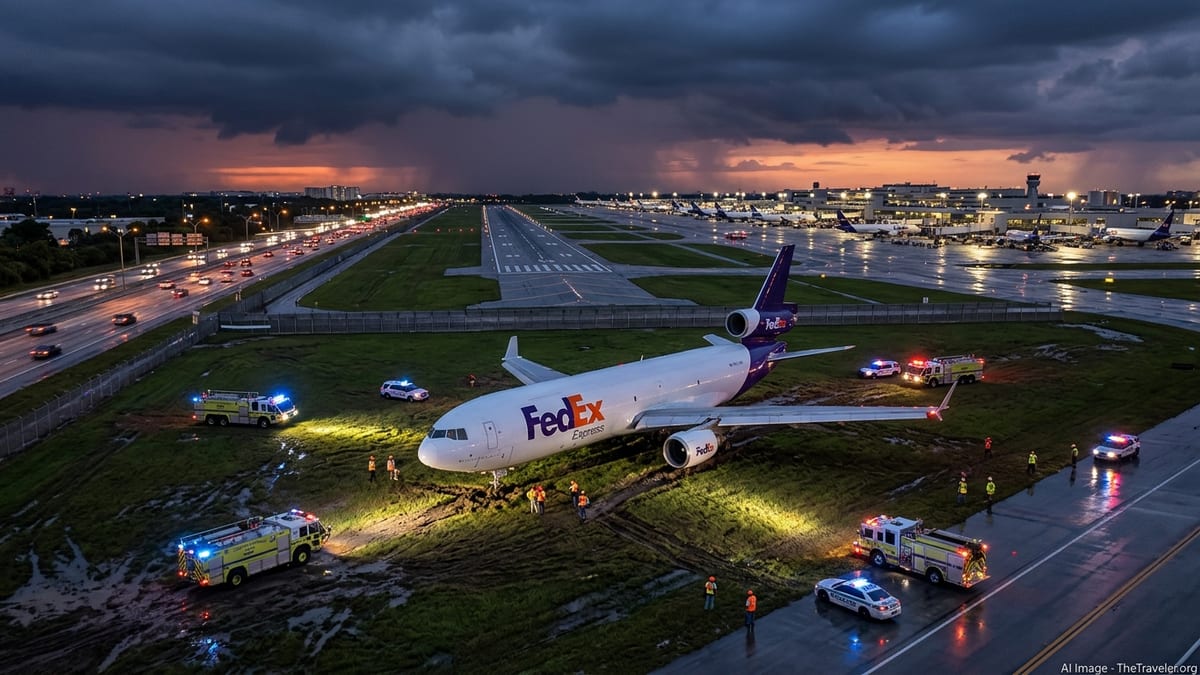
What happened to FedEx Flight 910 at Miami International
According to Miami International Airport and multiple aviation incident summaries, the aircraft involved was a FedEx Express McDonnell Douglas MD‑11F operating as Flight 910 from Frederick W. Smith International Airport in Memphis to Miami on Wednesday, November 25, 2026. The jet landed on Runway 26R in rainy conditions at around 8:30 to 8:40 p.m. local time before overrunning the end of the runway and coming to rest in the grass near the airport perimeter fence. No injuries were reported among the crew, and officials said there were no casualties on the ground.
Airport statements and contemporaneous photos show the freighter intact but immobilized beyond the paved surface, with emergency crews and investigators working around the aircraft overnight. Runway 26R remained blocked through the early hours of Thanksgiving while recovery teams inspected the jet and the runway environment and began planning its removal. As of Thursday morning, the aircraft was still on the infield adjacent to 26R, and full operations on that runway had not yet resumed.
The Federal Aviation Administration (FAA) said an advisory ground stop was issued for Miami-bound flights shortly after the incident, citing a disabled aircraft on the runway. At first, all arrivals and departures were paused while air traffic control and airport operations assessed the situation. One runway was then returned to service for limited departures before additional runways were gradually reopened for both arrivals and departures.
Runway closures, ground stop and knock-on delays
Miami International has four runways, and the FedEx overrun on 26R effectively took three of them out of normal use for a period on Wednesday night as emergency and inspection work continued. With only one runway available at a time during parts of the evening, the airfield’s capacity was sharply reduced, and the FAA’s Miami ground stop held many departures for the airport at their points of origin until controllers could safely accept more traffic.
Airport and airline status boards overnight showed a wave of late-night arrivals pushed into the early hours of Thursday, with some flights delayed into the late morning or early afternoon on Thanksgiving Day. For example, at least one inbound American Airlines service from New York JFK that had been scheduled to arrive shortly before the incident was retimed to midday Thursday, while a later JFK–Miami service on Thanksgiving was forecast to arrive roughly an hour behind schedule rather than suffering an overnight delay.
Departures experienced similar disruption. Some Wednesday evening flights from Miami that were due to leave around 9 or 10 p.m. eventually appeared on Thursday’s departure boards with new slots early to mid-afternoon, reflecting both the closure of three runways overnight and the aircraft and crew rotations pushed out of position by the ground stop. While delays were extensive late Wednesday, by mid-morning Thursday most scheduled Thanksgiving Day flights were operating, albeit with residual lateness for some services as airlines worked through the backlog.
Weather, investigation and what is known so far
At the time of the overrun, Miami was experiencing periods of rain and reduced visibility associated with passing showers and embedded thunderstorms moving across South Florida. Surface observations from the airport around the time of the landing indicated wet pavement, visibility reduced compared with earlier in the day, and a reported tailwind component on the landing runway. Aviation tracking data and eyewitness accounts suggest the MD‑11F used most of the available paved distance on 26R before leaving the end of the runway and continuing into the grass.
The FAA has confirmed it has opened an incident investigation, a standard step following a runway excursion involving a transport-category aircraft at a major airport. The National Transportation Safety Board (NTSB) typically takes the lead in more serious accidents involving substantial damage, injuries or fatalities. As of November 27, authorities have reported no injuries and have not publicly released a detailed damage assessment for the airframe, and neither the FAA nor NTSB has issued a preliminary narrative explaining the sequence of events.
Investigators are expected to review the aircraft’s flight data and cockpit voice recorders, weather and runway condition reports, air traffic control communications and the crew’s performance and decision making. They will also look at the state of the runway surface, braking action reports and any available surveillance or ground radar recordings. With those inquiries still in their early stages, officials have not said whether the overrun was primarily related to weather conditions, aircraft performance, operational factors or a combination of elements, and no causal findings have been made.
Second runway overrun at Miami in under three months
The FedEx incident is the second runway overrun by a cargo jet at Miami International in less than three months. On September 6, 2026, a Boeing 767 operated by 21 Air on a cargo service for Amazon Prime overran another runway at the airport on landing and crashed into vehicles beyond the runway end, killing five people traveling in a van and seriously injuring several others. That earlier crash caused significant damage beyond the airfield boundary and prompted an extensive NTSB investigation focused on landing distance, runway conditions and safety protections at the ends of runways.
In its preliminary documentation on the September 6 event, the NTSB reported that the 21 Air 767, arriving in daylight, touched down long on the runway and did not stop before the paved surface ended, continuing into an area occupied by ground vehicles outside the protected runway environment. The crash highlighted the risk posed by runway overruns where there is limited space between the runway end and nearby roads, parking or other infrastructure, particularly at land-constrained airports integrated into dense urban areas.
By contrast, current information indicates the FedEx MD‑11 stopped in the grassy area within the airport perimeter, short of any public roadway, and without impacting vehicles or buildings. Even so, the proximity of the aircraft to the perimeter fence and a busy road on the far side has renewed attention on Miami’s runway-end safety margins. Aviation observers and some local residents have questioned whether additional engineered arrestor systems might be warranted at certain runway ends, but for now there has been no formal announcement of new infrastructure changes, and any such decisions would follow technical studies and regulatory review.
Impact on Thanksgiving travelers and what passengers should do next
For passengers, the most severe disruption from the FedEx overrun hit those traveling on Wednesday evening, November 25, particularly on flights scheduled to arrive in or depart from Miami during the ground stop and immediate aftermath. Many travelers faced long waits on aircraft held at origin airports, diversions to alternate airports while the ground stop was in effect, or late-night arrivals shifted to the following day as airlines reworked their schedules around the constrained runway capacity.
By Thanksgiving morning, three of Miami International’s four runways had been returned to service, and the airport’s public flight information screens showed a largely functioning schedule, though with a cluster of delays of an hour or more on select arrivals and departures. Airlines were rebooking affected passengers onto available Thanksgiving and Friday flights, prioritizing those who had missed connections or faced particularly long delays the previous night. Because the incident involved a cargo aircraft and not a passenger jet, there were no commercial passengers directly on board the plane itself, and the disruption came from the knock-on effect on airport capacity rather than the loss of a scheduled passenger aircraft.
Travelers with upcoming itineraries through Miami over the long holiday weekend are being advised to keep a close watch on their flight status through airline apps and email or text alerts, especially for early-morning and late-night services that are more exposed to residual scheduling imbalances. As of November 27, airlines and the airport are treating the FedEx overrun as an isolated operational incident, and there is no broader capacity restriction in place beyond the temporary closure of Runway 26R for inspection and recovery work. Passengers with tight connections at Miami may nevertheless want to allow extra time, as overnight aircraft positioning and crew duty-time limits can lead to sporadic delays even after the immediate ground stop has ended.
Authorities have not yet provided a timeline for fully reopening Runway 26R or for releasing preliminary investigative findings. Historically, preliminary reports from the NTSB in similar runway excursions have taken several weeks to appear, with full reports and any safety recommendations arriving months or longer after the event. Travelers and industry observers should expect a phased flow of information as investigators move from on-scene documentation to analysis, and airlines and cargo operators may adjust operational procedures at Miami and similar airports once more details about the landing and runway conditions are known.