


More news on this day
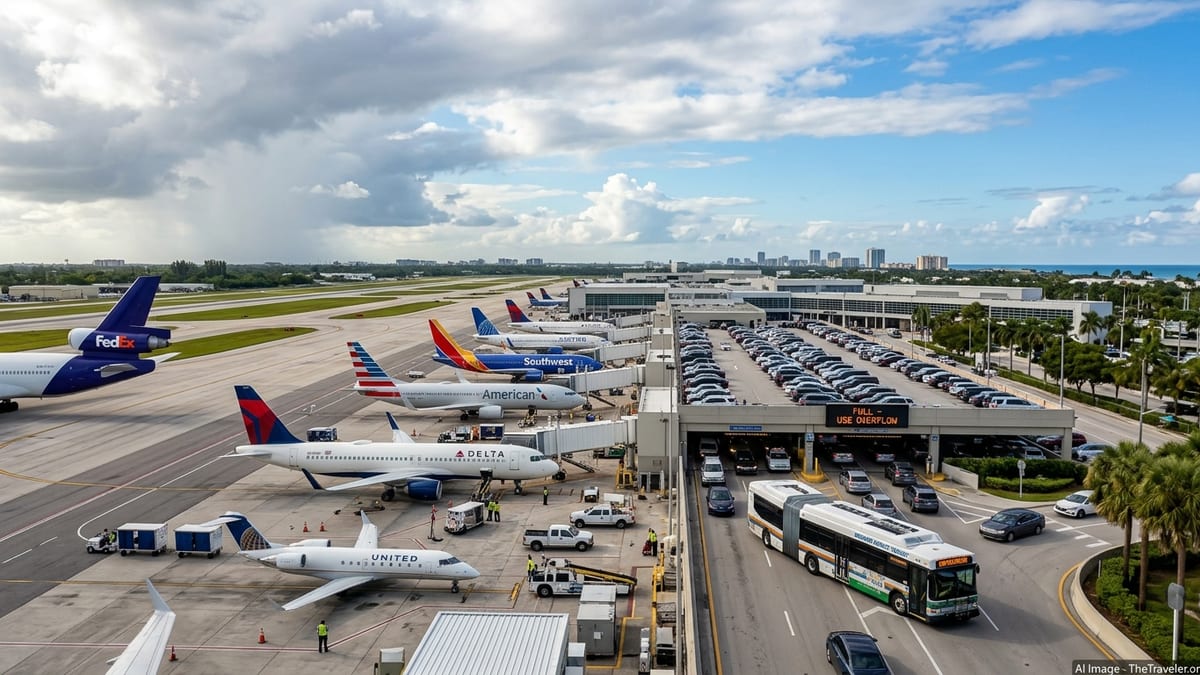
Flight operations at Fort Lauderdale-Hollywood International Airport were stabilizing on Thursday, November 26, after a day of widespread weather-related disruptions across South Florida and a separate runway overrun incident involving a FedEx cargo jet at nearby Miami International Airport, easing pressure on one of the country’s busiest Thanksgiving travel corridors.
Get the latest news straight to your inbox!
Stormy Thanksgiving eve gives way to clearer skies
Heavy rain and thunderstorms that swept across South Florida on Wednesday, November 25, contributed to hundreds of delays and cancellations nationwide, including at Fort Lauderdale-Hollywood International Airport, Miami International Airport and Palm Beach International Airport. FlightAware data cited by local and national outlets indicated more than 1,000 delays across the United States by Wednesday morning alone, with South Florida among the hardest hit regions as the storms moved through during peak holiday travel hours.
By Thursday morning, conditions in Broward County had improved significantly. Aviation weather reports showed clearing skies and more stable winds over Fort Lauderdale, and local broadcasters reported temperatures in the 70s with sunshine breaking through after the previous day’s downpours. The improved weather reduced the need for en route diversions around storm cells between Florida and the Bahamas and helped air traffic controllers at Fort Lauderdale and Miami manage a steadier flow of arrivals and departures.
Airport officials and the Federal Aviation Administration continued to warn that residual delays were possible as airlines worked through aircraft and crew imbalances created by Wednesday’s weather. However, snapshots of airport departure and arrival boards in Fort Lauderdale on Thursday showed far fewer cancellations than the previous day, with most flights operating close to schedule or with modest delays of under an hour.
FedEx runway overrun in Miami adds to regional disruption
Compounding the weather issues, Miami International Airport experienced a separate operational setback on Wednesday night when a FedEx MD-11 cargo aircraft arriving from Memphis overran Runway 26R shortly after landing. According to the airport and the FAA, the incident occurred at around 8:40 p.m. on November 25. The aircraft came to rest beyond the paved surface, prompting emergency response vehicles to converge on the scene and leading authorities to temporarily close all but one of the airport’s runways.
Federal officials imposed a ground stop for flights bound for Miami while crews assessed the condition of the disabled aircraft and runway. Although no injuries were reported and there was no immediate indication of major structural damage to the FedEx jet, the partial runway closure reduced Miami’s capacity during one of the busiest nights of the Thanksgiving travel period. Airlines warned passengers of knock-on delays and advised them to monitor flight status before heading to the airport.
The constraint at Miami prompted some tactical adjustments across the region, including the use of Fort Lauderdale as a diversion point for certain flights that could not land at Miami during the height of the disruption. Tracking data on Wednesday night and early Thursday showed at least one widebody international arrival diverted to Fort Lauderdale before repositioning to Miami once conditions and capacity allowed. While diversions of that scale remained limited, they added to traffic levels at Fort Lauderdale and underlined the interconnected nature of South Florida’s three major airports.
Fort Lauderdale’s parking squeeze and passenger experience
Even as flight operations steadied on Thursday, ground access emerged as a key challenge for travelers using Fort Lauderdale-Hollywood International Airport. Ahead of the Thanksgiving rush, Broward County officials had warned that the airport’s two parking garages and curbside valet service were likely to reach capacity, and on Wednesday the airport activated its overflow parking lot west of Interstate 95 on Southwest 42nd Street. By Thursday, the airport’s social media feeds indicated that the garages were closed to new arrivals, with self-parking vehicles directed to the overflow facility and shuttle buses ferrying passengers to and from the terminals.
The use of the remote lot lengthened the journey for some travelers, who faced an additional shuttle ride of approximately 15 to 20 minutes depending on traffic. Local coverage showed county-operated buses weaving between the lot and Terminal 1 throughout Thursday morning as passengers arriving for delayed or rebooked flights made their way back to the airport. Officials advised drivers to allow extra time for parking and check-in, and encouraged the use of off-airport parking operators, ride-hailing services, taxis or drop-offs to avoid congestion at the terminal curbs.
Inside the terminal, conditions were markedly calmer than on Wednesday night, when holiday travelers had contended with long security lines and limited seating as storms disrupted schedules. By midday Thursday, local television images showed fewer crowds and largely cleared gate areas at Fort Lauderdale, even as some monitors still displayed weather-related delays to and from the storm-affected Northeast. Passengers arriving from Philadelphia, New York and Boston spoke to local reporters about being relieved simply to have arrived on Thanksgiving Day after closely watching weather and flight status updates the previous 24 hours.
South Florida holiday travel volumes remain high
The easing of delays at Fort Lauderdale came against a backdrop of exceptionally strong Thanksgiving travel demand in South Florida. Miami International Airport projected around 1.9 million passengers over the extended holiday period, while Fort Lauderdale-Hollywood International forecast approximately 735,000 travelers over the same stretch, according to recent local reports citing airport and county estimates. AAA and regional tourism agencies have named Orlando, Fort Lauderdale and Miami among the country’s most popular destinations for Thanksgiving this year, helping to fill flights into South Florida despite the unsettled weather.
Historic data underline why even a temporary spike in delays at Fort Lauderdale has an outsized impact on passengers. Analyses of federal on-time performance statistics released ahead of the holiday period ranked Fort Lauderdale among the U.S. airports with some of the highest Thanksgiving delay rates over recent years. One consumer study placed Fort Lauderdale at or near the top of its list of major airports most prone to disruption at this time of year, with Miami also scoring poorly. While those rankings reflect past performance rather than a forecast, they have reinforced the message from airlines and airports that travelers should allow extra time and stay flexible when flying into or out of South Florida in late November.
Despite Wednesday’s challenges, there were relatively few outright cancellations in Fort Lauderdale by Thursday compared with the height of the previous day’s storms. Flight-tracking data and local station tallies indicated that cancellations at Fort Lauderdale were in the low double digits on Thursday, versus significantly higher numbers systemwide on Wednesday. Miami, still contending with the aftermath of the FedEx overrun and heavier traffic volumes, continued to report higher levels of delay and a larger number of scrubbed flights, though both airports were moving toward more normal operations as the day progressed.
What Thanksgiving travelers should do next
For passengers still due to travel through Fort Lauderdale-Hollywood International Airport over the Thanksgiving weekend, the main risks have shifted from widespread weather disruption toward routine congestion and residual knock-on delays. Forecasts for Broward County point to more settled conditions than those seen on Wednesday, though forecasters caution that scattered showers and further unsettled weather are possible elsewhere along the East Coast, which could affect flights arriving from or heading to those areas.
Airports, airlines and the FAA are continuing to urge travelers to closely monitor their flight status, particularly on connections that still rely on constrained hubs like Miami. Passengers are advised to check their airline’s app or website before leaving home and to sign up for text or email alerts, as gate changes and revised departure times remain common following major operational disruptions. Those parking at Fort Lauderdale should verify in advance whether the on-site garages are accepting new vehicles or whether the overflow lot remains in use, and factor additional time into their journey if a shuttle transfer from remote parking is required.
Security agencies recommend arriving at least two hours before scheduled domestic departures and three hours before international flights during the peak Thanksgiving period, guidance that is especially relevant for Fort Lauderdale given its history of crowded checkpoints on major travel days. Travelers connecting onward to Caribbean destinations such as the Bahamas should be prepared for weather-driven schedule adjustments even after South Florida skies clear, since storm systems along their route can still force airlines to slow or reroute flights. With flights now largely operating, the focus for many travelers has shifted from whether they will get away at all to managing longer-than-usual travel times and maintaining flexibility in case of lingering delays.