


I arrived at Plage du Ponteil in Antibes expecting the classic French Riviera chaos: shoulder-to-shoulder towels, blaring music, and the low-level stress that can cling to even the prettiest of beaches. Instead, I stepped onto a curve of pale sand that felt far more peaceful than I had imagined, a place where the noise of the Côte d’Azur seemed to soften into the hush of shallow waves and distant conversation.
Get the latest updates straight to your inbox!
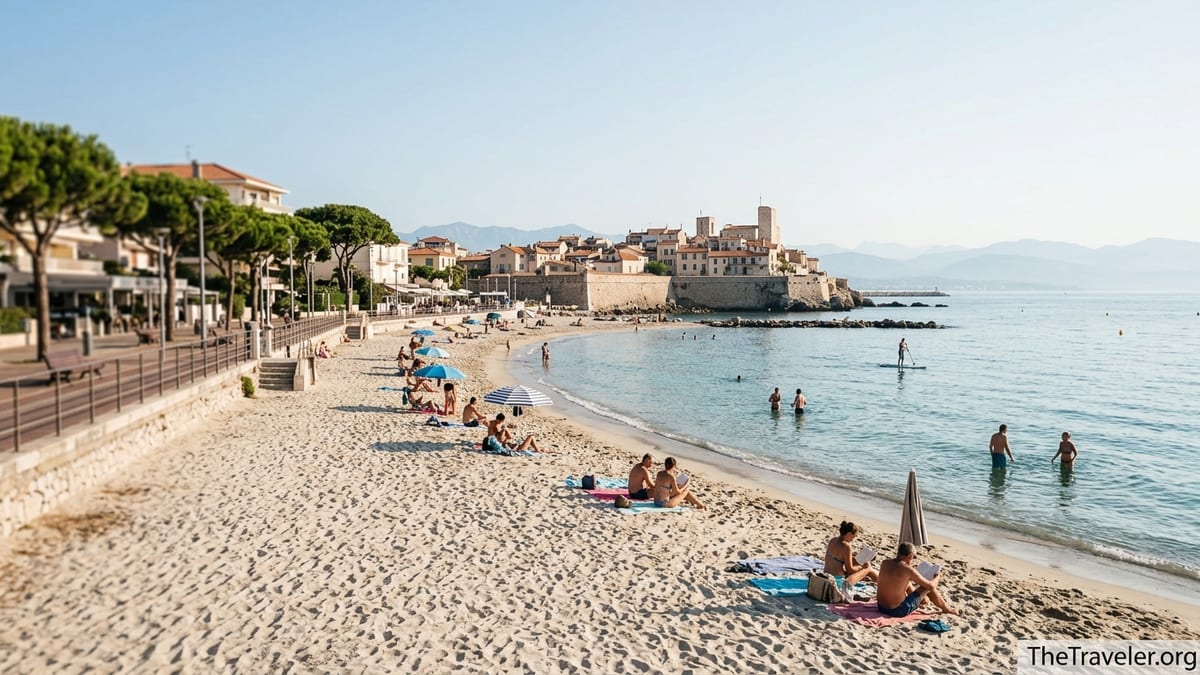
First Impressions of a Surprisingly Quiet Riviera Beach
Plage du Ponteil sits just a short walk from Antibes’ old town, on the stretch between the city ramparts and the start of Cap d’Antibes. On paper it sounds like a recipe for crowds. The beach is popular with families, there is a car park immediately behind the trees, and the promenade funnels a constant flow of walkers and joggers. Yet my first impression, standing near the Royal Beach restaurant end and looking back toward the medieval walls and the Alps beyond, was of calm. The bay was almost flat, the water a soft turquoise rather than an electric blue, and the sounds were muted: the rhythmic slap of paddleboards, the rustle of palm leaves, a low murmur from the café terrace across the road.
The sand itself is a key part of that first impression. Unlike many of the pebbly stretches along the Riviera, Ponteil has fine, pale sand that feels almost silky underfoot. It is not manicured luxury in the style of a private beach club, but a straightforward, civic beach with showers along the waterline and lifeguard posts set back from the shore in summer. Walking down the few stairs from the promenade, I noticed how quickly the urban world seemed to fall away. Cars on the road above were reduced to a distant hum, and conversations were easy to follow without ever tipping into a wall of noise.
Timing helped. I visited on a weekday in late June, arriving around 9:30 in the morning. By high season standards, this is still early, and there were only scattered groups on the sand: a couple from Lyon unpacking a simple picnic from a Casino supermarket bag, an elderly local doing slow stretches at the water’s edge, and a family setting up a sunshade for a toddler who was more interested in stomping patterns into the damp sand. Yet even as the beach filled up toward midday, that first, unexpectedly peaceful impression never fully disappeared.
Gentle Water, Soft Light and the Feeling of Safety
Much of the sense of calm at Plage du Ponteil comes from the character of the water itself. The bay is sheltered by the headland of Cap d’Antibes on one side and the curve of the old town on the other, which means the sea is usually flat or only faintly rippled. On the morning I swam, the water stayed shallow for a long way out, cool but not shocking, with the gentle gradient that makes parents visibly relax. I watched several families from Northern Europe allow their children to wade out without gripping their wrists, something you rarely see on steeper, wave-battered beaches.
From a practical perspective, Ponteil is one of those rare places where nervous swimmers can take their time. I met an Australian traveler who had come to Antibes specifically because the beaches here are less intimidating than some of the wilder Mediterranean stretches. She told me she had chosen Ponteil over the rockier coves around Nice because “here you can see the bottom and trust that it stays soft and level under your feet.” She spent most of the morning moving slowly between standing depth and a gentle breaststroke, never needing to fight waves or sudden drops.
The quality of light adds another layer to the atmosphere. Early in the day, the sun sits behind the town, which means the water in front of the beach glows while the ramparts and tiled roofs of Antibes rise in soft shadow. It is not the dramatic, sunset-gold Riviera of postcards. Instead, it feels like an easy brightness that encourages you to stay in the water longer, to float on your back and look up at the sky while the sounds of the promenade fade into the background. Even by early afternoon, when the sun begins to strike the sand more fiercely, the presence of shade from the promenade trees and the option of slipping into a nearby café keep the mood from turning frantic.
Safety measures reinforce that tranquillity. During the main summer season, lifeguards watch the central stretch, and access is straightforward, with ramps and designated areas for people with limited mobility. On the day I visited, I saw an older local man arriving with a wheeled walker, greeted by name by staff near the designated assisted-bathing area. Their casual familiarity made it clear that this is a beach integrated into daily life for Antibes residents, not just a stage set for passing tourists.
The Promenade Rhythm: Real Life Instead of Riviera Drama
Behind the sand, a narrow strip of trees and a pedestrian promenade separate the beach from the traffic. This might sound like a recipe for bustle, but the effect is the opposite. The promenade gives structure to the scene. People move along it in a steady, almost meditative flow, which keeps the beach itself from feeling like a thoroughfare. From my spot on the sand, I watched an elderly couple pass three times during the morning, each circuit a slow walk with a pause on the same bench facing the sea.
At one point, a group of local teenagers arrived on scooters, which might make some travelers tense up. Instead of blasting music through speakers, they leaned their scooters against the railings, dropped towels on the sand, and were in the water within minutes, their laughter blending with the general background chatter. The absence of portable speakers, at least during my visit, was noticeable. The noise that did carry across the beach came from children negotiating over inflatable rings, the occasional dog splashing near the shoreline, and a father reading passages from a guidebook about Picasso’s relationship with Antibes to his unimpressed teenager.
Real-world conveniences are close at hand without intruding visually. Directly across the road from one stretch of the beach, a small supermarket offers reasonably priced basics: a bottle of chilled water for around one euro, a fresh baguette for a late breakfast, or pre-cut melon in plastic tubs that seem designed for impromptu picnics. A newsagent nearby sells beach mats, sunhats, and the kind of paperback thrillers that always seem to end up speckled with sand. None of these places shout for your attention. Their presence explains why so few people feel the need to bring large coolers or complicated setups. The approach here is simple: pick up what you need, return to the sand, continue relaxing.
By late morning, a pattern emerged. Locals came down for an hour-long swim before work or during a break, then left while day visitors from Nice and Cannes were still arriving. That constant gentle turnover kept the beach from ever feeling completely packed. Towels did edge closer, of course, but there remained just enough space between groups to maintain a sense of personal territory.
Small Decisions That Make the Experience More Peaceful
The peacefulness of my visit was not accidental. It was the result of a series of small, practical decisions that any traveler can replicate. First, I chose to stay in or near the old town of Antibes, which meant I could walk to Plage du Ponteil in about fifteen minutes. This eliminated the tension of hunting for a parking space in the narrow lot along the beach, which fills quickly in high summer. Walking through the market streets in the morning, picking up fruit and a wrapped slice of local socca to eat later, felt like an extension of the beach day rather than a separate errand.
Second, I accepted that at a popular public beach I would not have complete solitude. By adjusting my expectations, I found it easier to appreciate the kind of calm Ponteil offers: not silence, but a gentle, collective relaxation. I deliberately left headphones in my bag and let the ambient sound become part of the experience. In return, I got to overhear snatches of daily life, from a local woman discussing school holidays with a friend to a British family planning a day trip by train to Menton.
Finally, I packed light. On many Mediterranean beaches, people arrive equipped for a campaign: folding chairs, full-sized parasols, coolers loaded with glass bottles. At Ponteil, a simple setup worked better. I brought a lightweight beach towel, a refillable water bottle, sunscreen, and a paperback. For shade, I relied on the trees that cast partial shade on the back of the beach until late morning, shifting my towel forward as the sun rose. This minimalist approach made it easy to move if a noisy group settled nearby or if I wanted to change my view along the curve of the bay.
These may sound like minor choices, but together they significantly shaped the day. By midday, when other beaches along the Riviera can feel overrun, I still felt unhurried. When I finally left in the early afternoon, walking back toward the old town past the sailing school and paddleboard rentals, I realized I had managed to spend several hours at one of Antibes’ most popular beaches without a single spike of stress.
Eating, Drinking and Wandering Without Breaking the Mood
One of the pleasant surprises of Plage du Ponteil is how easy it is to eat well without leaving the tranquil frame of mind that the beach encourages. At the eastern end, a polished beach restaurant serves composed plates of grilled fish and salads on a shaded terrace overlooking the sand. Prices reflect the setting, but the atmosphere remains calm rather than flashy. Late in the morning, a couple at the next table ordered a carafe of chilled rosé and a shared platter of grilled vegetables, then returned to their towels on the public sand. That easy movement between restaurant and beach is part of the Ponteil rhythm.
If you prefer something more low-key and budget-conscious, a short stroll along the promenade or across the road brings you to takeaway counters selling sandwiches, panini, and ice cream. I opted one day for a simple jambon-beurre baguette and a lemon tart from a nearby bakery, carrying them back to eat on the sand. Prices were modest compared to some of the more famous Riviera towns: a sandwich for under five euros, a slice of tart for around three. Crucially, the takeaway spots are close enough that you do not lose your patch of sand if you pop away for ten minutes.
Afternoons invite a different sort of calm. Once the heat becomes more intense, many beachgoers retreat under umbrellas or slip away entirely, and the promenade takes over as the main stage. Couples in linen shirts and summer dresses stroll toward Cap d’Antibes, some continuing past Plage de la Salis toward the coastal path that circles the peninsula. It is easy to turn a beach morning into a gentle walking afternoon, with nothing more complicated than a refill of your water bottle and perhaps an espresso from one of the cafés lining the road.
For those who crave a little activity without sacrificing the low-key mood, the nearby sailing club and paddleboard rental offer a good compromise. Taking a board out from near the Antibes Yacht Club end of the beach, I paddled slowly along the shoreline, close enough to hear the small sounds of the beach yet far enough out to feel delightfully detached. Looking back at Ponteil from the water, the beach seemed even more peaceful: a narrow ribbon of sand framed by green trees, pale buildings, and the pinkish stone of the old town ramparts.
Comparing Ponteil With Other Antibes Beaches
Antibes offers several distinct beach experiences within a short distance, which makes the particular character of Plage du Ponteil more apparent. A ten-minute walk toward the old town brings you to Plage de la Gravette, a horseshoe of sand tucked beneath the ramparts. Gravette often feels more enclosed and, at peak times, more crowded, with families drawn by the extremely shallow water and total protection from waves. It is atmospheric and photogenic, but the echo of voices within the stone walls can make it noisier than Ponteil.
In the other direction, a short stroll along the coast takes you to Plage de la Salis, where the sand widens and the views across the bay to Nice open up. Salis has its own charm, especially for those who like slightly more space between towels and the option of walking straight on toward Cap d’Antibes. However, the road feels a little closer here, and the sense of being nestled between town and headland that defines Ponteil is less pronounced.
Further afield, the private beach clubs of Juan-les-Pins, a few minutes away by train or bus, cater to a more overtly glamorous crowd. Here you can rent a sun lounger for the day, complete with waiter service and cocktail lists. Many travelers love that experience, and it certainly has its place on a Riviera itinerary. Yet after a morning at Ponteil, with its mix of locals and visitors quietly sharing public space, the beach clubs can feel slightly overstimulating. At Ponteil, there is no separation between those who can afford a sunbed and those who bring only a towel.
For travelers who prefer rocky coves or pebble beaches, the coastline west of Antibes offers more rugged options, and places like Villefranche-sur-Mer and Beaulieu-sur-Mer have devoted followings. Those beaches, though, can be physically harder to navigate, especially for anyone with mobility concerns or for small children. Ponteil’s simple, level approach from promenade to sand to shallow water is one of its biggest strengths, and a major reason why my visit felt as easy as it did.
The Takeaway
By the time I left Plage du Ponteil, my original expectations of a hectic Riviera beach day felt almost amusing. What I found instead was a place that balances popularity with poise. The calm water, shallow gradient, and understated promenade culture combine to create an atmosphere that is less about posing and more about quietly enjoying the sea. Even at the height of the day, there was space for small moments of privacy: floating on my back and watching a plane trace a white line across the sky, or sitting on the edge of the promenade bench after my swim, feet still sandy, as locals walked past with shopping bags and beach towels.
For travelers planning a French Riviera itinerary, Plage du Ponteil is not the loudest or most photographed option. It is not where you go to see celebrities or to spend the afternoon on a designer sunbed. Instead, it is where you might unexpectedly rediscover the simplest version of a beach day: a patch of sand, a book, a bottle of water, and an easy path into the sea. In a region that often trades on spectacle, that kind of unassuming peace can feel almost luxurious.
FAQ
Q1. Where exactly is Plage du Ponteil in Antibes?
Plage du Ponteil sits between Antibes’ old town ramparts and the start of Cap d’Antibes, a short walk from the historic center and close to the Antibes Yacht Club.
Q2. Is the water at Plage du Ponteil suitable for children and weak swimmers?
Yes. The water is usually calm and stays shallow for quite a distance, which makes it a reassuring spot for children and anyone who prefers gentle, gradual entry into the sea.
Q3. How crowded does Plage du Ponteil get in summer?
In July and August the beach can be busy by late morning, but arriving before about 10:00 usually allows you to find a comfortable spot without feeling packed in.
Q4. Are there facilities like showers and toilets on the beach?
Yes. There are freshwater showers along the waterline and public toilets set back from the sand near the sailing and yacht club end of the beach.
Q5. Can I buy food and drinks near Plage du Ponteil?
Yes. Directly behind the beach and along the nearby streets you will find small supermarkets, bakeries, cafés, and a beachside restaurant for everything from simple snacks to full meals.
Q6. Do I need a car to reach Plage du Ponteil?
No. If you are staying in or near the old town of Antibes, you can easily walk to the beach in about ten to fifteen minutes. Local buses also stop a short walk away.
Q7. Is there shade available on the beach?
There is some natural shade near the back of the beach from trees along the promenade, especially in the morning, but many visitors bring their own umbrellas or rent parasols.
Q8. Are there water sports or activities at Plage du Ponteil?
Yes. Near the Antibes Yacht Club and the neighboring beaches you can often rent paddleboards or kayaks and, in season, book sailing lessons or simple boat rentals.
Q9. How does Plage du Ponteil compare to Plage de la Gravette or Plage de la Salis?
Plage du Ponteil feels a bit more open and less enclosed than Gravette, and slightly more urban and intimate than Salis, which has a broader sweep of sand and bigger views.
Q10. When is the best time of day to visit for a peaceful experience?
Early morning on clear days, roughly between 8:30 and 10:30, tends to be the quietest, with softer light, fewer people, and a particularly calm, unhurried atmosphere.