


More news on this day
China’s domestic aviation network faced fresh disruption as more than 150 flights were reportedly cancelled across major hubs including Beijing, Shanghai, Guangzhou and Shenzhen, with services operated by China Eastern, Air China, China Southern and several other carriers affecting key routes to cities such as Wuhan, Xi’an, Chongqing and Kunming.
Get the latest news straight to your inbox!
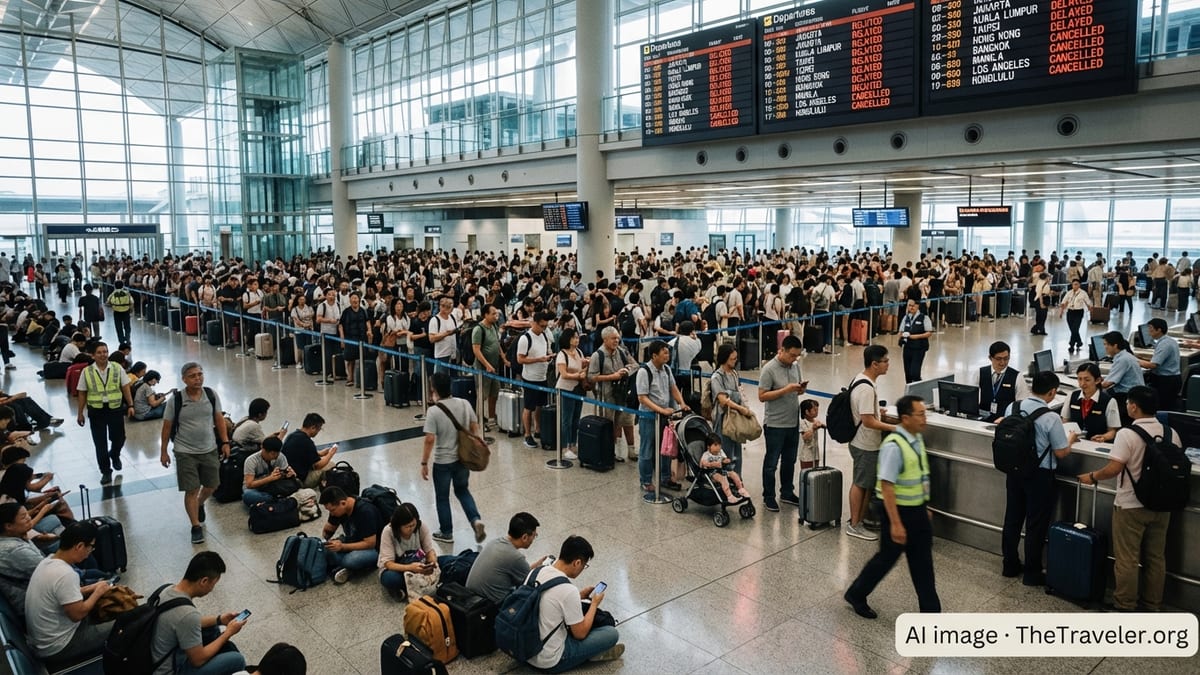
Major Hubs See Wave of Cancellations
Real-time tracking data and local media coverage indicate that a new wave of cancellations has hit some of the country’s busiest airports, concentrating on Beijing Capital and Beijing Daxing, Shanghai Pudong and Hongqiao, Guangzhou Baiyun and Shenzhen Bao’an. These airports function as primary or secondary hubs for China Eastern, Air China, China Southern and a range of regional airlines, magnifying the impact when schedules are disrupted across multiple carriers at once.
Published summaries of airport operations show that more than 150 flights have been removed from departure and arrival boards within a short time window, with the largest clusters of cancellations concentrated on dense trunk routes connecting coastal hubs with central and western cities. Services linking Beijing and Shanghai with Wuhan, Xi’an, Chongqing and Kunming appear particularly affected, alongside cancellations on links from Guangzhou and Shenzhen into the interior.
Previous disruption patterns in March and April 2026 demonstrated how quickly problems at one or two major airports can cascade through the tightly timed domestic networks that dominate Chinese air travel. When aircraft and crews are knocked out of position, late-morning and afternoon waves of departures are particularly vulnerable, and operational data now being reported suggests a similar chain reaction may be unfolding during this latest episode.
Key Routes to Central and Western Cities Disrupted
According to published route maps and schedule data for the country’s largest airlines, the trunk corridors between Beijing, Shanghai and Guangzhou on one side and Wuhan, Xi’an, Chongqing and Kunming on the other handle some of the heaviest passenger volumes in the domestic system. China Eastern’s strong presence in Shanghai, Air China’s networks radiating from Beijing and China Southern’s extensive operations via Guangzhou and Wuhan mean that cancellations on these axes can quickly affect travelers across multiple provinces.
Reports referencing today’s disruption describe cancellations and severe delays on flights from Beijing and Shanghai into Wuhan and Xi’an, with some onward legs to Chongqing and Kunming also removed from schedules. These routes not only serve point-to-point demand but also act as key connectors for passengers transferring between coastal business centers and interior tourism and manufacturing hubs.
Travelers relying on these links may face extended waits for rebooking as aircraft and crews are reshuffled, particularly where airlines have already trimmed frequencies in response to fuel cost pressures or softer demand on certain days. In some cases, same-day alternatives may involve detours through secondary hubs or even a shift to high-speed rail for segments where rail and air lines run in parallel.
Multiple Factors Behind the Travel Chaos
Publicly available information suggests that the latest round of disruption is likely driven by a combination of factors rather than a single, clearly defined cause. Recent weather forecasts for northern and northeastern China have highlighted strong spring winds and shifting systems that can trigger temporary air traffic control restrictions, lowering the capacity of crowded approach routes into major airports.
Earlier in 2026, Chinese carriers also adjusted fuel surcharges and selectively reduced or consolidated flights in response to higher operating costs linked to global energy prices. Industry analysis has pointed out that when schedules are already optimized and spare capacity is limited, any additional stress from weather, airspace constraints or ground handling bottlenecks can prompt airlines to proactively cancel rotations that are more difficult to operate reliably.
Operational commentary from aviation data providers over recent months has emphasized that rolling disruptions are becoming more common across large domestic markets, including China, where traffic has largely recovered but infrastructure and staffing remain under pressure at certain airports. Under these conditions, a single morning of challenging weather at a hub like Shanghai Pudong or Beijing Capital can reverberate for an entire day across a network that stretches from Xinjiang to Yunnan.
Impact on Passengers and Travel Planning
For passengers, the immediate effect of more than 150 cancellations in a single day is visible in longer queues at rebooking counters, crowded departure halls and mounting uncertainty about connection times. Travelers holding separate tickets for onward domestic or international legs face particular risk, as schedule changes by one carrier may not automatically trigger protection on another airline.
Consumer advisories from travel risk and passenger rights organizations covering the Chinese market stress the importance of monitoring flight status in real time, especially on routes known for high load factors and limited frequency. When cancellations hit popular city pairs such as Beijing to Wuhan or Shanghai to Xi’an, the pool of available seats for same-day rebooking can shrink quickly, pushing some travelers onto next-day departures or alternative modes of transport.
Passengers affected by the current wave of disruption are generally encouraged by public guidance to retain all travel documentation, including cancellation notifications, boarding passes for completed segments and receipts for accommodation or meals incurred during extended delays. Such records can be important when seeking refunds, schedule changes or, where applicable, compensation under airline policies or local regulations.
What Travelers Should Watch in the Coming Days
As China’s aviation system works to absorb the latest shock, operational updates from airports and airlines over the next 24 to 48 hours will offer the clearest indication of whether cancellations are stabilizing or continuing to spread. Patterns observed in previous events during 2026 show that networks can take a full day or more to rebalance once aircraft and crews have been displaced from their planned rotations.
Travelers with upcoming flights involving Beijing, Shanghai, Guangzhou or Shenzhen, particularly those connecting onward to Wuhan, Xi’an, Chongqing, Kunming or other interior cities, may wish to build in additional buffer time for transfers, or consider adjusting itineraries to reduce tight connections. Some travel management companies have advised corporate clients in recent months to keep alternative rail options in mind for certain domestic segments, reflecting the growing role of high-speed rail as a backup when air services become unreliable.
While the exact drivers of today’s disruption are still being parsed by analysts, the episode underlines a broader trend of vulnerability across large, high-density air networks. For domestic and international travelers alike, keeping a close eye on evolving schedules, maintaining flexible plans where possible and understanding airline policies before departure remain essential steps when flying in and out of China’s busiest hubs.