


More news on this day
Air travellers across Australia and New Zealand are facing a turbulent mid‑2026, as a mix of dense fog, global conflicts, cost pressures and tight airline schedules fuels rolling flight delays and cancellations at major hubs and regional airports.
Get the latest news straight to your inbox!
Wave of July disruptions hits key trans Tasman gateways
Recent operational data and industry coverage point to a sharp spike in disruption across Australasian skies in July 2026, with Sydney, Melbourne and Auckland at the centre of the latest wave of delays and cancellations. A composite analysis of flight tracking reports for 19 July indicates that Qantas, Jetstar, Virgin Australia and Air New Zealand jointly delayed hundreds of services and cancelled several dozen flights in a single day, illustrating how quickly pressure can build across interconnected schedules.
Travel trade bulletins and specialist aviation outlets describe a pattern in which relatively small operational shocks ripple through tightly timed networks. When an aircraft arrives late into a major hub, subsequent departures are pushed back, leading to late‑night curfews at airports such as Sydney and Auckland coming into play. Once those curfews are breached, evening services are forced to cancel rather than depart, leaving passengers scrambling for accommodation and rebookings.
While airlines report incremental improvements in on‑time performance compared with the immediate post‑pandemic years, they also acknowledge that mid‑winter remains a fragile period. Increased passenger demand on popular school‑holiday routes across the Tasman and to Pacific islands has meant little slack in fleets or crew rosters, magnifying the impact of any disruption.
Industry commentary suggests carriers are exploring longer turnaround times and additional reserve aircraft to reduce the risk of cascading delays. However, these measures can be costly to implement and may take several seasons to deliver visible benefits to travellers regularly flying between Australia and New Zealand.
Fog and winter weather snarl Adelaide and Auckland
Weather continues to be one of the most visible drivers of disruption, with thick mid‑winter fog causing particular problems in both Australia and New Zealand. In Adelaide, a heavy blanket of fog on 15 July led to flights being cancelled, delayed or diverted, including multiple services that were forced to land in Melbourne rather than South Australia. Local media coverage described aircraft circling and then diverting as visibility deteriorated around the morning peak.
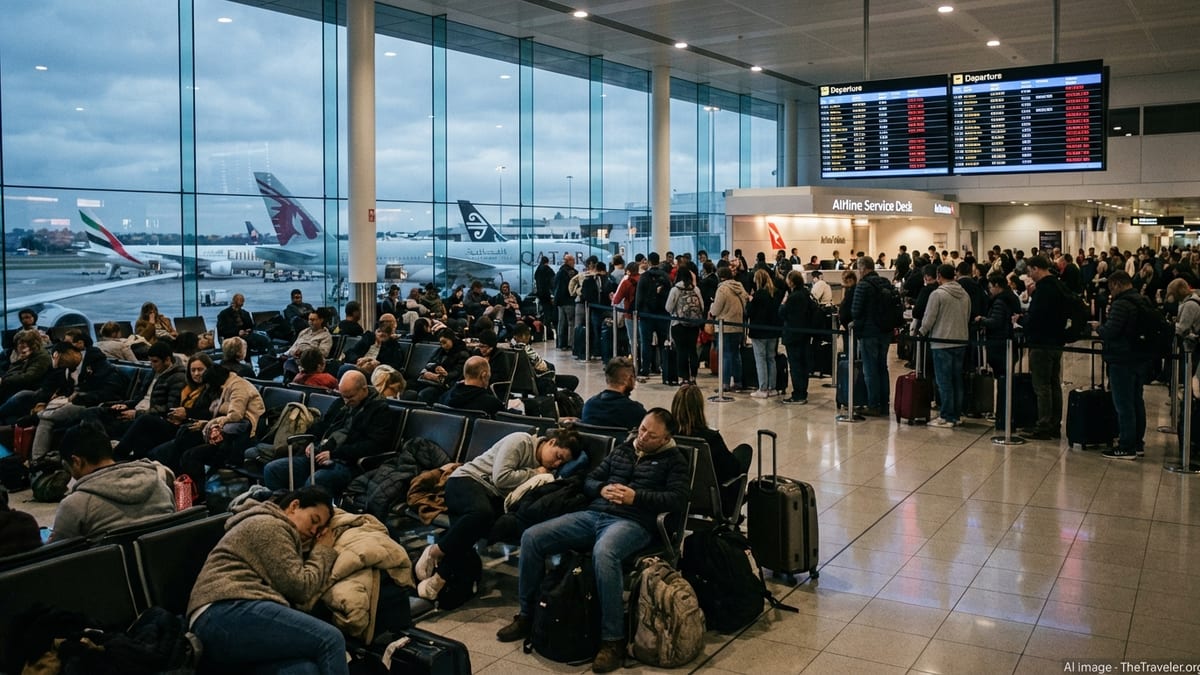
On the same day, dense fog at Auckland Airport resulted in at least a dozen regional flights being cancelled and many more delayed, according to domestic news reports and airport operational updates. Restrictions on landings during low‑visibility periods forced airlines to hold aircraft in the air or postpone departures entirely, contributing to long queues at check in counters and crowded terminal waiting areas.
These weather‑linked incidents follow a series of storm and fog events earlier in the year, particularly in February, when severe systems over New Zealand brought heavy rain, flooding and slips that disrupted air and ground transport. Travel advisories and government briefings at the time highlighted the vulnerability of key corridors into and out of Auckland and Wellington when runways, navigation systems or regional airports are affected by poor conditions.
Meteorological agencies have cautioned that climate‑related shifts in storm intensity and the frequency of fog events may add further volatility to aviation schedules over coming winters. For passengers, that raises the likelihood that even routine domestic hops could be delayed at short notice when weather thresholds are breached.
Operational strain, fuel costs and tight schedules
Beyond the immediate impact of weather, structural pressures within airline operations are also contributing to disruptions. Market updates from major carriers indicate that fuel costs have risen significantly in 2026, prompting airlines to consolidate some services and prioritise aircraft deployment on higher‑demand routes. Air New Zealand, for example, has pointed to targeted reductions on select domestic and regional flights to preserve overall connectivity while managing costs.
Analysts observing the Australian market note that cancellation rates, while below the peaks seen during the worst of the pandemic, remain higher than pre‑2020 norms on some trunk routes. Studies prepared for competition and consumer policy reviews attribute cancellations to a mix of factors including weather, crew availability, technical issues and commercial decisions to combine lightly booked services.
Industry submissions and financial disclosures suggest that airlines are attempting a delicate balance between trimming capacity to maintain profitability and preserving resilience in their schedules. When fleets are fully utilised and spare aircraft are limited, any extended maintenance requirement or crew illness can quickly trigger a cascade of delays. This is particularly acute for overnight long‑haul flights from North America or Asia that connect into the morning domestic banks in Sydney, Melbourne, Brisbane and Auckland.
Regulators in both countries are monitoring reliability trends as part of broader reviews into aviation performance and consumer outcomes. Planning documents from aviation authorities highlight goals to improve queue times, enhance safety oversight and manage the flow‑on effects of fuel price volatility and infrastructure constraints on punctuality.
Global tensions and transit bottlenecks add to uncertainty
The disruptions affecting Australia and New Zealand are not solely homegrown. International developments, particularly in the Middle East and parts of Europe, have created additional layers of uncertainty for long‑haul travellers connecting through offshore hubs. New Zealand government travel advisories issued in early 2026 warn that conflict‑related risks and evolving security measures in the Middle East are leading to cancelled or heavily delayed services along some of the traditional transit corridors to and from Australasia.
Separate advisories highlight new biometric border controls in Europe, with fingerprinting and facial recognition systems at Schengen‑area entry points expected to lengthen processing times. While these changes are primarily targeted at security and migration management, they can also result in missed connections for passengers traveling between Australia, New Zealand and European destinations via major hubs.
These international bottlenecks have knock‑on effects at home. When long‑haul flights are delayed or diverted, aircraft may arrive late into Sydney, Melbourne or Auckland, compressing turnaround windows and contributing to further schedule slippage on onward domestic or regional legs. Airlines must then decide whether to hold connecting flights for late‑arriving passengers or depart on time to protect the rest of the day’s timetable.
Government agencies and industry bodies in both countries continue to advise travellers to allow extra time for transits through complex hubs and to remain alert to changing security conditions. While airline networks have proven adaptable, the combination of geopolitical flux and new border control systems means that punctuality for some intercontinental journeys is likely to remain unpredictable.
Passenger rights, contingency planning and future resilience
As disruptions mount, questions about passenger rights and airline obligations are gaining prominence across the region. Consumer guidance published in Australia and New Zealand emphasises that travellers may be entitled to rebooking assistance, care provisions or refunds in certain circumstances, particularly where delays or cancellations are within the carrier’s control. Online forums and travel advisories show that awareness of these protections remains uneven, with some affected passengers unclear about what support to expect when plans are upended.
Airlines have responded by refining their public commitments and customer service plans. Air New Zealand, for example, details on its customer service pages how it communicates about delays, cancellations and tarmac waits, including a goal to notify customers promptly once a disruption exceeds 30 minutes. Comparable information from Australian carriers outlines procedures for reaccommodation, meal vouchers and hotel support when major schedule changes occur.
Infrastructure and policy changes are also being used to bolster resilience. In New Zealand, the decision to make RNZAF Base Ohakea available as a permanent civilian alternative for wide‑body aircraft is intended to strengthen the country’s ability to cope when Wellington or other key airports are closed by weather or technical issues. Funding has been committed for round‑the‑clock air traffic control at the base so that it can function as a reliable backup runway.
Looking ahead to the remainder of 2026 and beyond, transport forecasts and industry strategy papers anticipate that airlines in Australia and New Zealand will gradually build more buffer into schedules, adjust route networks and invest in operational technology to better predict and manage disruption. For now, however, travellers are being advised to expect a heightened risk of delays during peak seasons, pay close attention to airline notifications, and plan itineraries with extra flexibility when flying within and between the two countries.