


Lisbon Humberto Delgado Airport is the main gateway to Portugal and a busy hub for TAP Air Portugal, European low-cost carriers, and long-haul flights from North America and beyond. If you are flying through Lisbon in 2026, you will find an airport that is compact and convenient in theory, but often crowded and occasionally chaotic in practice. This guide walks you step by step through what to expect, how to move between terminals, how long to allow for security and border checks, and where to find food, Wi-Fi, and a quiet seat when you need it most.
Get the latest updates straight to your inbox!
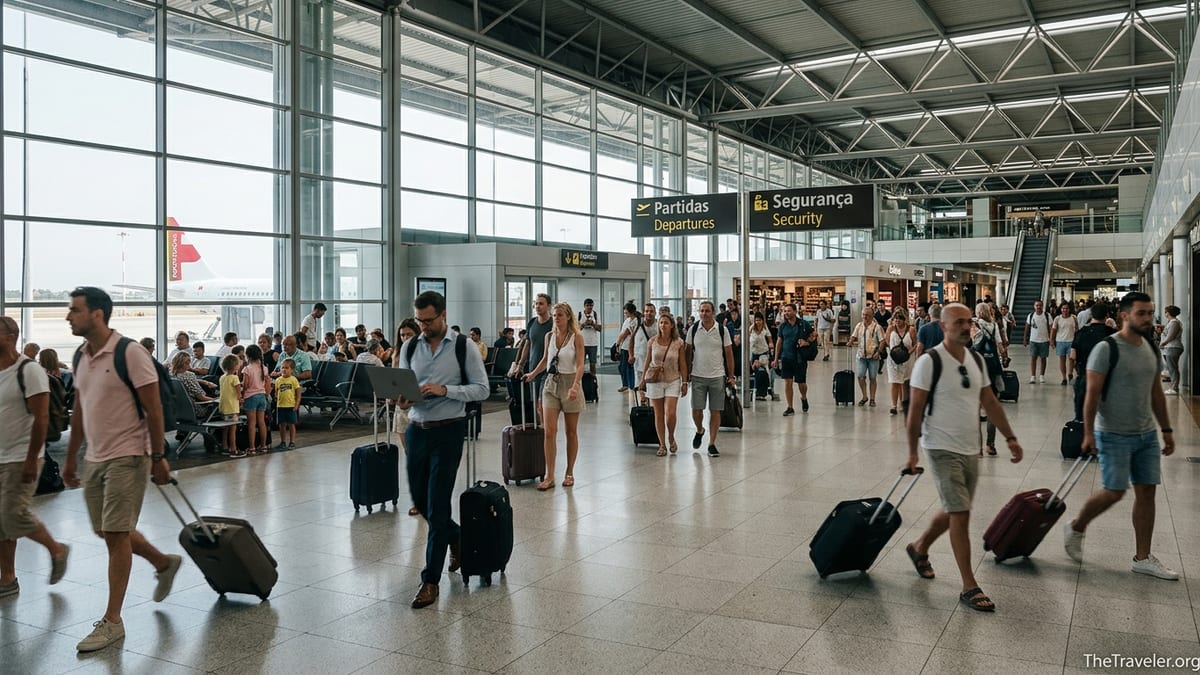
Understanding Lisbon Airport: Layout, Terminals, and Airlines
Lisbon Humberto Delgado Airport has two passenger terminals: Terminal 1 (T1) and Terminal 2 (T2). They are not connected airside. Terminal 1 is the main building that handles almost all arrivals and most departures, including TAP Air Portugal, the majority of full-service European airlines, and all long-haul intercontinental flights. Terminal 2 is a smaller, more basic facility that handles a rotating list of low-cost carriers on departures only, such as easyJet and Ryanair. All passengers arriving in Lisbon, regardless of airline, come into Terminal 1 for baggage claim and customs.
In practical terms, that means a typical traveler from New York on TAP to Lisbon, connecting to Madrid on TAP, will remain in Terminal 1 the entire time. By contrast, someone arriving from Paris on Air France and departing to Rome on a low-cost carrier might arrive at Terminal 1, clear border control, then take a landside shuttle to Terminal 2 for their onward flight. The arrangement can be confusing because boarding passes may simply say “Lisbon” with a gate number; always double-check the terminal in your airline’s app or at the airport’s departure screens once you land or check in.
Terminal 1 has the wider range of services: more shops and restaurants, the main security screening area, the ANA Lounge, a TAP-branded lounge used for premium passengers, and most of the airport’s duty-free. Terminal 2 is leaner and feels closer to a large bus terminal: there are simple snack bars, a few retail outlets, and basic seating, but limited quiet areas and no traditional airline lounges. If you value comfort before your flight and have any flexibility, booking flights from Terminal 1 generally gives a smoother experience.
Because the terminals are operated by the same airport operator, signage across the complex uses the same visual language and bilingual Portuguese and English labels. Look for large blue signs for “Partidas / Departures” and “Chegadas / Arrivals,” and for the circular bus icon indicating the free terminal shuttle when you need to move between T1 and T2.
Getting To and From Lisbon Airport: Metro, Taxis, and Rides
Lisbon Airport is close to the city center, and this is one of its greatest strengths. The Aeroporto metro station on the red line is directly outside Terminal 1. From here, you can reach central areas like Saldanha in roughly 15 minutes and Baixa-Chiado, via an easy change to the green or blue lines, in about 25 to 30 minutes in normal conditions. A single metro ticket costs just a few euros, and many travelers arriving with hand luggage and a hotel in the historic center find the metro the most predictable and cost-effective option, especially in rush hour traffic.
For those with large suitcases or traveling in a group, taxis and ride-hailing services are widely available in front of Terminal 1. Under normal traffic conditions, a taxi to downtown neighborhoods such as Baixa, Chiado, or Rossio is typically a 20 to 30 minute journey, with fares often in the 10 to 20 euro range depending on traffic and time of day. Official airport taxis use meters and display visible roof signs; you pay a small surcharge for luggage and nighttime rides. To avoid sitting in a long queue, some travelers choose to walk a few minutes to the nearby street outside the designated airport rank to hail a taxi or order a ride-hailing service in a quieter pickup spot.
Several public bus and airport shuttle lines also serve Lisbon Airport. Local urban buses are cheaper than private shuttles but can be crowded and make many stops, which may not be ideal with bulky bags. By contrast, private airport shuttles often link the airport directly to major hotel districts or train stations; they can make sense if your hotel participates in a shared service or if you are connecting to a long-distance train from Oriente station and prefer not to navigate the metro with luggage.
If you are flying out early in the morning, remember that the metro does not operate overnight. In those cases, pre-booking a taxi or ride-hailing car for a pickup around 3:00 or 4:00 a.m. is common for flights departing between 6:00 and 8:00 a.m. Many budget travelers staying in hostels in Baixa or Alfama report leaving their accommodations around three hours before departure to allow time for a short road transfer and any unexpected queues at the airport.
Connecting Through Lisbon: Schengen, Non-Schengen, and Timing
Lisbon is a Schengen entry and exit point for many passengers from North America, the United Kingdom, and beyond. If you are arriving from a non-Schengen country, such as the United States or Canada, and connecting to a Schengen destination like Porto, Barcelona, or Milan, your passport control is in Lisbon. After landing, you will follow signs to “Transfer / Connections” and “Border Control” before re-entering the departures area. If your onward flight departs from Terminal 1, you will generally clear border control and then go through security in the departures zone before reaching your new gate.
Recent travelers have reported that wait times at passport control can vary significantly, from as little as 10 minutes off-peak to more than an hour or longer during busy morning and evening waves, especially for non-EU passport holders. This unpredictability means conservative planning is wise. As a general guideline, aim for at least two and a half to three hours between an international arrival and a non-Schengen onward departure, and a minimum of two hours for a connection from an international flight into a Schengen destination, particularly if you must clear border control for the first time in Lisbon.
Schengen to Schengen connections within Terminal 1 are often smoother. For example, a traveler landing from Paris and continuing to Madeira on TAP may remain in the Schengen zone and simply follow the signs to their connecting gate, going through a standard security check if changing from a bus gate to a jet-bridge area. In uncongested periods, such a connection can be achieved in under an hour, but airline-recommended minimum connection times are longer, and opting for at least 90 minutes gives you some margin for late arrivals or a remote stand with bus transfer.
If your itinerary involves a change between Terminal 1 and Terminal 2, allow extra time. The free shuttle bus between terminals runs frequently but is subject to traffic outside the terminal. Travelers report that in most cases, the journey takes around 10 minutes, but it can stretch toward 20 minutes during busy times. Because you must be landside to transfer between T1 and T2, you will need to pass security again at your departure terminal. Choosing a connection of at least three hours for any itinerary involving a switch to or from Terminal 2 is a sensible safety margin.
Check-in, Security, and Border Control: How Early to Arrive
The biggest concern many travelers have about Lisbon Airport is crowding at security and passport control. This is a busy hub with limited physical space, and while the airport operator has been gradually expanding buffer zones and installing systems to monitor waiting times, passenger flows can still become uneven, especially during peak morning and late afternoon departure banks. Online and airport screens sometimes show optimistic wait estimates, yet travelers arriving at 7:30 or 8:00 a.m. for late-morning flights have occasionally reported unexpectedly long lines.
For departures to Schengen destinations, arriving at the airport around two hours before scheduled departure is often enough in quieter periods, such as midweek midafternoon flights in winter. However, during the busy summer months, early morning departures between about 6:00 and 9:00 a.m. and evening flights after 6:00 p.m. are more prone to long queues. For those flights, many seasoned travelers aim for at least two and a half hours, while cautious families with young children sometimes add an extra half hour for comfort.
For non-Schengen flights, such as those to the United States, the United Kingdom, or North Africa, you should allow more time to clear security and exit passport control. Three hours is a reasonable baseline, rising to three and a half hours during school holidays and peak weekends in July and August. For example, travelers on a Lisbon to New York flight departing at 11:00 a.m. often arrive at the airport by 7:30 or 8:00 a.m., check in quickly at the dedicated airline counters, and then spend considerable time in security and border queues before relaxing at the gate or in a lounge.
If you are traveling with only hand luggage and have checked in online, you can head straight for security upon arrival at the terminal. Lisbon Airport uses modern scanners and separate lanes for families, general passengers, and fast track users, but queues still form quickly when several flights close around the same time. Keeping liquids in a single transparent bag and limiting electronics can make your progress smoother. Border control for non-Schengen departures is located just beyond the main shopping zone at Terminal 1; do not forget that you must pass through it even if your gate is already visible from the main concourse.
Lounges, Wi-Fi, and Places to Work or Rest
Lisbon Airport offers a limited but useful selection of lounges and quiet spaces, centered on Terminal 1. The main pay-per-use facility is the ANA Lounge, located airside in Terminal 1 above the main Praça Lisboa shopping area, typically accessed by a long escalator near the Schengen departures gates. It usually opens early in the morning and closes late in the evening, with a maximum stay of around three hours and access possible starting a few hours before your scheduled boarding time. Entry is open to all travelers for a fee, and to many business class passengers and holders of lounge membership cards such as Priority Pass and DragonPass.
Inside the ANA Lounge you will find a cold buffet with sandwiches, pastries, salads, and fruit, along with self-service coffee, tea, soft drinks, and a selection of wines and spirits. Travelers describe the space as busy during peak times but still considerably more comfortable than the main concourse, with large windows overlooking the runway, work tables with power outlets, and quieter corners with sofas where you can read or rest. There is a small smoking area, shower facilities with paid kits, and updated flight information screens so that you can monitor your boarding while you relax.
Premium passengers on TAP Air Portugal and certain partner airlines may also have access to a dedicated TAP-branded lounge in Terminal 1. This lounge broadly mirrors the ANA Lounge in terms of food, drink, and seating, but access is restricted to eligible customers traveling in business class or holding qualifying frequent-flyer status. For travelers without lounge access, the general departures area in Terminal 1 does have some quieter seating zones at the far ends of the concourse, particularly near gates used for regional flights; walking away from the central shopping court often yields more available seats and calmer corners to work on a laptop.
Airport-wide Wi-Fi is available in both terminals and is usually free to access, though speeds can vary when many passengers are connected. Business travelers often report being able to handle email, cloud documents, and even moderate video calls from the ANA Lounge or less crowded gate areas, while heavy streaming can be less reliable at busy times. Power outlets are reasonably common in newer seating clusters and near some cafes; if you are working on a long layover, carrying a small multi-port adapter can help you make the most of a single available socket.
Food, Shopping, and Practical Services
The food and shopping offering at Lisbon Airport varies sharply between the two terminals. Terminal 1 hosts a full duty-free store, several international fashion brands, Portuguese souvenir shops selling regional wine, olive oil, and canned fish, as well as a mix of fast-food outlets and sit-down restaurants. Popular choices for a quick bite include international coffee chains in the departures hall, a couple of sandwich and pastry counters serving pastel de nata and other local snacks, and casual restaurants that offer grilled meats, salads, and daily specials at prices broadly similar to those in the city.
Travelers with longer layovers can comfortably sit for a full meal before security in Terminal 1, where there are restaurants with table service and wine lists showcasing Portuguese labels. Prices for a main course and drink are typically higher than in central Lisbon, but still reasonable by major European hub standards. After security, eateries cluster around the central shopping court; if your gate is in a quieter pier, you may find only vending machines or small kiosks nearby, so it can be wise to pick up any substantial food before walking out to the remote gates.
Terminal 2, by comparison, offers only a handful of snack bars, a small duty-free area, and limited seating near food outlets. Many budget travelers flying out of Terminal 2 choose to eat in the city or at Terminal 1 and then head to Terminal 2 closer to departure, especially if they have dietary restrictions or need more than a quick sandwich. It is worth noting that prices for water, coffee, and simple snacks are broadly in line with those at Terminal 1, so you will not be penalized significantly for choosing to buy food after security rather than carrying it from outside.
On the practical side, both terminals have ATMs, currency exchange desks, and information counters. Car rental desks are concentrated in and around Terminal 1 and in adjacent parking structures; if you are picking up a car, factor in some extra time to find your provider’s office and complete the paperwork. Pharmacies and travel accessory shops can be found in Terminal 1 for last-minute items such as plug adapters, travel pillows, or over-the-counter medication, and most larger outlets accept international credit cards as well as contactless payments.
Special Situations: Families, Reduced Mobility, Night Flights, and Delays
Lisbon Airport is reasonably accessible for travelers with reduced mobility, though the layout in Terminal 1 can involve long walks between check-in and distant gates. Wheelchair assistance and priority services should be requested through your airline in advance; once at the airport, dedicated staff usually accompany passengers who need assistance through security and border control, and the main ANA Lounge is configured to accommodate wheelchair users. Elevators link the different levels, and accessible toilets are clearly marked near most gate clusters.
Families with young children will find baby-changing facilities in both terminals and family lanes at security during busy periods. Still, the airport can be noisy and crowded, especially during morning departure peaks. Parents often choose to arrive a little earlier than strictly necessary to move through check-in and security at a comfortable pace, then let children burn off energy at quieter gate areas further from the central concourse. While there is not a large dedicated play area in the style of some bigger hubs, staff are generally accommodating with strollers at security and boarding.
For travelers on very early morning or late-night flights, services at Lisbon Airport can feel more limited. The metro does not run through the night, and only a subset of cafes and shops stay open in the small hours. If you arrive at the terminal before 4:00 a.m., you may find security lanes just opening or partially staffed. An example is a passenger on a 6:00 a.m. low-cost departure from Terminal 2 who arrives by taxi at 3:30 a.m. and spends the first half hour waiting for check-in and security to fully open. In these cases, bring snacks and a refillable water bottle and be prepared for a somewhat spartan experience until more outlets open around dawn.
Delays and disruptions, particularly in peak summer, are a reality at Lisbon Airport. Storms affecting other European hubs, air traffic control restrictions, or congestion in the single-runway operation can all ripple through schedules. If your flight is delayed after you have cleared security, staff will usually update departure boards quickly, but gate changes near departure time are not uncommon. Staying flexible, keeping carry-on essentials such as medication and chargers with you, and having a rough plan for how to occupy an unexpected extra hour or two in the departures area can make these disruptions easier to manage.
The Takeaway
Flying through Lisbon Airport in 2026 means balancing the advantages of a city-close, compact hub with the reality of occasional crowding and operational bottlenecks. If you understand the split between Terminal 1 and Terminal 2, build generous margins into your connection times, and arrive early for non-Schengen departures, you will greatly reduce the stress of your journey. Making smart choices about transportation to the airport, where to eat, and when to use a lounge can turn even a long layover into a relatively pleasant pause rather than an ordeal.
For most travelers, Lisbon rewards a pragmatic approach. Treat official minimum connection times as a baseline rather than a target, travel with carry-on only when possible, and keep paper or digital copies of your boarding passes and hotel details handy to smooth any conversations with airline or border staff. By combining this practical mindset with a bit of flexibility and patience, you will navigate Lisbon Humberto Delgado Airport with confidence and arrive at your final destination ready to enjoy Portugal or your next stop beyond.
FAQ
Q1: How early should I arrive at Lisbon Airport for an international flight?
For non-Schengen international flights, such as to the United States or the United Kingdom, aim to arrive about three hours before departure, and consider three and a half hours in peak summer or on busy weekends. This gives you time for check-in, potential queues at security, and exit passport control without rushing.
Q2: How long does it take to transfer between Terminal 1 and Terminal 2?
The free shuttle bus between Terminal 1 and Terminal 2 usually takes around 10 minutes, but you should allow at least 30 to 40 minutes door to door to include walking, waiting for the bus, and possible traffic. For any connection involving both terminals, plan on a total of around three hours between flights.
Q3: Is the metro the best way to reach Lisbon city center from the airport?
The metro is often the most predictable and budget-friendly option, especially if you have light luggage. From Aeroporto station on the red line, you can reach central interchanges like Saldanha in about 15 minutes and connect onward to Baixa-Chiado in roughly 25 to 30 minutes. Taxis or ride-hailing cars are more comfortable with heavy bags or groups but can be slower in rush hour.
Q4: Are queues at security and passport control in Lisbon really as bad as people say?
Experiences vary widely. At quiet times, some passengers clear security and border control in under 30 minutes, while others report waits of an hour or more during peak morning or evening waves, especially for non-EU passport holders. Planning conservatively, arriving early, and avoiding tight self-made connections is the safest way to manage this unpredictability.
Q5: Can I use the ANA Lounge if I am not flying business class?
Yes. The ANA Lounge in Terminal 1 is a pay-per-use lounge open to all travelers who pay the access fee, and it is also accessible with certain lounge memberships such as Priority Pass or DragonPass. Many frequent flyers in economy choose to buy access for longer layovers to secure a quieter space, food, drinks, and reliable Wi-Fi.
Q6: What should I do if I have a long layover at Lisbon Airport?
With a layover of three to five hours, many travelers stay airside, have a proper meal, and use the ANA Lounge or quieter gate areas to rest or work. If your layover exceeds six hours and you are comfortable with local transport, you might consider a quick metro ride into the city to stroll around central Lisbon, keeping in mind the time needed to return, clear security, and reach your gate.
Q7: Is Lisbon Airport easy to use for families with children?
Lisbon Airport can be busy but is generally manageable for families. There are baby-changing facilities and, at busy times, dedicated family lanes at security. Arriving a bit earlier, bringing snacks and entertainment for kids, and heading to quieter gate areas away from the central concourse can make the experience smoother.
Q8: How reliable is the free Wi-Fi at Lisbon Airport?
The airport offers free Wi-Fi in both terminals, and for most travelers it is good enough for emails, messaging apps, and light browsing. At very busy times, speeds can slow down, especially in crowded central areas. Business travelers who need stable connections for calls often prefer working from the ANA Lounge or less crowded gates with stronger signal.
Q9: What happens if my flight is delayed and I risk missing my connection?
If a delay on an earlier leg threatens your connection and both flights are on a single ticket with the same or partner airlines, approach the airline’s transfer desk or gate agents as soon as you land. They can rebook you on the next available flight or help with overnight arrangements if necessary. If you built your own connection on separate tickets, you may need to purchase a new onward ticket, so leaving generous time between flights is especially important.
Q10: Does Lisbon Airport operate 24 hours a day?
The airport itself functions around the clock, with flights arriving and departing from early morning into late evening and occasionally overnight. However, public transport options, security lanes, and shops do not all operate 24 hours. If you must be at the airport in the very early hours, plan for limited food options, rely on taxis or rides to get there, and be prepared to wait for certain services to open closer to dawn.