


Running low on cash halfway through a trip is stressful, especially when ATMs are unreliable or your bank does not love overseas withdrawals. MoneyGram sits in that space between traditional banks and app-based fintechs, letting you send or receive money in more than 200 countries and territories, often in cash within minutes. For many travelers, it is a backup plan that turns into a real lifeline. Here is how MoneyGram actually works when you are on the road, what it costs, and how to avoid the most common hassles.
Get the latest updates straight to your inbox!
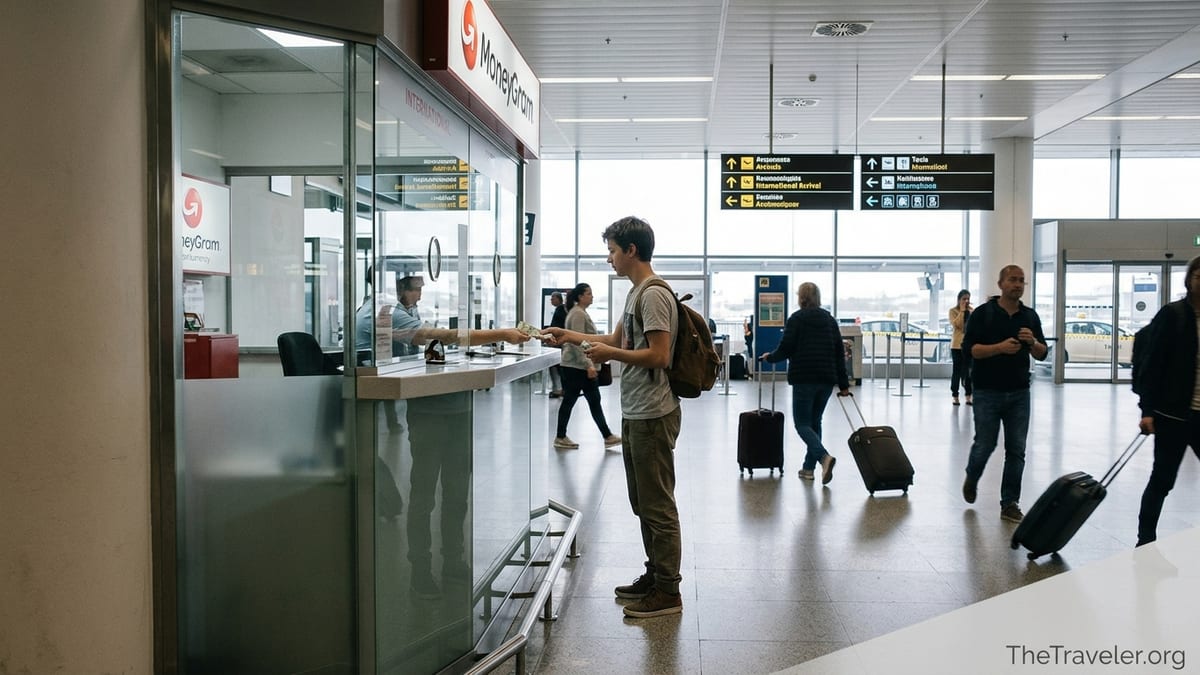
What MoneyGram Is and When Travelers Actually Use It
MoneyGram is a global money transfer company headquartered in Dallas, Texas, built around a network of roughly hundreds of thousands of agent locations worldwide where people can send and receive money. For travelers, the appeal is simple: you can usually receive funds in local currency as cash from a supermarket, currency exchange desk, small bank branch, or convenience store without needing a local bank account.
Imagine you are an American backpacker in Lima whose debit card is suddenly blocked after a fraud alert. Your parents in Chicago can walk into a MoneyGram location at a grocery store, send you 300 dollars for a cash pickup, and you collect Peruvian soles at a partner location near your hostel. In many busy travel corridors, this kind of transfer can be available in minutes, making it practical for emergencies as well as planned support.
Travelers also use MoneyGram in more routine ways. Long-term digital nomads might have rent due in Mexico City while their freelance payment just cleared into a U.S. bank. A friend at home can send a one-off transfer to bridge the gap. Some travelers in countries with capital controls or weak banking systems rely on cash pickups because foreign bank cards do not work reliably at ATMs or local banks impose unexpected withdrawal limits or fees.
On the sending side, you do not have to be overseas. Many travel-related transfers start in the traveler’s home country, sent from a laptop or phone at home to a traveler who is already abroad. Others are sent in the opposite direction, such as a traveler in Paris paying back a friend in New York who booked all the flights.
How a Typical MoneyGram Transfer Works Step by Step
Despite the different funding and payout methods, the essential MoneyGram flow is similar across countries: the sender sets up the transfer, MoneyGram processes it, and the recipient collects it either as cash or into an account or wallet. Understanding the sequence helps travelers avoid delays.
First the sender chooses the channel. In the United States that often means either using the MoneyGram website or mobile app, or going in person to an agent such as a pharmacy, supermarket, or payday-lending storefront. At the counter, the sender provides their own identification, the recipient’s full name as on their ID, the destination country, the payout method (for example cash pickup in local currency), and the amount. The system then shows an estimated fee and exchange rate before the sender pays by cash, debit card, or bank transfer, depending on what is available.
Once the transaction is confirmed, MoneyGram issues a reference number, typically eight digits, which the sender must pass to the traveler who is receiving the money. This number, along with a valid photo ID and sometimes additional details like the sender’s name and country, is what allows the traveler to collect the funds. If the transfer is for cash pickup and everything clears normally, the status in many corridors changes to available in just a few minutes.
For a traveler, the receiving side is straightforward but unforgiving if details do not match. You locate a MoneyGram agent in the city where you are staying, bring your passport or other accepted ID, complete a short receive form if required, and give the agent the reference number. The agent checks the details in MoneyGram’s system and, if everything matches, pays out the cash in the local currency or credits the funds to the chosen bank account or mobile wallet. A simple 200 dollar transfer from the U.S. to Thailand for a cash pickup, for instance, could go from sender confirmation to baht in your hand in less than half an hour in normal conditions.
Funding, Payout Options, and Real-World Use Cases
For travelers, the most relevant MoneyGram combination is usually a bank-funded or debit card-funded transfer that ends in a foreign cash pickup. A traveler in Athens who loses their wallet might call a sibling in Toronto, who then uses a debit card in the MoneyGram app to send 500 Canadian dollars equivalent for cash pickup in euros at a kiosk near Syntagma Square. The recipient never has to touch an ATM or open a local account.
In many popular travel destinations, MoneyGram also supports payouts directly to local bank accounts. A U.S. student studying in Berlin, for example, may have a German bank account for rent but still rely on parents in Texas for support. The parents can send euros directly into that German account, usually within the same day if not within minutes on certain corridors, skipping any in-person pickup.
Mobile wallet payouts are another option in some countries. A traveler in Kenya might maintain an M-Pesa wallet tied to a local phone number. Their partner in London can send a MoneyGram transfer for payout to that mobile wallet, and the traveler can then pay for taxis, restaurants, or guesthouses directly from the phone. This adds a layer of safety in cities where carrying a lot of cash is discouraged.
There are also more niche use cases. Some travelers send money to themselves as a backup. An American heading to Vietnam might set up a small transfer to their own name, planning to pick it up in Ho Chi Minh City if their card stops working. Others may combine MoneyGram with a local digital wallet or prepaid travel card as part of a diversified safety net.
Fees, Exchange Rates, and Why Total Cost Matters
MoneyGram earns money in two main ways: explicit transfer fees and the exchange rate it applies when converting currencies. The visible fee is what most travelers notice first. For example, a 1,000 dollar cash pickup to Mexico might carry a flat or tiered fee in the range of a few dollars when funded from a bank account, but be somewhat higher if funded by a credit or debit card. Actual pricing depends heavily on the send and receive countries, payment method, and payout type, and MoneyGram’s own help center directs customers to check a live quote for the specific route they need because fees vary over time.
The less obvious cost is the margin built into the exchange rate. Independent reviewers tracking MoneyGram quotes in 2026 have found that customer rates often sit roughly 1 to 5 percent above the mid-market exchange rate depending on the corridor and funding method, with smaller or riskier corridors tending toward the higher end. That difference may not feel huge on a single 200 dollar emergency transfer, but on a 2,000 dollar rent payment it can mean tens of dollars in hidden foreign exchange costs on top of the stated fee.
Consider a practical example: your partner in New York sends you 600 dollars for cash pickup in the Philippines while you are traveling there. If the mid-market rate is roughly 56 pesos to the dollar, you might expect about 33,600 pesos. If MoneyGram’s rate on that route is, for instance, 1.5 percent weaker than mid-market, you might receive closer to 33,100 pesos, losing roughly 500 pesos, plus whatever transfer fee was charged in dollars. Comparing that combined impact against alternatives like specialist international transfer apps is an important part of managing travel budgets.
Because exchange rate margins shift, it is wise for travelers to check MoneyGram’s quote screen alongside a neutral rate source such as a financial news site or a currency converter. If the rate gap seems unusually wide on a given day, you can sometimes save money by reducing the transfer amount, splitting payments over time, or using another provider for non-urgent transfers while keeping MoneyGram for small, time-critical cash pickups.
Limits, Identification, and Compliance While You Travel
MoneyGram operates under banking and anti-money-laundering regulations in each country, which means travelers will encounter transfer limits and identification requirements. The exact numbers vary by corridor and customer profile, but third-party guides in 2026 indicate that a newly registered U.S. online customer may start with transfer caps around the low thousands of dollars per transaction, with higher limits, sometimes around five figures per day, unlocked after full identity verification. These ranges are approximate rather than hard guarantees and depend on the send and receive countries and the payout method.
At the counter, agents are required to ask for ID. To pick up a transfer, travelers must usually present a government-issued photo ID such as a passport for international visitors, along with the reference number the sender shared. For larger amounts, some agents may ask for a second form of ID, proof of address like a utility bill or rental contract, or questions about the purpose of the transfer. Internal MoneyGram compliance guidance for U.S. agents, for example, highlights additional scrutiny for single-day activity above certain thresholds.
These rules can catch travelers off guard. A visitor to Uzbekistan, for instance, might try to collect a MoneyGram transfer at a bank in Samarkand only to find that local regulations require a national tax identification code that tourists do not have, leading to delays or refusals. In Japan, some travelers report that certain chains listed on MoneyGram’s locator no longer handle payouts, reflecting the way local partnerships can change faster than directory listings are updated.
The practical lesson is to treat limits and ID rules as more than fine print. Before relying on a large MoneyGram transfer to pay a rental deposit or tour balance, travelers should test the system with a smaller amount, confirm what ID the local agent accepts, and ask whether there are any local restrictions on foreigners receiving high-value cash transfers.
Finding Reliable Agent Locations and Avoiding Common Pitfalls
On paper, MoneyGram’s network reaches well over 300,000 physical locations worldwide. On the ground, the experience is less tidy. Franchise agreements end, small shops close, and some agents stop offering money transfers while still appearing on locators for a time. Travelers arriving at a small train station in rural Japan or a neighborhood in Latin America sometimes discover that the only listed MoneyGram counter is now a regular convenience store with staff who have never handled a transfer.
To reduce the risk of wasted trips, it is smart to cross-check a few things before sending. Instead of choosing the tiniest neighborhood kiosk on the map, look for agents inside established banks, national supermarket chains, or well-known currency exchange brands in city centers or major malls. When timing is critical, have the recipient call the selected location during local business hours and specifically ask if they still process MoneyGram payouts and what ID they will accept from a foreign traveler.
Another common pitfall is name mismatches. If the sender spells the traveler’s surname differently than it appears in their passport or uses a nickname instead of the legal first name, some agents will refuse the payout. Stories from pharmacy chains and convenience stores in North America confirm that staff are trained to insist that the recipient’s ID matches the name in the system. For travelers with multiple surnames or non-Latin scripts, it is worth sending a photo of the passport page to the sender so they can copy the name exactly.
Travelers should also budget time for queues and paperwork. In busy holiday periods, agent counters inside supermarkets in places like Mexico or the Dominican Republic can have long lines of people collecting remittances. While a simple 200 dollar pickup should not take long once you reach the front of the line, plan your visit well before a hard deadline such as a bus departure or hotel check-in time.
Security, Scams, and Using MoneyGram Safely on the Road
Because MoneyGram transactions can be collected in cash without a bank account, they are attractive to scammers. The company itself warns customers not to send money to strangers for online purchases, lottery winnings, or romantic partners they have never met. Once a traveler picks up the money and leaves the agent location, the funds are effectively gone from MoneyGram’s perspective, and reversing a payout is very difficult or impossible.
Travel-related scams often involve a fabricated emergency. A friend might receive a message supposedly from you claiming that your passport, cards, and phone were stolen in Barcelona and you urgently need 800 dollars via MoneyGram. The scammer may pressure the sender not to call or verify the story. Travelers can protect loved ones by agreeing on simple verification steps before departure, such as a shared code word or a video call requirement before any emergency transfer is sent.
At the agent location, security is mostly physical. In some countries, cash pickup counters are small and open to the street. If you are collecting the equivalent of several hundred dollars or more, consider going during daylight hours, bringing a trusted companion, and stepping away from the entrance before counting your money. Many travelers prefer to immediately deposit most of the cash into a hotel safe or pay upcoming bills to avoid carrying a visible wad of foreign currency.
Sending money to yourself can also raise flags if it resembles patterns used in fraud. Repeatedly sending and collecting cash transfers in short intervals in the same city, for example, might prompt extra questioning. When an agent asks detailed questions about the purpose of your transfer or source of funds, it is often because they are following required compliance scripts rather than doubting your story personally.
The Takeaway
For travelers, MoneyGram is neither a perfect all-purpose banking solution nor a relic of the pre-app era. It occupies a very specific niche: fast access to funds, often in cash, across borders where standard bank cards and accounts may not work smoothly. Used thoughtfully, it can turn a potential travel disaster such as a lost wallet, blocked card, or unexpected bill into a manageable inconvenience.
The key is preparation and realism. Before a big trip, decide with family or friends who could send you a MoneyGram transfer in an emergency, test a small transfer to your first destination, and confirm at least one reliable agent where you can pick up cash with your passport. Pay attention to total cost, not just the advertised fee, by glancing at the exchange rate and comparing it to independent sources for your route.
As regulations, fees, and partnerships evolve, treat MoneyGram like any other financial tool in your travel kit: useful when it fits the situation, but best combined with other options such as travel-friendly debit cards, specialist transfer services, and a small reserve of hard currency. With a bit of planning, it can be the safety net that keeps your trip on track when everything else seems to be going wrong.
FAQ
Q1. How fast can I receive a MoneyGram transfer while traveling abroad?
In many popular corridors, cash pickup transfers funded by debit card or cash can be available within minutes, though bank account or mobile wallet payouts may take longer depending on local banking hours and checks.
Q2. What identification do I need to pick up MoneyGram cash in another country?
Most travelers will need a government-issued photo ID, typically a passport, plus the reference number and sometimes additional details like the sender’s name and country; some countries may also require local tax IDs or proof of address for larger amounts.
Q3. Can I send money to myself with MoneyGram before I travel?
Yes, many travelers send transfers to their own name to pick up abroad, but you must ensure the name on the transfer matches your passport exactly and confirm beforehand that a nearby agent in your destination city can process payouts to foreign visitors.
Q4. How much does it usually cost to use MoneyGram for travel emergencies?
Costs vary by country pair, amount, funding source, and payout method, but you can expect a visible transfer fee plus an exchange rate that is typically a few percent weaker than the mid-market rate, which together make up the total cost.
Q5. Are MoneyGram locations at my destination always accurate in the online locator?
Not always, because local partners can stop offering the service or close; it is wise to choose agents inside established banks or major supermarkets and, when possible, call ahead or have someone confirm that the location still handles MoneyGram payouts.
Q6. What happens if the sender misspells my name on the transfer?
If the name on your ID does not closely match the name in MoneyGram’s system, many agents will refuse to release the money, so the sender may need to request a correction, which can cause delays and may involve additional verification.
Q7. Is MoneyGram safe to use while traveling, or can it be reversed if something goes wrong?
MoneyGram is widely used and regulated, but once a transfer is picked up in cash it is effectively irreversible, so you should only send money to people you know and trust and treat any request to send funds to strangers or for vague reasons as a red flag.
Q8. Are there limits to how much I can receive through MoneyGram as a traveler?
Yes, there are per-transfer and rolling limits that depend on the countries involved, the payout method, and your verification status, and large or repeated cash pickups may trigger extra questions or documentation requirements at the agent location.
Q9. Can I get the transfer in U.S. dollars instead of local currency when I am abroad?
In some countries, especially those with partial dollarization, certain agents may pay out in U.S. dollars, but in many destinations transfers are automatically converted into the local currency at MoneyGram’s rate at the time of payout.
Q10. When is it better to use another service instead of MoneyGram for travel money?
For large, non-urgent payments to foreign bank accounts, specialist online transfer services or multi-currency accounts often provide better exchange rates and lower total costs, while MoneyGram remains especially useful for smaller, time-sensitive cash pickups where speed and reach matter more than marginal savings.