


More news on this day
Nine major Schengen gateway countries, led by France, are keeping special flexibility to dial back full biometric checks under Europe’s new Entry/Exit System (EES) into late 2026, after warning Brussels that forcing immediate, rigid compliance risks serious passport-control queues at busy airports, ports and UK–EU juxtaposed borders.
Get the latest news straight to your inbox!
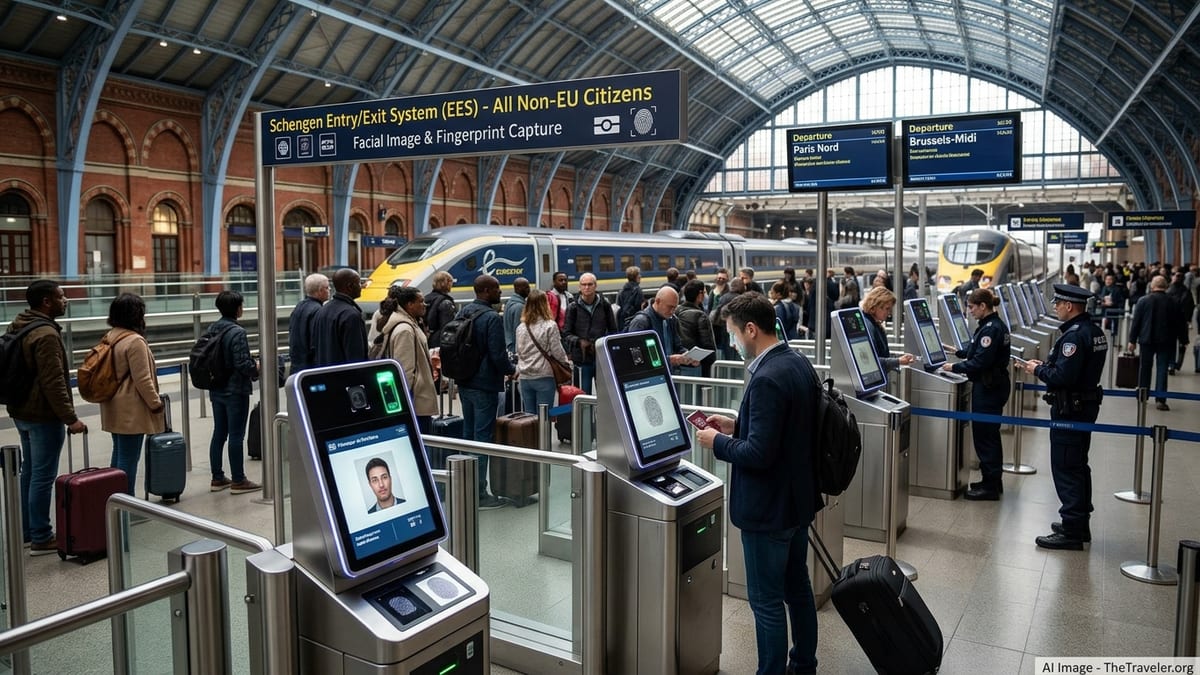
What EES is and how far it has rolled out
The EU’s Entry/Exit System is a central biometric database that registers non‑EU, non‑EEA and non‑Swiss short‑stay travellers each time they cross the external Schengen border. Instead of manual passport stamps, it records facial images, fingerprints and passport details, then automatically tracks how long visitors stay.
EES moved from testing to phased operations in late 2025 and became mandatory at external Schengen borders in April 2026, following a six‑month ramp‑up period. According to recent European Commission reporting, tens of millions of entries and exits were captured in the first half‑year, with tens of thousands of travellers refused entry for having no legal right to enter, typically because of overstays or security flags.
Although the legal obligation to use EES now applies area‑wide, practical implementation remains uneven. Some border points are operating full biometric checks at every crossing, while others are still using a mix of EES kiosks, manual inspection and targeted enrolment during busy periods.
Nine countries ask Brussels for more leeway
On 7–10 July 2026, a group of nine Schengen states – France, Belgium, the Netherlands, Germany, Greece, Malta, Portugal, Italy and Switzerland – wrote jointly to the European Commission and Council asking to prolong emergency “tolerance” measures designed to prevent border queues during the EES bedding‑in phase. Their request became public through national and specialist reports later in the summer.
The safeguard mechanism they sought to extend had been due to expire on 6 September 2026. It allows national border authorities to relax or temporarily suspend some EES biometric capture requirements when passenger flows exceed local processing capacity, for example during peak holiday weekends or when kiosks suffer technical failures.
Following the July letter and subsequent talks with EU institutions, these nine countries were effectively allowed to keep using such flexibility into late 2026, even after the formal expiry date. The European Commission has not scrapped EES, but it has signalled a willingness to tolerate controlled, time‑limited derogations where needed to keep border traffic moving while technical issues and staffing gaps are addressed.
Documented pressure points and France’s approach
Summer 2026 brought well‑documented EES‑related disruption at several external Schengen borders. Airport and airline groups reported longer waits at peak times, especially where many travellers were being enrolled in the system for the first time and where kiosks or software updates reduced available capacity. Industry bodies warned in October 2026 that immigration‑related delays were contributing to missed connections in parts of Spain, Italy, Greece and Belgium, and urged regulators to make emergency flexibility a standing option during high season.
France has publicly defended EES as a long‑term tool to strengthen border management, but its Interior Ministry has also acknowledged operational strain during the rollout. The French strategy has focused heavily on pre‑registration kiosks and tablets at key air and sea gateways, including at UK locations where French police conduct “juxtaposed controls” before departure, such as Dover, Folkestone/Eurotunnel and London St Pancras for Eurostar services.
At the Channel ports, authorities in Boulogne‑Calais confirmed in early September 2026 that France’s EES tolerance period would remain in place at least until 31 December 2026. In practice, this has allowed local border police to modulate the intensity of biometric checks when vehicle queues build, while continuing to enrol first‑time EES travellers whenever conditions permit.
What travellers can expect in queues and checks
EES affects non‑EU, non‑EEA and non‑Swiss short‑stay visitors, including UK passport holders. Citizens of Schengen countries, and other EU nationals crossing within the free‑movement area, are not enrolled in the system and continue to use existing e‑gates or manned EU lanes.
For travellers subject to EES, the first visit after the system’s introduction is the most time‑consuming. You will normally provide four fingerprints and have a facial image captured at a self‑service kiosk or at the inspection booth, alongside the usual passport scan and basic travel questions. Border officials stress that, in normal conditions, a straightforward first‑time enrolment only takes a few minutes, but bottlenecks arise when many people are doing this at once or when equipment is out of service.
On subsequent trips, the system retrieves your stored data and focuses on verifying your identity and travel rights, which should be quicker. However, because the nine countries benefiting from extended flexibility can still adapt how strictly they apply full biometric checks, conditions vary widely. Some airports and ports in these states are running near‑full EES processes on all eligible passengers, while others prioritise first‑timers or conduct more selective checks during peak waves.
Known hot spots and what to watch next
Current reports point to specific pressure points rather than uniform disruption. Juxtaposed UK–EU controls, where Schengen entry checks are carried out before departure on UK soil, remain particularly sensitive: Dover’s ferry terminal, the Eurotunnel terminal at Folkestone and Eurostar’s platforms at London St Pancras have all been highlighted as locations where EES teething problems could quickly translate into visible queues for UK‑bound holiday traffic.
Busy Mediterranean leisure airports and major hubs in the nine flexible states, such as Paris, Rome, Athens and Lisbon, have also seen episodic EES‑related queues during summer peaks, especially when combined with local staffing shortages or system updates. By contrast, other external border points within the Schengen area have reported relatively smooth operations, underlining how local infrastructure and passenger mixes shape the impact.
Looking ahead, the European Commission continues to insist that EES is a permanent feature of Schengen border management, not a pilot. Work is ongoing on a “Travel to Europe” pre‑enrolment app for some member states, intended to let travellers capture data before reaching the border, and on integrating EES with the separate ETIAS pre‑travel authorisation scheme once that system finally goes live. Exact timelines for phasing out the remaining tolerance measures in France and the eight other states, and for ETIAS to launch, remain subject to further EU and national decisions, so travellers should check the latest guidance from airlines, ports and interior ministries before departure, particularly for trips in late 2026 and early 2027.