


Tracy Arm Fjord is one of Southeast Alaska’s most dramatic landscapes: a narrow, roughly 30‑mile granite corridor filled with waterfalls, floating ice and tidewater glaciers about 45 miles south of Juneau. Recent landslide and tsunami activity has changed how large and small vessels use the fjord, but it remains a signature Inside Passage experience for many visitors. This guide explains what Tracy Arm is, how to visit from Juneau or a cruise ship, what has changed since the 2025 landslide, and how it compares with alternatives such as Endicott Arm and Glacier Bay.
Get the latest updates straight to your inbox!
What and Where Tracy Arm Is
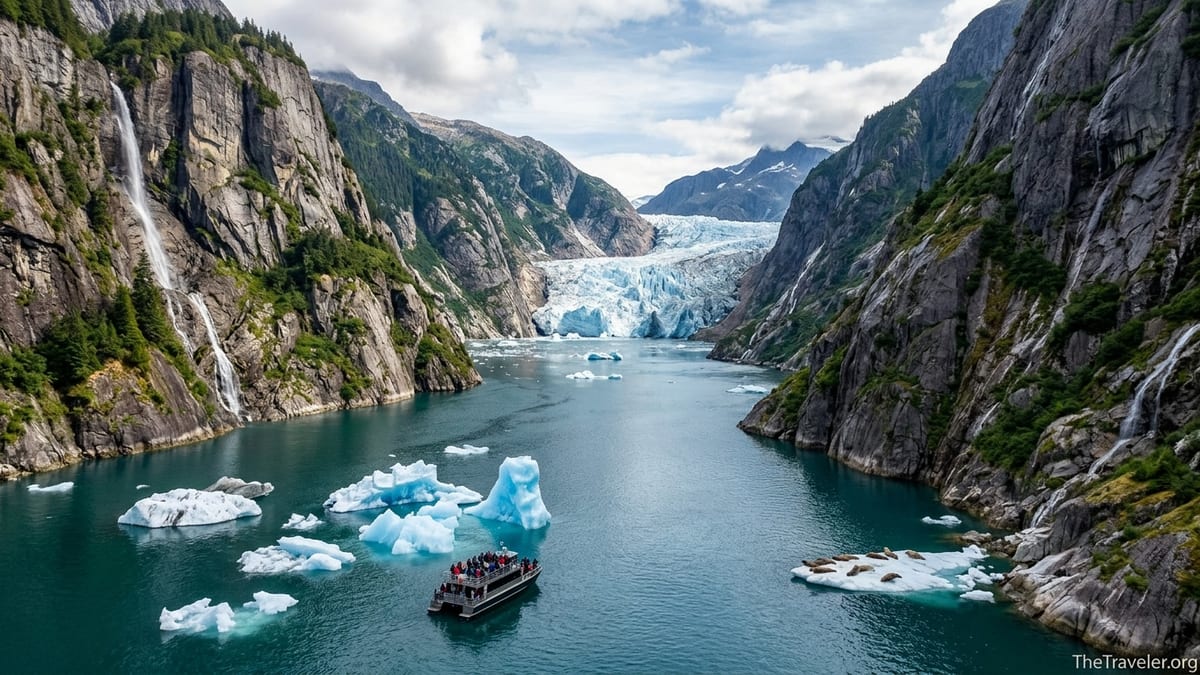
Tracy Arm is a glacially carved fjord in the Tracy Arm–Fords Terror Wilderness of Tongass National Forest. Its mouth opens off Holkham Bay and Stephens Passage, roughly 45 miles south of Juneau. The fjord itself runs for about 30 miles between sheer granite walls that in places rise several thousand feet almost straight out of the water, creating a narrow, winding corridor punctuated by waterfalls and hanging valleys.
At the head of the fjord lie the twin Sawyer Glaciers, North Sawyer and South Sawyer, tidewater glaciers that historically have calved blue icebergs into the water. Along the way, floating ice, patches of old-growth forest clinging to ledges, and frequent waterfalls give a sense of traveling deep into a remote, enclosed world. The surrounding wilderness is habitat for harbor seals that haul out on glacial ice, as well as bears, mountain goats and seabirds.
The Tracy Arm–Fords Terror Wilderness is a federally designated wilderness within Tongass National Forest, which means motorized access is generally limited to the water, and there are no roads into the fjord. Research on harbor seals and glacial fjords in this area has helped shape broader guidelines that emphasize keeping distance from wildlife and minimizing disturbance in these sensitive habitats. The lack of development and regulations aimed at protecting natural processes give visitors the impression of entering a largely untouched environment.
It is important to distinguish Tracy Arm from two other well-known Alaskan fjord destinations. Endicott Arm, just to the south and also part of the same wilderness area, leads to Dawes Glacier rather than the Sawyer Glaciers. Glacier Bay, farther west, is a separate national park and marine ecosystem with its own collection of tidewater glaciers and stricter vessel rules. Cruise itineraries sometimes feature one of these in place of another, but they are distinct experiences.
Why Travelers Go: Scenery, Glaciers and Wildlife
Visitors are drawn to Tracy Arm for its combination of steep-walled fjord scenery, active tidewater glaciers and the chance to see wildlife in a wild, relatively undeveloped setting. From the water, passengers watch sheer rock faces streaked with green vegetation, long veils of meltwater plunging from hanging glaciers above, and small avalanches of loose rock or ice that hint at the landscape’s ongoing change.
The tidewater Sawyer Glaciers are a central focus when access conditions allow. Even when boats must remain some distance away because of ice or safety zones, the icebergs calved from the glacier provide constant visual interest, from flat white sheets to luminous blue towers. The fjord is also a key pupping and molting area for harbor seals on glacial ice, and research in the Tracy Arm–Fords Terror region has documented how sensitive these animals can be to vessel disturbance. That scientific work underscores why many captains now emphasize slow approaches, quiet viewing and adherence to viewing guidelines.
Wildlife sightings vary day by day. Harbor seals are commonly seen resting on icebergs near the upper fjord. Visitors also sometimes spot humpback whales in Stephens Passage on the way to or from Tracy Arm, as well as porpoises, bald eagles, mountain goats on the cliffs and the occasional black or brown bear along shorelines. None of these sightings can be guaranteed, and conditions after the 2025 landslide have altered parts of the upper fjord, but for many travelers the blend of geology, ice and potential wildlife is the main appeal.
Equally compelling is the sense of remoteness. Even on a busy summer day, the fjord feels far removed from Juneau’s waterfront or cruise terminals. The high walls block roads and most radio signals, and towering mountains hem in the view so completely that visitors often describe feeling like they have entered a hidden side chamber of the Inside Passage.
Tracy Arm, Endicott Arm and Glacier Bay: Key Differences
Tracy Arm, Endicott Arm and Glacier Bay all offer narrow fjords and tidewater glaciers, but they differ in access, regulation and what you are most likely to experience. Tracy Arm historically led visiting ships deep among icebergs to viewing positions near Sawyer Glacier. Endicott Arm, slightly broader and farther south, terminates at Dawes Glacier, another active tidewater glacier that has become a major substitute destination when Tracy Arm conditions are unfavorable.
Since the major August 10, 2025 landslide above the toe of South Sawyer Glacier, Tracy Arm has faced heightened safety scrutiny. Scientists documented a very large landslide-generated tsunami that stripped vegetation hundreds of meters up the opposite wall and sent energy out into Stephens Passage and Endicott Arm. Follow-up analyses by federal and academic researchers note that continued rockfall from the scar could generate smaller tsunamis in the upper fjord. In response, many cruise companies have adjusted itineraries to reduce or eliminate deep entry into Tracy Arm until the risk is better understood.
Endicott Arm, while not risk-free, has become the primary alternative fjord for big-ship scenic cruising in this part of Southeast Alaska. Several major cruise lines publicly stated in 2026 that they were substituting Endicott Arm and Dawes Glacier for Tracy Arm on upcoming seasons. For passengers, that often means similar dramatic scenery, with a slightly different route and glacier name on the itinerary. Glacier Bay, by contrast, is managed as a national park and generally allows one or two large ships per day under strict quotas, offering longer periods inside a broader network of inlets and glaciers but usually without the same extremely tight granite walls that characterize Tracy Arm.
If your Alaska schedule is limited, the choice often comes down to priorities. Travelers keen on a classic national park experience with interpretive rangers and high odds of seeing multiple glaciers may prioritize Glacier Bay. Visitors excited by the idea of threading a very narrow fjord with huge vertical walls, even if access stops short of the glacier face, may find Tracy Arm or Endicott Arm day cruises from Juneau especially satisfying.
How You Can Visit: Big Ships, Small Boats and Flightseeing
There are three main ways to experience Tracy Arm and its neighboring fjords. The first is as a scenic cruising day on a big ship as part of an Inside Passage cruise. In this scenario, the ship devotes a morning or afternoon to sailing into a fjord, typically either Tracy Arm or Endicott Arm depending on safety assessments and ice. Passengers view primarily from outside decks or panoramic lounges as the captain slowly threads the ship among ice and turns at a safe point to exit.
The second option is a dedicated small-boat excursion. From Juneau or from a cruise ship that anchors outside the fjord, fast catamarans and expedition-style vessels carry smaller groups deep into Tracy Arm or Endicott Arm. These vessels can maneuver among icebergs and approach waterfalls and wildlife more closely than a large ship, though they must still keep safe distances from glacier faces and harbor seals. A number of Juneau-based operators advertise full-day Tracy Arm or Tracy Arm–Endicott Arm wilderness cruises, and some cruise lines sell similar tours that start by disembarking from the ship, exploring the fjord and then rejoining the ship later near Juneau.
The third way is by air. Flightseeing trips from Juneau offer aerial views of the Tracy Arm–Fords Terror Wilderness and nearby icefields. Planes or helicopters do not normally land in the fjord itself, but they may circle above fjords and glaciers, providing views of the landslide scar, the broader icefields feeding the glaciers, and the intricate network of valleys that boats cannot reach in a single day. Flightseeing is highly weather dependent, and many operators decide on the day whether conditions allow safe flying.
Given the landslide-generated tsunami in 2025 and subsequent scientific assessments, operating patterns in Tracy Arm are evolving. Some operators now emphasize Endicott Arm as the primary route, using Tracy Arm only under specific conditions or for research and monitoring. It is essential to check the exact route and contingencies directly with your cruise line or tour operator close to your travel date, as decisions can change season to season based on updated hazard evaluations and ice conditions.
Is Tracy Arm Open After the 2025 Landslide?
On August 10, 2025, a large landslide near South Sawyer Glacier in Tracy Arm triggered one of the highest tsunami runups ever documented in a fjord setting. Seismic monitoring and subsequent field surveys by the U.S. Geological Survey and collaborating scientists identified a debris volume on the order of tens of millions of cubic meters and a wave that ran hundreds of meters up the opposite slope. Fortunately, poor weather and timing meant there were no large cruise ships deep in the fjord at the time, though small vessels and campers in nearby Endicott Arm and Holkham Bay experienced abrupt water level changes and strong currents.
In the months that followed, hazard specialists noted continuing rockfall potential from the landslide scar and the possibility of localized tsunamis if additional material failed into the upper fjord. As of late 2026, authorities have not permanently closed Tracy Arm, but major cruise companies have reduced or suspended routine deep entry to the head of the fjord. Several large lines publicly announced that they had removed Tracy Arm from 2026 itineraries in favor of Endicott Arm, citing safety concerns and scientific advice.
Smaller Juneau-based operators and specialty expedition ships have taken varied approaches. Some now promote Endicott Arm and Dawes Glacier as their primary tidewater glacier destination, with Tracy Arm mentioned more cautiously or as subject to change. Others still advertise Tracy Arm fjord cruises but note that ice, weather and safety assessments may limit how far into the fjord they travel, and that itineraries could pivot to Endicott Arm on short notice.
For travelers, the practical takeaway is that Tracy Arm is not “closed” in a simple sense, but the upper fjord around the Sawyer Glaciers is under closer scientific and operational scrutiny. Anyone planning a 2026 or later trip should treat cruise line brochures and early tour descriptions as tentative for this specific fjord. Confirm near your departure date whether your scenic cruising day, small-boat tour or flightseeing route is currently using Tracy Arm proper, Endicott Arm or another alternative.
Day Trips from Juneau: What to Expect
For independent travelers basing in Juneau, a Tracy Arm or Endicott Arm day cruise is typically a long, full-day outing on the water. Representative itineraries from Juneau list total durations of about 8 to 9 hours, including travel time south through Stephens Passage, entry into the fjord, glacier and wildlife viewing, and the return leg. Some tours begin in downtown Juneau, while others use harbors a short drive away, but all follow a broadly similar route toward Holkham Bay and the wilderness area beyond.
On a classic Tracy Arm itinerary when conditions allow, the vessel leaves Juneau in the morning, heading south along Stephens Passage. Passengers watch for humpback whales, porpoises and seabirds as they move between islands. Approaching Holkham Bay, the boat turns into Tracy Arm itself. As the fjord narrows, the scenery becomes more vertical and icebergs appear. Depending on ice and current safety guidance, the captain may proceed toward views of the Sawyer Glaciers or stop farther down-fjord where ice and the configuration of the landslide scar allow comfortable maneuvering.
On many 2026 schedules, Endicott Arm has become the primary advertised route, even when tours reference the broader Tracy Arm–Fords Terror Wilderness. In that case, guests follow a similar overall timing but turn into Endicott Arm to approach Dawes Glacier. Operators describe these trips as approximately 8.5 hours, with time for slow cruising among icebergs, pausing at waterfalls and glassy, protected stretches of water that showcase reflections of the surrounding peaks.
On a typical day trip, visitors can expect long periods outdoors on open decks or in partially enclosed viewing areas. Many boats offer indoor heated space, restrooms and simple meals or snacks. Exact inclusions vary by operator and may change year to year. Travelers should confirm what is provided when booking and avoid relying on specific historical price figures or menus, since those details are adjusted frequently.
Seasons, Conditions and Safety Considerations
Tracy Arm and Endicott Arm are most commonly visited between late spring and early fall, roughly May through early September, with the exact start and end of the operating season varying by company and year. Early in the season, lingering winter ice and seasonal snowmelt can make the upper fjords more challenging to navigate. In some years, boats cannot safely reach the glacier faces until later in summer, and even then may need to hold position well back from the ice front.
Summer brings long daylight, especially around June and early July, which allows for extended viewing even on all-day excursions. However, weather remains changeable. Low clouds, rain and fog are common at any point in the season, and conditions in Stephens Passage can be choppy even when the fjords themselves are calm. Captains may slow down, adjust routes or in rare cases cancel or turn back early when visibility, ice or sea state raise safety concerns.
Even in July and August, conditions on deck can feel cold, wet and windy. Wind over cold water quickly cuts body heat, especially when combined with spray and periods of standing still at the rail to take photos. Travelers should plan for layered clothing including a warm base layer, insulating midlayer and waterproof outer shell, along with gloves, a warm hat and sturdy, non-slip footwear. Many visitors are surprised by how quickly they become chilled without adequate layers, even on a seemingly mild summer day.
Motion sickness is another consideration. While the fjords themselves are usually protected and relatively calm, the open stretches of Stephens Passage can produce noticeable swell. Those prone to seasickness should talk with their doctor or pharmacist about preventive medication and take it before departure as recommended. Cameras and phones should be secured with straps or cases, since decks can be wet and sudden swells or turns may cause slips.
Logistics From Juneau and the Lack of Road Access
Juneau is the primary staging point for independent visits to Tracy Arm and Endicott Arm. The city is the capital of Alaska but is not connected to the North American road network. Instead, almost all visitors arrive by air or sea. Commercial flights and regional airlines link Juneau to other Alaskan communities and to major hubs in the Pacific Northwest. Many travelers come as part of Inside Passage cruise itineraries that include a port call in Juneau along with scenic cruising days in one or more fjords.
For those traveling more widely in Southeast Alaska, the Alaska Marine Highway System provides a ferry network that links Juneau with other coastal communities, stretching from Bellingham, Washington through Southeast and out along the Gulf of Alaska. Ferries carry both foot passengers and vehicles, but schedules and routes vary by season. Juneau’s ferry terminal is located north of downtown, and onward transfers require local transportation. These ferries are an important part of Alaska’s transportation infrastructure but do not serve Tracy Arm directly.
There are no roads to Tracy Arm or Endicott Arm, and the surrounding peaks and forests make overland access impractical for typical travelers. As a result, nearly all visits take place through organized boat tours or flightseeing operators that hold the necessary permits to operate in the wilderness area. Private yachts and small personal vessels do enter Holkham Bay and sometimes venture partway into the fjords, but navigating near icebergs and steep, unstable slopes requires significant local knowledge and is outside the scope of most visitors’ plans.
Independent travelers should book Tracy Arm or Endicott Arm tours well ahead in the main season, especially if they have only one or two potential days available. Weather, ice and evolving safety guidance can force last-minute adjustments, so flexible expectations are valuable. Trip insurance that covers weather-related cancellations may be worth considering for those planning a fjord cruise as a highlight of their visit.
Cruise Ship Scenic Cruising Days and Catamaran Add‑Ons
For many visitors, first contact with Tracy Arm or Endicott Arm comes not from Juneau but from the deck of a large cruise ship. Scenic cruising days are typically scheduled so that the ship sails into a fjord in the early morning or afternoon, slowing dramatically as it enters narrower waters. Passengers gather on open decks with cameras and binoculars while naturalists or onboard staff provide commentary about glaciers, wildlife and the recent landslide history.
Because ice and safety assessments change, captains may decide on relatively short notice whether to attempt entry into Tracy Arm or to use Endicott Arm instead. Even when itineraries list Tracy Arm, fine print from cruise lines often notes that Endicott Arm is the default alternative in the event of heavy ice or other hazards. After the 2025 landslide and subsequent scientific reports, several major lines have publicly described Endicott Arm and Dawes Glacier as comparable scenic substitutes and have shifted many 2026 sailings accordingly.
Some itineraries offer an optional catamaran or expedition boat excursion branded as a Tracy Arm Fjord or Glacier Explorer experience. In these cases, passengers transfer from the cruise ship to a smaller vessel, usually early in the day before the ship reaches Juneau. The catamaran then spends hours exploring deeper into the fjord, while the main ship continues along its route. Later, typically near Juneau, the smaller boat reunites with the cruise ship and passengers reboard. Fine-grained details, such as the exact meeting points and timing, vary by line and year but the general pattern is consistent.
With these ship-run excursions, the same caveats apply. Ice, weather and updated assessments about Tracy Arm’s landslide scar may cause the route to pivot to Endicott Arm even if the excursion name still references Tracy Arm. Prices and inclusions change regularly and should not be assumed based on prior seasons. It is wise to read the current excursion description carefully for language about alternative fjords and route flexibility, and to remember that safety decisions rest with the captain and local pilots on the day.
Who Tracy Arm Best Suits and When to Choose Alternatives
Tracy Arm and its neighboring Endicott Arm are ideal for travelers who place scenery and a sense of wilderness above all else. Photographers, geology enthusiasts and those who enjoy long hours quietly taking in mountains, waterfalls and ice will generally find these fjords rewarding, even if conditions prevent close approaches to glacier faces. Visitors who appreciate the story of a changing landscape, including the recent landslide and its effects, may also value seeing the fjord with that context in mind.
On the other hand, travelers whose top priority is guaranteed close-up glacier viewing or onshore hiking to ice might prefer alternatives. Juneau’s Mendenhall Glacier offers relatively straightforward access to visitor center trails and overlooks reachable by road and short walks. Glacier Bay National Park, when included on a cruise itinerary, typically provides a full day of slow ship travel among multiple glaciers with rangers on board and no need to rely on a separate day-trip booking from Juneau.
Those particularly concerned about the residual landslide and tsunami hazard in narrow fjords may find that Endicott Arm, Glacier Bay or other destinations better match their comfort level. While authorities and operators continuously assess risk and adjust operations accordingly, no guide can guarantee specific exposure levels in a dynamic environment. Reading the latest updates from your cruise line or tour operator and considering your own risk tolerance is an important part of trip planning.
Ultimately, Tracy Arm remains one of Southeast Alaska’s most striking fjords, but its recent history means itineraries and access are more fluid than in the past. If you approach it with flexibility, appropriate clothing and realistic expectations about wildlife and glacier proximity, a day in Tracy Arm or Endicott Arm can be a powerful highlight of an Inside Passage journey. For those with limited time, weighing this experience against Glacier Bay or Mendenhall will help you decide how best to prioritize your days in and around Juneau.