


More news on this day
A residential world cruise marketed as a “never-ending” life at sea has come to an abrupt halt in Cambodia, leaving more than 200 passengers who had turned a ship into their full-time home suddenly ordered to disembark and find their own way on land.
Get the latest news straight to your inbox!
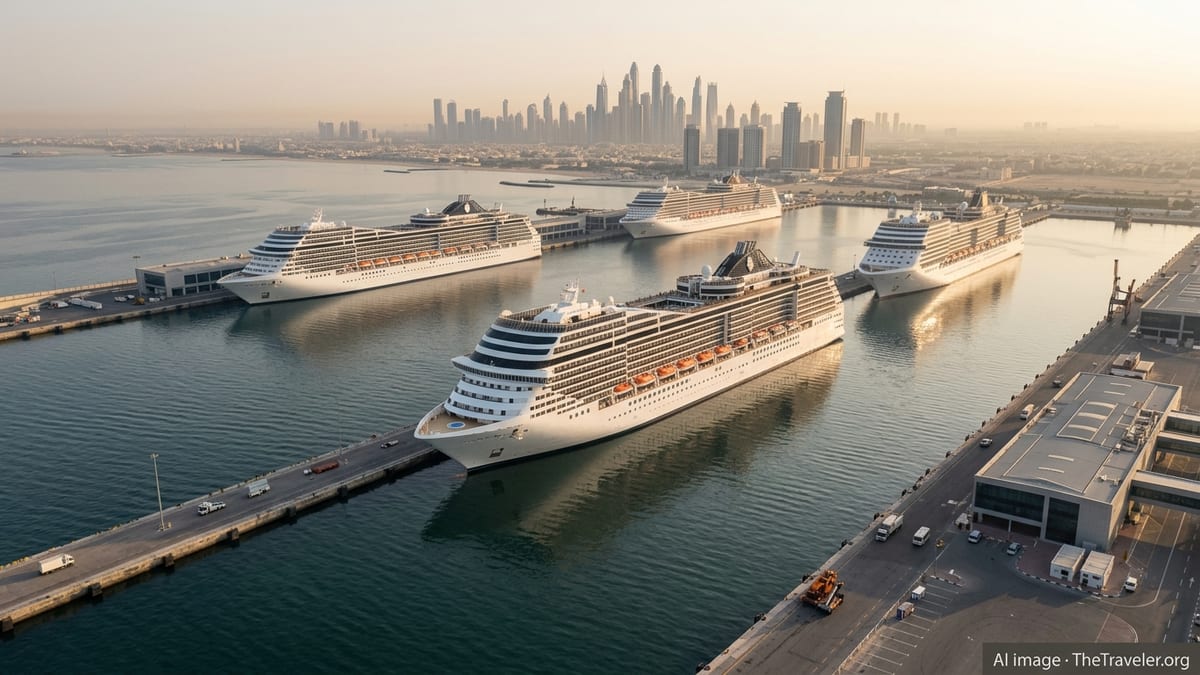
A Cruise Sold as a Floating Home Suddenly Stops
The ship at the center of the disruption is the Villa Vie Odyssey, a U.S.-linked residential cruise vessel that had been marketed as an open-ended or multi-year global voyage where passengers could live on board instead of maintaining homes on land. Publicly available company materials promoted the concept as a “never-ending” journey, with cabins sold on long-term contracts and residents encouraged to downsize their land-based lives in exchange for a permanent address at sea.
According to reporting from Associated Press and other outlets, the Odyssey suspended its global itinerary while in the Cambodian port city of Sihanoukville after the operator cited soaring fuel costs and signaled plans to seek Chapter 11 bankruptcy protection in the United States. Industry and regional coverage indicates that operations ceased with little advance warning to passengers, many of whom had been on board for months and expected the voyage to continue indefinitely.
Statements described in news reports and company communications outline a sharp financial shock following a steep rise in global fuel prices linked to the ongoing conflict involving Iran, which has disrupted shipping routes and driven up marine fuel costs across multiple regions. Analysts quoted in cruise trade coverage suggest that the economics of keeping a relatively small residential community at sea year-round became unsustainable once fuel bills rose by several hundred percent compared with earlier projections.
With the ship laid up in Sihanoukville, the operator ordered passengers to leave, effectively ending what had been promoted as a long-horizon lifestyle choice rather than a conventional time-limited cruise holiday.
Residents Who Sold Everything Now Face Life Ashore
Many of the affected passengers are retirees or remote workers who had sold homes, cars, and much of their belongings to buy into the residential cruise model. Coverage in outlets including BBC, Yahoo Travel, and multiple travel-specialist publications describes residents who had structured their finances around multi-year cabin leases or ownership-style agreements, in some cases planning to remain at sea for the foreseeable future.
Reports indicate that more than 200 people were on board when the voyage was halted, with a mix of full-time residents and shorter-term guests. Some had already completed significant legs of a global itinerary, while others had only recently joined the ship expecting years of continuous travel ahead. Several passengers speaking to international media characterized the experience of life on board as “magical” and community-focused, contrasting sharply with the uncertainty they now face on shore.
Because many residents no longer maintain primary homes on land, the sudden disembarkation has left them scrambling to secure hotel rooms, rental apartments, or alternative long-stay options in Cambodia and beyond. Personal accounts gathered by major broadcasters and travel outlets describe passengers trying to stretch retirement savings to cover unplanned living and travel costs while they wait for clarity on any refunds or compensation.
Published coverage also notes that a portion of passengers had health care routines, mail services, and even small onboard businesses tied to the ship, adding further disruption as they work to re-establish everyday services in unfamiliar cities far from home.
Stranded in Sihanoukville With Limited Connectivity
Sihanoukville, on Cambodia’s southern coast, has seen rapid growth as a port and resort destination, but it is still not as well connected as major regional hubs such as Bangkok or Singapore. Travel reporting from the region points out that while the city now offers an expanding inventory of mid-range and upscale hotels, international flight options remain relatively limited, often requiring connections through Phnom Penh, Ho Chi Minh City, or other regional gateways.
As a result, passengers disembarking the Odyssey have had to navigate a patchwork of flight schedules and ground transport options while competing for hotel rooms with other visitors and business travelers. Some have chosen to remain in Sihanoukville or nearby coastal towns temporarily, while others are attempting to move quickly onward to Bangkok, Kuala Lumpur, or Singapore to access more frequent long-haul flights back to North America and Europe.
Travel advisories reviewed by news organizations have not flagged specific security threats affecting Sihanoukville in connection with this incident, but the broader environment for global travel remains sensitive due to regional tensions and the economic effects of higher fuel costs. Insurance specialists quoted across industry analysis say that the circumstances surrounding the cruise’s suspension are likely to prompt fresh scrutiny of how long-stay maritime products handle repatriation, emergency assistance, and default scenarios.
Some passengers are turning to online forums and informal support groups to share information on accommodation options, local logistics, and potential legal steps. These digital networks, alongside assistance from family or friends at home, have become important tools for navigating the unexpected and complex task of rebuilding life on land from a port city that few residents had planned to call home.
Residential Cruise Model Tested by Economic and Legal Pressures
The collapse of the “never-ending” voyage comes at a time when the residential cruise model is still relatively new and lightly tested. Several start-ups in recent years have promised multi-year or open-ended itineraries that allow residents to live at sea at prices that, on paper, can rival the cost of maintaining a home in major cities. The business case depends on high occupancy, stable operating costs, and the ability to keep ships moving efficiently between ports to satisfy both lifestyle expectations and immigration rules.
Analysts cited in cruise industry reporting observe that sharp swings in fuel prices are especially challenging for residential products, which typically carry a smaller number of passengers than mainstream cruise ships while still shouldering similar operational costs for crew, maintenance, and port fees. The Villa Vie Odyssey episode is being described as an early and high-profile stress test for whether these ventures can withstand geopolitical shocks and commodity price spikes over multi-year horizons.
The situation also draws comparisons to the 2023 Life at Sea Cruises saga, when a separate company canceled a planned three-year residential voyage shortly before departure, leaving would-be residents seeking refunds and in some cases scrambling for housing after giving up rentals or selling property. In that case, as documented in U.S. and European media coverage, passengers alleged that promised repayments were delayed or incomplete, leading to calls for greater regulatory oversight of long-term cruise products marketed as lifestyle investments.
Legal specialists quoted in public commentary on both cases have pointed to existing international conventions governing maritime safety and financial guarantees for cruise operators, while also noting potential gaps when ships are sold as quasi-residences rather than traditional leisure sailings. How regulators respond could shape the next generation of residential cruise offerings, particularly around escrow requirements, transparency on vessel ownership, and clear plans for passenger repatriation if voyages are interrupted.
What Prospective “Cruise for Life” Residents Should Watch Now
For travelers intrigued by the idea of living at sea, the collapse of the Villa Vie Odyssey voyage is prompting calls for a more cautious and research-intensive approach. Consumer advocates appearing in travel media discussions advise prospective residents to review contracts closely, look for explicit language about financial protections and refund policies, and seek independent confirmation that vessels are fully acquired, certified, and insured before committing large upfront payments.
Specialists also suggest paying careful attention to how operators hedge against fuel price risk and other volatile costs. Some lines report using fuel surcharges or dynamic pricing to pass costs on to passengers, while others promise fixed pricing over several years, which can become difficult to sustain when major geopolitical events disrupt energy markets. Understanding how a company has structured these risks, and whether any third-party guarantees are in place, may provide an indication of resilience in the face of sudden global shocks.
Insurance is another key consideration. Standard travel insurance policies are often geared toward short-term holidays rather than open-ended residence at sea, and may exclude or limit coverage for insolvency or operator default. Insurance commentators quoted across recent coverage recommend that would-be residents ask detailed questions about what scenarios are covered, how long policies can run, and whether additional specialty products are available for long-stay cruises.
In the near term, attention will remain focused on Sihanoukville and the fate of the more than 200 passengers who expected to spend years circling the globe and instead find themselves, at least for now, grounded on shore and working out how to rebuild the lives they had already packed into their cabins.