


On a humid August morning in Puerto Rico’s central mountains, I pointed my rental car inland toward Utuado with a simple goal: drink coffee where it is grown. Tourism brochures kept mentioning Café Gran Batey, a small family farm outside town that still welcomes visitors for a free tour and tasting. Instead of another café in San Juan, I wanted to meet the people actually tending the plants, see how a cherry becomes a cup, and decide for myself whether the winding drive into coffee country was worth a day of my trip.
Get the latest updates straight to your inbox!
Booking a Real Farm Visit, Not a Coffee-Themed Attraction
I started planning the visit the way most travelers will: by cross-checking official tourism information with the farm’s own details. Discover Puerto Rico’s August 25, 2026 Utuado guide lists Café Gran Batey as a family farm that has been worked for more than 45 years, offering an explanation of the coffee-growing and roasting process plus a tasting with homemade cake. It also notes that the visit, tour, and coffee sample are free, and that the farm is open to the public from Tuesday through Saturday between 10 a.m. and 3 p.m.
Because opening hours for rural farms can change with harvest, family needs, and weather, I did not rely on that listing alone. The farm maintains a simple online presence with current contact information and product prices, so I used the published phone number to call ahead the day before my visit. A member of the family confirmed that as of mid-October 2026 they continue to receive visitors Tuesday through Saturday, with tours generally starting on demand between 10 a.m. and mid-afternoon, and asked me to arrive by 1 p.m. so they would have time to show me the full process.
That call shaped my expectations in a useful way. There was no booking platform, no instant confirmation email, and no advance payment. The experience still runs on trust and conversation. The family member on the phone explained that groups of two to ten people can usually be accommodated without a problem, but asked that larger groups call several days in advance. She also reminded me that this is a working farm, not a restaurant, although they almost always have cake or a similar sweet to serve with the tasting.
For comparison, I also looked at Hacienda or Finca Horizonte, a larger 100-acre eco-farm in Utuado owned by musician Draco Rosa, which Discover Puerto Rico highlights for horseback riding and interpretive walks through organic crops. There, horseback riding tours must be booked ahead through affiliated operators and typically carry a per-person fee for the ride, farm interpretation, and coffee tasting. The contrast in booking alone signaled that my time at Café Gran Batey would feel much more like visiting a family project than joining a packaged excursion.
The Mountain Drive Into Coffee Country
Leaving San Juan, I followed the main highway south before turning inland toward Utuado. The drive to the town center took about an hour and a half, which aligns with what official guides promise. From there, Café Gran Batey sits along Road 111 in the Caguana sector, close to the Caguana Indigenous Ceremonial Park. The final stretch is a two-lane mountain road that narrows and curls as it climbs, with slow trucks, blind curves, and the occasional dog wandering into the lane.
This is not a quick detour on the way to the beach. From the town plaza to the farm took another 20 to 25 minutes of careful driving. Several pull-offs give glimpses of the mountains that once made Utuado Puerto Rico’s leading coffee-producing municipality in the late nineteenth century, and even today you see rows of coffee under taller shade trees scattered across the slopes. Cellular reception weakened as I neared the farm, so I was grateful I had checked the route and written down the kilometer marker beforehand.
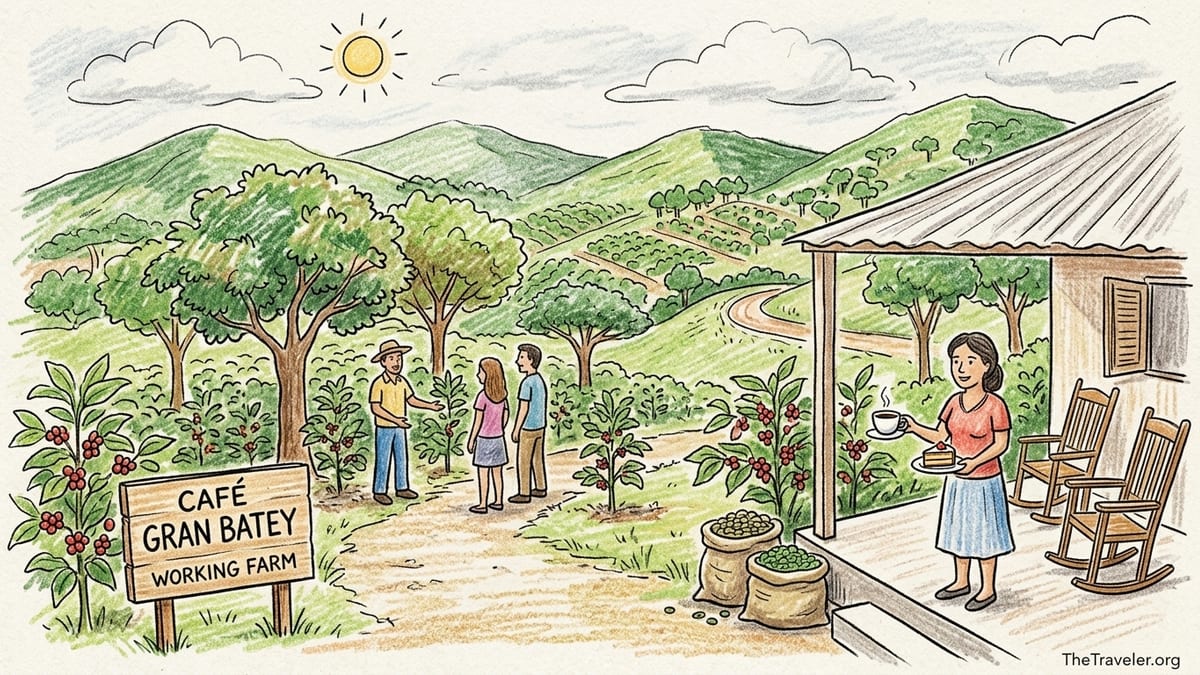
Arriving at Café Gran Batey felt more like driving into a family yard than pulling up to a visitor center. A small sign marked the entrance off Road 111, followed by a short concrete driveway lined with banana and plantain plants and a few coffee trees close enough to examine from the car window. A gravel parking area awaited at the top, with a simple building that serves as store, roasting room, and informal gathering point. There were no turnstiles or ticket booths, only a porch, a couple of rocking chairs, and the smell of recently roasted coffee drifting from inside.
If your idea of a worthwhile drive requires dramatic lookouts or high-speed roads, this trip may feel slow. But as a coffee-focused traveler, I found the gradual climb part of the education. The air cooled slightly with elevation, mist accumulated in folds of the valley, and the patchwork of shade and sun over coffee plots began to make sense long before anyone formally explained agroecology to me.
Meeting the Family Behind the Beans
Inside the main building, I was greeted by two generations of the family that runs Café Gran Batey. Discover Puerto Rico notes that the land has been worked by the same family for more than 45 years, and the way they introduce the farm reflects that timeline. One of the owners gave a short history in Spanish, with his daughter repeating key points in English for visitors less comfortable with Spanish. They described how the farm began as a smallholding supplying local buyers and evolved into a specialty coffee brand while staying independent.
Importantly, this introduction did not feel scripted for tourists. There were no headsets, no pre-recorded segments, and no branded uniforms. We stood around sacks of green coffee beans and an old but well-maintained depulping machine while the family member spoke, occasionally pausing to answer questions from a couple from Chicago and a solo traveler from Germany who had arrived just before me. The tour group that day totaled six people, a size that allowed everyone to ask detailed questions without slowing things down excessively.
The family placed clear boundaries around what the tour is and is not. There is no separate restaurant, no barista workshop, and no latte art demonstration. Instead, you are walking through their actual workflow: the same patios where coffee dries in season, the same roaster where beans for their packaged products are prepared, and the same small store where locals occasionally stop in simply to buy their usual coffee.
This interaction set the tone for the rest of the visit. It felt educational rather than commercial, in part because the family was explicit that the tour and tasting remain free. Their business model bets that if they teach visitors how much time and care goes into each pound, some of those visitors will choose to buy bags to take home. There was no pressure, but the pride with which they described the process made it difficult to walk away empty-handed.
Walking the Fields and Learning the Agroecological Shift
The outdoor portion of the tour began with a short walk from the main building to one of the coffee parcels closest to the house. Under the humid mountain sun, our guide pointed out different stages of the coffee plant’s life, from saplings in a shaded nursery to mature trees bearing green, yellow, and red cherries. He encouraged us to pick a ripe cherry, pop it open, and taste the sweet, sticky mucilage around the seed, an experience that connects the plant more directly to fruit than to the bitter beverage most travelers know.
Discover Puerto Rico currently describes Café Gran Batey as moving toward agroecological practices through support from a local agroecology institute, and I asked our guide what that meant in concrete terms. He explained that, in recent years, they have been gradually increasing shade cover with native and fruit trees, reducing chemical inputs, and experimenting with ground cover plants that protect soil from heavy rain. Instead of neat, almost bare rows under full sun, the coffee grows in more complex layers, with plantain, citrus, and native shade trees interspersed.
What surprised me most was the candid way he talked about the trade-offs. Greater shade and more diversity can reduce short-term yields and complicate harvest logistics, especially when labor is scarce and expensive, but they help buffer the farm against the intense rains and hurricanes that have repeatedly damaged Puerto Rico’s coffee sector. He pointed to scars on trunks that dated back to Hurricane Maria and noted how newer plantings are arranged to reduce erosion and wind exposure.
Until that walk, I associated “agroecology” with marketing language and academic papers. On this hillside, it translated into a set of very practical decisions: which trees to plant above the coffee, how to handle pests without blanket spraying, and how to keep soil from washing away during severe storms. That grounded explanation, delivered while standing among the plants, gave the term a weight that brochures seldom manage.
From Cherry to Roasted Bean: The Processing and Roasting Demonstration
After the field walk, the group returned to the processing area to follow the coffee’s path from harvested cherry to roasted bean. The family uses a small depulping machine to separate the outer skin and most of the pulp from the seeds, which are then fermented and washed before drying. In peak harvest months, the patios fill with parchment coffee spread in thin layers that workers rake regularly to ensure even drying. During my August visit, the harvest was between peaks, so there were only a few demonstration trays, but the guide used them to show how moisture level and color signal when beans are ready for storage.
Inside the roasting room, a medium-sized drum roaster dominates the space. Our host loaded a batch of their own beans, explaining that they produce several roast levels but focus on a balanced profile suitable for traditional Puerto Rican brewing methods like café con leche and espresso-style pocillos. On the shelves, I saw their branded packages in 8-ounce and 16-ounce sizes, similar to those available through their online store, where current prices list a 16-ounce bag of whole beans at around 22 dollars.
The roasting demonstration was practical, not theatrical. We watched as the beans turned from green to yellow to a mottled light brown, then listened for the first crack. The guide discussed how slight differences in roast time and final temperature affect acidity, body, and aroma, using plain language rather than technical jargon. When someone asked about dark roasts, he acknowledged that some customers expect very dark, almost oily beans because that is what mass-market Puerto Rican brands often sell, but he emphasized that their goal is to protect the bean’s origin flavors rather than roast everything to a single smoky profile.
Seeing the modest scale of the roaster and storage area clarified how limited the farm’s total output is. This is not a factory satisfying supermarket contracts across the island. It is a small specialty operation roasting in batches sized more like those of a neighborhood roastery in a North American city. That reality helps explain both the higher price per pound and the emphasis on telling their story directly to visitors.
Tasting the Coffee and Sharing Cake in the Mountains
The tasting took place back on the main porch, where a row of cups waited beside a large moka-style stovetop pot and a smaller brewer more familiar to espresso drinkers. The family served their own coffee, ground fresh that morning, at what they described as a medium roast intended for everyday drinking. Unlike some tastings that overwhelm visitors with multiple origins, this one focused on depth: one farm, one roast, brewed well.
Each visitor received a generous cup poured at the table. The coffee in my cup had a medium body, subtle sweetness, and a lingering cocoa note, with almost no harsh bitterness. Our host suggested tasting it first black, then adding milk for those who prefer a traditional café con leche. They had whole milk available and a small pitcher of sugar, but they did not add any flavors or syrups. The focus remained squarely on the coffee itself.
True to the tourism board’s description, the coffee was paired with a slice of homemade cake. On the day I visited, it was a simple vanilla cake with a light cinnamon touch, baked by a family member that morning. There was no charge for the tasting or cake. The family reiterated that the entire visit remains free, though they encouraged us to consider purchasing coffee or flour products from their store if we enjoyed the experience.
Sitting on that porch with my cup, I realized how different this felt from a café visit in San Juan or a resort tasting flight. There was no soundtrack, no branded photo wall, no upsell to a more expensive package. Just coffee, cake, the sound of coqui frogs beginning to call from the hills, and a family answering questions from a half-dozen strangers about the work that defines their lives.
What I Bought, What It Cost, and Whether It Felt Commercial
At the small store counter, I browsed shelves stocked with Café Gran Batey products. The same 16-ounce bag of whole-bean coffee listed on their online shop at approximately 22 dollars was available at the farm for a similar price, alongside 8-ounce bags around 11 dollars and larger 5-pound bags that reached into the triple digits. They also offered other items like coffee flour in 16-ounce and 8-ounce formats priced similarly to the beans. Payment could be made in cash or by card, although the family noted that in rare cases in past years storms had temporarily interrupted card processing.
I purchased two 16-ounce bags of whole beans, one for myself and one as a gift, and a smaller 8-ounce bag of coffee flour out of curiosity. The total came to just over 55 dollars, a sum that felt reasonable given the farm’s small scale and the time they had invested in our group without charging an entrance fee. There was no pressure to buy; another visitor bought only a single 8-ounce bag, and the staff treated them with the same warmth.
Throughout the visit, I never felt funneled through a scripted sales funnel. The sequence of introduction, field walk, processing explanation, roasting, tasting, and store visit followed the logic of the coffee itself rather than a marketing strategy. When asked where else visitors might learn about coffee in the area, the family readily mentioned other Utuado producers, including Finca or Hacienda Horizonte, which offers horseback riding tours, interpretive walks, and cabins on a larger property.
That willingness to point guests toward neighboring farms underscored how little this tour relies on exclusivity. Café Gran Batey is not trying to be the only story visitors hear about Puerto Rican coffee. It is trying to be honest about its own history, constraints, and choices, and to send people back down the mountain with a clearer picture of coffee as agriculture rather than a lifestyle accessory.
Comparing Café Gran Batey With Hacienda Horizonte
To put my experience at Café Gran Batey in context, I scheduled a separate visit to Finca or Hacienda Horizonte, the 100-acre eco-farm that Discover Puerto Rico promotes for horseback riding and farm interpretation. Unlike Café Gran Batey, Horizonte is typically accessed through tour operators that package horseback riding along the Tanamá River with time on the farm, or through direct arrangements with the property for overnight stays and guided walks.
Booking there felt more like arranging a typical excursion. I contacted a recommended operator who offered a half-day horseback experience that included a guided ride through parts of the coffee plantation and surrounding forest, an explanation of their organic farming practices, and a coffee tasting at the end. The quoted price was per person, higher than the value of the coffee I had bought at Gran Batey, and payment details were handled on booking, reflecting a more conventional tourism business model.
On site, the scale difference was clear. Horizonte’s land extends across hills and down toward the river, with several trails, cabins, and dedicated areas for horseback riding. The interpretation of coffee and other crops fit into a broader narrative about organic agriculture, conservation, and rural lifestyle. Guides were trained to handle groups of varying sizes and interests, from families mainly excited about the horses to travelers curious about soil health and biodiversity.
For a traveler who wants a more structured adventure with added activities like horseback riding, Horizonte offers a rich option. For someone primarily interested in coffee as a crop and in meeting one family whose livelihood depends on it, Café Gran Batey felt more intimate and direct. Experiencing both in the same week helped me understand Utuado’s coffee landscape not as a single attraction, but as a spectrum of farms that open their gates in different ways.
Was the Long Drive Worth It and What I Learned
By the time I steered my car back onto Road 111 and began tracing the curves toward the coast, I had spent a little over two hours at Café Gran Batey. That included about 30 minutes in the fields, 20 minutes in the processing and roasting areas, another 30 minutes tasting and talking on the porch, plus unhurried time in the store. Combined with the three hours of driving there and back from the San Juan area, it made for a full half-day committed almost entirely to one small farm.
For me, that trade was more than worthwhile. Before this visit, my knowledge of Puerto Rican coffee was mostly historical and consumer-oriented: I knew that Utuado had once been a major producer, that hurricanes had devastated many farms, and that supermarket shelves were dominated by a few large brands. Walking a hillside where new shade trees were being planted, and talking with people adapting in real time, shifted that understanding from abstraction to lived reality.
I learned exactly how agroecological practices look on a mid-size family farm, how roast level decisions balance local preferences with bean quality, and how a free tour can function as a form of direct marketing without losing its educational heart. Perhaps most importantly, I left with a clearer sense of the vulnerability and resilience built into mountain agriculture: one strong storm season can damage years of work, yet families continue to replant and adjust their methods.
If your only goal is to taste good coffee, you can find excellent cups in San Juan without leaving the metropolitan area. If you want to understand why those cups taste the way they do, and who is behind them, the drive to Utuado is worth every curve. Café Gran Batey, with its free, family-led tour and emphasis on agroecology, offers one of the most grounded introductions to Puerto Rican coffee available to travelers today.
The Takeaway
Visiting Café Gran Batey is not about ticking off another attraction. It is about entering a working landscape where history, climate, and family decisions shape something as everyday as your morning coffee. The lack of an entrance fee, the small group size, and the family’s willingness to answer detailed questions create an experience that feels more like being welcomed into someone’s livelihood than attending a show.
Adding a stop at Finca or Hacienda Horizonte, with its horseback riding and broader eco-farm narrative, can round out an Utuado itinerary for travelers who have more time and want a contrasting style of coffee tourism. Together, these visits underscore that “coffee country” is not a singular destination but a living region where producers are experimenting with agroecology, managing risk, and inviting visitors into that process in different ways.
For travelers who care about food, agriculture, and the stories behind what they drink, a day in Utuado is one of the most rewarding detours you can make in Puerto Rico. Go for the beans, stay for the conversations, and leave with a deeper appreciation of the mountains that fill your cup.
FAQ
Q1. Do I need a reservation to visit Café Gran Batey?
As of October 2026, the family appreciates a phone call in advance, especially for groups, but individual visitors are usually welcomed during their posted open hours.
Q2. What are the current opening hours for Café Gran Batey?
According to recent tourism information and direct confirmation, the farm is generally open to visitors from Tuesday through Saturday between 10 a.m. and 3 p.m., though it is wise to call ahead in case of weather or harvest changes.
Q3. How much does the tour and tasting at Café Gran Batey cost?
The tour, explanation of the process, and coffee tasting with cake are currently offered free of charge, with income coming from optional purchases of coffee and related products at the end.
Q4. How long should I plan to spend at the farm?
Most visits last between 1.5 and 2 hours, including the field walk, processing and roasting explanation, tasting, and time to chat with the family and buy coffee.
Q5. Is the drive to Utuado suitable for nervous drivers?
The drive includes mountain roads with curves, hills, and occasional slow traffic, but they are paved and manageable for cautious drivers who are comfortable taking their time.
Q6. Can I visit both Café Gran Batey and Hacienda or Finca Horizonte in one day?
It is possible to combine both, but doing so requires an early start and careful planning, especially if you include horseback riding or other activities at Horizonte, which must be booked in advance.
Q7. What type of coffee will I taste at Café Gran Batey?
You will sample coffee grown, processed, and roasted on the farm itself, typically served at a balanced medium roast suitable for drinking black or with milk as café con leche.
Q8. Are there food options beyond cake at Café Gran Batey?
The farm is not a full-service restaurant; during a visit you can usually expect cake or a similar homemade sweet with the coffee, but not a full meal.
Q9. Can I buy beans to take home, and how much do they cost?
Yes, you can buy whole-bean coffee in several sizes, with recent farm prices around 11 dollars for an 8-ounce bag and 22 dollars for a 16-ounce bag, with larger formats also available.
Q10. Is the experience at Café Gran Batey more educational or commercial?
It feels primarily educational, with family members personally guiding visitors through the fields and processing steps, while sales take place quietly at the end for those who choose to buy coffee.