


Once a closed-off working port, Galataport Istanbul has been transformed into a major cruise terminal and waterfront lifestyle district in Karaköy and Tophane. Stretching along the Bosphorus where the Golden Horn meets the strait, it combines a state-of-the-art underground cruise port with a car-free seaside promenade, high-street and luxury shopping, dining terraces and two major museums. For many visitors it is both their first and last impression of the city, and even if you are not cruising, Galataport is increasingly a destination in its own right.
Get the latest updates straight to your inbox!
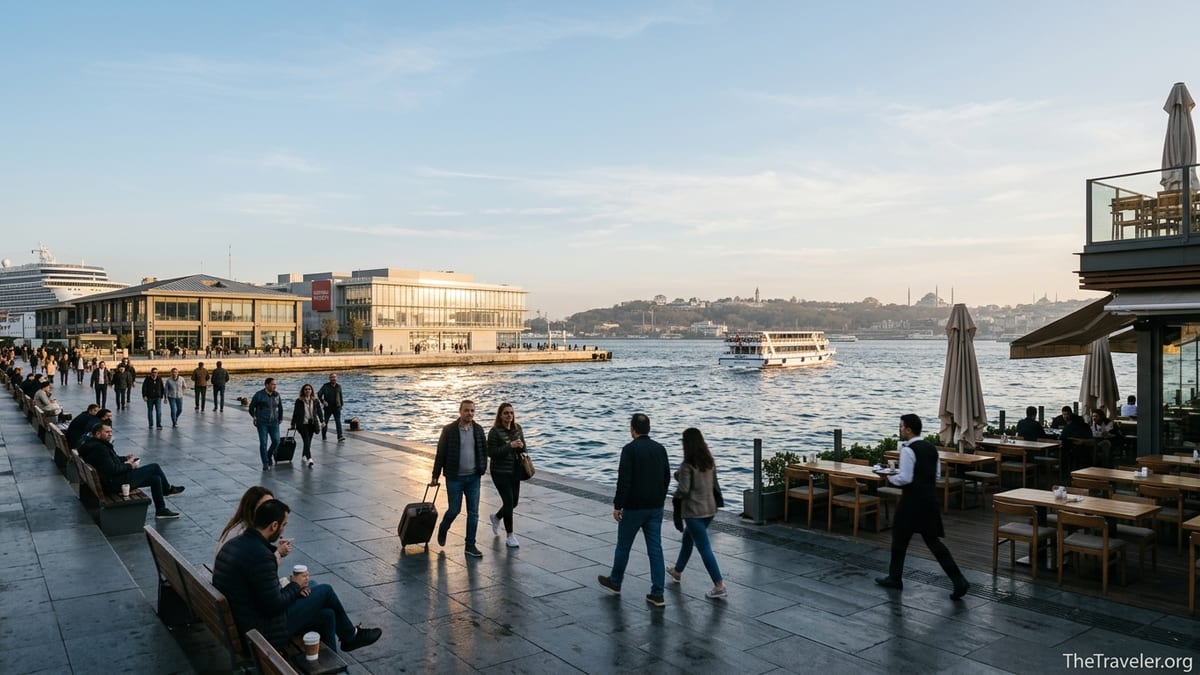
What and where is Galataport Istanbul
Galataport Istanbul is a 400,000 square meter mixed-use development along the Karaköy and Tophane waterfront on the European side of Istanbul. It occupies the historic port zone just below the Galata Tower, roughly between the Karaköy ferry docks and Tophane tram stop. Today it functions as the city’s main cruise terminal combined with an open-air shopping street, restaurant quarter, offices, hotels and cultural venues.
The project opened in stages from 2021 and was built around the world’s first large-scale underground cruise terminal. The pier level that used to be fenced off for port operations has been turned into a continuous seafront promenade, while customs and baggage handling now sit below street level. This means that even when a large cruise ship is in dock, pedestrians can still walk along the Bosphorus almost uninterrupted, something that was not possible for nearly two centuries.
For orientation, Galataport runs parallel to Meclis-i Mebusan Caddesi, the coastal road. At the northern end you are a few minutes’ walk from the Karaköy ferry terminal and Galata Bridge; at the southern end you are next to Tophane Square, the Tophane tram stop and several historic mosques. Most of the development is at seafront level, with a series of open-air streets and courtyards rather than a closed shopping mall.
Because it sits between the historic peninsula and the popular Beyoğlu and Galata districts, Galataport can be a strategic base: you can walk uphill to the Galata Tower in about 15 minutes, or take the tram across the bridge to the Sultanahmet monuments in roughly 15 to 20 minutes, depending on crowds and connections.
Using the Galataport cruise terminal
Galataport is now the primary cruise gateway to Istanbul, used by large lines such as MSC, Costa, Royal Caribbean, Celebrity and others. The cruise terminal itself is subterranean, accessed through dedicated entry points controlled by security staff along the quay. If you are embarking or disembarking, follow the signage for “Cruise Terminal” rather than the general Galataport mall entrances; porters and cruise line staff usually wait just inside the controlled area.
Embarkation procedures are similar to other major Mediterranean ports but take into account Istanbul’s traffic. From central Sultanahmet, a taxi to Galataport can take 15 to 35 minutes depending on the time of day; fares fluctuate with inflation, but as a rough guide many visitors currently report paying the equivalent of around 7 to 15 US dollars for the journey, using the taxi meter. The T1 tram offers a predictable alternative: ride it to Tophane and then walk a few minutes downhill to the waterfront.
If you are in transit for the day, you exit directly into the Galataport complex after clearing immigration. From there you can decide whether to stay on the waterfront, walk into Karaköy’s older streets or catch public transport. Because the terminal is integrated into a shopping and dining zone, it is possible to spend an entire port day on foot without using a bus or taxi, simply moving between museums, cafes and the promenade.
Be aware that security rules mean only ticketed cruise passengers and staff can access the underground terminal itself. Friends or relatives meeting you must wait in the public areas at street level. There are plenty of cafes such as branch locations of local chains and international names where they can sit with a coffee while following your ship’s docking progress via the harbor view.
Shopping at Galataport: what to expect
Galataport’s retail mix feels closer to a premium outdoor mall than to a traditional Istanbul bazaar. There are more than 200 shops and food and beverage outlets, with a combination of international brands and Turkish labels. Visitors will find familiar names in fashion, sportswear and accessories alongside local designers and concept stores. Expect mid-range to high-end pricing rather than bargain hunting.
Specific Turkish brands here can include well-known clothing chains, leather and shoe stores, jewelry and homeware labels that you will also see in malls such as Zorlu Center or IstinyePark. For example, you might browse a Turkish ready-to-wear brand for a tailored coat, step next door into a leather goods shop for a locally made bag, then pick up minimalist ceramics or textiles from a contemporary home store. Prices for a casual dress from a mid-range Turkish brand are often in the range of the equivalent of 50 to 120 US dollars, while leather bags and shoes run higher.
Travelers interested in design will appreciate some of the smaller boutiques featuring Turkish-made accessories, candles, stationery and gifts that are easier to pack in a suitcase than a full carpet. You can, for example, find delicate gold-plated jewelry inspired by Ottoman motifs, hand-poured soy candles scented with Anatolian herbs, and notebooks printed with Istanbul skylines. These make more distinctive souvenirs than mass-produced magnets, although the prices reflect their boutique positioning.
Even if you are not shopping, the streets and courtyards are pleasant for a stroll. Many storefronts have floor-to-ceiling glass facing the Bosphorus, and there are frequent seating areas where you can pause with a takeaway coffee. It is not, however, a place to seek deeply local or bargain textiles; for that, the side streets of Karaköy, the Grand Bazaar area, or the independent boutiques of Cihangir and Kadıköy offer more variety and lower prices.
Dining and waterfront cafes
Food is one of Galataport’s strongest attractions. The development hosts a mix of Turkish and international restaurants, with many terraces directly facing the Bosphorus. Options range from smart seafood houses to casual burger joints, dessert shops and coffee specialists. Well-known Istanbul names have opened branches here, alongside international arrivals such as New York dessert brand Magnolia Bakery, which is popular for its banana pudding and cupcakes.
Waterfront seafood restaurants typically serve grilled sea bass, sea bream, shrimp and meze spreads similar to those you would find in traditional meyhane taverns, but in a more polished, mall-like environment. Expect to pay a little more than you would in a neighborhood restaurant away from the water. As an approximate guide, a main course in a sit-down waterfront spot may run the equivalent of 12 to 25 US dollars before drinks and starters, depending on the cut of meat or fish and the level of the venue.
For lighter bites, you will find Turkish chains offering simit (sesame-crusted bread rings), borek pastries and Turkish breakfast plates, as well as international staples: burgers, pizzas, poké bowls and sushi are available from various outlets. Coffee culture is strong, with multiple local roasters and global chains side by side. Grabbing a flat white or traditional Turkish coffee to sip on a bench while watching ferries and pilot boats pass by is one of the simplest pleasures of Galataport.
Keep in mind that, although many restaurants advertise a sea view, not every table actually overlooks the Bosphorus. If a view is a priority, it is worth asking explicitly when you are seated or requesting an outdoor terrace table. At busy sunset hours, especially in summer and on weekends, prime terrace spots can fill up quickly, so consider early dinner or late lunch times if you want a front-row view without a wait.
Strolling the promenade and enjoying the Bosphorus
The promenade is arguably Galataport’s biggest gift to residents and visitors. It is one of the few long, largely car-free stretches where you can walk right along the water’s edge on the European side, with uninterrupted views across to Üsküdar and Kadıköy. Benches, low walls and occasional loungers provide plenty of places to sit and people-watch, and the atmosphere is usually relaxed, with a mix of cruise passengers, local families and office workers on lunch breaks.
Sunset is the most atmospheric time, when the light softens over the Asian shore and the silhouettes of mosques and ferries stand out against the sky. Photographers will appreciate the reflections of city lights on the water once it gets dark, as well as the close-up views of cruise ships when they are in port. On days with a ship alongside, the sheer scale of the vessel looming over the low-rise promenade can be striking in itself.
Because the sea level is only a few steps below the walkway, you can feel very close to the Bosphorus without boarding a boat. However, there are no public swimming facilities or designated sunbathing spaces here; Galataport is for strolling, sitting and dining rather than beach-style activities. In windy or rainy weather, the open waterfront can feel exposed, so dress one layer warmer than you might in the sheltered streets behind.
If you prefer a quieter vibe, come in the late morning on weekdays, when most cruise passengers are off on excursions and local office workers are indoors. Weekends, especially Saturday evenings, see more of a crowd, with families pushing strollers, couples taking selfies and groups of friends using the promenade as a meeting point before heading into Beyoğlu for the night.
Museums and culture: Istanbul Modern and beyond
Galataport is not just about shopping and dining; it anchors a small museum district. The headline institution is Istanbul Modern, Turkey’s flagship museum for modern and contemporary art. The museum reopened in a new purpose-built building at Galataport, designed by Renzo Piano’s architecture studio, in 2023. The structure has a low, shimmering profile with large windows, a transparent ground floor and terraces overlooking the Bosphorus.
Inside, Istanbul Modern hosts a permanent collection of Turkish modern art along with rotating international exhibitions, photography shows, film screenings and education workshops. The interior is spacious and bright, with high ceilings and polished concrete floors. On a typical visit you might move from early 20th-century Turkish painting to installations by contemporary international artists, then step out for a coffee on the museum terrace. Tickets for foreign visitors are priced at a level comparable with major European museums; at the time of writing a standard adult ticket is roughly the equivalent of 20 US dollars, with discounts for students and special hours that are free for Turkish residents.
Next to Istanbul Modern stands the Mimar Sinan Fine Arts University Istanbul Painting and Sculpture Museum, housed in a renovated industrial building at Tophane. This museum focuses more on Turkish painting and sculpture from the late Ottoman and early Republican periods, and is a good complement if you want to deepen your understanding of local art history. The building’s brick-and-steel shell contrasts nicely with the sleek lines of Istanbul Modern.
Beyond formal museums, Galataport periodically hosts outdoor installations, design fairs, food festivals and live music events in its courtyards. Schedules change from season to season, but during summer weekends it is common to stumble upon pop-up markets featuring local designers, children’s workshops or small concerts. Checking the events calendar on arrival at the complex can help you plan around these extras.
Connections to Karaköy, Tophane and ferry links
One of Galataport’s advantages is how easily it connects to the rest of central Istanbul. At the northern end, a short walk brings you to the Karaköy ferry terminal, where city ferries cross to Kadıköy and Üsküdar on the Asian side. These ferries are an inexpensive way to experience the Bosphorus in daily life: you can pay with an Istanbulkart transit card, grab a glass of tea on board and arrive on the opposite shore in around 20 minutes.
The T1 tram line runs directly behind Galataport along Meclis-i Mebusan Caddesi, with Tophane station at the southern end and Karaköy station slightly further north. This line links you to the historic peninsula, including stops like Gülhane, Sultanahmet and Beyazıt near the Grand Bazaar. For many travelers, taking the tram one way and walking back along the bridge and waterfront is an efficient way to combine sightseeing with a seafront stroll.
Tophane itself is a district in transition, where new hotels and galleries sit alongside historic mosques and older residential buildings. From the southern edge of Galataport you are only a few steps from Tophane Square, home to the 16th-century Kılıç Ali Pasha Mosque complex designed by Mimar Sinan, one of the Empire’s most celebrated architects. The contrast between the calm mosque courtyard and the contemporary glass of Galataport highlights the layers of Istanbul’s urban history within a few hundred meters.
Up the hill from Galataport and Karaköy, narrow streets climb toward the Galata Tower and the Beyoğlu district. You can reach the tower on foot in about 15 minutes, passing cafes, bakeries and small boutiques. Many visitors combine a morning at the museums with lunch at Galataport, then an afternoon exploring the Galata backstreets or taking the historic Tünel funicular up toward İstiklal Avenue.
Is Galataport worth visiting if you are not cruising
Whether Galataport is “worth it” depends on what you look for in Istanbul. If your priority is atmospheric old streets, traditional markets and modest local eateries, the older parts of Karaköy, Eminönü and the Grand Bazaar area may feel more authentic and better value. Some locals view Galataport as polished and somewhat generic, a place designed as much for global brands and cruise passengers as for residents.
On the other hand, if you enjoy contemporary architecture, design-forward cafes, an easy waterfront walk and the convenience of having shopping, dining and museums in one compact area, Galataport can be an excellent half-day destination. It is particularly appealing for travelers who might feel overwhelmed by the intensity of the Grand Bazaar or Istiklal crowds and want somewhere calmer and more predictable.
For families, the wide, mostly flat promenade is stroller friendly, and there are plenty of restroom facilities and indoor spaces to escape bad weather. Couples may appreciate sunset drinks on a terrace, followed by a short stroll to a traditional meyhane in nearby Karaköy for a more local dinner. Solo travelers can comfortably wander, window-shop and sit with a book without attracting much attention.
If you are tight on time in Istanbul, consider visiting Galataport mainly if you are already nearby, such as after seeing the Galata Tower or while making your way to or from the Asian side by ferry. If you have several days in the city, it is worth allocating a few hours for a museum visit and promenade walk, especially around golden hour when the Bosphorus views are at their best.
The Takeaway
Galataport Istanbul represents a new face of the city’s waterfront: organized, polished and highly curated, with a strong emphasis on cruise passengers but increasingly popular with locals as a promenade and meeting point. Its underground cruise terminal allows the historic port to function efficiently while returning the shoreline to public use, a significant shift in how Istanbulites can experience the Bosphorus.
For travelers, the main reasons to visit are the car-free waterfront walk, the chance to see major contemporary art at Istanbul Modern, and the convenience of having cafes, restaurants and shops in a compact, clean environment. Prices are generally higher than in surrounding neighborhoods, and the atmosphere more international than traditional, but the setting along the water is hard to beat.
Used thoughtfully, Galataport can fit neatly into an itinerary: a morning art visit followed by lunch on a terrace, a sunset stroll after a day in the historic peninsula, or an easy embarkation or disembarkation day base before or after a cruise. It will not replace Istanbul’s older quarters, but it offers a different lens on the city, one that foregrounds contemporary design and public waterfront access.
FAQ
Q1. Where exactly is Galataport Istanbul located
Galataport sits along the Karaköy and Tophane waterfront on the European side of Istanbul, between the Karaköy ferry terminal and Tophane tram stop, just below the Galata Tower hill.
Q2. How do I get to Galataport from Sultanahmet
The easiest way is to take the T1 tram toward Kabataş and get off at Tophane or Karaköy, then walk a few minutes downhill to the waterfront entrances. A taxi is faster in light traffic but less predictable at peak times.
Q3. Can I walk into Galataport if I am not a cruise passenger
Yes. The shopping streets, restaurants, promenade and museums are open to the public. Only the underground cruise terminal and customs areas are restricted to ticketed passengers.
Q4. Is Galataport expensive compared with other parts of Istanbul
In general, yes. Food, drinks and shopping at Galataport are priced closer to international mall or airport levels. You pay for the waterfront location and convenience, though some cafes and mid-range restaurants remain affordable by European standards.
Q5. What are the main things to see at Galataport besides shops
The highlights are the Bosphorus promenade, Istanbul Modern museum, the neighboring Painting and Sculpture Museum, and the views across to the Asian side. Even a short walk with a coffee can be rewarding.
Q6. How long should I plan to spend at Galataport
If you are only walking the promenade and grabbing a drink, one to two hours is enough. Adding a visit to Istanbul Modern or the Painting and Sculpture Museum turns it into a half-day outing.
Q7. Is Galataport a good place for families with children
Yes. The area is mostly car-free and stroller friendly, with plenty of space to walk and sit, along with clean facilities and many casual food options. Parents should still keep an eye on children near the water’s edge.
Q8. Are there ferries from Galataport to the Asian side
There is no separate Galataport-branded ferry, but the public ferries from nearby Karaköy pier run frequently to Kadıköy and Üsküdar, making it easy to combine a Galataport visit with a trip across the Bosphorus.
Q9. Is it worth visiting Galataport if I only have one full day in Istanbul
If you have just one day, focus on the historic peninsula and perhaps Galata. Galataport is pleasant but not essential on such a tight schedule unless your cruise departs from there and logistics make it practical.
Q10. What time of day is best to visit Galataport
Late afternoon into sunset is ideal, when the light over the Bosphorus is beautiful and temperatures are more comfortable. Weekday mornings are quietest, while weekend evenings are livelier and more crowded.