


La Gomera has a mild subtropical climate, but conditions in Garajonay National Park’s high, forested interior differ markedly from the sunny coastal resorts. While San Sebastián de La Gomera and Valle Gran Rey enjoy warm, dry weather for much of the year, the park’s laurel forests sit between roughly 800 and 1,400 meters where moist trade winds pile up against the hills. This creates frequent cloud cover, persistent mist or drizzle and noticeably cooler temperatures that walkers need to understand when choosing travel dates and planning each day on the trails.
Get the latest updates straight to your inbox!
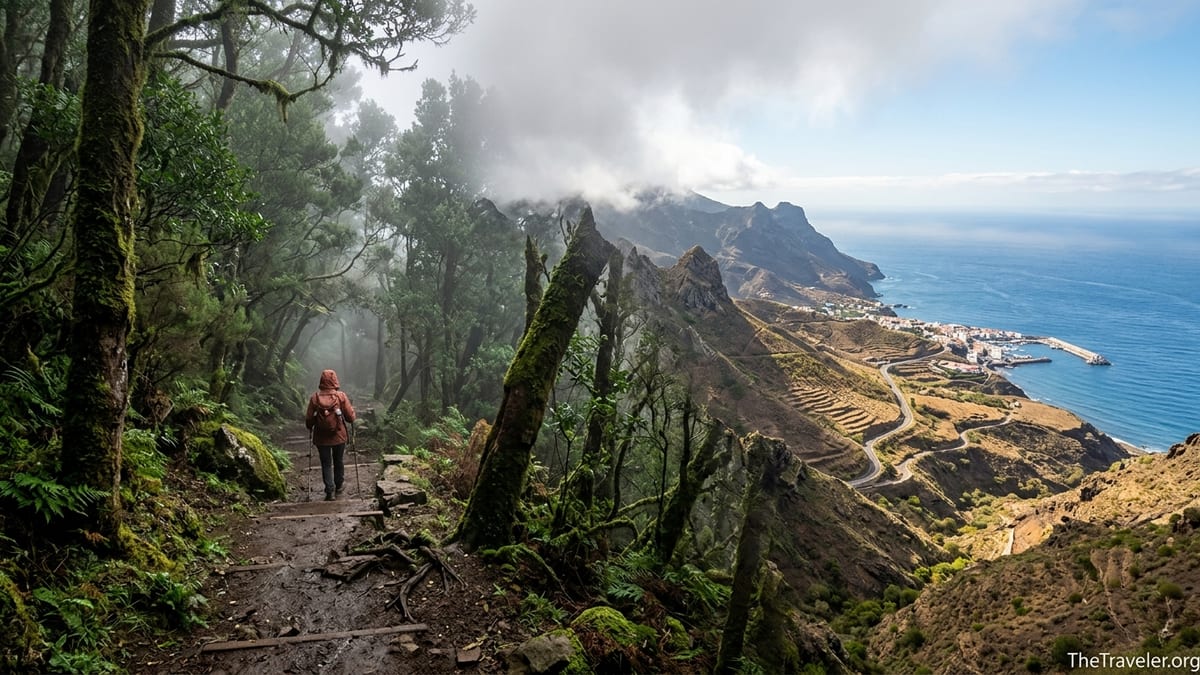
Climate contrasts between coast and high forest
Garajonay National Park occupies the central highlands of La Gomera, with summits such as Alto de Garajonay reaching about 1,487 meters. Here the climate is shaped by the northeast trade winds and a temperature inversion that traps a “sea of clouds” against the northern slopes. Studies and official park material describe annual rainfall of roughly 600 to 800 millimetres in the high forest, with humidity commonly above 75 percent. Much of this moisture arrives as drizzle or windblown cloud rather than heavy downpours, which keeps the laurel forest damp and mossy even when the coasts look parched.
On the coast, conditions are very different. San Sebastián de La Gomera, near sea level on the eastern shore, has annual average temperatures around the high teens to low twenties Celsius, with mean monthly values near 18 degrees in winter and 22 to 23 degrees in late summer. Average annual rainfall is low, on the order of 150 millimetres, and rainfall days are limited to roughly a dozen to 20 days per year, concentrated between November and February. Coastal sunshine is generous, with many months recording well over eight hours of sunshine per day on average.
By contrast, meteorological studies from high catchments inside Garajonay, around 1,100 to 1,300 meters, describe a humid Mediterranean climate with much cooler air and frequent cloud. Typical annual temperatures in the upper forest hover in the low to mid teens Celsius, several degrees below the coast. While precise sunshine statistics for summit weather stations are limited, field work consistently notes reduced sunshine hours due to persistent low cloud, particularly on the windward northern slopes. Fog drip and horizontal rain mean that effective moisture input to the forest can be close to double the measured rainfall.
For visitors, this means that even when forecasts show warm and dry conditions for San Sebastián or Valle Gran Rey, Garajonay’s interior may be cool, damp and shaded. Pack as though you were heading into a temperate mountain forest rather than a beach resort, and treat coastal climate data as only a rough starting point for planning hikes in the park.
Winter in Garajonay: cool, damp and often ideal for walking
Winter on La Gomera, roughly December to February, brings the most Atlantic disturbances and the bulk of annual rainfall. On the coasts, daytime temperatures usually sit around 19 degrees Celsius with mild nights and a modest increase in rainy days. In the park’s uplands, winter air is noticeably cooler. Typical daytime temperatures in the forest may lie in the low to mid teens, and can feel colder where wind and cloud reduce the perceived temperature. Rainfall events are more likely to be proper showers or longer periods of drizzle, and the laurel forest often remains wet underfoot for days.
Trail conditions in winter are usually good for reasonably equipped hikers, but expect mud, slick rock and exposed roots, particularly on popular circuits such as those around El Cedro or from Pajarito to Alto de Garajonay. Mossy stone steps can be slippery when wet. On unsettled days, cloud frequently sits at summit level, limiting views from Alto de Garajonay and viewpoints above Hermigua or Valle Gran Rey. When cold upper air arrives with an Atlantic low, visibility can drop sharply in fog, and very occasionally there can be hail or a dusting of snow on the highest points, although such events are rare and short lived.
Many regular walkers consider winter one of the best times to visit. Cooler temperatures make the steep ascents more comfortable, and the forest is lush, with running water in ravines and streams. However, daylight hours are shorter compared with spring and summer, so it is wise to start longer routes early. Winter is also when storms and strong winds most often affect ferry links between La Gomera and Tenerife or La Palma. While complete cancellations are not everyday events, Atlantic systems can bring rough seas and temporary disruption, so travelers should keep an eye on marine forecasts and allow some flexibility around arrival or departure days.
Operationally, winter is low to shoulder season for international tourism outside the Christmas and New Year period. Park visitor centers and information points usually keep regular opening hours, but it is prudent to check the latest schedule, as occasional maintenance closures or reduced afternoon hours can occur. Guided walks run by the park or local operators may be offered fewer days per week than in peak season, and some commercial hiking tours cluster around the Christmas holidays and late winter, when northern European demand for warm-weather walking is strongest.
Spring: lush forests, changeable mist and growing crowds
From March through May, Garajonay enters a transitional period that many plant enthusiasts regard as optimal. According to park guidance, spring is particularly rewarding for those drawn to flowering understory plants and the intense greens of the laurel forest. Coastal temperatures begin to climb toward the low twenties Celsius by May, and days lengthen, offering more time on the trails. In the high forest, air temperatures are still on the cool side, often in the mid teens during the day, but there is usually less prolonged rain than in mid-winter.
Spring remains a season of frequent cloud and mist as the trade-wind inversion strengthens. The “sea of clouds” often thickens along the northern slopes, especially in April and May, enveloping popular routes like those near Laguna Grande in shifting fog. Ground conditions are generally damp rather than saturated, though shaded gullies and north-facing paths can stay muddy well into April. Occasional late-season Atlantic fronts can still bring heavier rain, and Saharan dust intrusions can briefly raise temperatures and bring hazy skies, although these episodes are more common toward early summer.
Crowds start to build in spring, particularly around Easter and during school holiday weeks for European visitors. La Laguna Grande recreation area, with its easy access and picnic facilities, becomes noticeably busier on weekends and holidays, and short walks to viewpoints may feel crowded in the late morning and early afternoon. Parking spaces near major trailheads can fill up by mid-morning in peak weeks, especially when tour buses arrive. Starting hikes early in the day remains the best strategy for a quieter experience and easier parking.
Overall, spring offers an excellent compromise: relatively cool hiking temperatures, abundant greenery and wildflowers, and a good chance of at least some clear spells at the viewpoints between cloud banks. Travelers should still plan for mist, changeable visibility and occasional muddy sections, and those with fixed travel dates around Easter should book accommodation and ferry tickets well ahead.
Summer: drier trails, warmer air and hazier views
Summer on La Gomera, broadly June to September, is dominated by stable subtropical high pressure and strong northeast trade winds. On the coasts, mean temperatures rise to around 21 to 23 degrees Celsius, with hot episodes occasionally pushing inland temperatures much higher. Recent heat advisories in the Canary Islands have highlighted that interior valleys and south-facing slopes of La Gomera can see temperatures in the mid 30s Celsius during heatwaves. Rainfall is scarce in summer at sea level, and sunshine hours are at their maximum.
Inside Garajonay, summer hiking conditions depend strongly on altitude and aspect. At typical forest elevations, daytime temperatures are usually pleasant, often in the high teens to low twenties Celsius, with significantly cooler nights. Trails tend to dry out compared with winter and spring, so there is less mud underfoot and stream levels are lower, which many walkers appreciate. However, summer often brings more stable layers of low cloud that can linger at mid-elevations while summits may sit just above or within the cloud deck. This can lead to hazy or completely obscured views from Alto de Garajonay, especially in the middle of the day when convection and moisture are at their peak.
Saharan dust events are more likely in summer, carried by hot, dry air from Africa. These “calima” episodes can reduce visibility, create a yellowish haze and raise temperatures even in the forest. They tend to be brief, lasting a day or two, but hikers with respiratory sensitivities may prefer to schedule longer or more exposed walks for cleaner-air days. At lower altitudes, particularly in ravines leading down to Valle Gran Rey and other south or west facing slopes, afternoon heat can be intense, and exposed sections of trail demand extra water and sun protection.
Summer is also the key season for fire risk. The park authorities periodically introduce fire prevention measures, such as closing barbecues at recreation sites like La Laguna Grande when risk is high. Past communications from the park have announced closures of cooking facilities from late June during particularly dry and hot spells. Campfires are not allowed in the forest, and smoking is tightly restricted. Visitors should always check the latest park notices before planning picnics that depend on grills or open flames and should be aware that restrictions may apply only to certain areas rather than the entire island.
Autumn: transition season with variable conditions
Autumn, from late September through November, is another transitional period and can be one of the most variable times in Garajonay. Sea temperatures remain warm, and coastal air stays relatively mild with average temperatures around 21 to 22 degrees Celsius in September, slowly cooling into the high teens by November. Rainfall begins to pick up again, especially in late autumn, although there can be extended dry spells early in the season.
In the park’s interior, early autumn often still feels summery on clear days, with comfortable daytime temperatures in the upper teens or low twenties Celsius at mid altitudes. Trails tend to remain dry through much of September and sometimes into October, although the first autumn storms can quickly make shaded sections slick again. Cloud behavior is less predictable in this season. Some days bring wide, clear panoramas from Alto de Garajonay, while others see thick cloud bands rolling in from the north by late morning, cutting the views for hours at a time.
By November, frontal systems from the North Atlantic become more common, bringing bands of rain and gusty winds. These systems can cause temporary disruptions to ferry schedules if seas become rough, especially on the exposed crossings between Tenerife and La Gomera. Mountain paths may experience short-lived waterflow in normally dry gullies, and leaf litter on already moist soil can increase the risk of slips. Hikers traveling in late autumn should be ready for a genuine mix of warm, sunny days and cool, drizzly ones within the same week.
Autumn tourist numbers tend to dip after the main summer holiday period, although October half-term weeks in some European countries can still see a short spike in family visits. This can translate into busier midday periods at La Laguna Grande and car parks near popular lookouts, but overall the feel is less crowded than in midsummer or at Christmas. Accommodation and rental car availability is generally better than in peak holiday weeks, while temperatures remain favourable for long hikes.
Daily timing: choosing the right hour for trails and viewpoints
Regardless of season, timing within the day can strongly influence your experience in Garajonay. Early mornings often bring the calmest winds and, on some days, clearer skies before cloud builds on the ridges. Starting a summit ascent to Alto de Garajonay soon after sunrise increases your chances of open views across to El Teide and the western islands, especially in late autumn, winter and early spring when instability later in the day can trigger cloud growth. Morning temperatures are cool in the forest, so extra layers are useful when setting out.
By late morning and early afternoon, trade wind clouds tend to thicken along the northern slopes, and popular sites such as La Laguna Grande usually reach their busiest period. Tour buses, rental cars and local families converge on picnic areas, and parking can become scarce on fair-weather days. Short signed trails around the recreation areas can feel crowded at these times, and viewpoints may sit inside the cloud deck, with limited visibility. If skies are already grey by mid-morning, consider focusing on lower-level routes in more sheltered ravines, where cloud cover may be thinner.
Late afternoon often brings subtle improvements in visibility as convection decreases, particularly in stable weather patterns. Light slants through the forest, enhancing the atmosphere of moss-draped laurel trees, and day-trippers begin to leave, easing pressure on car parks and viewpoints. However, hikers should keep a close watch on daylight, especially in winter months when darkness falls early. It is wise to plan to be back at the trailhead before sunset rather than relying on fading light under the canopy.
Recent visitor reports highlight recurring issues like very slippery stone sections after overnight drizzle and sudden fog banks that reduce visibility along exposed ridges. Because such conditions can develop quickly, check same-day forecasts for the park’s interior, not just coastal towns, and be prepared to adjust your route or turning point if visibility or footing deteriorates.
Wind, sea crossings and operational considerations
Wind plays a dual role in Garajonay. In the forest itself, moderate trade winds are often filtered by the trees, but exposed summits and ridgelines can be gusty, making them feel considerably colder than the air temperature suggests, especially in winter and during frontal passages. Strong wind can drive fine drizzle into clothing and increase the chill factor, so a windproof and waterproof outer layer is useful year-round. During summer, persistent trades help keep forest temperatures comfortable even when lowland ravines heat up.
At sea level, winds and swell are more critical for trip logistics. Ferries between Tenerife and La Gomera generally operate reliably, but winter storms or strong trade winds occasionally lead to delays or cancellations for safety reasons. Swell from distant Atlantic systems can also affect ports, particularly if combined with local winds. Because such events tend to cluster in certain weather patterns, travelers with fixed entry or exit dates should build in some margin and check marine forecasts and operator updates, especially from November to February and during notable Atlantic low-pressure episodes.
Within the park, services and facilities are relatively simple but still subject to seasonal adjustment. Visitor centers, such as the main information center, usually maintain consistent daily hours, yet special exhibits or audiovisual presentations may run reduced schedules in low season or during maintenance. Official guided walks can be more frequent in the high-demand winter walking season and slightly scaled back in the hottest summer weeks, when fewer visitors choose longer forest routes. Actual schedules vary from year to year, so travelers should confirm details shortly before arrival through the latest official communications.
Fire safety measures are perhaps the most important operational factor linked directly to weather. The island has suffered severe fires in the past, including a major event in 2012 that burned a significant part of the park’s area and led to long-term recovery work. During periods of high fire risk, particularly in summer and early autumn, authorities can close barbecues at recreation areas, restrict smoking even in designated areas, or temporarily limit access to specific trails or viewpoints for safety. These restrictions are usually localized rather than island-wide, so it is important to check which facilities are affected at the time of your visit.
Packing, safety and matching seasons to your priorities
Garajonay’s cool, humid forest demands different packing choices than La Gomera’s beaches. Layering is essential in every season. A light base layer, a warm mid-layer such as a fleece, and a waterproof, windproof shell allow you to adapt to changes in altitude, wind and cloud. Even in summer, conditions at 1,400 meters can feel chilly if you pause at a breezy viewpoint enveloped in fog. Long trousers and sturdy footwear with good grip are strongly recommended, as many paths cross wet rock, roots and occasional mud, especially in winter and spring.
Waterproofs are useful year-round due to the park’s tendency for drizzle and horizontal rain rather than short, heavy showers. A compact umbrella is less practical on narrow or windy ridges. Sun protection is also important even on cloudy days because UV levels remain high at altitude; bring a hat, sunglasses and sunscreen. In summer and early autumn, carry more water than you expect to need, particularly if descending into sun-exposed ravines, where temperatures can be much higher than in the shaded forest.
From a timing perspective, serious hikers who prioritize long days on the trail and cooler air may find late autumn through spring, excluding the stormiest winter spells, the most rewarding. Those who want the greenest, most vibrant forest with flowing streams and blossoming understory plants should focus on March to early June. Visitors chiefly seeking clear summit views and more reliable dry footing may prefer late spring or early autumn shoulder periods, accepting that visibility can still be hit and miss on any given day.
Travelers sensitive to cold and rain might favour late spring through early autumn, basing themselves on the coast where conditions are warm and scheduling shorter incursions into the forest on days with more favourable forecasts. Regardless of the season, conditions in Garajonay vary from year to year and from day to day. Before traveling, and again shortly before each hike, check the most recent weather forecasts for the island’s interior, review any current park advisories about trail closures, fire restrictions or guided walk schedules, and remain flexible in your plans. This approach will give you the best chance of matching Garajonay’s unique climate to your own ideal walking experience.