


More news on this day
Plans by new entrant Gemini to run open-access trains between London and Cologne are the latest sign that Europe’s liberalised rail market is entering a more competitive cross-border phase, with France and several other countries seeing a wave of new services and proposals.
Get the latest news straight to your inbox!
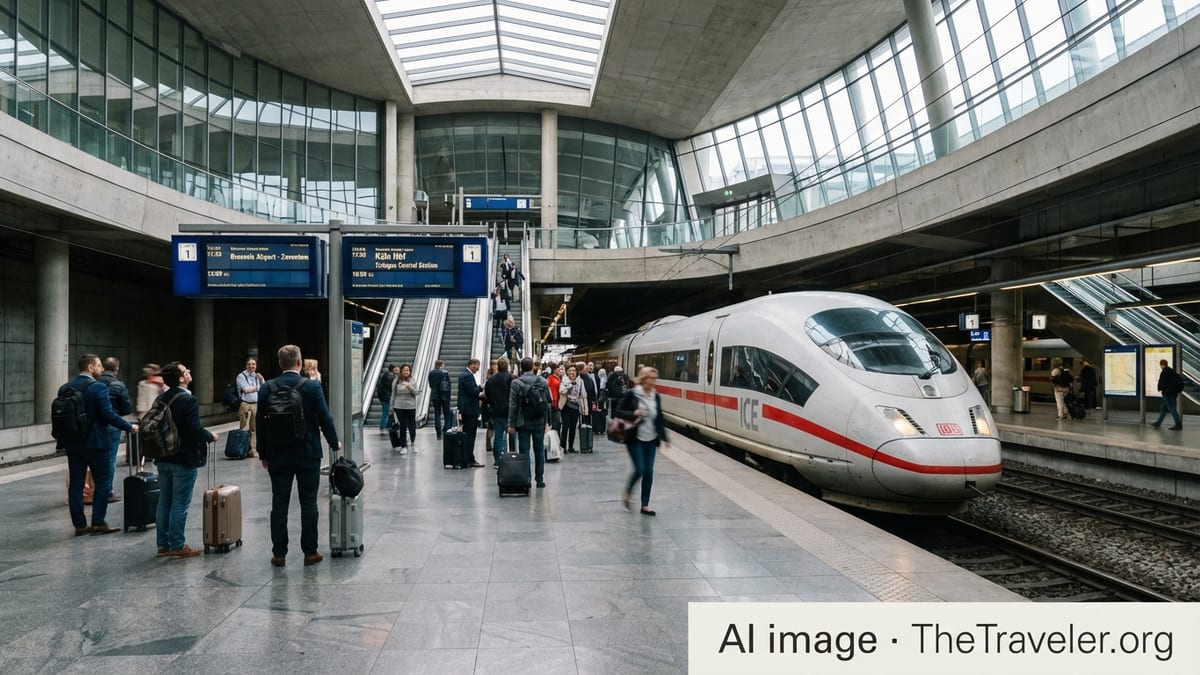
Gemini Targets First Direct London–Cologne Link
Documents submitted to the UK Office of Rail and Road describe Gemini as an aspiring open-access operator seeking to use the Channel Tunnel to connect London with major cities in mainland Europe, including Cologne in western Germany. In a recent filing responding to industry feedback, the company restated its intention to run direct services between the British capital and Cologne, positioning the route as part of a broader plan to bring new competition to cross-Channel rail.
Open-access operators run trains at their own commercial risk and purchase track access on shared infrastructure rather than operating under an exclusive franchise. This model has been central to rail liberalisation across the European Union, particularly for international services, where any licensed operator is generally allowed to run cross-border trains and pick up passengers along the route. Publicly available regulatory and company reports indicate that Gemini aims to make use of these rules to enter a market long dominated by a single high-speed operator between the UK and continental Europe.
Industry material suggests that Gemini is one of several newcomers attracted by the significant passenger flows between Britain and Germany. The London–Cologne corridor is already well known to rail travellers who currently connect via Brussels with existing high-speed services, but no operator yet offers a through train. Gemini’s proposal, if realised, would remove the need to change trains and could cut journey times, while also aligning with broader climate goals by shifting more long-distance travel from air to rail.
However, any new cross-Channel operator must navigate technical, security and capacity constraints, as well as complex approval processes in multiple countries. Channel Tunnel infrastructure manager Getlink stresses in its latest annual reporting that the fixed link is open to any qualified railway undertaking on a non-discriminatory basis, but also notes that new entrants must secure paths, rolling stock approval and financing in a competitive environment.
Eurostar and Deutsche Bahn Explore Parallel UK–Germany Corridor
Gemini’s ambitions emerge alongside a separate initiative involving the incumbent players on either side of the Channel. In late 2025, the UK government publicised a memorandum of understanding between Eurostar and Deutsche Bahn that sets out an intention to develop direct high-speed trains linking London with German cities such as Cologne and Frankfurt in the early 2030s. According to official summaries of the agreement, the partners see the potential to offer faster, greener alternatives to short-haul flights on one of Europe’s busiest air corridors.
Getlink’s recent filings echo this trend, highlighting that Eurostar has placed additional rolling stock orders, with some units earmarked for planned expansion towards Germany. The same documents list Gemini, along with Evolyn, FS Group and Virgin Trains Europe, among a cluster of operators signalling interest in using the Channel Tunnel for new passenger services. This indicates an emerging multi-operator ecosystem rather than a single challenger facing a monopoly provider.
Taken together, these developments suggest that competition on cross-Channel and UK–Germany routes may intensify over the next decade. For travellers, the outcome could be more departure options, differentiated onboard products and pressure on fares, provided that sufficient train paths and terminal capacity can be secured. Policy makers at both UK and EU level also view such projects as contributing to climate objectives by making rail more attractive on medium-distance international journeys that are currently dominated by aviation.
Timelines remain indicative, and no firm launch date has been announced for Gemini’s London–Cologne concept. The coexistence of newcomer proposals with the Eurostar–Deutsche Bahn framework raises questions about how many operators the market can sustain, how capacity will be shared, and whether competing or complementary timetables will emerge once the first direct trains are running.
France as a Testbed for High-Speed Competition
The cross-Channel push comes as France consolidates its role as a key laboratory for open-access high-speed rail in continental Europe. Since 2021, Trenitalia France has operated Frecciarossa services on the flagship Paris–Lyon–Milan axis, directly competing with state-owned SNCF Voyageurs. Research published in academic and policy outlets finds that competition on the Paris–Lyon segment has brought more frequencies and a wider range of fares, providing early evidence of liberalisation benefits in a market long characterised by a single operator.
SNCF Réseau and the French transport ministry report that the national rail network has been progressively opened to competition, with passenger services fully liberalised in principle since 2020. New entrants are now able to request access for commercial high-speed and long-distance routes, while regional authorities can also tender contracts for local services. In the high-speed segment, France now hosts multiple brands, including SNCF’s inOui and Ouigo alongside Trenitalia and Spain’s Renfe on certain international links, creating one of the most diverse competitive landscapes in Europe.
Regulatory monitoring by the French transport regulator indicates that non-subsidised passenger activity is still largely dominated by SNCF’s various subsidiaries, but the arrival of foreign incumbents and private challengers has begun to erode the historic monopoly. Authorities also highlight a pipeline of additional projects, from proposed Atlantic high-speed links within France to further cross-border initiatives involving operators such as European Sleeper. Many of these concepts remain at planning or approval stage, yet they demonstrate sustained investor interest in French corridors that could connect seamlessly with new services like a London–Cologne train.
This growing competition interacts closely with EU-level rules that require the separation of infrastructure management and train operations, and that give open-access operators a right to offer international services. Academic analyses of these frameworks note that France, Italy and Spain have become reference cases for how economic equilibrium tests and capacity allocation can balance new commercial services with existing publicly supported operations.
New Cross-Border Services Reshape the European Rail Map
Beyond France and the UK–Germany axis, the wider European rail network is undergoing a broader wave of cross-border expansion. The European Commission’s “Connecting Europe by Train” initiative identified pilot routes that include new or enhanced services such as Stockholm–Copenhagen–Berlin night trains, Prague–Berlin–Copenhagen daytime links, and a planned Amsterdam–Barcelona overnight connection from European Sleeper. Official material on these pilots underlines a goal of improving practical connectivity by overcoming timetable, ticketing and infrastructure bottlenecks that have long hampered international rail.
Member state progress reports show that several of these pilots are now advancing into implementation or detailed planning. For instance, operators in the Netherlands and Belgium are preparing to double frequencies on the Amsterdam–Brussels corridor, adding a faster option that shortens journey times for cross-border travellers. In southern Europe, the Italian and German incumbent operators have announced high-speed links between Milan or Rome and Munich, targeted for around 2026, which will add another important north–south spine to the continent’s rail map.
These developments coincide with a gradual revival of night trains as an alternative to medium-distance air travel. Although some cross-border night services have been curtailed or reshaped as subsidy arrangements evolve, new privately and publicly backed projects continue to appear, often supported by EU pilot schemes or bilateral agreements. The emerging picture is one of a patchwork in which some legacy routes are discontinued while new combinations of cities gain direct rail links, driven by changing demand patterns and environmental policy priorities.
For travellers planning multi-country itineraries, the result is a more complex but potentially richer set of options. Where once many journeys required multiple changes and fragmented tickets, the combination of renewed night trains, new high-speed corridors and open-access competition is slowly producing more one-seat rides between major cities. A direct London–Cologne train would extend that trend, plugging the UK more firmly into central Europe’s growing network of frequent, cross-border rail services.
Liberalisation, Climate Policy and the Next Phase of Growth
The backdrop to these route announcements is the European Union’s long-running effort to create a single rail market under successive “railway packages.” Official EU material explains that national freight and international passenger markets are largely open to competition, with any certified undertaking in principle able to run cross-border services. The same framework also promotes neutral infrastructure management, non-discriminatory allocation of train paths and transparent charging, all of which are intended to lower barriers for operators like Gemini contemplating new services.
Recent policy and research reports argue that rail liberalisation interacts strongly with climate and transport goals. Comparative environmental assessments of routes such as Paris–Bordeaux show that high-speed rail can significantly reduce lifecycle emissions relative to short-haul flights, especially as electricity generation decarbonises and train occupancy rises. In this context, new international trains are increasingly framed as part of a broader climate strategy, complementing measures such as restrictions on ultra-short domestic flights where rail alternatives exist.
At the same time, regulators caution that the benefits of competition and new routes are not automatic. Economic equilibrium tests are used to assess whether proposed open-access services would unduly undermine subsidised public service contracts, and infrastructure capacity remains constrained on several key corridors. National monitoring in France and elsewhere points to ongoing challenges in coordinating investment, maintenance and path allocation so that additional operators can be accommodated without degrading reliability.
Even with these constraints, the arrival of projects like Gemini’s planned London–Cologne connection signals that the liberalisation agenda is moving into a new phase in which multiple international operators may compete head-to-head on major corridors. For passengers in France, Germany, the UK and beyond, this could translate into more direct city pairs, integrated ticketing options and a stronger rail alternative on journeys that today are often made by air.
Gemini Trains regulatory filing (UK Office of Rail and Road)
UK government summary of planned direct UK–Germany rail link
European Commission overview of the EU rail market