


Greek island hopping can feel effortless in photos and maddening in real life. The difference usually comes down to ferries: which Athens port you choose, the type of vessel you book, how you time connections, and whether your island combination makes any sense on an actual map. This guide walks through the real logistics for 2026, using concrete examples so you can spend your holiday on a beach instead of on a quay clutching a melted ticket.
Get the latest updates straight to your inbox!
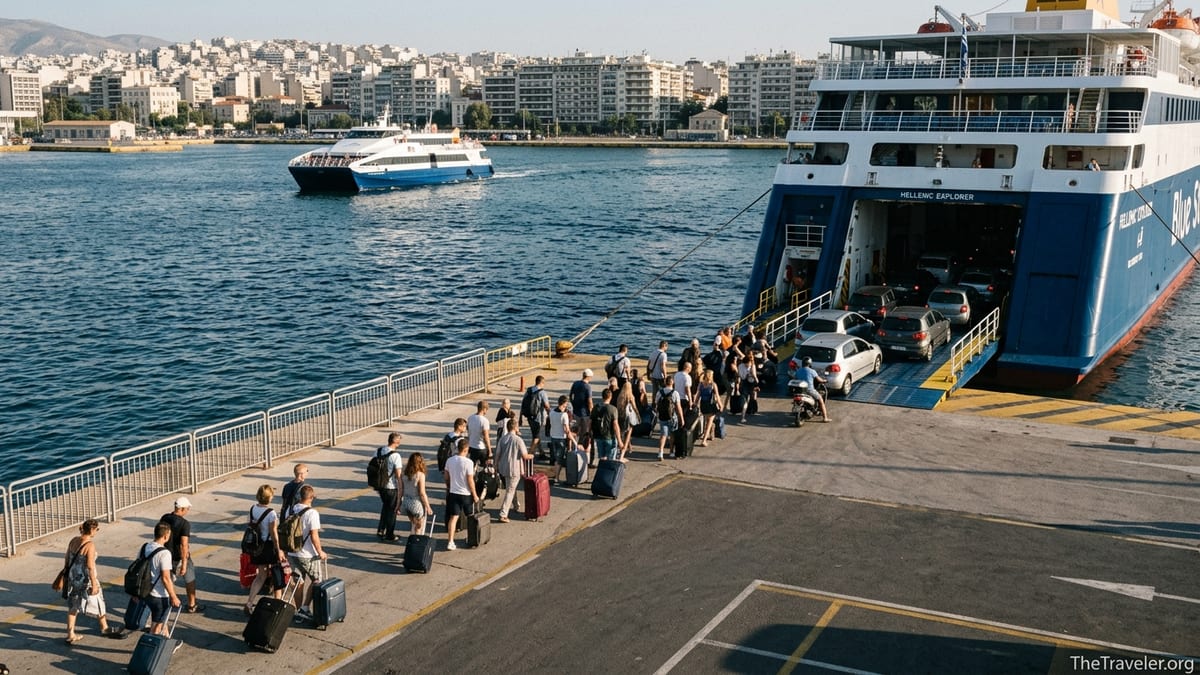
Understanding Athens’ Three Ferry Ports
Athens functions as a three-port hub for the islands: Piraeus, Rafina and Lavrio. All three sit in the Attica region, but they are in different directions from both the city center and the airport, and each one naturally serves different island groups. Most first-time problems start with booking the right island and the wrong port on a non-refundable ticket.
Piraeus is Greece’s largest passenger port and effectively part of metropolitan Athens, on the Saronic Gulf. It is the main gateway for the Cyclades, Crete, the Dodecanese and the Saronic islands, with major routes to places like Santorini, Mykonos, Naxos, Paros, Rhodes and Heraklion. From Athens International Airport, the X96 airport bus runs 24 hours a day and usually takes around 70–95 minutes depending on traffic; a taxi can be anywhere from about 45 to 75 minutes in normal conditions, longer in rush hour.
Rafina sits on the east coast of Attica, roughly 25–30 kilometers from the airport. Regional KTEL buses link it directly with Athens International Airport, and taxis in 2026 often quote around 30–40 minutes from the terminal in moderate traffic. Rafina is generally more convenient for the northern Cyclades: Andros, Tinos and Mykonos see daily service, with seasonal high-speed routes continuing to Naxos and Paros in peak summer. For a traveler landing at 15:00 and heading straight to Andros, a 17:30 ferry from Rafina is realistic in a way that a 17:30 ferry from Piraeus often is not.
Lavrio lies in southeast Attica, about 35 kilometers from the airport, with regional buses and taxis taking roughly 35–50 minutes. It is less known to foreign visitors but important for nearby islands like Kea and Kythnos, plus occasional Cyclades routes. Lavrio often appears in itineraries that combine the Athenian Riviera with a quiet island like Kea. The port is smaller and calmer than Piraeus, which some travelers appreciate on busy August weekends.
Fast vs Slow Ferries: Comfort, Cost and Seasickness
Greek island ferries fall broadly into two categories: conventional “slow” ferries and high-speed catamarans or monohulls. Conventional ferries such as many Blue Star vessels are large, with open decks, vehicle garages and cabins on longer routes. High-speed ferries operated by companies like SeaJets or Golden Star Ferries tend to be enclosed catamarans or sleek monohulls designed for speed rather than strolling on deck.
On a popular route like Piraeus to Santorini in high season, a conventional ferry might take around 7.5–8 hours with indicative economy deck fares in the region of 45–60 euros one way. A fast catamaran on the same route may cover it in about 4.5–5.5 hours with fares more typically ranging from 70 to a little over 100 euros, depending on the date and seat class. Similarly, from Rafina to Mykonos, a high-speed ferry in summer can be around 2.5–3 hours compared with 4–5 hours on a conventional boat, with ticket prices adjusted accordingly.
The trade-off is comfort in rough seas. The Aegean is subject to the meltemi, strong northerly winds that frequently blow in July and August. Large conventional ferries usually handle these conditions better and are more likely to sail on time, while smaller high-speed catamarans are more vulnerable to delays and cancellations. Travelers prone to seasickness often report that catamarans feel bouncy when the sea is choppy, even on days that are technically “safe to sail.” Many locals quietly advise that if you know you get motion sick, you are better off on a large, slower ferry, even if it means a couple of extra hours.
If you must take a high-speed ferry, choose a seat near the center of the vessel where motion is reduced, eat lightly beforehand and consider over-the-counter seasickness tablets after checking with a pharmacist. On very windy days, some travelers have found that even with medication they felt unwell on smaller high-speed vessels, while similar conditions on a big Blue Star ferry felt more like a long bus ride. For trips longer than five hours, the ability to walk on deck, sit outside and change position often outweighs the time saved by a fast ferry.
Tickets, Boarding and Dealing with Delays
For 2026, almost all major Greek ferry companies offer online booking and digital tickets, though some still require check-in at a kiosk for a printed boarding pass on certain routes. On a Piraeus to Naxos sailing with Blue Star, for instance, you might receive a QR-coded e-ticket that can be scanned directly from your phone; on some smaller lines, staff at the port will print a ticket after checking your confirmation and passport. Always read the instructions on your booking confirmation and arrive with enough time to complete check-in if needed.
Summer prices fluctuate, but a mid-July economy ticket from Piraeus to Naxos on a conventional ferry may be in the approximate range of 40–55 euros, while a high-speed crossing could be 60–80 euros or more. Booking earlier generally gives better choice of departure times and seat categories, particularly on Fridays, Sundays and around public holidays. If you are taking a vehicle, reservations should be made as far in advance as possible; car spaces on popular routes such as Piraeus to Paros or Rafina to Andros can sell out while foot-passenger tickets remain available.
Delays are part of the Aegean reality. A delay of 15–45 minutes is fairly common and often due to port congestion or slower-than-expected boarding at earlier stops. In strong meltemi conditions, delays of several hours or even cancellations can affect high-speed ferries in particular. This is why it is generally unwise to book an evening flight home on the same day you plan to arrive by ferry from an outer island. Many experienced travelers choose to finish their trip with a domestic flight from the island back to Athens a day before their international departure, or they plan a final night in Athens so that a wayward ferry does not jeopardize a long-haul flight.
At boarding time, ports can look chaotic but are usually well organized. For example, in Piraeus the X96 airport bus drops passengers close to gates used by Cyclades ferries, with large signs and electronic boards listing ship names and departure gates. Staff direct passengers and vehicles up the loading ramps. Foot passengers usually queue on the quay where boarding for their specific vessel is announced. Keep your ID and ticket handy and do not rely on announcements always being audible; check the ship name printed on your ticket against the vessel moored in front of you.
Luggage, Seating and Onboard Life
Greek ferries are surprisingly relaxed about luggage. There is rarely a strict weight enforcement for foot passengers, and many travelers board with large rolling suitcases plus backpacks. On conventional ferries such as Blue Star Delos or Blue Star Naxos, you will usually find large luggage racks immediately inside the main passenger doors on the vehicle deck and again at the foot of internal staircases. Most people leave big bags there and carry valuables and small daypacks with them to their seats.
If you are nervous about leaving luggage in common racks, bring a small cable lock to attach your suitcase handle to the rack. In practice, theft on these routes is uncommon compared with busy train stations in major cities, but with several hundred passengers on board it is wise not to leave passports, laptops or large amounts of cash unattended. On high-speed ferries where access to the vehicle deck is restricted during sailing, staff often designate specific luggage areas on the passenger deck itself.
Seat types range from basic economy airplane-style seats to reserved “air seats,” business lounges and private cabins on longer overnight routes. On a conventional evening sailing from Piraeus to Rhodes, for example, you can purchase an economy deck ticket and sit wherever you find space in public areas, or pay extra for a numbered air seat or private cabin with beds and bathroom. On shorter Cyclades crossings, most passengers opt for reserved seats in air-conditioned lounges, though many still seek out the outdoor deck for fresh air and views when the weather allows.
Onboard facilities vary by ship but commonly include a café counter serving coffee, soft drinks, beer, simple snacks and light meals such as sandwiches, salads and packaged pastries. Prices are higher than in a supermarket but usually lower than airport food courts. Wi-Fi is increasingly available, sometimes for a small fee or free in premium lounges, but coverage can be patchy in open water. For families, conventional ferries with open decks, more space to move around and occasional play areas tend to be more comfortable than enclosed high-speed catamarans.
Piraeus, Rafina or Lavrio: Matching Port to Island and Flight
The right Athens port depends on where you are coming from, where you are going and what time your plane arrives. A classic mistake is landing at Athens International Airport at 16:30 and booking an 18:00 ferry from Piraeus because the timetable makes it look efficient. In practice, by the time you clear immigration and baggage, walk to the X96 bus stop or taxi line and reach Piraeus through traffic, that 18:00 departure will be very difficult to make. Many local drivers now advise giving yourself at least 3 hours between a scheduled landing and a Piraeus departure, and more at peak times.
Rafina can be much more realistic for same-day airport-to-ferry connections. A traveler landing at 14:00 in July, for instance, might comfortably catch a KTEL bus or taxi and board a 17:15 ferry from Rafina to Andros or Tinos. This is one reason northern Cyclades itineraries that start with Andros or Tinos work so well with midday or afternoon arrivals. Conversely, if your trip includes two days in central Athens before you sail, Piraeus is usually the most straightforward, reachable in around 25–35 minutes by metro or about the same by taxi outside rush hour.
Lavrio typically suits those headed to Kea or Kythnos, or travelers combining a few days on the Athenian Riviera with a nearby island. From the airport, regional buses run to Lavrio, and taxis in 2026 often quote about 40–50 minutes travel time depending on traffic. An example itinerary might be a late afternoon arrival in Athens, an overnight in a coastal hotel near Sounio, then a late-morning ferry from Lavrio to Kea, avoiding central Athens entirely.
Whichever port you choose, aim to avoid ultra-tight connections. If your long-haul flight lands after 20:00, consider staying near the airport or in Rafina or Piraeus and taking a morning ferry. Outside very budget-conscious trips, the cost of a simple airport-area hotel is modest compared with the stress and potential loss of a non-refundable ferry ticket if your plane is late or baggage handling is slow.
Smart Island Pairings and Route Mistakes to Avoid
The Greek ferry network is not a grid. It radiates in spokes, usually from Athens or a regional hub. Many classic “bad itineraries” come from drawing straight lines on a map and assuming any island can connect neatly to any other. Santorini to Corfu, for example, looks romantic but is deeply impractical by ferry; most travelers in 2026 will combine Santorini with other Cyclades such as Naxos, Paros, Ios or Milos instead.
Within the Cyclades, smart combinations follow the main ferry routes. A popular and efficient loop from Piraeus might be Paros, Naxos and then Santorini, all on direct or near-direct lines, with travel times between islands ranging from roughly 1.5 to 3 hours on a mix of conventional and high-speed ferries. From Rafina, good starting points include Andros, Tinos and Mykonos, which connect onward to islands like Naxos and Paros. Travelers with 10–12 days often choose a northern cluster (Andros, Tinos, Mykonos) or a central-southern cluster (Paros, Naxos, Ios, Santorini) rather than trying to stitch them all together.
Problematic combinations tend to cross between island groups or require backtracking through Athens. Trying to pair Zakynthos in the Ionian Sea with Mykonos in the Cyclades purely by ferry, for example, involves complicated bus and boat changes and can consume entire days of vacation time. Similarly, many people discover too late that there is no sensible direct ferry between Santorini and some Dodecanese islands on the dates they need, despite lines appearing on a seasonal route map. When in doubt, check real 2026 timetables for your dates rather than relying on last year’s blog posts or generic route diagrams.
Another frequent trap is planning ambitious island hopping in August without factoring in meltemi-related changes. Booking a tight chain like Mykonos to Naxos to Amorgos with only one night on each island leaves no margin if a high-speed ferry is canceled. A more resilient plan might be to choose two islands with good daily connections and spend four or five nights on each, using day trips by local boat instead of changing bases every 24 hours. Think of ferries as an essential part of your trip, but not as precision instruments like trains in central Europe.
Seasickness, Weather and When to Fly Instead
For many travelers, the question is not whether ferries run but whether they will feel well on them. The Aegean can be choppy, particularly in July and August when the meltemi blows from the north. Even in May, strong winds or lingering swell from a previous storm can make certain crossings uncomfortable for sensitive passengers. Reports from recent seasons show that on some fast ferries a noticeable portion of passengers felt unwell on rough days, despite medication.
If seasickness is a serious concern, consider designing your route around shorter crossings on larger vessels. For example, pairing Athens with Aegina, Hydra or Poros in the Saronic Gulf typically involves rides under two hours, often on more sheltered water compared with open-sea stretches to the Cyclades. Within the Cyclades, choose routes like Piraeus to Syros or Naxos to Paros that are relatively short and well served by larger conventional ships. Avoid small high-speed catamarans on days when strong wind warnings are in place.
There are also times when the best ferry decision is not to take one at all. On high-demand routes such as Athens to Santorini or Mykonos, domestic flights from Athens International Airport can be only modestly more expensive than a high-speed ferry, especially if booked early, and take roughly 40–50 minutes in the air. For tight end-of-trip connections, flying from the island back to Athens the day before your international flight is usually more reliable than banking on a long ferry that could be subject to weather-related disruption.
In shoulder seasons like late April, May, late September and October, seas are often calmer, and ferries can be a pleasant, scenic way to travel without the crowds. Schedules may be less frequent, however, so you might have only three or four sailings a week to smaller islands. This makes checking current-year timetables essential. If your dates are inflexible and your chosen island has limited service, you may want to anchor your itinerary around those specific ferry days or consider an island with daily links.
The Takeaway
Using Greek ferries well is less about insider magic and more about aligning three things: the right Athens port for your island, the right type of ferry for your comfort level, and realistic time buffers around flights and onward travel. Once you understand that Piraeus is the main hub, Rafina is usually best aligned with the northern Cyclades and airport arrivals, and Lavrio is the quiet gateway to closer islands like Kea and Kythnos, your planning already moves into a more resilient zone.
Think carefully before picking the absolute fastest vessel if you are prone to motion sickness, and remember that large conventional ferries are often more forgiving in rough seas and more tolerant of the Aegean’s summer winds. Build in slack around every important connection, particularly at the start and end of your trip, and resist the temptation to chain together islands that look close on a map but are awkwardly linked in the real ferry network.
With a grounded plan, ferries become a highlight instead of a hurdle: the moment you sip a coffee on deck outside Piraeus as the Athens skyline shrinks, or watch a string of Cycladic islands pass slowly by on the horizon. Treat them as part of the journey, not just transport, and the Greek islands will feel much closer together than any timetable suggests.
FAQ
Q1. How early should I arrive at the port before my Greek island ferry?
For most sailings in 2026, arriving 45–60 minutes before departure is usually enough if you already have an e-ticket. If you need to collect printed tickets, are traveling with a car or are sailing in peak August weekends, aim for 60–90 minutes to allow for queues and finding the correct gate.
Q2. Which Athens port is best if my flight lands in the afternoon?
If you are heading to the northern Cyclades and there is an appropriate sailing, Rafina is often the most realistic option for a same-day connection because it is closer to the airport. For central Cyclades or other island groups, or if you are spending time in Athens first, Piraeus remains the main hub, but avoid booking a ferry less than three hours after your scheduled landing.
Q3. Are high-speed ferries worth the extra cost?
They can be, especially if you have limited time and want to cut a long journey such as Piraeus to Santorini down to around five hours. However, they are more vulnerable to delays and cancellations in strong winds and can feel rougher if you are prone to seasickness. If you value stability and open decks over speed, a conventional ferry is often the better choice.
Q4. What happens if my ferry is canceled due to weather?
When a ferry is canceled for safety reasons, the operator typically offers to move you to the next available sailing on the same or a similar route at no extra cost, or to refund your ticket according to their conditions. In peak season this may mean waiting until the following day. If your schedule is tight, speak with the ticket office as soon as you receive a cancellation notice and check whether a flight or alternative route might work better.
Q5. Can I store large luggage safely on Greek ferries?
Yes. Most conventional ferries have large luggage racks near the passenger entrances and stairwells where people leave suitcases. Theft is uncommon, but you should keep passports, electronics and money with you and consider a small lock if it makes you more comfortable. On high-speed ferries, staff usually designate specific luggage zones on the passenger deck.
Q6. Is it realistic to island hop every day or two?
It is technically possible but not advisable for most travelers. Even short sailings involve check-in, waiting to board, disembarking and finding your new accommodation. Changing islands every one or two nights can make your trip feel like constant transit and leaves no buffer for delays. Most visitors are happier choosing two or three islands with strong ferry links and spending several nights on each.
Q7. Should I end my trip with a ferry or a flight back to Athens?
If you have an important onward international flight, finishing with a domestic flight from your island to Athens a day before departure is usually the safer option. Ferries are reliable most of the time but can be delayed or canceled in bad weather, especially longer high-speed crossings. If you must rely on a ferry, plan to arrive in Athens at least one day before your long-haul flight.
Q8. Do I need to print my ferry ticket?
Many major operators now accept digital tickets that can be scanned from a phone, but some still require check-in at a kiosk to print a boarding pass. Check the instructions on your booking confirmation. As a rule of thumb, if the email mentions a “boarding card” or “web check-in,” complete that step in advance or arrive early enough to collect paper tickets at the port.
Q9. What are some easy island combinations from Athens for first-timers?
From Piraeus, combinations like Paros and Naxos, or Naxos and Santorini, work well because they sit on busy routes with daily connections. From Rafina, Andros and Tinos, or Tinos and Mykonos, make efficient pairs that fit neatly with airport arrivals. These clusters keep travel times reasonable and reduce the risk of getting stranded by a canceled sailing between more remote islands.
Q10. When is the sea usually calmest for ferry travel?
Conditions vary year to year, but in many seasons late April, May, early June, late September and October bring lighter winds and smaller crowds, which can mean smoother crossings. July and August often see stronger meltemi winds, especially in the Cyclades, so travelers nervous about seasickness may prefer the shoulder months or plan shorter, more sheltered routes during high summer.