


Choosing between the Greek islands and the Croatian islands is one of Europe’s more enjoyable travel dilemmas. Both offer bright-blue seas, historic stone towns and long, hot summers, yet the experience on the ground can feel surprisingly different. The right choice depends less on which country is “better” and more on your budget, travel style and how you like to spend a perfect summer day.
Get the latest updates straight to your inbox!
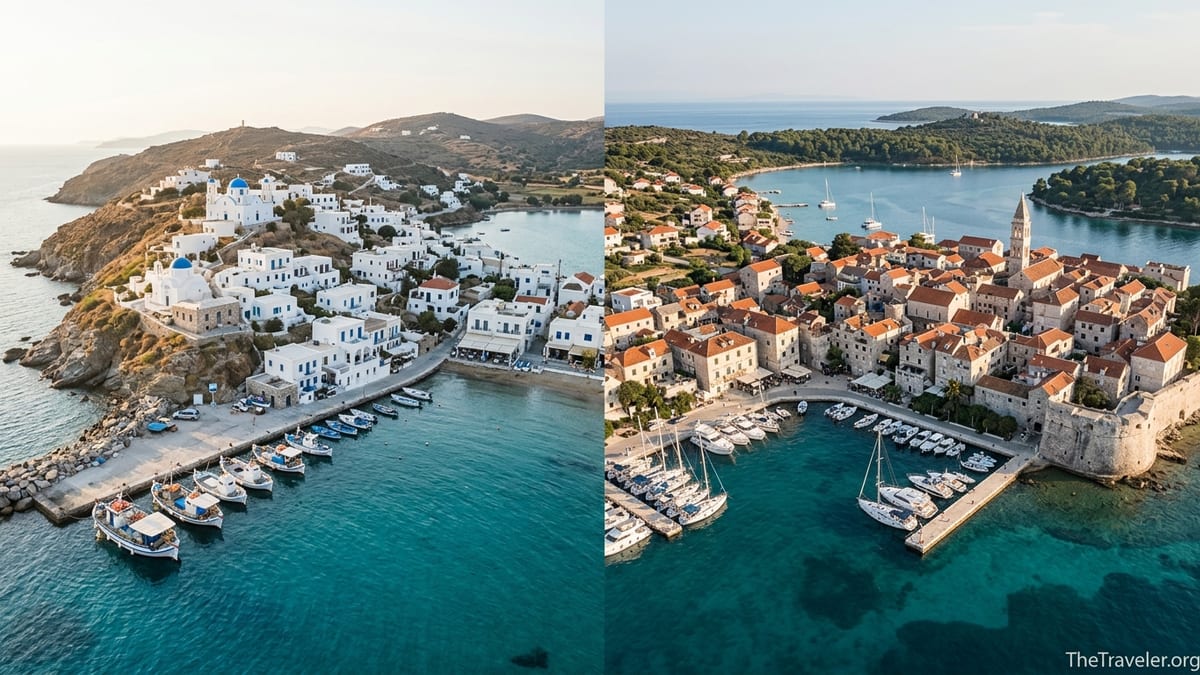
Overall Vibe: What Each Island Chain Feels Like
Greece feels expansive and sun-bleached, with hundreds of inhabited islands scattered across the Aegean and Ionian Seas. Classic destinations like Santorini, Mykonos and Paros sit alongside quieter spots such as Naxos, Milos or Kefalonia. A typical day might be breakfast at a simple café in a whitewashed village, a swim at a cove with turquoise water, then sunset drinks on a terrace facing layers of islands fading into the horizon.
Croatia’s islands feel more compact and green, strung like beads along the Adriatic coast. Many visitors base in Split or Dubrovnik and then hop to nearby islands such as Hvar, Brač, Korčula or Vis. Instead of white cube houses, you see terracotta roofs, Venetian-style bell towers and stone harbours backed by pine-covered hills. Even on busy Hvar, you are rarely far from a quiet pebbly cove or a tiny fishing village with a single konoba, or traditional tavern.
In terms of atmosphere, Greece tends to feel more Mediterranean and wide open, while Croatia feels Central European-meets-Med, with a tidier, slightly more orderly edge. For some travelers, Greece is the place for big, iconic island dreams; Croatia appeals if you like a little more structure, shorter distances and combining islands with standout mainland stops such as Plitvice Lakes or Krka National Park.
Both countries are very safe for visitors and used to international tourism. English is widely spoken in popular areas in both, though you will hear more English-first menus and signage on famous Greek islands and more German or Italian on Croatia’s coast, reflecting its key European markets.
Beaches and Sea: Sand vs Pebbles, Turquoise vs Glass-Clear
This is where many travelers notice the sharpest contrast. Greece wins for sheer variety of beaches. On one trip you might see black volcanic sand at Perissa on Santorini, fine white sand on Naxos’s Plaka Beach, dramatic cliffs plunging into neon-blue water at Navagio on Zakynthos, and silky coves on Milos where you walk across moonlike white rock. Families often like the shallow, sandy shores of the Ionian islands such as Corfu or Lefkada, where children can wade in easily.
Croatia’s beaches are typically pebbly or rocky, but the trade-off is astonishingly clear water. On Brač’s Zlatni Rat, one of the Adriatic’s most famous beaches, white pebbles slope into water so transparent that you can clearly see your toes meters below the surface. Around Hvar Town, locals and visitors escape to nearby Pakleni Islands by boat taxi to swim off flat rocks into deep, jewel-toned coves. You will want water shoes in Croatia, but snorkelers and swimmers often prefer this kind of coastline because visibility is excellent.
Water temperature also differs slightly. The Aegean in Greece can be warmer at the height of summer, especially around the Dodecanese and Cyclades, though strong winds can sometimes make the sea choppy. The Adriatic around Croatia is usually pleasantly swimmable from mid-June through September, with many locals still swimming in early October in sheltered bays. If your ideal beach day means soft sand and long, shallow entries, Greece is the better bet. If you prioritize ultra-clear water and do not mind pebbles, Croatia can be perfect.
Realistically, both destinations deliver the archetypal swim-off-the-boat experience. Take a day cruise from Paros to Antiparos in Greece or from Split to the Blue Cave and Vis in Croatia, and you will be diving into that incredibly blue water either way, just with a different backdrop of architecture and coastline.
Ferries and Island Hopping Logistics
Island hopping works beautifully in both countries, but it feels different in practice. Greece has a much more extensive ferry network, with multiple companies running fast and slow ferries between dozens of islands. In summer, you can connect Athens to the Cyclades, Dodecanese and many Ionian islands and then continue onward between islands without returning to the mainland. Routes like Athens to Mykonos or Santorini often take between 2.5 and 5 hours on modern high-speed ferries, while shorter hops such as Paros to Naxos can be around an hour. In high season, typical one-way fares for popular high-speed routes can be in the range of roughly 40 to 70 euros per person, depending on distance and vessel type.
The downside in Greece is that sea conditions and wind can disrupt schedules, especially in the Aegean where the strong summer meltemi wind sometimes causes cancellations or delays. Journeys can also be quite long. For example, getting from Athens to the more remote islands of the Dodecanese might involve 8 to 10 hours on a conventional ferry. For first-time visitors trying to fit too many islands into a short itinerary, the travel days can start to eat into beach time.
Croatia’s island network is simpler and more compact. The dominant operator runs many of the main lines, with catamarans and car ferries radiating out from hubs such as Split, Dubrovnik and Zadar. A common route such as Split to Hvar typically takes about one hour by catamaran, while Split to Brač can be under an hour on a car ferry. Fares for these shorter hops often come out a bit lower than longer Greek crossings, especially on routes under two hours, which can make Croatia feel more manageable and budget-friendly for travelers who want to move around without committing to very long ferry days.
If you are new to Europe and feel anxious about complex logistics, Croatia’s shorter distances and relatively straightforward route maps can be reassuring. If you have more time and want to string together a proper island odyssey, Greece has far more combinations, from a Cyclades loop such as Mykonos–Paros–Naxos–Santorini to an Ionian chain including Corfu, Lefkada and Kefalonia.
Prices: Accommodation, Food and Day-to-Day Costs
Both Greece and Croatia have become more expensive in recent years, particularly in the most famous hotspots in July and August. Broadly, headline islands like Santorini and Mykonos in Greece and Dubrovnik and Hvar in Croatia now price at a similar premium level. Off the main tourist tracks in each country, costs drop noticeably.
Daily budgets vary widely by travel style, but cost-comparison data and on-the-ground reports suggest that mid-range travelers might expect to spend somewhat more per day in Greece than in Croatia overall. One travel cost aggregator estimates average total daily costs, including accommodation, meals and local transport, in the low- to mid-200 euro range per person in Greece and closer to the mid-100s in Croatia, with big swings depending on whether you stay in major island hubs or smaller towns. In practical terms, that might mean a mid-range double room on a popular Greek island in late July going for 180 to 260 euros per night, versus perhaps 130 to 200 euros on a comparable Croatian island at the same time.
Food and drink show similar patterns. A casual dinner for two with house wine in a simple taverna on Naxos or Crete might come to 40 to 60 euros, while a meal in a busy harbour-front restaurant on Santorini could easily reach 80 euros or more if you add fresh fish and cocktails. On Hvar or Korčula, expect something similar: maybe 35 to 55 euros for two in a family-run konoba away from the main marina, and higher prices at waterfront spots facing the yachts. Quick reference comparisons suggest that everyday items like a fast-food combo or a draft beer often cost a little less in Croatia than in Greece, which aligns with many travelers’ experience that Croatia feels slightly cheaper outside its top luxury resorts.
For budget-conscious travelers, both countries reward you for stepping away from the biggest names. In Greece, that might mean choosing Paros over Mykonos or staying in inland villages on Crete instead of seafront resorts. In Croatia, it could mean basing in Šibenik or on less-hyped islands such as Šolta or Lastovo rather than in the very heart of Dubrovnik’s Old Town. In shoulder seasons like May, early June and late September, room rates and car rentals in both countries can drop significantly compared to peak August prices, making an island trip far better value.
Nightlife, Food and Culture
If you are chasing summer nightlife, both countries deliver, but with different personalities. Greece’s Mykonos and Ios remain big names for beach clubs and DJ sets that run until sunrise, with entry and drinks priced similarly to major party hubs elsewhere in Europe. On the other side of the Adriatic, Hvar Town’s harbor strip turns into a lively scene in July, with bars, open-air clubs and boat parties that attract an international crowd. The island of Pag, particularly the Zrće beach area near Novalja, is Croatia’s answer to a full-scale festival and clubbing destination.
Beyond the big party spots, evenings in both countries revolve around long, late dinners and strolling seafront promenades. Greek food leans toward grilled fish, octopus, tomato-based stews, salads piled with feta and olive oil, and generous portions of dishes such as moussaka, souvlaki and baked vegetables. It is common for tavernas to bring a complimentary dessert or fruit plate at the end of the meal. Croatia’s coastal cuisine mixes seafood risottos, grilled fish and calamari with Italian influences like pizza and pasta. In many konobas, the house specialty might be slow-cooked peka, lamb or octopus baked under an iron bell with potatoes.
Culturally, Greece offers a much deeper ancient historical layer. Even if you focus on islands, you are never far from sites that date back thousands of years, from the volcanic ruins of Akrotiri on Santorini to ancient temples on islands near Athens. Many travelers combine a few days in Athens for the Acropolis and the National Archaeological Museum before or after their island time. Croatia’s story is different: its headline heritage tends to be Roman (Split’s Diocletian’s Palace) and medieval or Venetian (the walled Old Town of Dubrovnik, Korčula’s stone alleys, Trogir’s UNESCO-listed core). If your dream is to walk through classical ruins, Greece is the obvious winner; if you picture climbing medieval ramparts over a shimmering harbor, Croatia will hit the mark.
Language and customs feel broadly similar to visitors used to Mediterranean travel. Coffee culture is strong in both countries, smoking is still relatively common on outdoor terraces, and dinner rarely starts before 8 pm in summer. Greek islands often feel slightly more informal and improvisational; Croatian coastal towns can feel neater, with labelled walking paths and more structured marina areas, particularly around yacht harbors.
Weather, Crowds and Best Time to Go
Summer conditions are broadly comparable, but a few important differences matter for planning. Greek islands, especially in the Aegean, can be hotter and windier. July and August routinely bring daytime highs around 30 to 35 degrees Celsius on islands such as Mykonos or Santorini. The meltemi wind can be a blessing during heatwaves, cooling beaches and making sunsets crystal clear, but it can also produce rough seas that affect ferries and make sailing challenging for beginners.
Croatia’s Adriatic coast enjoys a warm Mediterranean climate with slightly milder summer peaks, particularly in the northern and central parts. In July and August, daytime highs often sit in the high 20s to low 30s Celsius in places like Split or Hvar. Rain is rare but possible as short thunderstorms. Humidity can be noticeable, though sea breezes in the afternoons usually soften the heat. Shoulder months of June and September can be ideal, with warm seas and fewer crowds.
In terms of visitor numbers, both countries now see intense peak-season crowds. Santorini’s caldera viewpoints, Dubrovnik’s city walls and Hvar’s harbor can all feel saturated on an August afternoon. Yet Greece has far more islands and seaside towns, so the pressure spreads out more. You can escape the crowds relatively easily by choosing islands with smaller airports or no airports at all, or by staying in inland villages. In Croatia, the most famous coastal hubs feel more concentrated and manage visitor flows with measures such as time-slot systems for popular walls or old towns in the busiest weeks.
For a first-time European summer trip, many travelers find early June or mid-September sweet spots for both Greece and Croatia: ferries and flights are running frequent schedules, the sea is warm enough for long swims, and accommodation prices are noticeably lower than in late July and August. Families tied to school holidays may need to travel in peak season, in which case booking key ferries, island hotels and rental cars several months ahead is now wise for both destinations.
Which Is Better for First-Time Europe Summer Trips?
For a first-time visitor to Europe who is focused on islands, sunshine and a relatively easy introduction to the region, both Greece and Croatia work well, but each has a slightly different learning curve. Greece offers more direct flights from long-haul markets such as North America to Athens and, in high season, to major islands like Santorini, Mykonos, Rhodes and Crete. That means many travelers can fly straight onto an island without needing to transfer through multiple hubs. The flip side is that once you start island hopping, you are managing a more complex web of ferry tickets and schedules.
Croatia’s main international gateway for island trips is often Split or Dubrovnik, connected to many European cities but with fewer direct long-haul options. For travelers already in Europe, it can be straightforward to connect via hubs such as Frankfurt, Munich, Vienna or London, then immediately board a bus, catamaran or ferry to their first island. Once there, the short distances between islands and the mainland mean less time in transit. It is common to base two or three nights in Split, then add Hvar and Korčula or Brač in one trip, with no individual boat ride much over a couple of hours.
Think about your comfort with do-it-yourself planning. If you are happy using online ferry aggregators, comparing multiple operators and building a multi-stop route, Greece gives you enormous flexibility. If you would prefer something easier to visualize, Croatia’s linear coastline and smaller set of main islands can be more approachable. Package-style one-week small-ship cruises that visit several Croatian islands from Split or Dubrovnik have also become popular with first-timers who want a sample of many places without organizing each leg themselves.
Language, payment and safety are similar in both. Cards are widely accepted in tourist areas, though it is sensible to carry some cash for small kiosks and village cafés. Both use the euro, which simplifies multi-country trips. For many first-time Europe visitors, the bigger challenge is often heat, crowds and managing expectations in famous places rather than any particular difficulty with local systems in Greece or Croatia.
The Takeaway
If your dream summer trip is all about iconic whitewashed villages, long sandy beaches, deep ancient history and big, cinematic sunsets, the Greek islands will probably come closest to the postcard in your mind. You will pay a premium for the most famous islands in July and August, but by choosing slightly less hyped spots and traveling in June or September, you can still find reasonable value and plenty of authenticity.
If you imagine crystal-clear coves against pine hillsides, compact stone towns, easier, shorter ferry hops and slightly lower overall costs, then Croatia’s islands may be the better match. Places like Hvar, Korčula and Brač combine easily with historic Dubrovnik, Split and national parks on the mainland, creating a varied itinerary in a relatively small area.
For many travelers, the ideal solution ends up being not either or, but which first. One summer might be a Cyclades loop out of Athens, the next a string of Adriatic islands from Split. Both countries reward repeat visits and both still have quieter corners if you are willing to step a little away from the biggest names. Whichever side of the Adriatic you choose this time, you are unlikely to regret a week of swimming, island sunsets and plates of fresh seafood by the water.
FAQ
Q1. Which is cheaper overall, the Greek islands or Croatian islands?
Croatia often feels slightly cheaper day to day, especially outside Dubrovnik and Hvar, while Greece’s most iconic islands can be among the priciest spots in the Mediterranean. In less famous areas of both countries, prices become more comparable and you can travel comfortably on a mid-range budget.
Q2. Where will I find better beaches, Greece or Croatia?
Greece generally wins on variety and sandy options, with everything from black volcanic sand to long golden bays. Croatia’s beaches are mostly pebbly or rocky but the water is exceptionally clear, so swimmers and snorkelers often prefer the Adriatic experience even if they need water shoes.
Q3. Is island hopping easier in Greece or Croatia?
Greece has a far larger ferry network and many more island combinations, but routes can be long and sometimes affected by strong winds. Croatia’s island network is smaller and more linear, with shorter, simpler ferry rides from hubs like Split and Dubrovnik, which some first-time visitors find easier to handle.
Q4. Which destination has livelier nightlife?
Both can be very lively in summer. Mykonos and Ios in Greece and Hvar and Pag in Croatia are major party hubs with beach clubs and late-night bars. Outside these hotspots, nightlife in both countries is more about relaxed seafront bars and long dinners than all-night clubbing.
Q5. Which is better for families with children?
Families often appreciate Greece’s sandy, shallow beaches on islands like Naxos, Paros or parts of Crete, plus the option to mix in historical sights. Croatia works well for families who do not mind pebbly beaches and want shorter ferry trips, calm coves for swimming and easy day excursions to national parks.
Q6. How far in advance should I book ferries and accommodation?
In July and August, it is sensible to book ferries and popular island stays at least a couple of months ahead in both Greece and Croatia, especially on marquee routes and in small hotels. In May, June and late September, you usually have more flexibility, though booking your first and last nights in advance is still wise.
Q7. Can I visit both Greece and Croatia on one summer trip?
Yes, but you will need to account for the extra transit. Many travelers fly into one country and out of the other, using a regional flight or a connection through a European hub in between. Combining, for example, Athens and the Cyclades with Dubrovnik and one Croatian island works best if you have at least two weeks.
Q8. Which country is better for history lovers?
If your focus is ancient history, Greece is hard to beat, with Athens, Delphi, Olympia and numerous island sites. Croatia offers outstanding Roman and medieval heritage, such as Split’s Diocletian’s Palace and Dubrovnik’s walls, so it is excellent if you are more interested in those periods than in classical antiquity.
Q9. Is it easy to get around without a car?
On the main islands and in popular towns of both Greece and Croatia, you can manage with ferries, buses, taxis and occasional day tours. A car becomes useful on larger islands like Crete or in rural areas where bus services are limited. Many visitors mix a few car rental days with mostly public transport or walking.
Q10. For a first-time Europe trip, which should I choose if I am still unsure?
If you dream of classic whitewashed villages, ancient ruins and varied beaches, start with Greece. If shorter hops, extremely clear water and combining islands with dramatic walled towns appeal more, begin with Croatia. In either case, keeping your itinerary to two or three bases will make the trip feel relaxed rather than rushed.