


More news on this day
A temporary ground stop at Seattle-Tacoma International Airport led to widespread delays across the Pacific Northwest air network, as takeoffs into and out of one of the region’s busiest hubs were briefly halted before operations gradually resumed.
Get the latest news straight to your inbox!
Brief Halt Triggers Outsize Disruption
Reports from federal aviation traffic management data and airline status boards indicate that departures bound for Seattle-Tacoma International Airport were ordered to remain on the ground for a period earlier in the day, creating an official ground stop that briefly froze much of the airport’s operation. While the pause was lifted within a relatively short time, the stop immediately pushed back departure and arrival times across multiple airlines that rely on Seattle as a primary hub.
Ground stops are a routine but disruptive tool used in U.S. air traffic management when conditions at a destination airport temporarily outstrip its ability to safely handle inbound traffic. Publicly available information shows that the directive covering Seattle-Tacoma was categorized as a collaborative ground stop, an approach in which the national command center and local airspace managers coordinate to meter flights and reduce airborne holding.
Although the ground stop ended as conditions stabilized, the sudden halt left aircraft, crews, and passengers out of position. Throughout the morning and early afternoon, airline status pages continued to show knock-on delays that extended well beyond the formal lifting of the restriction.
By midafternoon, federal dashboard information showed Seattle-Tacoma back in normal operating status with only minor arrival and departure delays, underscoring how quickly headline-grabbing stoppages can give way to more routine congestion once traffic begins moving again.
Weather, Volume and Airspace Complexity Under Scrutiny
Publicly available weather forecasts for the airport pointed to shifting conditions through the day, including low cloud layers and passing showers typical of the region’s changeable patterns. While aviation authorities did not publish a single definitive cause tying the ground stop to a specific meteorological trigger, operational summaries noted a mix of arrival and departure management actions consistent with weather-related constraints.
Seattle-Tacoma’s position as the primary international gateway for the Pacific Northwest adds complexity whenever the airport experiences even a brief slowdown. The hub handles thousands of flights connecting domestic cities with destinations across Asia, Europe, and Alaska, meaning that tight connection windows can quickly erode when departure banks are compressed into shorter timeframes after a stop is lifted.
Industry analyses of past disruptions at Seattle and other major hubs suggest that airports with dense schedules and limited runway flexibility can be particularly vulnerable to short-term imbalances between demand and capacity. When surface conditions, changing winds, or low visibility push operations below their planned throughput, tools such as ground stops and ground delay programs are frequently used to keep aircraft from stacking up in holding patterns.
Local observers tracking traffic patterns around Seattle-Tacoma noted that departure queues lengthened rapidly once the stop was lifted, with aircraft departing in tightly spaced sequences as controllers worked through the backlog. Despite the accelerated flow, average delays remained elevated for several hours as the system absorbed the earlier pause.
Travelers Face Missed Connections and Rebookings
The most immediate impact of the Seattle-Tacoma ground stop was felt by travelers already in the air toward the region or waiting at departure gates across the country. According to airline status tools, many flights headed for Seattle incurred schedule changes ranging from modest pushbacks to delays of an hour or more, feeding uncertainty for passengers attempting to make onward international and domestic connections.
Published coverage from travel and aviation trackers showed that some transpacific departures from Seattle, including long-haul services, were forced into later departure slots than originally scheduled as airlines adjusted aircraft rotations. This, in turn, increased the risk of missed overnight connections in both directions, particularly for routes linking Asia and the U.S. East Coast via the Pacific Northwest.
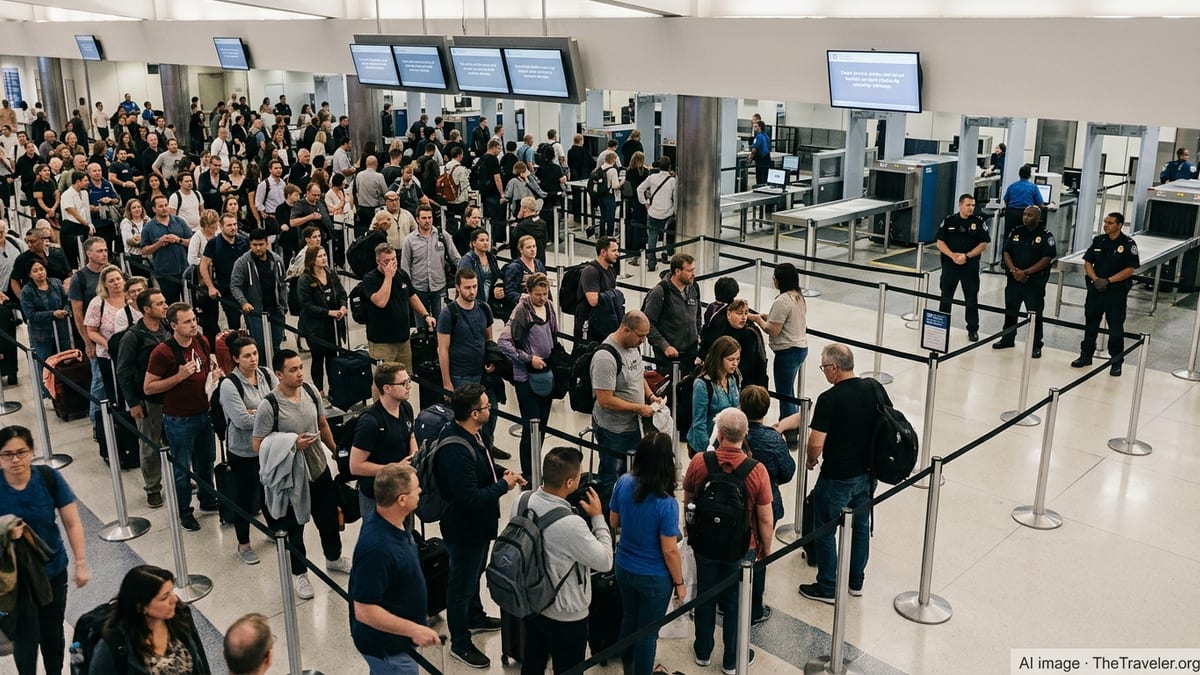
Within the terminal, the combination of delayed arrivals and compressed departure banks contributed to familiar scenes of full gate areas, crowded security queues, and longer waits for customer service assistance. Passengers arriving late into Seattle often faced rebooking onto later flights when minimum connection times could not be met, especially on routes with only one or two frequencies per day.
Standard airline policies typically prioritize same-day reaccommodation for missed connections caused by controllable delays, but when disruption stems from broader traffic-management directives, options can be more limited. Many travelers on affected itineraries were routed onto alternative hubs or offered overnight stays when same-day options were no longer feasible.
Operational Recovery and Lessons for Peak Travel Season
By late afternoon, operational dashboards indicated that Seattle-Tacoma had largely worked through the immediate backlog created by the ground stop, with most airlines reporting on-time or only slightly delayed departures. However, scattered disruptions persisted on some routes as aircraft and crews gradually returned to their original rotations.
For airlines, the episode offered another reminder of the importance of resiliency during the busy summer travel period. Carriers serving Seattle increasingly rely on tight turn times and complex bank structures to maximize aircraft utilization, leaving limited margin when an unexpected constraint, such as a ground stop, compresses the schedule.
Aviation analysts note that airports like Seattle-Tacoma, which operate close to capacity for significant stretches of the day, may continue to experience these kinds of short, sharp disruptions even as infrastructure projects and airspace modernization efforts advance. While new gates, improved taxiway layouts, and enhanced digital coordination tools are gradually being introduced, demand for air travel through key hubs has rebounded faster than many of the physical and procedural upgrades designed to support it.
For travelers planning itineraries through Seattle in the coming weeks, publicly available guidance from airlines and travel advisers suggests building in extra connection time, especially when linking to long-haul services. The latest ground stop showed how quickly a single traffic-management intervention at a major hub can unsettle travel plans across multiple time zones, even after normal operations appear to have resumed.
What the Ground Stop Means for Future Sea-Tac Operations
While ground stops at Seattle-Tacoma remain relatively rare compared with more weather-prone or traffic-saturated hubs, the latest event reinforces the airport’s role as a critical pressure point in West Coast aviation. When capacity dips, even briefly, the effects ripple north and south along the coast and across the interior of the United States.
Public reports from air traffic management programs show a growing emphasis on collaborative decision-making, where airlines, airport operators, and traffic managers share data in real time to fine-tune responses such as ground stops and reroutes. At Seattle-Tacoma, this approach is intended to prevent airborne holding, reduce fuel burn, and keep congestion from spilling over into surrounding airspace and surface roads.
For the traveling public, the incident underscores the value of flexible plans in an era when even short-lived operational constraints can cascade throughout the day. Same-day schedule monitoring, mobile alerts from airlines, and contingency plans for missed connections have become necessary tools for anyone transiting major hubs like Seattle.
As aviation heads deeper into the peak summer period, the Seattle-Tacoma ground stop serves as a case study in how a fast-moving, data-driven response can restore operations, but not without leaving behind a trail of disrupted journeys that may extend well beyond the moment when the airport’s status page turns back to green.