


More news on this day
A temporary ground stop at Hartsfield-Jackson Atlanta International Airport has expired, but travelers are being warned to expect continued delays as airlines work through backed-up departures and arrivals.
Get the latest news straight to your inbox!
Ground stop lifts as operations gradually resume
Flight operations at Hartsfield-Jackson Atlanta International Airport are ramping back up after a Federal Aviation Administration ground stop paused many departures and limited arrivals into the world’s busiest hub. Published data from national air-traffic systems shows the restriction has now expired, allowing flights to begin moving again.
The ground stop, which applied to flights bound for Atlanta, meant aircraft were held at their origin airports until conditions improved. Although Atlanta remained open during the disruption, the reduction in inbound traffic and spacing requirements on the runways significantly slowed the flow of aircraft in and out of the airport.
Once a ground stop is lifted, it can take hours for flight banks to normalize at a major connecting hub. Airlines must re-sequence departures, adjust crew schedules and reposition aircraft, while air-traffic controllers continue to meter flows to avoid further congestion on taxiways and in surrounding airspace.
Early indications from flight-status boards show a mix of delayed and on-time departures, suggesting that while the immediate halt to traffic has ended, the operational impact is far from over for passengers connecting through Atlanta on Sunday.
Weather and congestion behind the disruption
Ground stops at Hartsfield-Jackson are often tied to convective weather in the Southeast, and reports on Sunday point to storms and reduced visibility in the region once again playing a role. Published FAA advisories and local media coverage indicate that thunderstorms moving across Georgia prompted tighter arrival spacing and triggered the short-lived halt on some inbound flights.
Because Atlanta serves as a critical hub for domestic and international traffic, even a relatively brief slowdown can ripple across multiple time zones. Aircraft heading to and from the Northeast, Midwest and transatlantic gateways may all be affected as dispatchers adjust routes and departure times to skirt storm cells and avoid overloading the airspace around the airport.
The airport’s own contingency planning documents note that heavy precipitation and lightning can limit ramp operations, slowing the loading and unloading of aircraft and forcing crews to pause baggage handling and refueling for safety reasons. When those conditions coincide with peak travel periods, the result is often a rapid buildup of delayed flights across several concourses.
Airlines typically respond by implementing ground-delay programs, which space out arrivals over set time intervals. These programs can remain in place after a ground stop expires, meaning that while planes are no longer barred from departing for Atlanta, they may still face controlled release times and adjusted routings.
What travelers are seeing at the terminals
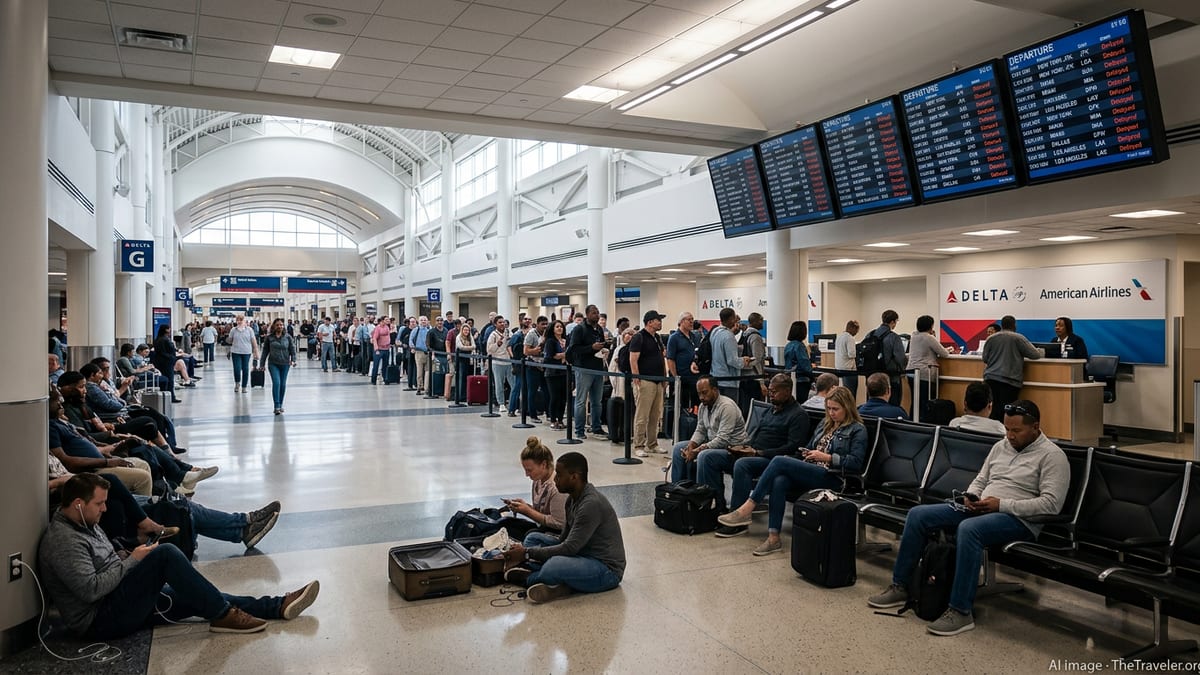
As flights gradually resume, passengers at Hartsfield-Jackson are encountering crowded gate areas, longer-than-normal lines at customer-service desks and tight connections. Real-time tracking platforms show many flights operating with departure delays, particularly on routes that feed Atlanta’s large domestic connecting network.
Inside the airport, publicly available information highlights the scale of the challenge. Hartsfield-Jackson regularly handles hundreds of departures and arrivals each day, and any disruption requires airlines to reshuffle gate assignments and turnaround times across multiple concourses linked by the airport’s Plane Train people mover system.
Travelers arriving late into Atlanta are finding that some onward connections have already left or have been rebooked. Others are being moved to later flights, with some itineraries pushed into the evening as carriers rebuild their schedules one departure bank at a time.
While security operations and ground transportation are functioning normally, terminal congestion can still rise as delayed passengers remain airside longer than planned. Food courts, seating areas and gate zones often become pinch points until the backlog of flights eases.
How long delays may last
Even though the formal ground stop has ended, industry data suggests residual delays can persist for several hours. The duration depends on how quickly airlines can cycle aircraft through the airfield and how stable the weather remains through the afternoon and evening.
At a complex hub like Atlanta, recovery typically involves carefully coordinating departure pushes so that taxiways and runways are not overwhelmed. If additional storms develop near the airport or along key flight corridors, airlines may have to continue using longer routings or reduced speeds, further stretching recovery timelines.
Passengers on later flights may still encounter revised departure times as traffic is resequenced. Aircraft that arrived significantly behind schedule earlier in the day must be turned around, inspected and prepared for their next segments, which can create downstream knock-on effects, including aircraft swaps and last-minute gate changes.
For those with international connections, the impact can be particularly acute, as long-haul departures operate on narrower scheduling windows. If a feeder flight arrives too late to make a transoceanic bank, travelers may be rebooked for the next available service, sometimes extending itineraries by a day.
Advice for passengers traveling through Atlanta today
Travelers scheduled to pass through Hartsfield-Jackson for the rest of the day are being urged, through airline advisories and airport-facing travel coverage, to stay flexible and build in extra time. Same-day itinerary checks via airline apps and departure boards remain essential, as many flights continue to show revised times and occasional gate shuffles.
Experts in airline operations note that passengers with tight connections should monitor both legs of their trip and proactively seek earlier options where available. Those originating in Atlanta are encouraged to arrive at the airport with sufficient time for check-in, security screening and potential terminal changes prompted by rolling schedule adjustments.
For travelers whose flights become significantly delayed or canceled, standard rebooking options remain the primary avenue for relief. Some carriers may offer limited fee waivers or the ability to move to alternative flights when weather-related control measures affect large numbers of passengers, though specific policies differ by airline and fare type.
While the expiration of the ground stop marks a positive step toward normal operations at Atlanta’s main airport, the day is still likely to be challenging for many fliers. Anyone traveling through the hub is advised to keep close watch on real-time updates and prepare for the possibility of lingering disruption before schedules fully stabilize.