


More news on this day
Flights are once again arriving at Philadelphia International Airport after a disruptive air traffic control equipment outage triggered a federal ground stop, but schedules remain badly out of sync and passengers are being warned to expect significant delays throughout Tuesday.
Get the latest news straight to your inbox!
Ground stop lifted, but recovery remains slow
According to publicly available flight tracking data and airport statements, the Federal Aviation Administration lifted the ground stop for arrivals into Philadelphia International Airport on Monday afternoon after an equipment failure at a regional air traffic facility brought traffic to a near standstill. The restriction was relaxed after technicians restored key systems, allowing arrivals to resume.
Local coverage indicates the ground stop affecting Philadelphia was lifted around late afternoon, with some outlets reporting an expiration at about 5 p.m. East Coast time after earlier advisories had already been adjusted during the day as capacity fluctuated. By Tuesday morning, the FAA’s command center site showed no active ground stop for Philadelphia, even as the wider system continued to work through a large backup of flights.
Data cited in regional reports show that more than 400 flights at Philadelphia were delayed and well over 200 were canceled on Monday alone, underscoring how quickly a regional equipment problem can ripple through airline schedules. Average arrival delays of several hours were reported on some routes, and the disruption extended into late-night operations.
On Tuesday, publicly available information from airport spokespeople suggested conditions had improved but not yet normalized. Out of more than 700 scheduled flights at Philadelphia, a relatively modest number of delays and cancellations remained, but these were layered on top of aircraft and crews that were still out of position from the previous day’s ground stop.
What caused the disruption in Philadelphia’s airspace
Reports from aviation outlets and general news coverage indicate that the outage originated at the Philadelphia Terminal Radar Approach Control, or TRACON, the facility that manages arriving and departing traffic for Philadelphia and, in recent years, a large share of the airspace around Newark and other Northeast airports. The problem was described as a failure of a primary communications circuit combined with damage to a backup fiber line.
Information released by federal transportation officials and summarized in multiple news reports points to construction activity in New Jersey as the trigger. A crew working near rail infrastructure reportedly severed a fiber optic cable used as a backup communications route, shortly after the primary telecom circuit supporting the TRACON failed. With both paths compromised, controllers lost reliable access to some of the systems needed to manage high-density approach and departure traffic safely.
Regional reporting notes that the outage affected key radio frequencies and other communication links used to handle aircraft in the busy corridor serving Philadelphia, Newark, New York City, and surrounding airports. To keep the system stable while capacity was reduced, air traffic managers limited the number of flights allowed into the affected airspace by ordering ground stops and flow restrictions.
The event drew renewed attention to long-standing concerns about aging telecommunications infrastructure and complex interdependencies between airports in the Northeast corridor. Previous congressional oversight material has highlighted Philadelphia’s TRACON as a critical node for Newark and other airports and has questioned whether existing equipment and staffing levels leave the system vulnerable to disruptions.
How travelers are being affected across the Northeast
The immediate impact for passengers was concentrated on Monday, when ground stops and equipment-related delays rippled across multiple major airports. Publicly available flight status summaries for Philadelphia and Newark showed hundreds of delays and cancellations, with knock-on effects extending to Boston, New York-area airports, and even farther afield as aircraft and crews ended the day in the wrong cities.
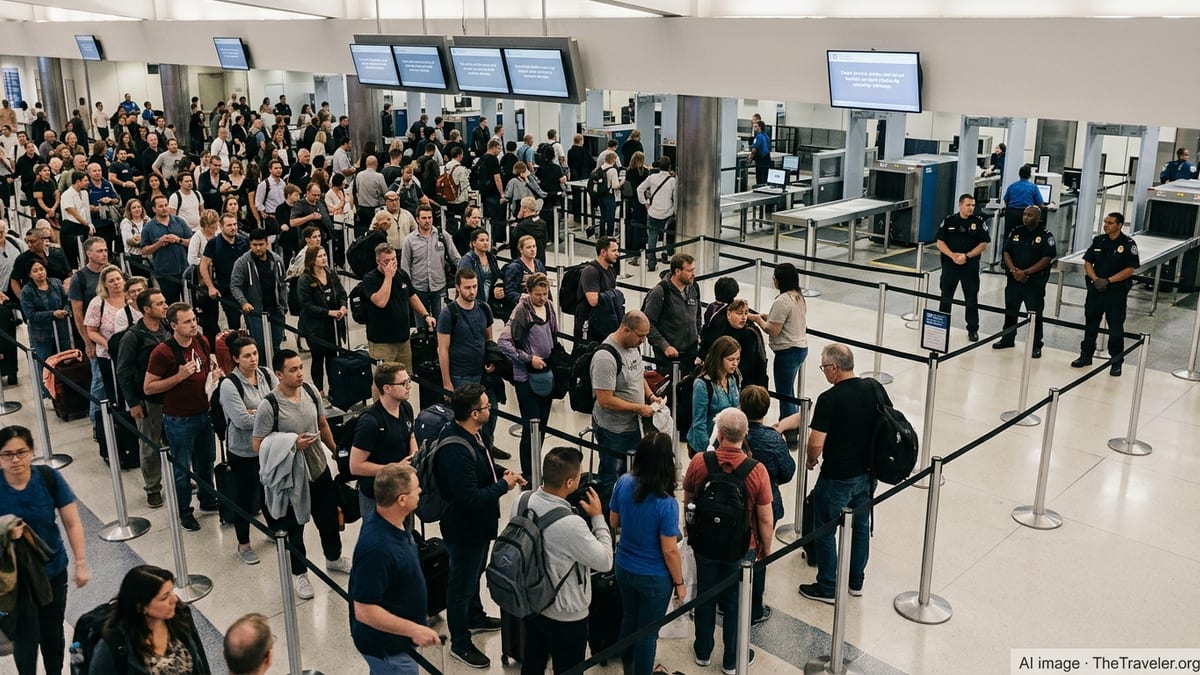
Coverage from regional outlets describes scenes of crowded gate areas and long rebooking lines as airlines attempted to consolidate flights and reassign aircraft once the ground stop was lifted. Some travelers reported being held on the ground for hours awaiting departure clearance or being diverted to alternate airports while the outage was being managed.
By Tuesday, the overall numbers at Philadelphia had decreased substantially, but the delay pattern had shifted rather than disappeared. Remaining disruptions included late-morning and afternoon departures pushed back to accommodate arriving aircraft, as well as cancellations on routes where aircraft could not be repositioned in time. At Newark and other Northeast airports, delays related to Monday’s outage were still visible in system data, though mixed with routine congestion and weather.
Major airlines responded with travel waivers for affected routes, according to publicly posted notices and airline advisories circulated on social media channels. These waivers typically allowed customers booked through the early part of the week to change flights within a limited date range and fare class without additional change fees, offering some flexibility for those willing or able to shift their plans.
Guidance for passengers flying through PHL today
Public messages from Philadelphia International Airport and multiple airlines are urging travelers scheduled to fly on Tuesday to pay close attention to their flight status before heading to the airport. With no active federal ground stop in place, most flights are operating, but adjustments to departure times remain common as the system rebalances.
Passengers are being encouraged through airport and airline channels to use mobile apps and text alerts for the most current information on boarding times and gate changes. Given the potential for longer check-in and security lines during recovery from a major disruption, travelers connecting through Philadelphia or flying at peak times may wish to arrive earlier than usual.
For those whose flights are significantly delayed or canceled, airline policies vary, but many carriers have been waiving change fees and, in some cases, fare differences for rebooked travel within a specified window. Travelers whose plans are flexible may find that shifting to later in the week reduces the risk of knock-on delays tied to the equipment outage.
Anyone with tight connections, especially on international itineraries, may want to build in additional buffer time or consider rerouting if options are available. While the FAA’s national status page now lists Philadelphia without special programs beyond standard flow management, residual congestion can still lead to last-minute adjustments in departure sequences.
Why a single outage can disrupt an entire region
A ground stop is an air traffic management tool used to pause departures headed for a particular airport or region when the arrival capacity there is sharply reduced. Although the restrictions are typically temporary, they can trigger widespread delays when issued in a high-traffic area such as the busy Northeast corridor.
In this case, publicly available information shows that the Philadelphia TRACON’s responsibilities extend beyond the immediate Philadelphia area to include approach control for Newark and a portion of the New York-area airspace. When communications and radar-related systems at that facility were compromised, arrivals across multiple airports had to be slowed until safe separation could be assured with the available tools.
Because many flights operate in tightly timed rotations, hours of reduced capacity on one afternoon can cascade into the following day as aircraft and crew schedules fall out of alignment. Airlines may need to cancel later flights to give crews mandatory rest or to move planes back to their usual bases, which is why passengers can still see cancellations even after a ground stop has been formally lifted.
For travelers, the Philadelphia outage underscores how dependent modern air travel is on well-functioning, redundant communications infrastructure. Industry analysts and policymakers have previously called for targeted investment in critical facilities such as the Philadelphia TRACON to reduce the likelihood that a single construction mishap or telecom failure will again send shockwaves through some of the country’s busiest air routes.