


More news on this day
Flights are departing and arriving again at Philadelphia International Airport after a federal ground stop tied to an air traffic control equipment outage, but travelers are being warned to expect substantial delays and residual disruptions throughout Tuesday as airlines work through the backlog.
Get the latest news straight to your inbox!
Ground stop lifted after Monday’s system failure
Philadelphia International Airport was one of several major Northeast hubs affected on Monday, September 21, 2026, after an equipment outage at a regional air traffic control facility prompted federal traffic managers to halt many flights bound for the region. Publicly available aviation advisories described a ground stop for arrivals into PHL that was tied to an “equipment outage” in the Philadelphia area airspace.
Coverage from regional outlets indicates that the ground stop affecting PHL arrivals was lifted in the late afternoon, with one set of advisories expiring around 5 p.m. local time. By that point, hundreds of flights across the Northeast corridor had been delayed or canceled, and aircraft already in the air were being sequenced into limited arrival slots.
Local reporting on Tuesday, September 22, describes airport operations at PHL as technically open but still heavily impacted, with morning departure and arrival banks operating under extended delays as airlines reposition aircraft and crews. The Federal Aviation Administration’s public status page has shifted PHL from a formal ground stop to delay programs and general delay indicators, reflecting a move from outright suspensions to managed, reduced-capacity operations.
Separate accounts from national aviation coverage link the disruption to damage affecting communications infrastructure serving the Philadelphia Terminal Radar Approach Control facility, which handles approach and departure flows for multiple airports in the region. The outage reduced the ability of controllers to safely manage normal traffic levels, prompting a cascading series of ground stops and delays at PHL and other major airports.
How the equipment outage rippled across the Northeast
Reports from aviation and general news outlets describe Monday’s outage as a regional event rather than an isolated problem at a single airport. Traffic into Newark Liberty International, New York’s LaGuardia and John F. Kennedy airports, and several smaller New York-area fields was also slowed or halted at times as controllers and federal traffic managers worked to cope with reduced capacity in the shared airspace.
Airlines responded by implementing flexible travel policies for affected passengers. Major carriers serving PHL and Newark issued travel waivers covering trips on September 21 and, in some cases, September 22, allowing customers to rebook within specified windows without change fees or fare differences in certain fare classes. These waivers were designed to give travelers options as aircraft and crew rotations were disrupted by the system constraints.
Flight-tracking data compiled in news reports shows that at the height of the disruption on Monday, arrivals to some Northeast hubs slowed to a near standstill for several hours. At PHL specifically, extended gaps in arrival streams coincided with federal advisories instructing departing airports to hold flights on the ground rather than continuing to send more aircraft toward constrained airspace.
By early Tuesday, operations at New York-area airports and PHL were ramping back up, but airlines were still contending with displaced aircraft, crew-duty time limits, and crowded ramp and gate areas. Publicly available information from airline status boards and flight-tracking platforms showed a mix of delayed departures, rolling gate changes, and scattered cancellations as the system attempted to realign.
What travelers flying through PHL can expect today
As of midday Tuesday, September 22, reports from local and national outlets describe conditions at Philadelphia International Airport as improved compared with Monday’s peak disruptions, but still challenging for passengers. Average delay times for some arriving flights were being reported in the range of several hours, and outbound flights were frequently departing behind schedule as aircraft arrived late from previous segments.
Travelers with flights to, from, or through PHL are being advised in published guidance to check their flight status frequently, with particular attention to same-day schedule changes and gate reassignment. Airlines are encouraging the use of carrier apps and text alerts, which can reflect rolling delays more quickly than overhead announcements in the terminal.
For those with flexible plans, rebooking to later flights or even to travel on Wednesday is presented in some advisories as a way to avoid the heaviest congestion. Where travel waivers remain in effect, passengers may be able to shift plans without additional charges, but the specific terms vary by airline and ticket type, so travelers are urged by publicly available airline notices to review the details carefully.
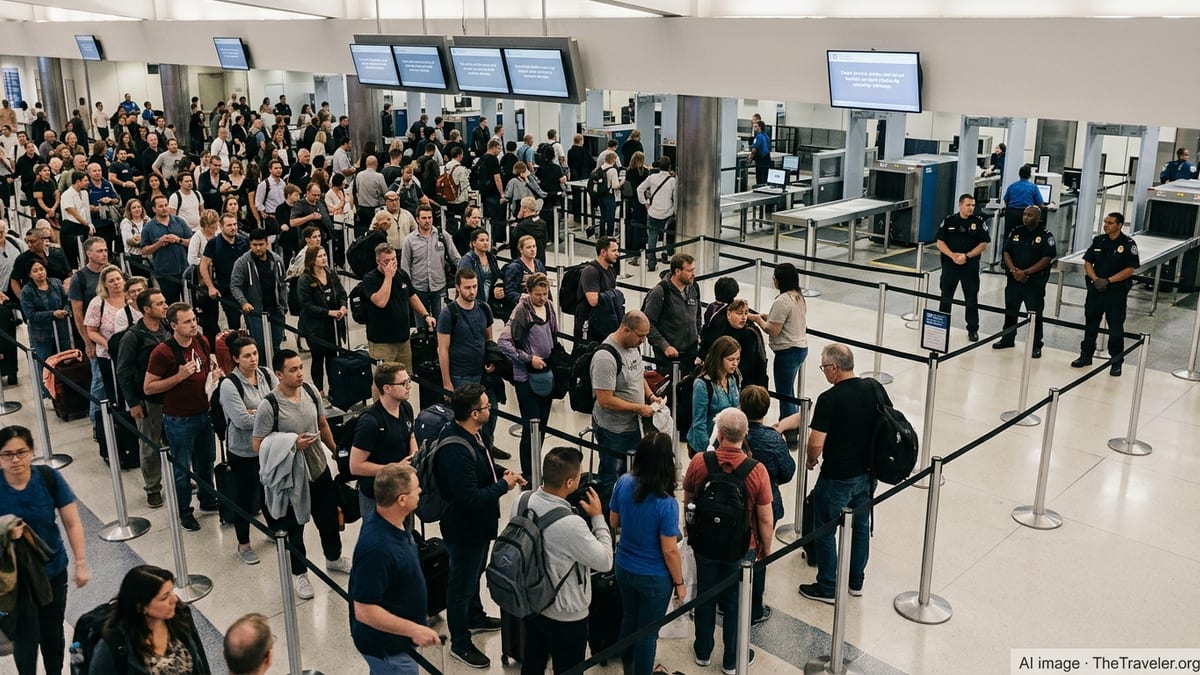
Passengers already at the airport are encountering longer lines at ticket counters and customer service desks as travelers seek new connections or overnight accommodations. While some carriers are offering hotel and meal vouchers under their individual customer-service policies, published coverage notes that assistance is not uniform and may depend on factors such as the length of delay and whether a passenger is on a domestic or international itinerary.
Why disruptions persist even after a ground stop ends
A recurring theme in aviation analysis of Monday’s outage is that lifting a ground stop does not instantly restore normal operations. When a ground stop is in place, flights are held at their origin airports, leading to a queue of delayed departures that must be carefully sequenced once the affected airspace or airport can again accept arrivals at higher rates.
In the case of PHL, once the equipment issue was stabilized and constraints were eased, traffic managers still had to work within conservative arrival and departure rates to ensure safety and avoid overwhelming controllers and airport infrastructure. This meant that even as new flights were permitted to depart for Philadelphia, the airport continued to see rolling delays as it processed the backlog.
Airlines also face operational knock-on effects that extend beyond the formal end of a ground stop. Aircraft that arrive hours late may miss their next scheduled flights, crews can time out under duty rules, and connecting passengers can be left without viable onward options. Each of these variables adds friction to the recovery process and lengthens the period of residual disruption felt by travelers.
Industry observers note in public commentary that the tightly interconnected nature of airline networks means an outage in one region can trigger delays across the country, especially on busy travel days. With key Northeast hubs affected, the Philadelphia-area equipment failure sent schedule ripples into the Midwest, South, and West Coast as aircraft and crews failed to arrive where they were needed for later operations.
Tips for travelers navigating the ongoing delays
Travel advice circulating in consumer and aviation outlets emphasizes preparation and flexibility for anyone flying through PHL or other recently affected Northeast airports. Travelers are encouraged to arrive earlier than usual, particularly if they need to check bags, adjust itineraries at a ticket counter, or clear security during busy morning and evening peaks.
Passengers are also urged in published guidance to monitor both their specific flight and the broader status of their departure and arrival airports. Even when an individual flight appears on time, wider arrival or departure restrictions can quickly lead to schedule adjustments. Keeping an eye on airline communications and airport social media feeds can provide additional context on evolving conditions.
For those with connecting itineraries, aviation-focused commentary suggests considering longer connection times where possible until operations fully stabilize. If a tight connection involves a change of terminals or security checkpoints, travelers may wish to explore alternative routings offered under active travel waivers.
Although the worst of Monday’s outage appears to have passed, publicly available information indicates that PHL and other Northeast gateways will likely experience elevated delays into the evening travel period. Travelers who build extra time into their plans and stay closely engaged with airline updates are best positioned to navigate the lingering effects of the equipment failure.