


More news on this day
Travelers moving through North Texas on Thursday faced another day of heavy disruption as ground stops at Dallas Fort Worth International Airport and Dallas Love Field rippled across airline networks and pushed the number of delayed flights in the region past 900.
Get the latest news straight to your inbox!
Second day of stoppages compounds North Texas disruption
Publicly available data from flight tracking services shows that departures and arrivals at both Dallas Fort Worth International Airport and Dallas Love Field were halted for periods on Thursday, marking the second consecutive day in which federal air traffic managers temporarily stopped most movements into the region’s two major airports.
Reports indicate that the latest ground stop at Dallas Fort Worth was lifted in the late afternoon, with operations gradually resuming afterward, while restrictions at Dallas Love Field eased slightly later in the day. Even after the formal stoppages ended, schedules remained significantly out of position, with dozens of aircraft and crews unable to return to normal rotations.
By early evening, aggregated figures from aviation tracking platforms showed more than 900 flights delayed across the two airports, placing Dallas Fort Worth among the most impacted hubs in the country. Airlines serving the region continued to warn of rolling disruptions as aircraft, flight crews, and connecting passengers attempted to recover from the backlog.
According to published coverage from local outlets, Thursday’s outages followed a difficult operational day on Wednesday, when similar restrictions on traffic into North Texas triggered extensive delays and cancellations, particularly for passengers connecting through Dallas Fort Worth, a major hub for domestic and international routes.
Weather, technology and airspace constraints behind halts
Ground stops are used by federal air traffic managers when conditions at an airport or in surrounding airspace make it unsafe or impractical to accept normal arrival volumes. Aviation guidance notes that these programs are typically linked to severe weather, equipment failures, or other constraints that sharply reduce the number of aircraft an airport can handle at a given time.
Recent advisories published by the Air Traffic Control System Command Center show that Dallas Fort Worth has experienced multiple ground stops and ground delay programs over the past several months as strong storm systems and regional airspace limitations have pushed the network to its limits. In some cases, separate advisories have also noted technical issues affecting facilities that manage traffic flows into North Texas.
Local news accounts describe a combination of heavy thunderstorms and communication or telecom challenges in the Dallas area this week, a pattern that has previously forced air traffic officials to suspend operations at both Dallas Fort Worth and Love Field. When this happens, flights already in the air may be rerouted or slowed, while aircraft that have not yet departed are kept at their origin until capacity returns.
Aviation analysis pieces emphasize that, although ground stops are disruptive for passengers, they are designed as a safety tool intended to prevent congested holding patterns overhead and to give controllers and airlines time to reset the system in a controlled manner.
Over 900 delays ripple through airline networks
On Thursday, Dallas Fort Worth once again ranked near the top of national delay boards, with flight tracking dashboards showing hundreds of departures and arrivals pushed back by an hour or more. Dallas Love Field, while smaller in scale, also reported a high share of delayed departures, with the majority tied to knock-on effects of the regional stoppages.
Because Dallas Fort Worth functions as a central hub for a major U.S. airline, the impact extended far beyond North Texas. Passengers on connecting itineraries through Dallas reported missed onward flights and unexpected overnight stays in hub cities, while airlines worked to rebook travelers on remaining available seats later in the day and into Friday.
Disruptions at Love Field produced similar challenges for point-to-point travelers relying on dense short-haul schedules. With many aircraft and crews out of sequence after multiple days of irregular operations, carriers at the airport faced a shrinking margin to absorb additional delays, and some flights were ultimately canceled when rotations could not be recovered in time.
Operational summaries published by airport and airline dashboards showed that even flights listed as technically on time often departed or arrived later than usual as congestion on taxiways and in terminal operations slowed the pace of recovery once the ground stops were lifted.
Stranded passengers crowd terminals across North Texas
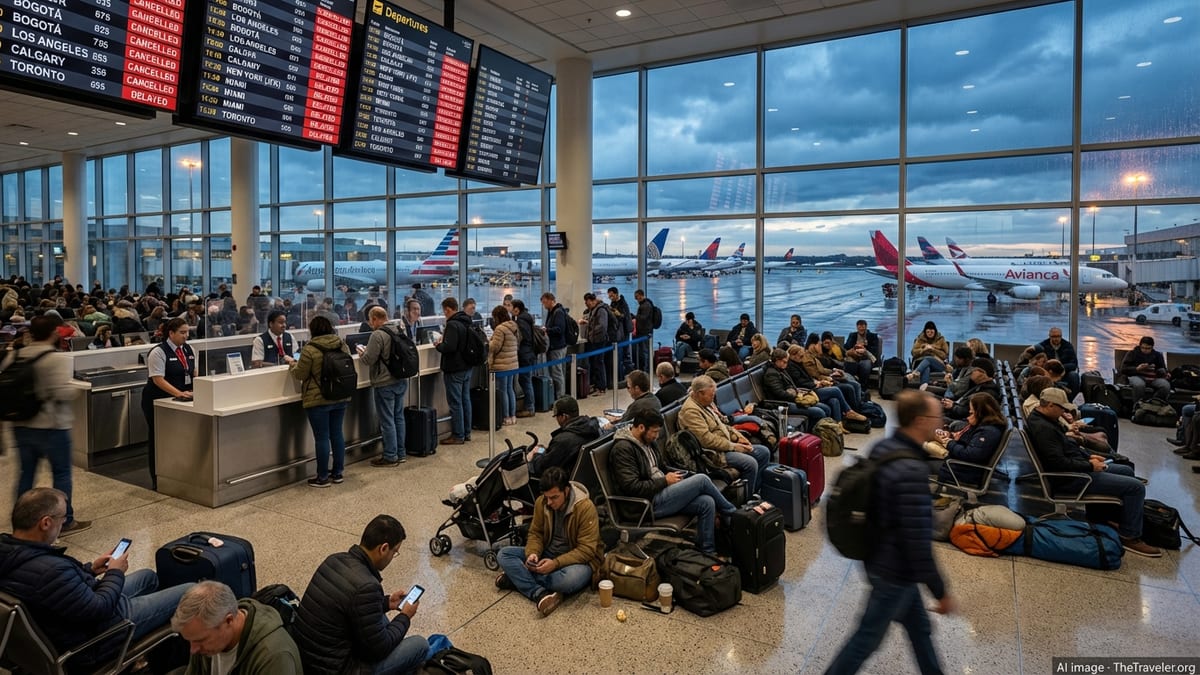
Inside the terminals, images and descriptions shared on social media platforms depicted long lines at check-in counters, security checkpoints, and rebooking desks as travelers attempted to adjust plans on short notice. With thunderstorms passing intermittently through the region, some passengers reported being held on aircraft at the gate while crews awaited updated departure clearances.
Others recounted missed family events, business meetings, and international connections as rolling delays from Wednesday compounded into Thursday. Airline mobile apps and airport information screens periodically updated with new departure times, though passengers noted that changing forecasts and evolving air traffic restrictions frequently rendered those estimates uncertain.
At both airports, overnight travel options became increasingly scarce as evening progressed and flights reached crew duty time limits. Travelers unable to secure same-day alternatives turned to nearby hotels or remained in terminal seating areas, monitoring airline notifications for open seats on early morning departures.
Consumer advocates note that while weather and air traffic control constraints are generally categorized as events outside airline control for compensation policies, carriers are still expected to provide up-to-date information and basic assistance to stranded passengers, particularly those with complex itineraries or special travel needs.
What travelers should know if flying through Dallas
Travel industry guidance suggests that anyone scheduled to pass through Dallas Fort Worth or Dallas Love Field in the coming days should monitor flight status frequently and consider building extra time into itineraries, especially when planning tight connections. Given the scale of the recent disruptions, residual delays and occasional cancellations may continue as airlines reposition aircraft and crews.
Passengers are advised to rely on multiple information sources, including airline apps, airport operations dashboards, and public air traffic advisories, to gain a clearer sense of evolving conditions. When ground stops are active, flights that have not yet departed from their origin may show extended delays even if weather at that departure airport appears clear.
Travel analysts also recommend that passengers with flexible plans consider early-morning departures, which often have more room for recovery if outages develop later in the day. Those with critical same-day commitments may want to explore backup routings that avoid potential bottlenecks in North Texas while the system stabilizes.
As peak summer travel continues, the back-to-back ground stops at Dallas Fort Worth and Love Field highlight how quickly localized weather and infrastructure challenges in a key hub region can cascade across national and international flight networks, affecting travelers far beyond the immediate storm zone.