


More news on this day
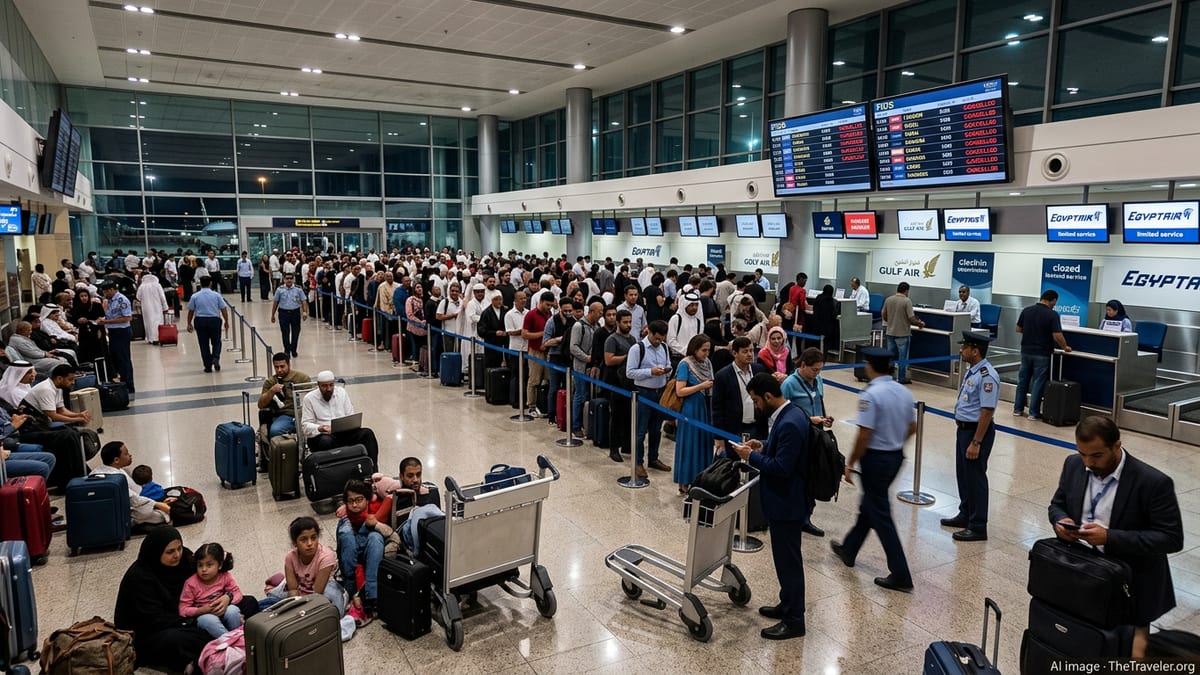
Gulf Air and flydubai have canceled close to a dozen services at Bahrain International Airport in the latest wave of disruption linked to regional airspace instability, disrupting major departure flows to Singapore, Dubai, Muscat, Jeddah, Islamabad, Dhaka and other key hubs.
Get the latest news straight to your inbox!
Fresh Cancellations Hit Bahrain’s Reopening Effort
Recent operational data and airline updates show that Bahrain International Airport is again grappling with short-notice cancellations, even as the kingdom has only recently moved to reopen its airspace and gradually restore traffic. Publicly available schedules and tracking platforms indicate that several Gulf Air departures that had been restored in early April are now withdrawn or marked as canceled, particularly on regional and South Asian routes connecting through Bahrain.
Travel industry coverage notes that Bahrain had positioned its reopening as a turning point after weeks of wholesale suspension of flights, with Gulf Air resuming a slimmed-down network to cities such as Dubai, Jeddah, Dhaka and Islamabad. Yet the renewed cancellations this week underline how fragile those plans remain as airline planners respond day by day to evolving security assessments and airspace restrictions across the wider Middle East corridor.
These reversals are being felt most sharply on high-demand departure banks that funnel passengers onward to Asia and the Gulf, including itineraries pairing Bahrain with Singapore, Dubai and Muscat. For travelers who had already rebooked onto the first wave of restored services, the renewed disruption is creating a second round of itinerary changes, refunds and overnight delays.
While Bahrain International Airport remains technically open, operational bulletins compiled by logistics and aviation risk firms point to a pattern of selective cancellations rather than a full shutdown, as airlines weigh load factors, alternative routings and crew duty-time constraints against the backdrop of continued regional uncertainty.
Gulf Air Adjusts Network via Dammam and Limited Bahrain Operations
Gulf Air, Bahrain’s national carrier, has been at the center of the turbulence since the initial closure of Bahraini airspace. Earlier advisories collated by consultancies and industry trackers described Gulf Air operations to and from Bahrain as suspended, with the airline building a temporary network routed through nearby Dammam in Saudi Arabia instead of its home hub. Subsequent updates in early April, highlighted in regional travel trade coverage, showed a cautious return of direct Bahrain flights to destinations including Dubai, Jeddah, Riyadh, Dhaka and Islamabad.
The latest adjustment appears to blend these two approaches. Schedules now indicate that while some Bahrain departures are operating, others are cut on short notice, and selected routes continue to be served only through the temporary Dammam hub. Reports from aviation data providers show that flights marketed to cities such as Dhaka, Lahore and Islamabad have been periodically rerouted or canceled outright, depending on the day and the viability of transit flows.
Passengers bound for Singapore and other long-haul Asian destinations are among the hardest hit, as Bahrain’s role as a connective waypoint has been sharply reduced. With Gulf Air still operating a patchwork of services and focusing on limited, high-priority routes, some travelers are being advised via public channels to accept rerouting through alternative regional hubs or to travel overland to Dammam to pick up replacement flights.
Consumer forums and traveler reports reflect widespread confusion over which Gulf Air services are genuinely operating from Bahrain on any given day. While the airline’s official channels continue to urge passengers to check their flight status before leaving for the airport, the pattern of short-notice cancellations has made advance planning especially difficult for those connecting from secondary cities.
flydubai Reduces Bahrain Frequencies Amid Wider Gulf Disruptions
flydubai, which has been running a reduced schedule across the Gulf due to broader airspace concerns since late February, is also reported to have cut several Bahrain rotations in recent days. Operational updates published on the airline’s own information pages emphasize that its network remains trimmed, with some airports seeing suspended or sharply reduced service while others receive limited daily flights subject to change.
Industry reporting from regional business outlets indicates that flydubai continues to operate a constrained schedule to and from Dubai, using a mix of regular and specially arranged services. However, with Dubai itself affected by earlier closures and ongoing capacity challenges, marginal routes such as short-haul links to Bahrain have become prime candidates for cancellation when aircraft and crew are reassigned to higher-demand corridors or repatriation-style services.
At Bahrain International Airport, that has translated into a cluster of canceled flydubai departures on what would normally be heavily traveled days, particularly around peak travel periods and late-evening departure windows. Passengers booked on Bahrain–Dubai segments are being redirected, according to public advisories, either to later flights or to alternative Gulf gateways, depending on availability and ticket conditions.
Because flydubai often serves as a feeder into the broader Dubai hub for onward journeys to Europe, Africa and Asia, the cancellation of even a handful of Bahrain flights can cascade into missed connections and extended layovers. Travelers who thought they had secured a path out of the disruption zone via Dubai are again finding themselves forced to rebook complex itineraries, sometimes at short notice and higher cost.
Regional Context: Asia and Gulf Hubs Under Strain
The flight cancellations at Bahrain International Airport are unfolding against a wider backdrop of instability across Asian and Gulf air corridors. Travel and aviation news outlets tracking daily disruption tallies across the region report hundreds of cancellations and thousands of delays on a single day, with Bahrain appearing among a long list of affected markets alongside major hubs in China, South Korea, Singapore, Indonesia and the wider Middle East.
Recently compiled disruption briefs from logistics and travel risk firms point to a patchwork of closures, partial reopenings and airspace restrictions that has left network planners with limited flexibility. On one hand, some carriers are cautiously restoring limited services to Gulf airports such as Dubai, Muscat and Jeddah, often with revised routings that avoid sensitive airspace. On the other hand, lingering uncertainty has kept other airlines operating under special frameworks or suspending flights entirely on selected routes through the end of April and beyond.
In this landscape, Bahrain’s attempts to resume normal operations are particularly vulnerable. The airport’s role as a secondary hub means it depends on stable connectivity to larger centers like Dubai and Jeddah, as well as to South Asian and Southeast Asian destinations such as Dhaka, Islamabad and Singapore. When those partner airports and corridors face their own disruptions, Bahrain quickly becomes a pinch point rather than a reliable transfer option.
The net effect for travelers is a heightened risk of rolling cancellations, even on routes that appear active on booking systems. Experts cited across trade and business media caution that published schedules throughout April should be treated as provisional, with actual operations often decided in the final 24 to 48 hours before departure.
What Travelers Through Bahrain Need to Do Now
For passengers booked on Gulf Air or flydubai services touching Bahrain International Airport in the coming days, the evolving pattern of cancellations has immediate practical implications. Travel advisories from airlines and airport authorities emphasize the importance of checking live flight status repeatedly in the 24 hours before departure and again just before leaving for the airport, as even same-day schedule changes have become more frequent.
Those connecting from Bahrain to Singapore, Dubai, Muscat, Jeddah, Islamabad or Dhaka are being urged in widely shared guidance from travel agents and industry commentators to build in longer connection times where possible and to consider flexible ticket options that allow rerouting via alternative hubs. Carriers based in other Gulf states and in South Asia are, in some cases, adding limited relief capacity on unaffected routes, but seats on those flights are in high demand.
Passengers already at Bahrain International Airport when cancellations are announced are facing crowded rebooking desks and extended waits, according to traveler accounts circulating on forums and social media. With hotel capacity in the vicinity also tightening during peak disruption days, some airlines are prioritizing rebooking onto the next available service over extended accommodation support, particularly for economy-class travelers on discounted fares.
Given the volatility, travel planners suggest that anyone who has not yet started their journey but holds tickets through Bahrain consider discussing alternative routings with their airline or travel agent, especially for nonessential trips. For those who must travel, the key recommendations are to stay informed, travel with digital copies of all bookings and to be prepared for last-minute changes as Gulf Air, flydubai and other carriers continue to recalibrate their Bahrain schedules in response to fast-moving regional developments.