


More news on this day
Gulf airlines are navigating a paradoxical moment in 2026, with robust demand and record profits colliding with airspace closures, Red Sea shipping disruption and political tensions that are reshaping routes across the wider Middle East.
Get the latest news straight to your inbox!
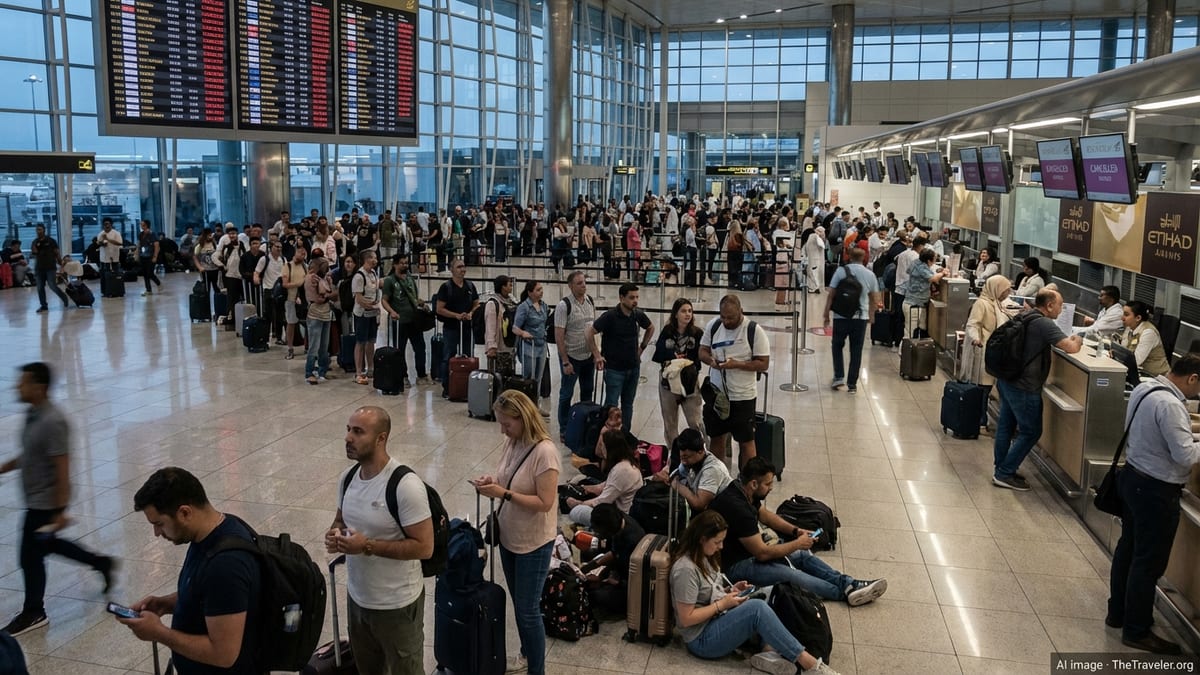
Record Profits Mask Rising Operational Risks
Publicly available financial results show that leading Gulf carriers have emerged from the pandemic period in a position of unusual strength. Emirates Group, based in Dubai, reported record profit and revenue for its 2024–25 financial year, cementing its status among the world’s most profitable airline groups even as new corporate tax rules took effect in the United Arab Emirates. Similar momentum has been evident across much of the Gulf, with passenger numbers, yields and load factors supported by resurgent long haul travel and expanding tourism projects in the region.
Beneath the headline figures, however, the cost of operating in an unstable neighborhood is increasing. Airlines domiciled around the Gulf rely heavily on sixth freedom traffic that connects Europe, Africa and the Americas with Asia and Australasia via their hubs. Conflicts in Gaza, Yemen and along Israel’s borders, along with periodic missile and drone incidents, have triggered a patchwork of airspace advisories and risk assessments that carriers must constantly update. The result is a complex web of reroutings, schedule changes and added fuel burn that erodes some of the recent financial gains.
Analysts note that robust cash balances and strong recent profitability give leading Gulf airlines a cushion that many competitors elsewhere lack. Yet the same hub geography that underpins their business model also exposes them most directly to regional flare ups. Investors and aviation planners now routinely factor in the possibility that a sudden escalation could alter flight paths overnight, interrupting carefully calibrated networks built around fast east west connectivity through Gulf hubs.
Red Sea Disruption Ripples Into the Skies
The crisis in the Red Sea, where attacks on commercial vessels have sharply reduced traffic through the Bab el Mandeb Strait and Suez Canal since late 2023, is often framed as a shipping story. But the knock on effects are increasingly apparent for aviation in the Gulf. Longer maritime routes have pushed up logistics costs and delivery times for jet fuel and spare parts on some corridors, feeding into the cost base of regional carriers. Industry research indicates that many container and tanker operators have diverted around Africa’s Cape of Good Hope, extending voyages by up to two weeks and raising freight rates on several key trades.
For Gulf airlines, the primary aviation impact of the Red Sea crisis has been indirect, through its drag on global trade and supply chains. Slower and more expensive shipping affects the belly cargo business that is a core revenue stream for long haul widebody fleets operated by Emirates, Qatar Airways and others. Studies of global trade flows show that rerouting around the Cape has reduced overall export volumes compared with pre crisis levels, even as capacity in the container fleet has increased. That combination can pressure yields on certain cargo lanes and complicate planning for fleet utilization.
At the same time, persistent security concerns along the Red Sea corridor have reinforced perceptions of the broader region as volatile, which can weigh on traveler sentiment. While there is little evidence of a sustained collapse in demand for major Gulf hubs, some corporate travel buyers and tour operators have reported a preference for routings perceived as more politically distant from areas of active conflict. This has particular relevance for secondary Gulf carriers that lack the brand strength and network breadth of the largest players and therefore have less room to discount or redeploy capacity quickly.
Airspace Closures Force Expensive Detours
The most visible aviation specific impact of Middle East tensions has been the closure or restriction of airspace over and around conflict zones. Since the outbreak of the Gaza war in October 2023, several states and aviation regulators have periodically advised airlines to avoid overflying parts of Israel, Lebanon, Syria, Iraq and Yemen. Additional episodes, including missile strikes and drone activity targeting urban areas and infrastructure, have reinforced the perception of heightened risk along traditional great circle routes linking the Gulf with Europe and North America.
In practical terms, these restrictions translate into longer flight times, increased fuel consumption and additional crew costs. Routes that once crossed northern parts of the Middle East are sometimes being pulled further south over the Arabian Sea or north over Turkey and the Caucasus, depending on the carrier’s risk tolerance and bilateral agreements. For heavily trafficked corridors such as Doha or Dubai to London, Paris and Frankfurt, even modest increases in block time can add millions of dollars in annual operating expense when multiplied across daily frequencies.
Reports from airline scheduling teams and independent route analytics providers indicate that carriers have responded with a mix of tactics. Some have trimmed frequencies on marginal routes where added costs outweigh demand, while others have upgauged aircraft on constrained services to preserve seat capacity with fewer movements. A number of Gulf airlines have also accelerated the retirement of older, less fuel efficient widebodies, betting that newer aircraft can better absorb the operational penalty of detours without undermining profitability.
Gulf Carriers Diverge in Strategy and Exposure
While the region is confronting a shared set of geopolitical risks, Gulf airlines are not experiencing the turbulence in identical ways. Industry coverage of Qatar Airways, for example, highlights how the flag carrier’s extensive network into conflict adjacent markets has required more route adjustments and schedule changes than some of its peers. Detours around sensitive airspace, combined with shifts in premium traffic linked to energy markets and corporate travel policies, have contributed to margin pressure even as overall demand for connecting traffic remains solid.
By contrast, Emirates, with its scale at Dubai International Airport and a diversified network spanning six continents, has so far absorbed the shocks while still reporting record results. Public documents and aviation analysis suggest that its large fleet of Airbus A380 and Boeing 777 aircraft, coupled with strong leisure and visiting friends and relatives demand, has given it a degree of pricing power even as costs rise. Budget focused affiliates in the region, including carriers based in the United Arab Emirates and Saudi Arabia, operate with thinner margins and have been more exposed to swings in fuel prices and passenger sentiment.
Saudi Arabia’s aviation strategy adds another layer of complexity. The kingdom is investing heavily in new airports and tourism destinations on the Red Sea coast, positioning its carriers and infrastructure as gateways to emerging resort clusters. That long term bet depends on perceptions of stability in nearby waters and flight corridors. Any renewed escalation affecting maritime or airspace security could undermine efforts to attract high spending tourists and global investors, even as domestic demand for air travel continues to grow.
Passengers Confront Higher Fares and Shifting Networks
For travelers using Gulf hubs, the region’s geopolitical turbulence is most directly felt in fares and itineraries. Independent fare trackers and travel agencies report that on some long haul markets connecting through the Gulf, ticket prices have remained elevated relative to pre conflict levels, reflecting both strong demand and higher operating costs. Where flights have been rerouted around closed or restricted airspace, longer flight times can also reduce the number of daily rotations an aircraft can perform, tightening capacity and reinforcing upward pressure on prices.
Schedule reliability is another emerging concern. While major Gulf carriers have generally maintained high completion rates, isolated cancellations and last minute routing changes tied to evolving security assessments have become more common on certain corridors. Passengers connecting through the region are advised by travel intermediaries to allow additional buffer time for transfers and to monitor itineraries closely in the days before departure, particularly during periods of heightened regional tension.
Despite these challenges, the Gulf’s role as a global aviation crossroads remains intact. Publicly available traffic data continues to show strong flows of passengers transiting through Doha, Dubai, Abu Dhabi and Jeddah as travelers take advantage of dense networks and competitive service standards. The current phase of regional turbulence has therefore not displaced the Gulf from the center of global air connectivity, but it has made clear that the model rests on constant adaptation to fast moving political and security realities.