


Most visitors arrive in the Bay of Naples with the same checklist: Pompeii, Capri, maybe a hurried loop along the Amalfi Coast. Yet just beyond those famous names lies a string of little islands, volcanic headlands and working harbors where Neapolitan life unfolds largely out of sight of tour buses. With a bit of curiosity and a flexible schedule, you can swap crowded viewpoints for quiet swimming coves, family trattorias and archaeological sites where you might share a whole terrace with just a handful of locals.
Get the latest updates straight to your inbox!
Why Look Beyond the Classics
The Bay of Naples is compact enough that you can reach most of its “hidden” corners in under ninety minutes from central Naples, usually by local train, ferry or bus. That makes it ideal for travelers who want a softer kind of discovery: sleepy seaside towns, lesser known ruins and wild headlands rather than a packed schedule of bucket-list stops. It is also one of the few places in Italy where you can combine active volcanic landscapes, world-class archaeology and uncomplicated beach days without long transfers.
In practical terms, looking beyond the classics often means accepting simpler infrastructure. In places such as Nerano or the fishing villages of Procida, you will find pebble beaches instead of decked-out beach clubs, local bars with plastic chairs instead of rooftop cocktail lounges, and guesthouses run by families rather than design hotels. The trade-off is powerful: lower prices, more contact with locals, and a feeling that you have stepped into the everyday Bay of Naples rather than a stage set built for visitors.
For most of the places below, allow at least half a day, and more if you like to linger. Public transport is affordable, with regional train tickets from Naples to Pozzuoli or Baia often costing just a few euros, and ferries to nearby islands such as Procida typically priced in the range many travelers would happily pay for a taxi in a major city. The key is to travel early or late in the day in high season, when temperatures and crowds both drop, and to book ahead for any guided excursions that have limited daily numbers.
Campi Flegrei: Volcanic Coast Without the Crowds
West of Naples, the Campi Flegrei, or Phlegraean Fields, form a huge volcanic caldera that few foreign visitors ever hear about. The area takes in working towns such as Pozzuoli and Bacoli, the thermal ruins of Baia and a coastline of curved bays and headlands shaped by ancient eruptions. You can reach Pozzuoli on the local train from Naples in around 35 minutes, and from there buses and short taxi rides connect to smaller centers such as Baia and Miseno. The atmosphere is immediately different from the city: fishing boats instead of cruise ships, neighborhood markets instead of souvenir stands.
History runs deep here. The coastal stretch around Baia and Bacoli was a Roman playground, with sprawling villa complexes descending the hillsides toward the sea and grand cisterns such as Piscina Mirabilis in Bacoli described by recent travel writers as evocative as a stone cathedral. Today the Parco Archeologico dei Campi Flegrei, headquartered in the Aragonese castle at Baia, links several of these sites across the region, yet even on sunny weekends visitor numbers feel modest compared to Pompeii. Entry fees are generally low enough that you can visit multiple sites in a day without straining your budget.
Campi Flegrei is also a place to feel the living geology of the Bay of Naples. Around Pozzuoli and Solfatara you notice fumaroles and warm ground underfoot, while Capo Miseno is the rim of an ancient volcanic structure now covered in Mediterranean scrub. Local authorities monitor seismic activity closely and minor tremors are not unusual, but current expert assessments indicate that an eruption is not considered imminent. For travelers this means an added layer of fascination: villages and vineyards thriving inside one of the most closely watched volcanic systems in Europe, yet carrying on much as they have for decades.
Baia and the Sunken Roman City
Of all the hidden corners around the bay, Baia may be the most surprising. Once an exclusive Roman resort described in modern accounts as a kind of “ancient Positano,” much of it now lies underwater due to gradual sinking of the coastline. The result is the Parco Archeologico Sommerso di Baia, an underwater archaeological park where mosaic floors, porticoes and statues rest a few meters below the surface. Despite this, it attracts a fraction of the visitors who queue daily for Pompeii or Herculaneum.
Experiencing Baia’s underwater city is easier than it sounds. From the small harbor, local operators run glass-bottom boat tours that allow you to peer straight down at submerged villas while a guide explains what you are seeing. For more immersive visits, snorkeling excursions typically last around two to three hours, including a short boat ride to the site. Recent listings from local diving centers suggest that guided snorkeling trips are usually priced in a range that compares to a mid-range restaurant meal in Naples, with all equipment provided, and small groups to minimize impact on the ruins.
Certified divers can explore deeper sections of the park on guided dives in shallow, calm water that many describe as technically easy. Visibility varies with conditions, but when it is clear you can hover over geometric mosaics, follow ancient road lines and inspect toppled columns while fish weave through the remains. For those who prefer dry land, the hilltop Baia castle houses the main archaeological museum of Campi Flegrei, with exhibits from across the region and terraces that look out over the entire caldera and the islands of Procida and Ischia. It is an excellent combination: one site that shows you how Baia looked above water, and another that reveals what now lies beneath.
Capo Miseno and the Quiet Bays of Bacoli
Drive or take a local bus from Baia a short distance west and you reach Bacoli and Capo Miseno, at the very rim of the bay. Miseno was once the home port of the Roman fleet, but today it feels more like a laid-back beach town than a historic heavyweight. The long arc of Miliscola and Miseno beaches is popular with Neapolitans on summer weekends, yet visitors from abroad are still relatively few. Outside of high season you can find room to spread out on the sand or book a simple sunbed and umbrella at one of the lidos for less than the prices typically charged along the Amalfi Coast.
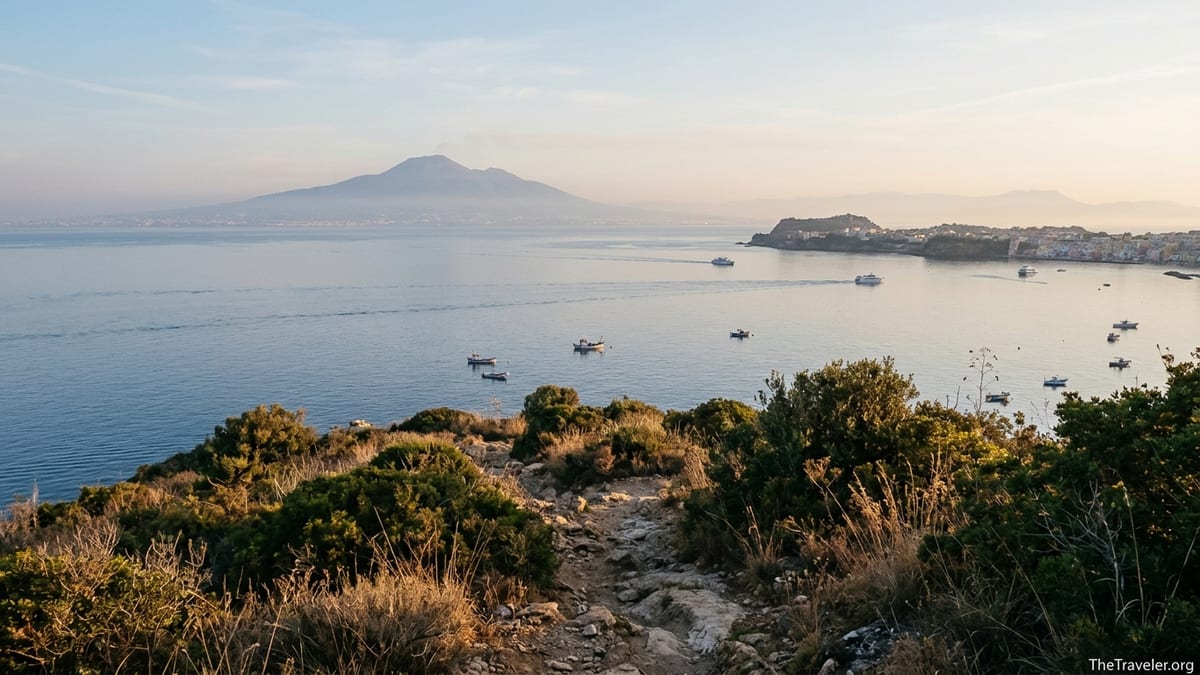
The real surprise here is above the beach. From the back of Miseno, a well-marked hiking trail climbs the slopes of the volcanic headland on what locals call the Sentiero degli Uccelli or Bird Trail. The path, traced on the flanks of an old crater and protected as part of a regional park, leads to a lighthouse and several natural terraces with wide-open views across the bay. Local walking guides suggest that the route is short but steep in places, requiring sturdy shoes and a bit of care in hot weather. In return you get a perspective that many visitors never see: the Bay of Naples spread out like an amphitheater, Vesuvius to the east, Procida and Ischia just offshore and the semicircular outline of the ancient caldera clearly visible.
Back at sea level, Bacoli’s small historic center and lakeside promenade around Lago Miseno offer a gentler way to pass the afternoon. Cafes serve espresso and cornetti to locals heading to work, and family-run trattorias feature the kind of seafood dishes that rarely appear on tourist menus in the city, such as pasta with tiny local clams or fried anchovies served by the paper cone. Prices tend to be noticeably lower than in better-known coastal towns, particularly if you sit at unassuming neighborhood spots a street or two back from the water.
Procida: The Everyday Island
Capri’s silhouette dominates the brochures, but the small island of Procida, between Naples and Ischia, remains quietly residential. Italian travelers know it well, especially since its turn as Italian Capital of Culture in 2022, yet many foreign visitors still skip it entirely. Ferries and faster hydrofoils connect Procida with Naples and Pozzuoli in around 30 to 60 minutes depending on the route, and in high season multiple sailings per day make it a convenient day trip. Because the island is only a few square kilometers in size, most visitors explore on foot, with local buses filling in the gaps.
Procida’s charm lies in the details: pastel houses stacked above the fishing harbor of Marina Corricella, laundry lines strung between balconies, fishermen repairing nets by hand. Travel writers who have spent time here describe walking entirely around the island coastline in a day, linking black-sand beaches such as Chiaiolella and Ciraccio with quiet hilltop lanes and the fortified village of Terra Murata. Prices in local cafes and bakeries are often comparable to or slightly above those in Naples, especially if you avoid the most scenic terraces in favor of backstreet bars where an espresso typically still costs around the same as in the city.
Unlike Capri, Procida has limited high-end infrastructure. There are a few boutique hotels and mid-range guesthouses, but also modest rooms above restaurants and simple holiday apartments aimed at Italian families. This keeps nightlife low-key. Even in summer you are more likely to hear the clink of glasses from neighborhood wine bars than the thump of beach clubs. A practical strategy is to arrive on an early ferry, walk up to Terra Murata for sweeping views and a visit to the former prison complex if it is open, then drop back down to Marina Corricella for a late seafood lunch before spending the afternoon on one of the island’s beaches.
Nerano and the Wild Bay of Ieranto
On the far tip of the Sorrentine Peninsula, where most visitors race past toward Positano, the tiny village of Nerano looks out over some of the clearest water in the region. It is technically part of Massa Lubrense, yet it feels a world away from the traffic of Sorrento. The main beach, Marina del Cantone, mixes simple pebble stretches with a row of low-key beach clubs and trattorias. Here you will see a mix of local families, Neapolitan weekenders and a much smaller number of foreign travelers than on neighboring Amalfi Coast beaches.
The real gem, however, lies just beyond the village. From the central square of Nerano, a signed path leads out toward the Bay of Ieranto, a protected inlet managed in cooperation with the national environmental trust. Multiple hiking organizations and local guides describe this trail as one of the most scenic in the region, contouring along the hillside with constant views of Capri and the open sea. The walk is not technically difficult but does involve uneven surfaces and significant sun exposure, so carrying plenty of water and starting early in summer are both wise.
At the end of the path, steps descend to a narrow cove with translucent water where motorboats are restricted as part of the marine protected area. In high season, local associations sometimes cap visitor numbers or encourage advance registration to prevent overcrowding and protect the environment, so it is worth checking current arrangements with the tourist office in Massa Lubrense or through your accommodation. Once you arrive, facilities are minimal: no loungers, no loud music, just rocks, water and a view of Punta Campanella and Capri’s cliffs in the distance. For many travelers used to busy Amalfi beaches, that simplicity is precisely the attraction.
Local Neighborhoods: Pozzuoli, Santa Lucia and Beyond
Not every hidden gem involves a hike or boat ride. Some are simply neighborhoods where life continues at a gentler pace just beyond the main visitor routes. Pozzuoli, a short train ride west of Naples, is one of these. The town’s seafront and compact historic center sit on the edge of the Campi Flegrei caldera, with an ancient Roman amphitheater and marketplace embedded directly into the urban fabric. In the evenings, residents drift along the harbor promenade for a passeggiata, stopping for gelato or paper cones of fried seafood from casual stands that rarely make it into English-language guidebooks.
Within Naples itself, areas such as Santa Lucia and the working harbor at Mergellina give a different perspective from the historic center’s narrow lanes. Early in the morning you can watch fishermen sell their catch directly from small boats while locals line up for inexpensive paper plates of freshly fried anchovies or tiny shrimp. Prices here tend to be lower than in the more polished waterfront districts closer to the main cruise terminals, and you are surrounded mostly by Neapolitans rather than tour groups. For travelers interested in food culture, spending a morning simply sitting at a cafe watching what locals order can be as illuminating as any formal tasting tour.
These quieter districts also make practical bases for exploring the bay, especially if you value easy access to ferries or suburban trains. Mid-range hotels and guesthouses a few blocks inland from the waterfront often offer lower rates than comparable properties in heavily touristed city-center streets while still placing you within walking distance of major sights. When combined with day trips out to Baia, Procida or Nerano, they allow you to experience both the iconic highlights and the more lived-in corners of the Bay of Naples without constantly changing hotels.
The Takeaway
The Bay of Naples rewards curiosity. Step a little away from the classic circuit and you find volcanic headlands where birds wheel above silent craters, underwater streets lined with Roman mosaics, island harbors where fishermen still mend their nets on the quay, and swimming coves with nothing more than a handful of sunbathers and the sound of cicadas. These places are not entirely undiscovered, but they are still used primarily by locals, which means that visiting them respectfully feels less like consuming a destination and more like borrowing a slice of everyday life.
From Baia’s submerged villas to the heights of Capo Miseno, from Procida’s pastel waterfronts to the wild stone terraces of the Bay of Ieranto, each of these spots adds another strand to the story of the bay. They show how the same sea that carried Greek colonists and Roman emperors now serves commuter ferries and fishing skiffs, and how life in the shadow of Vesuvius and the Campi Flegrei continues with an almost casual resilience. Build even one or two of these hidden gems into your itinerary and you will leave with a far richer sense of the region than a quick run between Pompeii and the Amalfi Coast can offer.
FAQ
Q1. Is it safe to visit the Campi Flegrei area given its volcanic activity?
Small tremors are relatively common in the Campi Flegrei, and local authorities monitor the area closely. Current expert assessments indicate no imminent eruption, so visiting remains considered acceptable, but travelers who are particularly risk-averse may wish to follow local news and official guidance before and during their stay.
Q2. How long do I need to visit Baia and its underwater archaeological park?
A full day is ideal. Many travelers spend the morning at the hilltop castle and archaeological museum, then join a glass-bottom boat or snorkeling tour for two to three hours in the afternoon, leaving time for a leisurely lunch or waterfront stroll.
Q3. Do I need to be an experienced diver to see the ruins at Baia?
No. While certified divers can book guided dives, first-time visitors often opt for glass-bottom boat trips or shallow snorkeling excursions that require only basic swimming ability and are led by professional guides who provide equipment and instruction.
Q4. Is Procida better as a day trip or an overnight stay?
For most travelers, Procida works well as a day trip, allowing time to explore Terra Murata, Marina Corricella and a beach or two. An overnight stay suits those who prefer slow travel, quiet evenings and early-morning walks before the first ferries arrive.
Q5. How challenging is the hike to the Bay of Ieranto from Nerano?
The path is relatively short but can be steep and exposed to the sun, with uneven terrain in places. Anyone with moderate fitness, sturdy shoes and sufficient water should manage it, but in high summer it is best tackled early in the morning or late in the afternoon.
Q6. Are the beaches around Miseno and Bacoli suitable for families?
Yes. The long, gently shelving beaches of Miseno and Miliscola are popular with local families, with a mix of free sections and simple beach clubs offering sunbeds, umbrellas and snack bars at prices generally lower than those on the Amalfi Coast.
Q7. What is the best way to reach these hidden spots without renting a car?
Regional trains connect Naples with Pozzuoli and beyond, ferries link the city to Procida and other islands, and local buses or taxis cover the final stretches to Baia, Bacoli and Nerano. Planning your day around these timetables makes car-free travel entirely practical.
Q8. When is the best time of year to explore the lesser known areas of the bay?
Late spring and early autumn offer a good balance of mild temperatures, open services and fewer crowds. July and August can still be enjoyable, especially on the islands and along the open coast, but you will need to start early, book ahead and be prepared for heat.
Q9. Are these lesser known locations more affordable than the main tourist hubs?
In general, yes. Food, beach services and accommodation in places such as Bacoli, Pozzuoli and Procida tend to cost less than in high-profile destinations like Capri or the Amalfi Coast, particularly if you choose simple local establishments over the most scenic or upscale options.
Q10. How can I visit respectfully and avoid contributing to overtourism?
Travel outside peak weekends when possible, support locally owned businesses, keep noise and waste to a minimum, follow any rules in protected areas like the Bay of Ieranto, and remember that many of these spots are everyday neighborhoods as much as they are destinations.