


My first view of the Bay of Naples did not arrive as a postcard-perfect snapshot. It unfurled slowly, almost theatrically, as our hydrofoil rounded the headland near Sorrento and the dark shape of Vesuvius rose out of the haze. I had seen the photographs and the travel posters, but the scale of the bay and the way the city clung to its curves felt more dramatic, more human, and somehow more precarious than anything I had imagined from home.
Get the latest updates straight to your inbox!
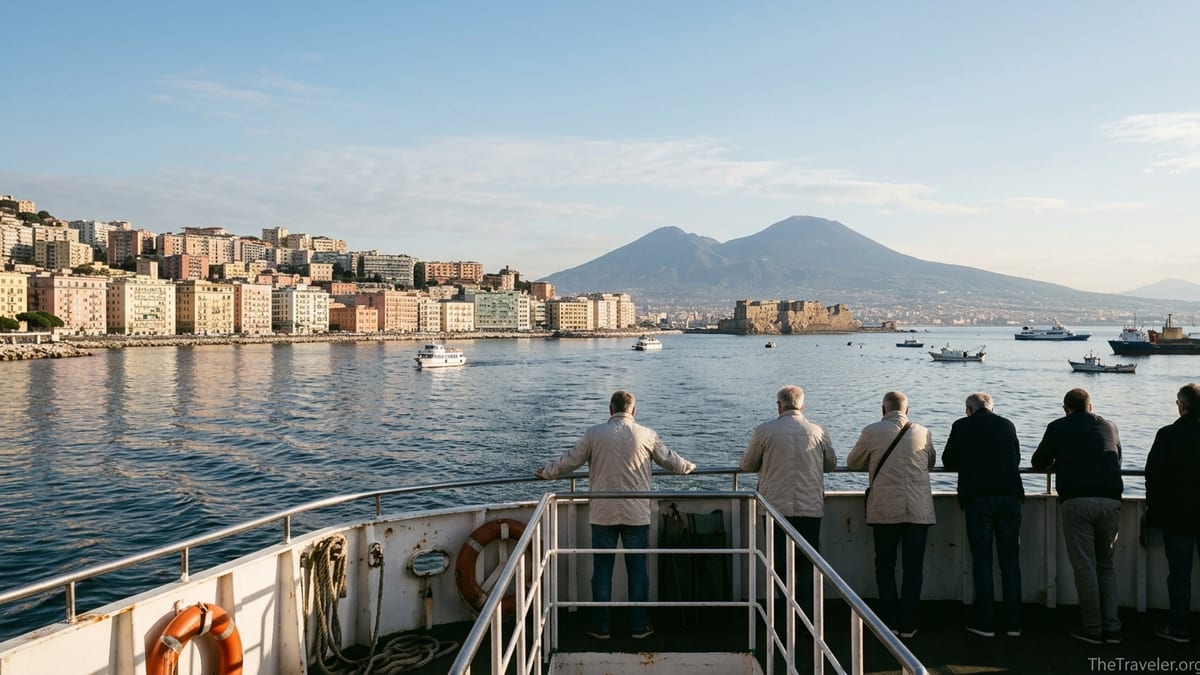
Approaching Naples by Sea: A Moving Panorama
I arrived in Naples from Sorrento on an early hydrofoil, one of the 40 minute crossings that stitch the two sides of the bay together throughout the day in peak season. The ticket cost just under 20 euros, not much more than the regional train, and I chose it precisely because I wanted that slow, cinematic approach across open water rather than an underground arrival at Napoli Centrale.
The vessel left Marina Piccola in Sorrento with little ceremony. At first the view was all limestone cliffs and small hotels stacked above the port, but as we cleared the peninsula the horizon widened. To the left, the shadow of Capri fell behind us; to the right, the low outline of Procida and Ischia hovered in the distance. Ahead, Vesuvius anchored the entire scene, a muted blue cone rising behind a smear of city that seemed to spill right into the sea.
What surprised me most was the sense of movement. Ferries to Capri and Ischia cut sharp white lines across the water. Cargo ships edged slowly in and out of the main commercial port. Even on a weekday morning in shoulder season, the bay felt busy but not frantic, more like a working amphitheater than a tranquil lake. It was easy to understand why so many travelers pick at least one sea crossing during a stay here: from the water, you see not just Naples but the entire geography of the Gulf in a single, shifting panorama.
For anyone considering the same arrival, it is worth choosing a crossing that lands at Molo Beverello, the central hydrofoil terminal, rather than the more industrial Calata Porta di Massa. Beverello puts you almost directly in front of the classic waterfront curve of the city; you step off the boat and the view you have been watching for the last hour is suddenly around you, not just in front of you.
That First Sweep of the Waterfront
As the hydrofoil drew closer, the textures of Naples began to separate. From a distance it is all earthy tones and a dense, almost opaque skyline. At about twenty minutes out, individual structures sharpen into view: the squat rectangle of Castel dell’Ovo on its tiny islet, the neoclassical dome of Galleria Umberto, the layered apartment blocks that climb toward Vomero hill.
The waterfront itself is not polished in the way some Mediterranean promenades are. There are parked scooters in unlikely places, fisherman’s vans tucked between more formal buildings, and a constant thread of traffic on Via Acton just beyond the port. Yet the overall picture is undeniably grand. Standing on the open deck, I watched the color of the buildings shift from pale cream to apricot and terracotta as the sun rose higher, while the water changed from steel to a softer, greener blue.
On the right, as the boat swung toward Beverello, a strip of the Lungomare came into view, the pedestrian-friendly seafront that runs past Castel dell’Ovo and into the Chiaia district. Later that day I would walk that promenade at sunset, watching locals in office clothes lean on the sea wall with espresso cups and paper cones of fried seafood. From the boat, though, what struck me was how intimately the city touched the water. There was no long buffer of lawns or marinas; the buildings seemed to step almost directly into the bay.
It was at this moment that the view overtook my expectations. I had pictured something stately and classical, perhaps a little static. Instead, Naples presented itself as a dense, working, unapologetically real city set against a backdrop that felt almost mythic. The contrast between the everyday details of laundry on balconies and the sleeping volcano behind them made the approach feel far more dramatic than any carefully framed photograph.
Vesuvius: The Constant Presence on the Horizon
No matter where you stand along the Bay of Naples, Vesuvius insists on being part of the story. From the deck of the ferry, the volcano looked deceptively smooth and benign, its twin peaks softened by a light morning haze. Yet it was impossible to forget what it has done to this coastline and how many people still choose to live in its shadow.
On land, the volcano’s presence becomes even more pronounced. Walking from the port toward Piazza del Plebiscito, I kept catching glimpses of it in the gaps between buildings: a wedge of dark blue above a side street, a jagged outline behind the cupola of a church. From the terrace of a small bar on Via Partenope, where an espresso costs little more than a euro standing at the counter, the volcano feels almost close enough to touch, its slopes providing a permanent backdrop to the bobbing lines of small fishing boats.
Later in the trip, I took the Circumvesuviana train from Napoli Porta Nolana station toward Pompeii and Sorrento. The journey takes about an hour between Naples and Sorrento, and the tracks hug the lower flanks of the volcano. From the window you see orange groves, small concrete houses, and occasional strips of sea, all under the same looming profile that had greeted me from the bay. The train is not glamorous, and at a few euros for the ride it can be crowded at peak times, but it offers another angle on the same geography that dominates the seaborne view.
The knowledge that the entire bay, from the luxury hotels in Sorrento to the backstreets of Naples, shares this same guardian added a layer of intensity to that first sight. The beauty was undeniable, but so was the sense that this is not a static postcard. It is a living, changing place shaped by forces far older and larger than any visitor.
Climbing to the Heights: Views from Vomero and Castel Sant’Elmo
If arriving by sea gives you a horizontal sweep of the Bay of Naples, climbing to Vomero hill delivers the vertical drama. On my second day, I followed local advice and took the Montesanto funicular from the historic center up to Vomero, a short ride that costs little more than a standard metro ticket and is included in day passes for city transport. The car emerged from the tunnel into a quieter, more residential neighborhood, and within ten minutes on foot I reached the entrance to Castel Sant’Elmo.
The fortress itself is an angular, star-shaped mass of stone that has guarded Naples for centuries, but the real attraction for most visitors is the 360 degree view from its ramparts. From up here, the dramatic effect of the bay intensifies. The curve of the coastline becomes clear, sweeping from the Sorrentine Peninsula on one side to the volcanic fields beyond Pozzuoli on the other. Ferries trace white arcs below, and Vesuvius sits almost center frame, its outline breaking the horizon in two.
Entry to Castel Sant’Elmo is modest by European standards, typically under 10 euros, and there is rarely a long line outside except on busy summer weekends. I visited mid-morning on a weekday and shared the walls with a scattering of school groups and a few couples taking photos. Standing at the edge, I could see the exact route my ferry had taken the previous day, the port of Molo Beverello already shrinking to toy size. The sense of scale from this height made that first arrival feel even more improbable, as if the bay were a painted backdrop and I had somehow sailed straight into it.
For travelers with limited time, it is entirely feasible to combine a morning visit to Castel Sant’Elmo with an afternoon walk along the seafront. A funicular ride up, an hour or two on the ramparts, and a leisurely descent back into the chaos of the Spanish Quarter gives you both the elevated and the sea-level perspectives that define Naples’s relationship with its bay.
Street-Level Encounters with the Bay
Despite the commanding views from boats and hills, some of the most memorable encounters with the Bay of Naples happen at street level. On my first evening, I joined the slow procession of locals and visitors along the Lungomare Caracciolo, the wide promenade that stretches from the Santa Lucia district toward Mergellina. Here the bay spreads out in front of you like a stage, with Vesuvius backlit by the sinking sun and Castel dell’Ovo turning from pale gold to soft gray.
Families pushed strollers, teenagers leaned against the railings sharing takeaway pizza slices, and joggers threaded their way through the crowd. On the sea side of the promenade, clusters of people sat on the rocks, some with fishing rods propped against their knees, others with plastic cups of local beer. The atmosphere was relaxed but not subdued; Neapolitan conversations tend to be animated whatever the setting, and the bay was no exception.
Food and drink here are reasonably priced compared with many Mediterranean waterfronts. A simple espresso at a standing bar can be around 1 euro, while a seat at a café terrace facing the water might bring that closer to 2 or 3 euros. A plate of fried seafood or a margherita pizza from a casual seafront spot usually stays under 10 to 15 euros. It is easy to linger for hours with a single drink, watching the ferries to Capri and Ischia glide out and return like slow-moving lights in the dusk.
Farther west, toward Posillipo, the coastline becomes more residential and steep, with villas clinging to the cliffs and smaller, more intimate views of the bay opening up between buildings. Local buses and taxis can get you to overlooks such as Via Petrarca, where a simple bench can offer a view as memorable as any rooftop bar. These are the places where the bay feels less like a spectacle and more like a backdrop to everyday life, which in many ways makes the view even more striking.
Practical Ways to Experience the Bay’s Drama
Part of what made my first view of the Bay of Naples so powerful was the way I had built the journey around it. Choosing the ferry from Sorrento rather than the train was the first step. In high season, several operators run foot-passenger hydrofoils between Marina Piccola and Naples, typically taking around 40 to 50 minutes depending on the vessel and sea conditions. Prices fluctuate by season and operator but often start in the mid to high teens in euros for a one-way ticket.
When booking, it helps to check which Naples port the ferry uses. Molo Beverello is the most convenient for immediate city views and for walking to central districts like Santa Lucia and Chiaia. Calata Porta di Massa caters more to car ferries and can feel more industrial on arrival, though it is still only a short taxi or bus ride from the main sights. Leaving time for potential delays is wise, especially in shoulder seasons when rough seas can occasionally disrupt schedules.
For those already staying in Naples, day trips across the bay are one of the easiest ways to see the city’s skyline from different angles. Fast ferries to Capri usually take under an hour, with slower, cheaper ships offering a slightly longer journey. Services to Ischia and Procida take roughly an hour to ninety minutes depending on the route. Even a simple round-trip excursion without a packed sightseeing schedule can provide multiple chances to watch the city recede and reappear against the water.
On land, consider combining sea-level walks with higher vantage points. The three main funicular lines within Naples connect lower districts with hilltop neighborhoods like Vomero, putting panoramic views within easy reach without strenuous climbs. A day pass on local public transport is usually not much more than a pair of single tickets, and it covers metro lines, funiculars, and many city buses, making it simple to move between viewpoints as the light changes.
The Takeaway
Travelers often arrive in the Bay of Naples expecting beauty. The posters in station corridors and glossy brochure covers promise sunlit water, sailboats, and a volcano drawn in clean lines. What struck me on that first approach, watching the city grow larger from the deck of a hydrofoil, was how much more layered and dramatic the reality is compared with that simple image.
The bay is not a tranquil backdrop but a working stage. Ferries and fishing boats cross its surface, apartment buildings and old palaces crowd its edge, and Vesuvius looms over everything as both threat and guardian. From the ramparts of Castel Sant’Elmo to a humble bench on the Lungomare, every vantage point offers a slightly different version of the same story: a dense, energetic city negotiating its place between sea and mountain.
If you are planning your own first view, consider shaping your itinerary around the water. Arrive or depart by ferry when you can, ride a funicular to see the bay from above, and give yourself time simply to stand still and watch the way light and weather change the scene from hour to hour. With a bit of planning and a willingness to move between sea level and hilltop, you may find, as I did, that the Bay of Naples feels far more dramatic, more complex, and more alive than any photograph prepared you for.
FAQ
Q1. Is it better to arrive in Naples by ferry or by train for the views?
Arriving by ferry is far more scenic, especially on crossings between Sorrento and Naples, as you watch the full curve of the bay and Vesuvius come into view.
Q2. Which port in Naples offers the most dramatic first impression?
Molo Beverello generally offers the best first impression, placing you right in front of the central waterfront with immediate views of the city and Castel dell’Ovo.
Q3. How long does the ferry from Sorrento to Naples usually take?
Fast hydrofoils typically take around 40 to 50 minutes between Sorrento and Naples, depending on the operator, vessel type, and sea conditions.
Q4. What is the most accessible viewpoint over the Bay of Naples?
Castel Sant’Elmo in the Vomero district is one of the most accessible panoramic spots, easily reached by funicular from the historic center and a short walk uphill.
Q5. Are ferries across the bay expensive compared with trains or buses?
Ferries usually cost more than local trains or buses, but prices are still moderate for most travelers, and the added scenery often justifies the extra expense.
Q6. When is the best time of day to see the Bay of Naples at its most dramatic?
Early morning and late afternoon are especially striking, when the light is softer, colors are warmer, and the outlines of Vesuvius and the city are more defined.
Q7. Can I see the Bay of Naples well if I stay only in central Naples?
Yes. Walks along the Lungomare and short funicular rides to hilltop districts like Vomero provide excellent views without leaving the city.
Q8. Do I need to book ferry tickets in advance for bay crossings?
In high season and on popular routes such as Naples to Capri, booking in advance is sensible, while on some commuter crossings you can often buy tickets on the day.
Q9. Is the Bay of Naples still enjoyable to see in cooler months?
Yes. Even in cooler months the bay can be atmospheric, with fewer crowds, softer light, and a slightly misty quality around Vesuvius and the islands.
Q10. Are there budget-friendly ways to enjoy bay views without boat trips?
Absolutely. Public promenades like the Lungomare, low-cost funicular rides, and simple café terraces with outdoor seating all offer excellent bay views at minimal cost.