


Most visitors come to Bosco di Capodimonte for the royal palace and a quick stroll along the main avenue before heading back downtown. Yet this vast green lung on the hill above Naples hides a network of forgotten gates, secluded valleys, historic farm buildings and quiet belvederes that even many locals have never fully explored. With a bit of curiosity, a park map and the right expectations, you can turn a standard museum outing into a full day of slow discovery.
Get the latest updates straight to your inbox!
Understanding the Real Bosco: Beyond the Palace Gardens
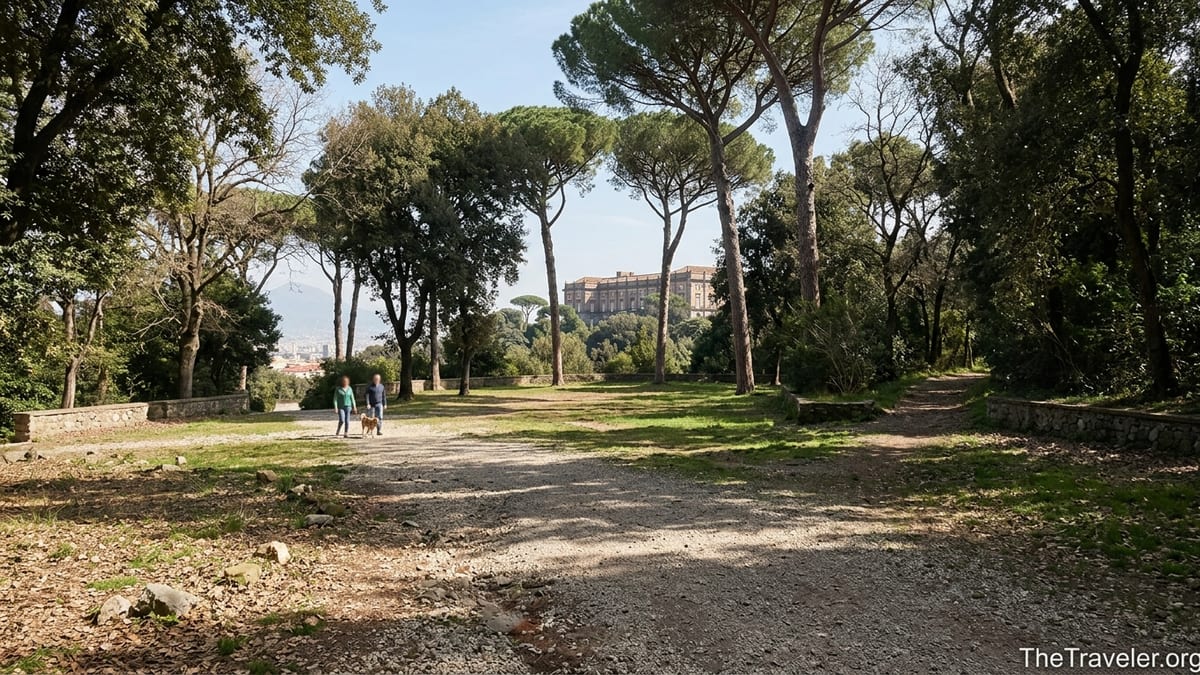
From the terrace of the Museo di Capodimonte it is easy to forget that the surrounding park stretches over roughly 120 to 130 hectares, enclosed by historic walls and crisscrossed by more than a hundred small paths. Most people see only the formal lawns in front of the palace and the main Viale dei Cipressi leading toward the viewpoint over the bay. The real bosco, however, starts once you pass through the inner gates, where the landscape shifts from royal parterre to genuine woodland and former hunting grounds.
The core layout dates back to the 18th century, when King Charles of Bourbon commissioned architect Ferdinando Sanfelice to design a royal hunting estate. Long straight avenues radiate outward, forming a kind of baroque grid, but between them lie wilder zones of oak, holm oak and chestnut, old quarries and former pastures. Modern guidebooks often highlight only the main monuments, so pockets like abandoned farm buildings, minor fountains or unfrequented clearings rarely get more than a line of mention, if at all.
Access is usually through three principal entrances: Porta Grande and Porta Piccola on the Ponti Rossi side, and Porta Miano on the northern edge near the residential quarter of Miano. Inside, another historic gate, the baroque Porta di Mezzo with its wrought-iron work in Neapolitan rococo style, once marked the transition into the most intimate heart of the royal wood. Today, only a fraction of visitors push far enough into the park to find the quieter sectors that made the bosco an aristocratic retreat.
For travelers with time, this scale is an advantage. While the palace ticket lines may be busy and the central lawns used by families and runners, you can walk less than fifteen minutes beyond the obvious routes and feel as if you have stepped into a different park altogether, where the hum of the city fades and you might encounter only dog walkers, elderly locals or a gardener trimming 18th century hedges.
Entering Like a Local: Little-Used Gates and Approaches
Most tourists arrive by taxi or bus and enter through Porta Grande or Porta Piccola opposite the city, because they are most directly connected to the historic center and the National Archaeological Museum. If you want a quieter start, approach from the northern side instead. Porta Miano, built in the 19th century facing the outlying neighborhood of the same name, sees far fewer foreign visitors. People using this gate are often locals heading to jog, walk their dogs or visit the nearby vaccination and sports areas, so you immediately feel part of daily life rather than a choreographed museum experience.
Porta Miano brings you into a more informal, slightly wilder section of the park, where grassy clearings alternate with small wooded dips. It is a good place to begin if you want to loop toward some of the old agricultural buildings like the Vaccheria, historically linked to royal cattle and dairy production. Paths from here feel more like rural lanes than palace promenades, and the city skyline disappears for long stretches. On a weekday morning, you may walk ten minutes without seeing another visitor, something almost unimaginable in central Naples.
If you stay closer to the palace, a lesser-known move is to walk purposefully toward the Porta di Mezzo and its hemicycle on the inner side of the park. This elegant semi-circular arrangement, edged with clipped holm oaks and dotted with statues, was once the ceremonial access into the bosco for the Bourbon court. Today many people pass near it without realizing its historical importance, but lingering here in early evening light gives a sense of the theatrical design that shaped the whole estate.
Practical details change seasonally, but in general the park gates open early, often around sunrise, and close before or soon after dusk. There is no entrance fee for the bosco itself, which makes it a rare free escape in a city where most headline attractions require tickets. Just remember that security staff will sweep the park at closing time, and outer gates like Porta Miano can shut earlier than the palace area, so confirm the schedule posted at whichever gate you use that day.
Forgotten Farmsteads, Porcelain Dreams and Working Corners
Beyond the manicured lawns, Bosco di Capodimonte still preserves scattered clusters of 18th and 19th century buildings that once supported the royal household. These sites are often mentioned only in passing on official maps: the Vaccheria, the Real Fabbrica delle Porcellane, the Casino della Regina, the Fabbricato Cataneo and various stables and service houses. Because they are spread across a large area and not all are fully restored, visitors who do not know where they are going tend to stay near the main palace.
One of the most atmospheric wanderings starts from the palace terrace and heads toward the former Real Fabbrica delle Porcellane, the royal porcelain factory. Much of the production moved long ago, but the surviving structures recall a time when Capodimonte porcelain, with its delicate figures and soft-paste glazes, was a rival to the famous manufactories of Meissen and Sèvres. The walk passes old stone walls lined with ivy and sections of lawn where you can still imagine carts transporting raw materials down to Naples’ port.
A little further into the bosco are the agricultural corners that once fed the court. The Vaccheria area, historically dedicated to dairy cattle, feels closer to countryside than to city. You may find modern uses, from storage to administrative functions, alongside traces of barns and fenced pastures. Travelers used to polished museum galleries sometimes find this contrast surprising, but it is part of what makes Capodimonte distinctive: it is both monumental estate and working landscape, not a frozen theme park.
Because these structures are functional rather than showpiece monuments, you will rarely see tour groups here. That quietness is the reward for independent travelers. Pack water and a simple picnic bought from a bar or bakery near the National Archaeological Museum or along Via Santa Teresa degli Scalzi, then spend an unhurried hour following the smaller paths that link one cluster of buildings to another. Use the park’s official map, available on-site and often posted at main crossroads, so you do not accidentally wander out toward the perimeter walls without realizing how far you have gone.
Hidden Chapels, Hermitages and Places of Prayer
Within the woods stand several religious buildings that once served the royal family, court staff and the surrounding countryside. The best known is the small church of San Gennaro, attributed to architect Ferdinando Sanfelice, whose playful staircases and facades helped define Neapolitan baroque. Many visitors see the church quickly while moving between palace and park, but fewer take the time to circle around the exterior, noting how the architecture is nested into the greenery rather than dominating it.
More secluded are the hermitage structures often referred to collectively as the Cappuccini hermitage, set in the deeper part of the bosco. These buildings were conceived in neo-Gothic style in the 19th century, a romantic reinterpretation of monastic seclusion which appealed to the Bourbon imagination. Access may vary depending on conservation works, but even when you can only view them from outside fences, the approach walk through dense foliage, with filtered light and birdsong, is one of the most atmospheric stretches in the park.
Travelers interested in religious heritage will appreciate how these chapels and hermitages tie Capodimonte to the broader devotional landscape of Naples. You might start the day at the catacombs of San Gennaro in the Rione Sanità, then walk or bus up toward Capodimonte and end in the park’s own church of San Gennaro, tracing the layered cult of the city’s patron saint from underground burial sites to royal woodland chapel.
Because these religious structures are not always staffed or open, it is wise to focus less on interior visits and more on their role in the overall landscape design. Bring a small binocular or use your camera’s zoom to appreciate decorative details on facades, such as stone crosses, carved window surrounds or modest bell turrets. Early mornings, when the sun slants low through the trees, are particularly evocative, with shadows stretching across old stone and the park still quiet before the day’s joggers arrive.
Wild Corners: Valleys, Vistas and Near-Empty Paths
Large sections of Bosco di Capodimonte retain a semi-wild character, with undulating ground, shallow valleys and thickets of undergrowth. These are not remote mountains, but for a city park they feel remarkably untamed. One of the pleasures of exploring is to leave the main viali and slip into these side paths, where surfaces may shift from smooth gravel to compacted earth and tree roots. Here you might cross tiny seasonal streams after rain or find exposed volcanic stone reminding you that Naples sits in a complex geological basin.
Although official documents occasionally refer to small internal valleys and quarries, most are not individually signposted on the ground, which keeps them off the casual visitor’s radar. Locals sometimes know them by nicknames, linked to nearby landmarks or past uses. The important thing for travelers is to understand the pattern: the further you move from the palace in any direction, the more the land begins to dip and fold, and the fewer people you encounter. Choose a fine day outside the peak of summer heat and you can enjoy extended shaded walks almost alone.
Viewpoints are another underappreciated asset. Everyone knows the main belvedere in front of the palace, at roughly 150 meters above sea level, which offers a classic panorama of the city and bay. Yet along the outer edges of the park there are smaller, more intimate glimpses toward Vesuvius, the Sorrento Peninsula or the working-class slopes of Naples’ northern districts. These are not marked as official scenic terraces, but appear where gaps in the tree cover align with old service lanes or disused clearings.
To find them, follow a side path that seems to rise slightly toward the outer wall, particularly near the Ponti Rossi section where the city falls away steeply. You may come on a rough stone bench, a stretch of low wall or just a trodden patch of grass where locals sit at sunset with takeaway coffee from a bar near the gate. These minor belvederes lack the postcard-perfect framing of the palace terrace, yet they often feel more authentic, reminding you that Capodimonte looks not only toward the bay but also back onto the everyday neighborhoods that feed and surround it.
Practical Ways to Experience Capodimonte’s Hidden Side
Planning a visit that goes beyond the obvious requires only a bit of forethought. First, allow enough time. Instead of pairing the museum with another major attraction on the same day, treat Capodimonte as a stand-alone destination. Aim to arrive in the late morning, tour the museum and palace for two or three hours, then dedicate the afternoon to the park. In summer months, the central hours of the day can be hot, but much of the bosco offers tree shade, and temperatures are usually a few degrees cooler than down in the dense streets of the centro storico.
Footwear matters more here than at other city sights. The main avenues are level and suitable for casual sneakers, but hidden paths may have loose stones or muddy patches after rain. If you plan to reach outlying buildings or follow loops from Porta Miano back to Porta Grande, lightweight trekking shoes or sturdy trainers are recommended. Bring at least one large bottle of water per person, especially outside the cooler months, because refreshment points inside the park are limited and may not be obvious away from the palace area.
Navigation is easier if you pick up or photograph the official park map near the entrance or museum information desk. The map shows the major viali, minor paths and the location of sites like the Vaccheria, porcelain factory and hermitage. Mobile data generally works, but tree cover and local network fluctuations can cause brief dead zones, so having a physical or saved map helps. As a simple orientation rule, the palace and main belvedere sit roughly at the park’s center-southern side, with Miano to the north and Ponti Rossi to the south-west.
Finally, keep expectations flexible. Because Bosco di Capodimonte is both heritage site and living urban park, some hidden gems may be under scaffolding, used for events or temporarily fenced off for safety works when you visit. Instead of focusing on ticking off a list of buildings, treat the day as a chance to feel the changing atmosphere of the place: from formal royal entrance at Porta di Mezzo to rural lanes by the Vaccheria and on to forgotten corners where ivy climbs over stone and the only sound is wind in the leaves.
The Takeaway
Bosco di Capodimonte rewards travelers who slow down, stay curious and are willing to walk beyond the palace lawns. Within a single enclosure you can move from one of Europe’s great art museums to semi-wild woodland, from elegant baroque gates to modest farm buildings and neo-Gothic hermitages. The contrast between manicured and untamed, ceremonial and everyday, makes this park far more than a simple backdrop to the royal residence.
For many visitors to Naples, Capodimonte remains a half-day diversion at the far edge of their itinerary. Yet those who give it a full day often describe it as one of the most unexpectedly peaceful and layered experiences of their trip. By entering through quieter gates, seeking out working corners and lingering at unmarked viewpoints, you tap into a side of the city usually reserved for residents. In a destination famous for crowds and chaos, that kind of spacious, reflective encounter is a rare gift.
FAQ
Q1. How much time should I plan to explore the hidden areas of Bosco di Capodimonte?
Plan at least half a day if you want to see both the museum and some quieter corners, and a full day if you enjoy slow walks and frequent stops.
Q2. Is there an entrance fee for the park itself?
No, access to the Bosco di Capodimonte is generally free, though the palace and museum require a paid ticket with separate opening hours.
Q3. Which gate is best if I want to avoid the crowds?
Porta Miano on the northern side is usually less busy than Porta Grande and Porta Piccola, giving a more local and tranquil introduction to the park.
Q4. Are the hidden farm buildings and hermitages always open to the public?
Not always. Access can change due to restoration or safety works, so you may only be able to view some structures from outside fences or paths.
Q5. Do I need a guide to find the quieter parts of the park?
No guide is necessary, but an official park map and some advance reading help you confidently leave the main avenues and still find your way back.
Q6. Is Bosco di Capodimonte safe to explore off the main paths?
During daylight the park is generally considered safe, but stick to visible paths, avoid dense undergrowth and head back toward main avenues before closing time.
Q7. Can I picnic in the more secluded areas?
Picnicking on the grass is widely practiced, but choose clean, open spots, avoid lighting any fires or stoves and always carry out all your rubbish.
Q8. What is the best season to experience Capodimonte’s hidden side?
Spring and autumn are ideal, with mild temperatures, greener foliage and fewer local vacationers than in the hottest weeks of summer.
Q9. Are there toilets and water fountains in the quieter sectors?
Facilities are concentrated near the palace and main entrances, so use them before heading deep into the bosco and always bring your own water.
Q10. How can I combine the palace visit with a more offbeat park walk?
Visit the museum in the late morning, have a simple lunch near the palace, then spend the afternoon following a loop from Porta di Mezzo toward the Vaccheria and back.