


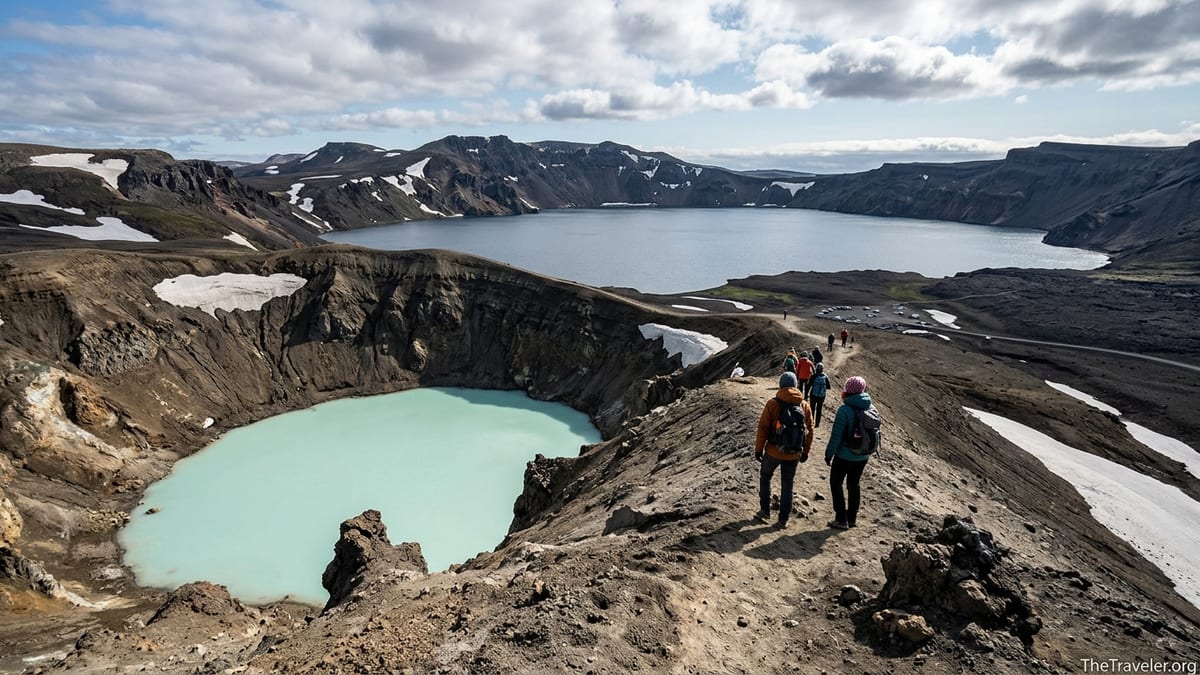
The classic hike from the Vikraborgir car park into the Askja caldera is one of Iceland’s most otherworldly short walks. Once you have made the long drive into the central highlands, this on-foot section takes you across raw volcanic terrain to the rim of the turquoise crater lake Víti and viewpoints over the deep, steel-blue waters of Öskjuvatn. Conditions can be demanding and changeable, so good preparation and realistic expectations are essential.
Get the latest updates straight to your inbox!
What the Víti and Öskjuvatn hike involves
The most popular starting point for exploring Askja on foot is the main Vikraborgir / Askja car park at the end of mountain road F894. From here a marked walking route leads across lava and ash to the rim of Víti and on to viewpoints over Öskjuvatn, often referred to as Lake Askja. The hike is short in distance but exposed in terms of weather, with underfoot conditions that can feel surprisingly tough for casual walkers.
According to current information from Vatnajökull National Park and recent trail descriptions, the official walking route from Vikraborgir to Víti and nearby Öskjuvatn viewpoints is roughly 2 to 3 kilometres each way. Most average adults should allow around 30 to 45 minutes in one direction and 1 to 1.5 hours return, with gentle elevation gain of roughly 100 to 150 metres spread along the route rather than one steep climb. Faster hikers and those very used to rough terrain may move quicker, but visitors are better off planning for the longer end of these ranges.
The trail is rated as easy to moderate in dry, high-summer conditions, but that label can be misleading. The path often crosses late-lying snow patches well into July, which can be icy and uneven underfoot, and sections of volcanic ash and pumice can feel like walking on loose sand. Early and late in the season, snow cover and freezing temperatures can significantly increase difficulty and may make the hike unsuitable for anyone without solid hiking experience.
It is important to understand that there are no services at the Vikraborgir car park itself beyond basic information boards and, in season, guidance from rangers if present. The nearest facilities are at Dreki mountain hut area a short drive away, so once you set out from the parking area you are fully exposed to weather with no shelter and must be self-sufficient until you return.
Trail conditions, weather and seasonal challenges
Askja sits high in the Icelandic interior, and conditions on the trail bear little resemblance to the milder, often calmer weather of the coastal regions. Even on a sunny day in Reykjavik or Akureyri, the Askja area can feel cold, windy and wintry. Temperatures along the trail are frequently close to freezing early and late in the summer season, and strong gusts can sweep across the open caldera with little warning.
Trail descriptions from Vatnajökull National Park stress that snow patches commonly linger around Víti and Öskjuvatn well into summer. In June and sometimes July you should expect to cross sloping snowfields where the surface can be icy in the morning and slushy by afternoon. These sections can be especially hazardous when descending, increasing the risk of slips for anyone without good tread on their boots or the habit of placing feet carefully.
Even where snow has melted, the path can be muddy or partially flooded after rain or rapid snowmelt. Volcanic ash and fine gravel can also turn slick when wet, particularly on short inclines just before the crater rim. In shoulder-season conditions this can push the hike firmly into moderate territory, and visitors who rarely hike should think carefully before committing if conditions look poor from the car park.
Weather changes matter because the route is fully exposed. Mist or low cloud can move in quickly and at times reduce visibility to just a few metres, making it harder to follow waymarks and appreciate the scenery. On very windy days, gusts at the crater rim can be strong enough that hikers need to keep well back from the edge for safety. Before starting, always check the latest forecast and any notices from Vatnajökull National Park or local rangers, and be prepared to turn back if conditions deteriorate.
Step-by-step: from Vikraborgir car park to Víti and Öskjuvatn
From the Vikraborgir car park you will see information boards about the Askja system and usually a clear start to the marked trail. After leaving the gravel parking area, you quickly step out onto broken lava, ash and pumice. Waymarks and worn path lines guide you across this dark, undulating plain, with little vegetation except small moss patches in sheltered hollows.
After roughly 10 to 20 minutes of steady walking, depending on conditions and pace, the view begins to open up. On clear days you will start to see the pale caldera walls ahead and, shortly after, your first partial glimpses of the steel-grey expanse of Öskjuvatn framed by darker volcanic slopes. The trail continues across gently rising terrain, often weaving between scattered lava blocks and crossing one or more snowfields that may linger here well into the main travel season.
As you approach Víti, the path swings closer to the inner edge of the caldera. After around 25 to 35 minutes from the car park, most walkers reach the first obvious viewpoints on the crater rim. Here the ground drops suddenly away to reveal Víti below, typically a milky turquoise pool set inside steep, pale walls. Take time to step back from the edge, find a stable footing and then choose your viewing spots with care, especially if there are strong winds or wet, slippery surfaces near the rim.
From these initial viewpoints you can continue along the rim in either direction for different angles on the crater and Öskjuvatn behind it. In roughly another 10 to 20 minutes of relaxed walking, you reach several broader vantage points where the full sweep of Öskjuvatn opens up, often with small patches of ice still floating on the surface early in the season. The return route usually follows the same path back to the car park, though in good conditions some hikers and guided groups make small variations while staying within the marked corridor to avoid trampling fragile ground.
Optional detours and shorter viewpoint options
The main walking goal for most visitors is to stand on the rim of Víti and look across at Öskjuvatn. Within that basic out-and-back route there are a few informal variations that can make the experience more or less demanding depending on your energy and the time available. In clear conditions, walking an extra 10 to 15 minutes beyond the first Víti viewpoints can reward you with a more expansive panorama of Öskjuvatn and the surrounding caldera walls.
For travelers with limited mobility or fitness, there are some possibilities for shorter outings. From the car park it is often possible to walk just far enough along the gently rising section of the trail to gain a partial view into the caldera, then turn around without committing to the full distance to Víti. The ground even near the start is uneven and rough, however, and not suitable for wheelchairs, strollers or anyone unsteady on their feet.
Vatnajökull National Park occasionally adjusts signed routes and viewpoint recommendations around Víti and Öskjuvatn in response to changing ground conditions, rockfall risk or snow cover. Visitors should always read the current signage at Vikraborgir and, if rangers are present, ask about any recent changes or temporary closures. Obeying these instructions is important not just for personal safety but also for protecting delicate volcanic surfaces under pressure from increasing visitor numbers.
If you are visiting with a guided tour, your guide will typically outline the recommended route and options at the car park before setting out. Solo drivers should take a few minutes to study the information boards, identify key landmarks along the trail and mentally set turnaround times based on their own pace and the overall schedule for the day.
Descending into Víti: bathing, risks and when to avoid it
One of the most debated questions at Askja is whether to descend into Víti and bathe in the warm crater lake. Historically some visitors have done so, and older guidebooks sometimes describe Víti as a natural hot pool. Current statements and warnings associated with Vatnajökull National Park, along with recent accounts from guides, take a much more cautious stance. Bathing is not promoted and is generally described as not recommended because conditions in and around the crater can be unpredictable and hazardous.
The descent path into Víti, where it is open, is steep, loose and often extremely slippery. The slope consists of loose ash, gravel and clay, which can turn slick in wet weather or when snowmelt runs across the surface. A fall here can easily result in injury, particularly if a hiker slides into rocks lower down or into water of uncertain depth and temperature. There is also potential for rockfall from the crater walls above, especially after heavy rain, freeze-thaw cycles or seismic activity in the greater Askja system.
Even if you reach the water safely, there are significant uncertainties. Geothermal inflows can cause sudden changes in water temperature, creating hot spots near vents that may not be visible from the surface. There is also the theoretical risk of sudden gas emissions or other changes linked to volcanic activity. Local experts and some recent guides have noted that uplift in the Askja caldera in recent years suggests an active underlying system, which is one reason park authorities urge caution and, at times, explicitly advise against entering the water at Víti.
As a rule of thumb, you should absolutely not attempt to descend into Víti if there is snow or ice on the access slope, if the ground is wet clay or churned mud, if visibility is poor, or if strong winds are blowing across the rim. In such conditions, even experienced hikers and guides tend to stay on the crater rim. It is important to understand that the fact previous visitors may have bathed in Víti on social media or older blogs does not mean it is currently safe or advisable. Your safest and often most rewarding choice is simply to enjoy the dramatic views from above and, if present, follow the latest advice from park rangers on site.
Facilities, preparation and what to pack
Askja is deep in Iceland’s highlands, far from settlements and services. There are no shops or cafés at the Vikraborgir car park, and you should not expect to buy food, drinks or gear anywhere near the trail. Dreki mountain hut area, a short drive away and operated in part by Icelandic touring associations, offers basic accommodation and a sanitary building with toilets and showers during the summer season, but it is not a full-service visitor center with a convenience store.
Because of this, visitors must arrive fully prepared for several hours without services. Sturdy, waterproof hiking boots are strongly recommended; sneakers or light shoes are not suitable for snow patches, mud and loose volcanic gravel. Even on apparently warm days, bring multiple clothing layers, including a warm insulating layer and a windproof, waterproof outer shell. Gloves, a hat and a buff or scarf can make a big difference in strong wind or sudden temperature drops on the open trail.
Rain gear is essential given how quickly showers can develop over the highlands. Sun protection is equally important on clear days: the high-elevation sun reflecting off snowfields and pale crater walls can burn exposed skin and strain unprotected eyes, so bring sunscreen and sunglasses. Carry enough water and snacks for at least several hours; highland air is dry, and the effort of walking on soft, uneven surfaces can be more tiring than the short distance suggests.
Toilet facilities are generally limited to the Dreki hut area and, in some seasons, simple toilets near the main car park or along the access roads. Opening dates and any small usage fees can vary from year to year, so travelers should check current information from Vatnajökull National Park or the relevant hut operators before departure. Out on the trail itself there are no toilets and little natural cover, which reinforces the importance of planning ahead and minimizing impact.
Fitness, accessibility and time constraints
In good summer conditions, the Víti and Öskjuvatn hike is realistic for adults and older children with at least moderate fitness and good balance. The main challenges are uneven, at times slippery surfaces and exposure to weather rather than extreme steepness or altitude. Those with knee, ankle or balance issues should consider using trekking poles and take extra care on any remaining snow patches and on short descents near the crater rim.
The trail is not accessible for wheelchairs or strollers, and there are no paved sections. Visitors who prefer a less demanding experience can treat the first part of the hike from the car park as a short out-and-back walk, turning around when the terrain becomes too challenging or when time pressure begins to mount. Drivers and tour guests should be honest about their pace and set conservative turnaround times, especially in colder or windier conditions.
Most organized tours from hubs such as Mývatn or Akureyri allow a limited window at Askja, often around 1.5 to 2.5 hours total on site, including time for bathroom breaks, gearing up and returning to the vehicle. Within that timeframe, slower hikers may find that they can comfortably reach the rim of Víti and nearby viewpoints but do not have much time left to linger or explore additional angles over Öskjuvatn. It is better to enjoy a slightly shorter walk at a relaxed, safe pace than to rush and risk fatigue or missteps on the return.
If you have arranged your own 4x4 transport, you have more flexibility but still need to respect overall daylight and road conditions. Driving in and out of Askja along highland F-roads is time-consuming and can be stressful in poor weather or rising rivers, so set a firm latest departure time from the car park and stick to it, even if conditions on the trail seem inviting.
Leave-no-trace principles and how long to allow at Askja
Askja’s volcanic landscapes are both fragile and slow to recover from damage. To help protect the area, always stay on the marked trail from Vikraborgir to Víti and Öskjuvatn and avoid creating new shortcuts or side tracks across bare lava and delicate moss. Pack out all litter, including food scraps and tissues, and keep a respectful distance from any research equipment or monitoring stations you might notice around the caldera.
Obey any temporary area closures or rerouted paths set by Vatnajökull National Park. These are typically based on up-to-date assessments of rockfall risk, snow stability, volcanic activity and erosion. Ignoring closures not only endangers you but can also undermine research and conservation work that helps keep Askja accessible for future visitors.
For travelers planning their day, a realistic minimum to enjoy the hike without feeling rushed is to allow around 1.5 to 2.5 hours of on-site time at Askja itself, in addition to the long approach and return drive. This window gives most visitors enough margin to walk from the car park to Víti and Öskjuvatn viewpoints, spend some time taking in the scenery and then return at a comfortable pace. Those who like to photograph, pause often or discuss geology with guides should err toward the upper end of that range or, if driving themselves, consider spending even longer.
Conditions in the Icelandic highlands and park rules around Víti and the walking routes can change between seasons and even within the same summer. Before setting out, and again shortly before entering the Askja area, check the latest updates from Vatnajökull National Park, local road authorities and your tour operator or accommodation. With realistic expectations, proper preparation and respect for this active volcanic environment, the hike from Vikraborgir to Víti and Öskjuvatn can be one of the most memorable walks of any Iceland trip.