


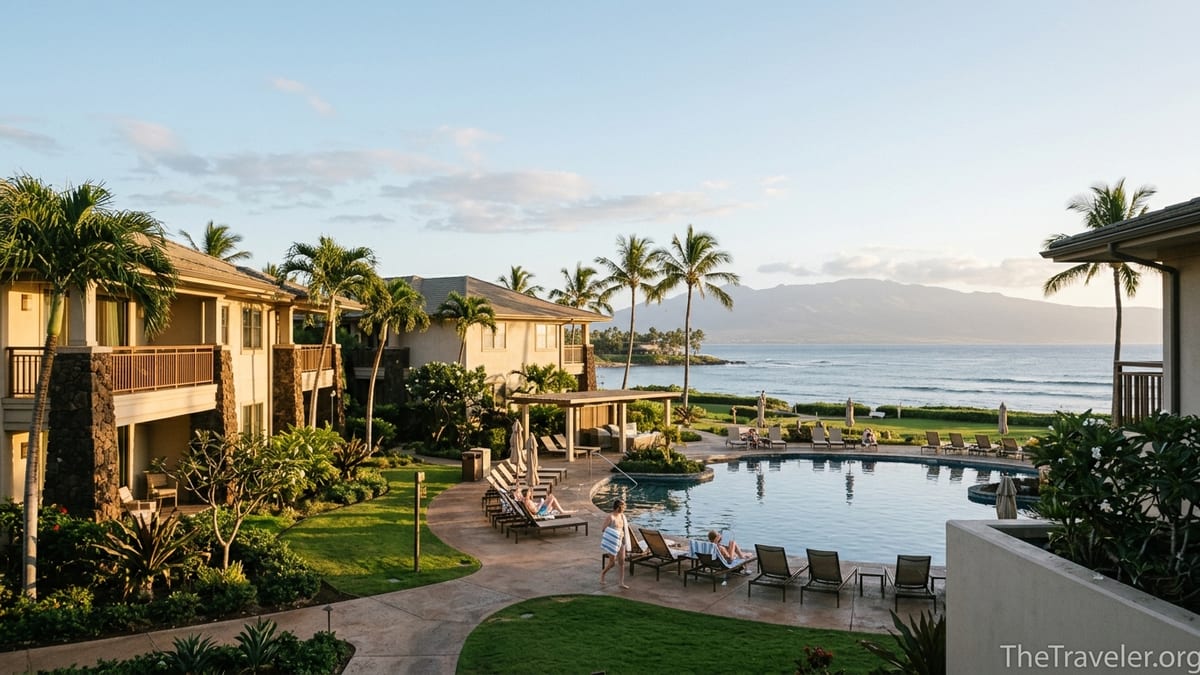
Picture this: you are sipping coffee on a lanai in Kīhei, looking across palm trees toward Maʻalaea Bay, and your stay at Hilton Grand Vacations Club Maui Bay Villas cost a fraction of the usual nightly rate. The tradeoff is a timeshare presentation. For many travelers, these offers can be a smart way to reduce the cost of a Maui vacation. For others, the hard sell and long-term financial commitment become an expensive regret. This guide explains how Hilton Grand Vacations (HGV) vacation offers work, what to expect at a Maui Bay Villas presentation, the real pros and cons, and how to decide if the Maui package is worth it for you.
Get the latest updates straight to your inbox!
How Hilton Grand Vacations Packages Work in Real Life
Hilton Grand Vacations markets “vacation packages” that bundle a highly discounted stay with a required sales presentation on vacation ownership. In practice, you might get a phone call or email offering something like four days and three nights near Kīhei on Maui for a few hundred dollars, plus bonus Hilton Honors points or a future hotel certificate, in exchange for attending a 90 to 120 minute presentation about HGV ownership. The reservation is typically prepaid and nonrefundable once you pass a short rescission window, and the presentation is a mandatory condition of keeping your discounted rate and incentives.
These offers are often framed as a way to “preview the resort lifestyle” rather than explicitly as timeshare sales, which can catch travelers off guard. For example, travelers have reported buying a “mini vacation” over the phone, only to learn later that it required a timeshare pitch at a Hilton Grand Vacations sales center. Others describe being transferred from a Hilton reservation line to HGV without realizing they were transitioning from hotel bookings to ownership marketing. The details are usually in the confirmation email and fine print, so reading those carefully before you book is essential.
Importantly, the discounted vacation packages are separate from actually buying a timeshare. Purchasing ownership with HGV is a multi‑tens‑of‑thousands‑of‑dollars decision, often financed and paired with annual maintenance fees that can run into four figures. You do not owe anything beyond your prepaid package price if you decline ownership, provided you attend the full presentation and meet the eligibility criteria set out in the offer.
For Maui specifically, packages have recently centered on stays at or near Maui Bay Villas in Kīhei or at other Hilton properties on island, sometimes with future-stay certificates valid for destinations like Las Vegas or Orlando. Exact prices and incentives change frequently, but travelers commonly mention offers under about 400 to 600 dollars for several nights in exchange for the sales pitch. Those numbers can look appealing compared with peak season rack rates for an ocean-adjacent Maui resort that may easily top 600 dollars per night.
What to Expect at a Maui Bay Villas Presentation
Despite the “90 minute” language you will see in marketing, travelers consistently report that Hilton Grand Vacations presentations often last closer to two to three hours, and sometimes longer, from check‑in to exit. At Maui Bay Villas and similar HGV locations, the process usually starts with a welcome desk, complimentary coffee or light refreshments, and a brief survey about your travel habits. You are then paired with a sales representative who will walk you through a group presentation or slideshow followed by a one‑on‑one pitch tailored to your answers.
Expect the conversation to focus on emotions and lifestyle rather than hard numbers at first. Many guests describe reps sharing personal stories about family trips, children learning to surf, or multigenerational reunions. At Maui Bay Villas, this often includes highlighting features like the pool complex, beach park across South Kīhei Road, and the ability to use points at other Hilton Grand Vacations resorts on Oahu, the Big Island, or the mainland. Only after building that emotional case do most reps bring out charts showing what you “would” spend over the next 20 or 30 years on traditional hotels compared with a timeshare.
Pressure tends to ramp up once you decline the first offer. It is common for a second, more senior salesperson or manager to join you with a “different option,” such as a lower‑point package, a smaller upfront cost, or a limited‑time discount “only available today.” Some travelers report feeling rushed, being asked to initial dense paperwork after hours of conversation, or being told that maintenance fees will stay manageable even though fee schedules show potential for increases. Others describe a more straightforward session where a firm but polite “no” was respected and they were checked out on time.
You should also plan for logistical rules. Many offers specify that both partners in a couple must attend together for the full time, that you must have a minimum household income and valid credit card, and that you cannot bring young children into the sales room. If you do not meet these criteria or if you arrive late or leave early, the package terms typically allow HGV to charge you the full rack rate for your stay or cancel your incentives. This is why it is important to confirm the exact presentation time and requirements as soon as you check in at Maui Bay Villas.
The Financial Reality of HGV Ownership at Maui Bay Villas
The pitch at Maui Bay Villas usually revolves around Hilton Grand Vacations ClubPoints, which you buy as an ownership interest associated with a specific resort. Maui Bay Villas ownership is positioned as a premium product because Maui is a high‑demand destination with limited inventory. Sales examples often involve buying a package of points that can be used for a one‑week stay in a one‑ or two‑bedroom villa every year or every other year, with flexibility to exchange into other HGV resorts across Hawaii, the continental United States, Europe and beyond.
In real terms, the upfront purchase price for an HGV timeshare can run from the low tens of thousands of dollars to much higher for larger, oceanfront or high‑season interests. On top of that, there are annual maintenance fees, property taxes and club dues that can easily approach or surpass several thousand dollars per year for Hawaii resorts, especially as association costs and insurance rise. These fees are payable whether or not you use your points in a given year. While salespeople may compare this to rising hotel rates and argue that you are “locking in” future vacations, you are committing to an ongoing bill that does not disappear in a downturn or after a life change.
Resale value is another crucial point. Travelers who have tried to resell HGV and other timeshares often discover that the secondary market value is far below what they paid, and in some cases essentially zero after brokers’ fees. Some owners report having to give away their interests or pay companies to help them exit. For Maui Bay Villas, it is too early to have a long history of resale data, but the broader timeshare pattern suggests you should not treat any HGV purchase as an investment. Think of it, at best, as prepaying for a specific style of vacation under a complex set of rules.
For many visitors, the numbers only make sense if you are certain you want condo‑style stays in HGV’s network almost every year, can comfortably afford the fees even during job changes or retirement, and are willing to learn and actively manage the points system. If your travel style is more varied, if you sometimes prefer independent vacation rentals, or if you are not sure how often you will return to Maui or other HGV destinations, a long‑term purchase tied to Maui Bay Villas is unlikely to be your cheapest or most flexible option.
Pros of Saying Yes to a Maui Bay Villas Package Offer
Where HGV vacation packages shine is in lowering the upfront cost of a Maui trip, particularly during shoulder seasons. A couple who might normally pay over 2,000 dollars for three nights in a one‑bedroom villa near the beach could instead pay a few hundred dollars for the same dates under a promotional package, effectively saving enough to cover flights from the West Coast or several restaurant meals in Kīhei and Wailea. Some packages also throw in sweeteners like 25,000 Hilton Honors points, which might be enough for a free night at a midrange Hilton on Oahu or the mainland later in the year.
If you approach the offer with clear boundaries and no intention of buying, the presentation can simply be an expensive morning of your time. Many travelers report treating it like a mandatory appointment: dress casually, enjoy the free coffee, listen politely, sign nothing, and use firm phrases such as “This is not financially right for us at any price today.” Afterward, you are free to spend the rest of your stay at the pool, walking the path along Kīhei’s shoreline or driving up to Haleakalā for sunrise without any further obligations.
Another potential upside is that you get a firsthand look at how HGV works without relying solely on online reviews, which can skew toward the most frustrated voices. You can ask pointed questions about maintenance fee history for Maui Bay Villas, the club reservation rules during peak whale‑watching season, or how easy it really is to book a two‑bedroom unit for spring break. That information can be valuable if you are genuinely considering some form of vacation ownership in the future, whether with Hilton or another brand, because it gives you a benchmark against which to compare other systems.
Finally, for a narrow group of travelers who vacation in HGV resorts every year and value predictability over maximum flexibility, ownership can bring psychological benefits. Families who always travel to Hawaii in July or to Orlando each spring break sometimes appreciate having their accommodations planned and prepaid, and Maui Bay Villas offers amenities such as full kitchens, separate bedrooms and laundry facilities that can make longer stays with children more comfortable compared with a standard hotel room.
Major Downsides and Common Complaints to Weigh Carefully
On the other side of the ledger, a recurring theme in consumer reviews and complaints about Hilton Grand Vacations is high‑pressure sales tactics. Guests describe presentations that stretch far beyond the advertised length, being handed from one salesperson to another after saying no, and feeling shamed or guilted for declining because they “care about their family’s vacations.” In some accounts, travelers say they were told they could easily rent out unused time or resell their interest later, only to find that real‑world demand did not match the sales pitch.
The emotional pressure can be especially uncomfortable when you are in a vacation mindset. It is not unusual for a couple celebrating an anniversary at Maui Bay Villas to be told that buying a timeshare is a way of “showing you are serious” about putting each other first or ensuring memories for future grandchildren. After an hour or two of this narrative, and with views of the ocean and West Maui Mountains as a backdrop, signing a contract can feel tempting even if you had planned to decline. This is where pre‑deciding your answer and sticking to it matters most.
There are also practical downsides tied to flexibility. ClubPoints work best when you plan far in advance and travel during less‑busy periods. Owners who can only vacation during holiday weeks or school breaks often struggle to find availability at popular resorts like Maui Bay Villas without booking a year or more ahead. If your work schedule is unpredictable, or if you prefer last‑minute travel, locking yourself into a system that rewards long‑range planning may lead to frustration and unused points that still cost you maintenance fees.
Lastly, the long‑term financial commitment is real. Even if the upfront cost is financed at a monthly amount that feels manageable during the presentation, maintenance fees can rise over time due to inflation, higher insurance costs and property improvements. Some owners only realize years later that they are paying thousands of dollars annually for vacations they are no longer taking as often, prompting them to seek resale or exit options that can be limited and costly. Entering that kind of contract because of a compelling two‑hour sales experience on Maui is rarely a sound financial decision.
Is the Hilton Maui Bay Villas Package Worth It for You?
Whether a Hilton Grand Vacations package tied to Maui Bay Villas is worth it depends on separating the vacation offer from the ownership pitch. If the numbers on the package itself work in your favor, you have a free half‑day to spare, and you are confident you can say no, then the deal can be a reasonable strategy to bring down the cost of a Maui trip. For example, a couple from Seattle who finds a 399 dollar four‑night offer for a one‑bedroom villa in Kīhei during fall shoulder season might save more than 1,000 dollars versus standard rates, even after accounting for resort fees and a rental car, provided they treat the presentation as a fixed obligation and resist on‑the‑spot buying.
On the other hand, if you are prone to making big decisions spontaneously, find high‑pressure sales emotionally draining, or are traveling with children who cannot easily be left in the kids’ club or with a sitter during the presentation window, the “cheap” vacation can feel far more expensive in stress than it looks on paper. Older travelers, in particular, should be cautious about taking on long‑term financial commitments with ongoing fees, especially if income is likely to be fixed or reduced in retirement years. In these situations, paying a higher nightly rate for a no‑strings‑attached condo or hotel on Maui may be the wiser choice.
A useful exercise before accepting any HGV offer is to imagine that you are legally prohibited from buying a timeshare for the next 30 days. Would you still take the package purely for the discounted stay, knowing the presentation is mandatory but no purchase is possible? If the answer is yes, the math probably works. If the answer is no because you suspect you would feel pressured to buy, or because devoting half a day of a short Maui vacation to a sales pitch sounds miserable, then it is better to decline the package and look for other promotions, such as airline vacation bundles or credit card points redemptions.
Also remember that Maui Bay Villas is only one of many ways to experience Maui. If you love the area but dislike the idea of a timeshare presentation, you can book independent condo complexes along South Kīhei Road, full‑service resorts in Wailea, or even upcountry cottages near Makawao and Pukalani using traditional channels. Comparing total trip cost and flexibility across these options will usually give you a clearer answer on whether the HGV package provides real value for your specific travel style.
How to Protect Yourself Before, During and After the Presentation
Preparation is your best defense. Before you arrive on Maui, read every line of your HGV confirmation, especially the eligibility criteria, presentation length, and penalties for nonattendance. Verify whether both adults listed on the booking must be present, whether there is a minimum income requirement, and what happens if your flight is delayed. Take screenshots or printouts of the terms so that you can refer to them if there is any confusion at check‑in. If any detail sounds ambiguous, call Hilton Grand Vacations in advance and ask for clarification in writing.
During the presentation at Maui Bay Villas, keep your financial information and identification close. You are under no obligation to let anyone take your credit card or phone out of your sight to “run numbers” or “check financing options.” If you do consider ownership, insist on seeing the full schedule of maintenance fees, club dues, and any special assessments in writing, and take your time reading the documents. Decline to sign anything same‑day. A simple, calm statement such as “We do not sign major contracts without at least 48 hours to review them at home” is both reasonable and hard to argue against.
Handling pressure requires a few rehearsed phrases. Travelers who report smoother exits often repeat variations of “We appreciate the information, but the answer is no” or “This is not in our financial plan, and that will not change today.” Avoid giving reasons that can be argued with, such as “We need to talk to our financial adviser” or “We might be interested later,” because seasoned salespeople are trained to overcome those objections. The more straightforward your no, the faster the conversation usually ends.
Afterward, keep all documentation from both the package and the presentation, including any receipts showing that you completed your obligation. If you feel you were misled or pressured into signing something you did not understand, act quickly. Timeshare purchases in Hawaii and many other jurisdictions come with a brief rescission period, often only a few days, during which you can cancel without penalty by following the exact instructions in the contract. Waiting until you return home from Maui may be too late, so knowing those deadlines before you attend the presentation is crucial.
The Takeaway
Hilton Grand Vacations Club Maui Bay Villas sits in one of Maui’s most convenient coastal areas, close to Kīhei’s beaches, shopping and restaurants, and a reasonable drive from both Kahului Airport and the road to Hāna. HGV’s discounted vacation packages can provide real savings on accommodations, especially when hotel rates on the island are high. For disciplined travelers who see the presentation as a fixed appointment and have no trouble saying no, the tradeoff of a few hours of sales pressure for a cheaper stay can be worth it.
At the same time, ownership at Maui Bay Villas or any HGV resort is a serious financial commitment that should never be made on impulse. High‑pressure tactics, long presentations, complex fee structures and limited resale value are all well‑documented realities in the timeshare world. If you are unsure, uncomfortable with debt or ongoing fees, or simply value maximum flexibility in how and where you vacation, the safest course is to enjoy the package if the math works, decline ownership, and leave the presentation exactly as you arrived: with your signature and your future travel decisions firmly under your own control.
FAQ
Q1. How long does the Hilton Grand Vacations Maui Bay Villas presentation really last?
The marketing often mentions 90 minutes, but many travelers report spending about two to three hours from check‑in to exit, especially if multiple salespeople speak with them.
Q2. What happens if I refuse to attend the timeshare presentation after checking in?
If attending the presentation is a condition of your discounted package, Hilton Grand Vacations can usually charge you the standard room rate or cancel your incentives, according to the terms you agreed to when booking.
Q3. Can I bring my kids to the Maui Bay Villas presentation?
Most HGV offers state that children cannot sit through the sales meeting and that both adults on the reservation must attend together, so you may need to arrange childcare or schedule around kids’ activities.
Q4. Do I have to decide about buying a timeshare on the spot?
No. You are never legally required to make a same‑day decision. If you feel pressured, you can decline politely, leave without signing, and later research HGV ownership on your own timeline.
Q5. Is Hilton Grand Vacations ownership at Maui Bay Villas a good investment?
Timeshares, including HGV, rarely appreciate in value. Resale prices are often much lower than original purchase prices, so it is best to view ownership as a prepaid vacation commitment, not a financial investment.
Q6. What kind of maintenance fees should I expect with a Hawaii timeshare?
Maintenance fees for Hawaii resorts are typically higher than many mainland properties and can increase over time. Exact amounts vary by unit size, season and ownership level, but they often reach into the thousands of dollars per year.
Q7. Can I use HGV points from Maui Bay Villas at other destinations?
Yes. Hilton Grand Vacations ClubPoints can usually be used at other HGV resorts and partner properties, subject to availability and booking rules, which may favor those who plan far in advance.
Q8. What should I say if I am not interested and want to leave the presentation?
Clear, firm language works best, such as “Thank you for the information, but the answer is no,” repeated as needed. Avoid giving negotiable reasons that invite further pressure.
Q9. Is the discounted Maui package still worth it if I know I will say no?
For many travelers, yes, provided the accommodation savings are significant compared with regular rates and you are comfortable trading a few hours of your vacation for the presentation.
Q10. How can I cancel a timeshare purchase if I change my mind after the presentation?
Timeshare purchases generally include a short rescission period, often just a few days, during which you can cancel in writing by following the instructions in your contract. It is important to act quickly and keep copies of all correspondence.