


Landing at Ho Chi Minh City’s Tan Son Nhat International Airport (SGN) for the first time can feel intense. The air is warm and humid, the arrivals hall is busy, and offers for taxis, SIM cards and tours come at you fast. With a little preparation, though, your arrival in Saigon can be straightforward, affordable and stress free. This guide walks you step by step through SGN, from immigration and baggage claim to getting a safe ride into the city and making domestic connections, including what to know about the new Terminal 3.
Get the latest updates straight to your inbox!
Understanding SGN: Layout, Terminals and First Impressions
Tan Son Nhat International Airport sits only about 6 to 8 kilometers from central District 1, which makes transfers into the city relatively quick compared with many Asian hubs. The airport is busy and compact rather than sprawling. As of 2026, there is one international terminal (Terminal 2) and two domestic terminals (Terminal 1 and the newer Terminal 3). Most foreign visitors land at Terminal 2 and either exit to the city or connect to a domestic flight to popular destinations such as Da Nang, Phu Quoc or Nha Trang.
For a first timer, the most important thing to know is that you will not need to take a long bus or train to reach town. In light traffic, a taxi or Grab car from SGN to the Ben Thanh Market area of District 1 can take as little as 20 minutes. In rush hour, especially around 5 to 7 pm on weekdays, the same ride can stretch to 45 minutes or more, so plan your onward schedule with that in mind if you have dinner reservations or a domestic connection booked on a separate ticket.
Inside the terminals, signage is in Vietnamese and English. The decor is functional rather than fancy; do not expect the polished shopping arcades you might see at Singapore Changi or Seoul Incheon. What SGN does offer is practicality. ATMs, money changers, basic cafes and convenience stores are present in all terminals, and there are clear signs pointing to exits, taxi ranks and bus stops. If you are unsure, airport security staff in the public areas are generally used to pointing travelers toward “Taxi,” “Bus 109” or “Domestic” and will usually understand simple English.
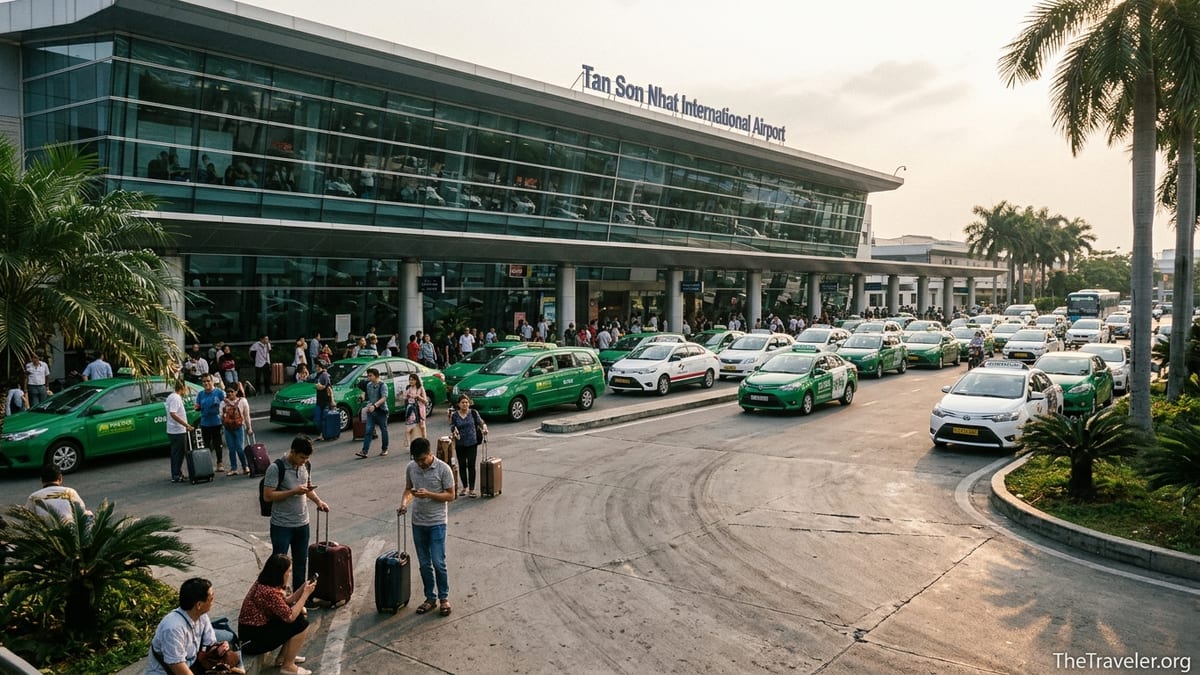
Many first impressions of SGN revolve around the crowds just outside arrivals. It can look chaotic: families waiting with flowers, drivers holding name boards, touts asking “Taxi? Taxi? Where you go?” and the humidity hitting you as soon as the automatic doors open. Taking 30 seconds to step aside, breathe and locate the official signs for “Public Taxi,” “App Car” or “Bus” will make a noticeable difference to how your arrival feels.
Immigration, Visas and Baggage: What to Expect When You Land
After your plane parks at Terminal 2, you will follow signs for “Arrival” and “Immigration.” For many nationalities, including most Europeans, Australians and some Asian passport holders, Vietnam offers either visa exemption for short stays or an e-visa system. If you have arranged an e-visa, you go directly to the immigration counters marked “E-visa” or “All Passports.” If you are using a visa on arrival approval letter, follow signs to the visa counter before joining the passport queue. Processing times vary: a full long-haul arrival bank can mean 30 to 45 minutes in line, while a quieter mid-afternoon landing might see you through in 10 to 15 minutes.
The immigration officer will typically ask simple questions such as the purpose of your trip and how long you plan to stay. Having your first-night hotel address printed or saved on your phone is useful. Once stamped in, you descend to baggage claim. Screens above each carousel show flight numbers. Bags for large wide-body flights can take 20 to 30 minutes to appear; for short regional hops the wait can be much shorter.
Customs at SGN is usually straightforward. After collecting your luggage, you walk toward the green “Nothing to Declare” or red “Goods to Declare” channels. Random bag scans do occur but most tourists are waved through, especially if they are carrying only regular suitcases and backpacks. Large cardboard boxes or oversized electronics are more likely to be inspected. As you pass customs and the automatic doors slide open, you emerge directly into the public arrivals hall where money exchange, ATMs, SIM card desks and transport options are all within a short walk.
If you have a tight domestic connection on a single ticket, your checked luggage may be tagged through to your final destination. In that case, follow the “Transit” or “Transfer” signs, which usually route you to a dedicated security channel and then to the domestic terminal without exiting to the public arrivals hall. If you booked separate tickets, you will generally need to clear immigration, collect bags, exit arrivals, then check in again at the domestic terminal.
SIM Cards, Cash and Connectivity on Arrival
Staying connected is extremely helpful in Ho Chi Minh City, particularly if you plan to use apps like Grab or Be for transport. As you exit customs at Terminal 2, you will find several branded mobile operator counters such as Viettel, Vinaphone and Mobifone, alongside independent resellers. Official packages aimed at tourists often start around 200,000 to 300,000 Vietnamese dong for a data-heavy plan that covers one to four weeks, with generous data allowances that are more than enough for maps, ride-hailing and social media.
Buying at the airport is slightly more expensive than in town, but the convenience is often worth the small premium for a first-time visitor. Staff at the official counters are used to setting up phones for foreigners; they will usually register your SIM using your passport, insert it into your phone, and check that mobile data works before you walk away. This process typically takes under 10 minutes. If someone approaches you in the arrivals hall offering a cheaper SIM “from friend” or “no registration,” it is safer to decline and buy from a clearly branded booth instead.
For cash, ATMs from major Vietnamese banks such as Vietcombank, BIDV and Techcombank are located just outside customs in Terminal 2 and in the public areas of Terminals 1 and 3. Many machines allow withdrawals of 2 to 5 million dong per transaction, and some allow more. Using an ATM generally gives a better exchange rate than changing large sums of cash at the first currency counter, though the fee depends on your home bank. A practical approach for first-timers is to withdraw enough for your first one or two days, then explore better exchange rates in the city, for example around Ben Thanh Market or in the central business district.
Card payments are increasingly accepted in hotels, upscale restaurants and larger coffee chains such as Highlands Coffee or Phuc Long, but many everyday transactions, including small eateries, local coffee stands, street food and some taxis, still work more smoothly with cash. Having at least 500,000 to 1,000,000 dong in small notes on arrival will make tipping, buying a snack or paying a bus fare much easier. Keep in mind that Vietnam uses many zeros on its notes; familiarize yourself with 10,000, 20,000, 50,000, 100,000 and 200,000 dong denominations so you do not accidentally overpay.
Grab, Taxis and Buses: Getting from SGN to Central Saigon
Once you step outside the terminal, your main options into the city are ride-hailing apps such as Grab or Be, regular metered taxis and airport buses. From Tan Son Nhat to the popular backpacker streets around Pham Ngu Lao and Bui Vien or to the Ben Thanh Market area, a typical app-booked car in 2026 usually costs in the region of 150,000 to 250,000 dong, depending on traffic, time of day and car type. For example, many travelers report paying around 170,000 to 200,000 dong from SGN to central District 1 in normal conditions for a standard GrabCar.
If you choose Grab or Be, you will need mobile data. After opening the app, set your pickup point as “Tan Son Nhat Airport” and select the correct terminal. The app will show a specific pickup zone, often labeled in the app and on airport signage as the “App car” or “Ride-hailing” area. Expect the driver to message you via the app; many will send a short text like “Gate 5?” or their license plate number. An easy method is to reply with the pillar number you are standing near, such as “Column B5,” which is clearly printed along the curb.
Metered taxis are the simplest option if you do not want to deal with apps immediately. Reputable companies such as Vinasun (white with green and red logo) and Mai Linh (green) operate from official taxi ranks just outside arrivals. Queues move quickly except in peak periods. Ask the dispatcher for “meter, District 1” and verify the meter is switched on as you leave. To central areas such as Dong Khoi Street or Ly Tu Trong, most visitors pay between roughly 170,000 and 230,000 dong, including airport surcharges. If someone inside the terminal offers you a “fixed price taxi” for 400,000 or 500,000 dong for the same journey, you can politely decline and walk to the taxi rank instead.
For budget travelers or those arriving in lighter traffic hours, airport buses are remarkably cheap. The yellow Bus 109 is designed for travelers, linking the airport with central District 1, including stops near 23/9 Park and close to Ben Thanh. Fares are modest, typically in the tens of thousands of dong, and buses are air conditioned with luggage space. The green Bus 152 also serves the airport and passes areas of District 1, though the route can be slower and more crowded, especially at local commuting times. These buses run roughly from early morning to late evening; if you arrive after about 11 pm, plan on grabbing a taxi or app car instead.
Domestic Connections and the New Terminal 3
Many first-time visitors land at SGN and head straight to coastal destinations like Phu Quoc, Nha Trang or Da Nang on separate domestic tickets. Understanding how the domestic terminals work will save you time and worry. Terminal 1 is the older domestic terminal used by several carriers, while the newer Terminal 3 has become the main base for many Vietnam Airlines domestic flights, particularly on high-traffic routes such as Ho Chi Minh City to Hanoi.
If you arrive on an international flight into Terminal 2 and have a domestic connection on the same ticket with your bags checked through, your airline will typically provide clear directions to the domestic transfer area. Staff can point you toward a shuttle or walkway. If your onward ticket is separate, you must exit into the public arrivals area, then follow signs or ask staff for “Domestic Terminal” or specifically “T1” or “T3” depending on your airline and flight.
A free shuttle bus connects the terminals. For instance, if your domestic flight departs from Terminal 3, you can exit Terminal 2 arrivals, walk toward the area where public buses stop, and look for the small shuttle bus marked for Terminal 3. Typical travel time between Terminals 2 and 3 is around 15 to 20 minutes, including waiting time. It is wise to allow at least two hours between scheduled international arrival and domestic departure if tickets are separate, more if you are landing in the evening peak when immigration and security queues are longer.
Inside Terminal 3, facilities are modern but straightforward. You will find coffee chains, bakeries, small restaurants, convenience stores such as minimarts selling snacks and drinks, and a mix of local and regional airlines at check in. Security can become busy at specific times, especially for morning departures to Hanoi and Da Nang. Each domestic boarding pass normally includes a barcode that is scanned at security and again at the gate. If you are connecting from an international flight and feel unsure, it is perfectly acceptable to show your domestic e-ticket on your phone at an information counter and ask for confirmation about which terminal you need.
Practical First-Time Arrival Tips and Common Pitfalls
Several recurring themes come up when travelers share stories about their first arrival at Tan Son Nhat. One common pitfall is accepting offers from unofficial drivers inside the terminal or right at the exit doors. These individuals might hold signs with generic hotel names or say they are from “airport taxi” but then quote inflated flat fares or refuse to use the meter. A simple strategy is to walk straight past such offers, continue to the official taxi rank or app pickup area, and only enter a car that clearly belongs to a recognized company or appears in your ride-hailing app.
Another frequent issue is confusion over prices due to large numbers on Vietnamese banknotes. For example, a typical fare of 180,000 dong can sound like “one eighty” when spoken quickly, which some visitors mishear as 18,000. To avoid misunderstandings, you can show the amount in your app, or type it into your phone calculator and show the driver. If paying cash, count out the notes slowly. Remember that a 20,000 dong note is usually blue, 50,000 is light blue, 100,000 is green and 200,000 is red-brown.
First-time visitors often underestimate how warm and humid Saigon can feel, especially if arriving from a cooler climate. The walk from the terminal doors to the taxi rank or bus stop is short, but you may be in an open-air area for several minutes while finding your ride. Keep a small bottle of water accessible in your carry-on and dress in light layers so you can adjust quickly on arrival. If you are connecting to a domestic flight, you might want to change into lighter clothing at SGN before heading on to a beach destination.
Finally, it is helpful to have your hotel address written in Vietnamese, not only in English. Many hotels in District 1, such as those on Le Thanh Ton, Nguyen Hue or Bui Vien, will send a confirmation email that includes a Vietnamese version of the address. Showing this to your driver usually eliminates confusion. If your accommodation is down a small alley, you can ask the hotel to mark the exact point on a map and send you a screenshot before you travel.
Inside the City: What Happens After the Airport Ride
Once your taxi or Grab leaves the airport perimeter, you quickly get a sense of Saigon’s traffic culture. Motorbikes weave between cars, roadside food stalls appear every few meters, and you may pass landmarks such as Gia Dinh Park or the Saigon Zoo area, depending on your route. Even this short trip can give you useful orientation: note where your driver joins main roads like Nam Ky Khoi Nghia or Nguyen Van Troi, which connect the airport area to the city center.
At your hotel, it is common for staff or security to open your car door and assist with luggage. If you used a metered taxi and paid in cash, there is no strict tipping rule, but rounding up the fare to the nearest 10,000 or 20,000 dong is appreciated. For example, on a 185,000 dong fare, giving 200,000 and saying “OK, thank you” is perfectly acceptable. For Grab or Be rides paid within the app, tipping is not expected; some apps allow adding a small tip digitally if you wish.
Understanding how close your hotel is to key points will help you plan your next steps. Many first-time visitors stay around Ben Thanh Market, which is roughly 7 kilometers from Tan Son Nhat. From there, you can walk to Nguyen Hue pedestrian street, the Saigon Opera House and the old Central Post Office in 10 to 20 minutes. If you arrive during the day and are not too jet-lagged, a short exploratory walk to get local cash, water and a first Vietnamese coffee can help reset your body clock and give you confidence navigating the streets.
When it is time to return to the airport at the end of your trip, you can reverse the same options. Most people in District 1 simply book a GrabCar or ask their hotel to call a Vinasun or Mai Linh taxi. In normal daytime traffic, leaving your hotel about two hours before a domestic departure or three hours before an international flight is usually comfortable. Add extra time for rush-hour or heavy rain, both of which can slow traffic significantly.
The Takeaway
Ho Chi Minh City’s Tan Son Nhat Airport can feel hectic at first encounter, but it is actually a straightforward gateway once you understand its layout and typical prices. Knowing that there is one main international terminal and clearly separated domestic terminals, including the modern Terminal 3, helps you plan connections with confidence. Recognizing realistic fares for taxis, Grab cars and buses makes it much easier to ignore inflated offers and walk calmly to official transport areas.
For a first-time traveler, the most valuable preparation is simple: arrange your visa or e-visa in advance, carry your first-night hotel address in Vietnamese, have a plan for getting a SIM card and cash at the airport, and decide whether you will use Grab, a metered taxi or Bus 109 into town. With those basics in place, SGN becomes just another travel step rather than a source of stress. Within an hour of landing, you can be checking into a hotel near Ben Thanh or sipping iced coffee on a shaded sidewalk, ready to explore Saigon’s markets, museums and food scene.
FAQ
Q1. How long does it usually take to get from SGN to District 1?
In light traffic, the ride to central District 1 typically takes around 20 to 30 minutes. During rush hours in the late afternoon and early evening, it can stretch to 45 minutes or slightly more, so allow extra time if you have reservations or a connecting trip.
Q2. Is Grab cheaper than a regular taxi from Tan Son Nhat Airport?
In many cases, yes. A standard GrabCar to the Ben Thanh or Dong Khoi area often falls in the 150,000 to 220,000 dong range, while a metered taxi including airport surcharges may be slightly higher. The difference is not huge, but Grab has the advantage of showing the price upfront and charging through the app.
Q3. How much should I expect to pay for a taxi to central Saigon?
For a reputable metered taxi such as Vinasun or Mai Linh from the airport to District 1, most travelers pay roughly 170,000 to 230,000 dong, depending on traffic and exact destination. If you are quoted 400,000 or 500,000 dong for the same trip, it is reasonable to decline and choose another taxi.
Q4. Is it safe to arrive at SGN late at night?
Yes, flights land at Tan Son Nhat throughout the evening and night, and the airport area remains active. After about 11 pm, bus options are limited, so you should plan on using a Grab or taxi. Stick to clearly marked taxi ranks or app pickups, avoid unofficial touts, and you should find late-night arrivals manageable.
Q5. Should I buy a SIM card at the airport or in the city?
Buying at the airport is slightly more expensive but very convenient, especially if you want to use Grab immediately. Staff at official Viettel, Vinaphone or Mobifone counters can set up your SIM in a few minutes. If you are comfortable navigating without data at first, you can wait and buy a SIM from an official shop in the city for a bit less.
Q6. Which bus goes from Tan Son Nhat Airport to the city center?
The yellow Bus 109 is the main airport bus linking SGN with central District 1 near 23/9 Park and close to Ben Thanh Market. It is air conditioned, has space for luggage and charges a modest fare in the tens of thousands of dong. The green Bus 152 also serves the airport but makes more local stops and can be slower.
Q7. How much time should I allow for an international to domestic connection at SGN?
If your flights are on a single ticket with bags checked through, 2 to 3 hours is usually adequate. For separate tickets where you must clear immigration, collect luggage, transfer to another terminal and check in again, it is safer to allow at least 3 to 4 hours, especially in the evening peak.
Q8. Do I need local cash on arrival, or can I use cards everywhere?
You can pay by card in many hotels and larger restaurants, but cash is still very useful for smaller eateries, street food, buses and some taxis. Withdrawing the equivalent of 20 to 40 US dollars in dong at an airport ATM will cover your initial taxi, a meal and basic expenses, after which you can decide whether to exchange more or keep using ATMs.
Q9. Are there luggage storage or locker facilities at SGN?
Services can change, but SGN has periodically offered luggage storage counters in or near the terminals rather than self-service lockers. If you plan a same-day layover in the city, it is best to check with your airline or a current airport information desk on arrival and confirm where you can store bags and what hours the service operates.
Q10. What is the biggest mistake first-time visitors make at Tan Son Nhat?
The most common mistake is accepting help from unofficial drivers or fixers immediately after exiting customs, which can lead to paying far more than necessary. Walking past the crowd to the official taxi rank or ride-hailing pickup, knowing typical fares in advance and having your hotel address ready in Vietnamese will prevent most problems.