


Landing at Ho Chi Minh City’s Tan Son Nhat International Airport can feel hectic, especially if you are arriving on a long‑haul flight and facing Vietnam’s busy immigration hall for the first time. Wait times here vary widely, from a breezy 20 minutes on a quiet weekday morning to more than an hour when multiple wide‑body flights from Europe and East Asia land together. This guide explains how immigration now works at Tan Son Nhat, typical queues at different times of day, how the new pre‑arrival declaration affects processing, and how much time you should realistically allow before booking onward flights, hotel pick‑ups or city plans.
Get the latest updates straight to your inbox!
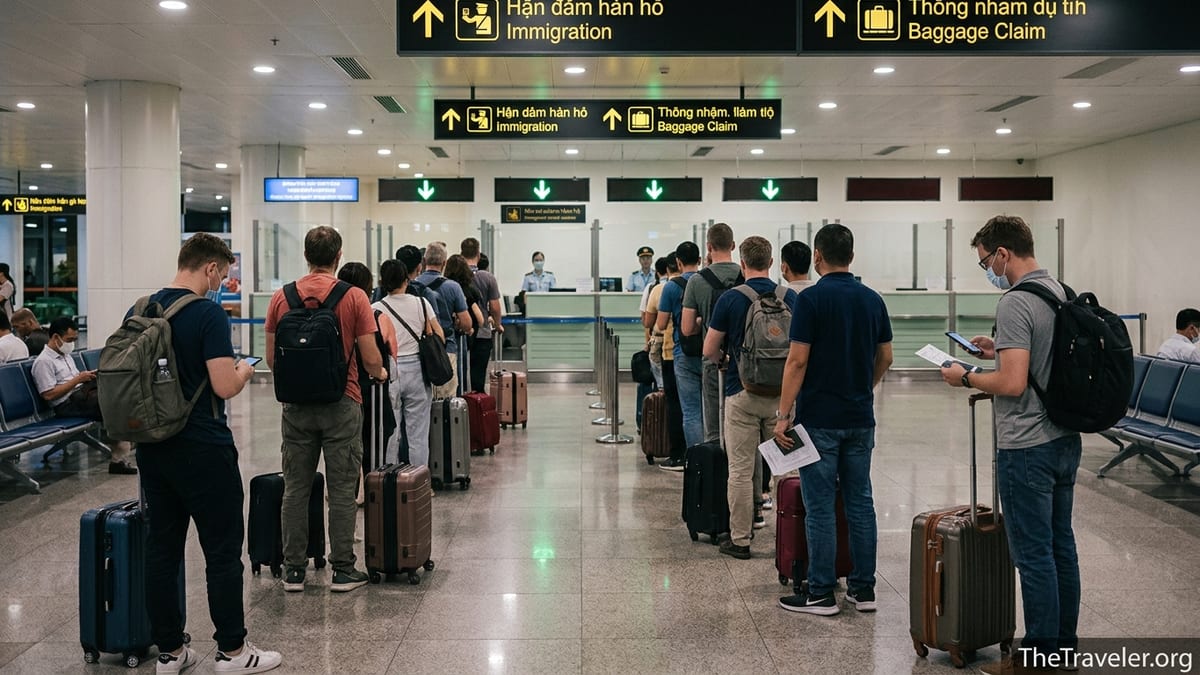
Understanding Tan Son Nhat’s Arrival Layout and New Entry Procedures
Tan Son Nhat International Airport (SGN) is Vietnam’s busiest airport and the main gateway to Ho Chi Minh City. The international terminal, commonly called T2, handles the bulk of long‑haul services from hubs such as Singapore, Bangkok, Incheon, Doha and various European cities. After landing, all international passengers follow the same sequence: disembark, walk through the arrivals corridor to immigration, clear passport control, collect checked luggage from baggage claim, pass customs screening and then exit into the public arrivals area.
Since April 15, 2026, Vietnam’s Immigration Department has been piloting a Pre‑arrival Information (PAI) system specifically at Tan Son Nhat. Travelers on visas or certain entry categories are required or strongly encouraged to complete an online declaration before they fly, providing basic personal and trip details and receiving a QR code to present on arrival. Official statements from Vietnam’s Ministry of Public Security and local media indicate that the goal is to shorten inspection times and reduce congestion during busy peaks by allowing immigration officers to pre‑screen data instead of keying it in at the counter.
In practice, the experience now differs between travelers who have already completed the pre‑arrival declaration and those who have not. Airlines such as Vietjet have begun emailing passengers reminders to fill in the online form before departure, warning that failing to do so can mean longer processing at the counter. Many frequent travelers report that officers now routinely ask for the QR code alongside your passport and visa or e‑visa approval when you reach the booth.
Transit passengers who remain airside are generally exempt from the pre‑arrival declaration, but anyone entering Vietnam through Tan Son Nhat should assume they will be expected to show that QR confirmation. This is in addition to, not instead of, the usual visa or visa‑exemption rules, so you still need to ensure your e‑visa approval or visa‑on‑arrival letter (where applicable) is fully arranged before your flight.
Immigration Wait Times: Typical Ranges and Peak Periods
Immigration wait times at Tan Son Nhat depend heavily on time of day, day of week and how many wide‑body flights land close together. Recent traveler reports suggest that during quieter weekday mid‑mornings, many passengers clear passport control in roughly 20 to 40 minutes from the moment they join the queue. Those arriving on early afternoon regional flights from Bangkok or Singapore often describe a fairly steady line that moves continuously, meaning they are through immigration in under 45 minutes when no major long‑haul banks are arriving at the same time.
The picture changes significantly during evening and late‑night peaks. Multiple travelers arriving around 8 pm, when several flights from Europe and Northeast Asia arrive within a short window, describe a “madhouse” in the immigration hall with queues that can stretch well back from the roped lines. In these worst‑case scenarios, it is not unusual to wait 60 to 90 minutes before reaching the counter. A few accounts mention standing in line for close to two hours on particularly busy holiday periods such as Tet or the late‑April and early‑May public holidays, when Tan Son Nhat handles more than 1,000 flights and nearly 170,000 passengers in a single day.
Morning peaks can also be intense. Reddit users discussing arrivals around 6 to 7 am frequently mention long lines as overnight flights from Sydney, Melbourne, the Middle East and regional hubs all converge. One traveler who landed just before noon described immigration as “crazy for morning flights” and recommended budgeting at least one hour before baggage claim on weekends. On the other hand, others report that in the last year immigration staffing has improved, and even when the hall looks crowded, the line can move more quickly than it appears if all booths are open.
It is important to note that there is no publicly maintained minute‑by‑minute wait time tracker specifically for Tan Son Nhat comparable to systems used by some North American airports. Various third‑party sites and queue‑tracking apps attempt to estimate waits based on crowdsourced data, but these figures are snapshots and can change quickly if a delayed wide‑body arrives. Treat any online “average time” as a rough guide only and always give yourself a generous buffer in case you happen to land during a bank of heavy arrivals.
How the Pre‑arrival Declaration and E‑Visas Affect Your Time at the Counter
The new Pre‑arrival Information system is designed to streamline document checks at the immigration desk. When you reach the front of the line, officers scan the QR code on your phone or printed confirmation, which pulls up your details in their system. If everything matches your passport and visa, the interaction can be surprisingly quick. Several recent passengers using the system at Tan Son Nhat describe spending no more than two or three minutes at the counter itself, compared with much longer in the past when officers had to type in each data field by hand.
By contrast, arriving travelers who have not submitted the pre‑arrival declaration may find that officers ask additional questions and spend more time entering details at the counter. While there is not yet a separate physical queue for PAI users and non‑users, the individual processing time per passenger can be noticeably longer if details need to be corrected or completed on the spot. On a busy evening, this can amplify delays quite quickly, especially if one or two passengers ahead of you have complex cases or incomplete paperwork.
E‑visa holders should be particularly careful to carry printed copies of their approval letters and to check that passport numbers and dates are accurate before they travel. Reports from Vietnam’s major airports indicate that small discrepancies, such as an old passport number or a mistyped date of birth, can lead to secondary checks which easily add 15 to 30 minutes to your time at immigration. In some cases travelers have been asked to step aside while officers verify details with superiors, effectively pausing the entire line behind them.
Travelers using visa‑on‑arrival services through third‑party agencies should also factor in the time needed to queue at the visa counter, pay stamping fees and then join the main immigration line. At Tan Son Nhat this can significantly extend total processing time compared with passengers who arrive with e‑visas or visa exemptions already confirmed. If you are on a tight connection or arriving late with a pre‑booked transfer, arranging an e‑visa ahead of time can be one of the simplest ways to keep arrival stress lower.
Baggage Claim, Customs and Total Time from Landing to Curb
Once you clear passport control, you proceed down the escalator into the baggage hall. Checked luggage from wide‑body international flights typically begins to appear about 20 to 30 minutes after landing, although this can vary with ground handling workloads and how quickly aircraft reach their gates. Several recent passengers who cleared immigration quickly reported then waiting an additional 30 to 60 minutes at the carousel, particularly during late‑evening peaks when multiple flights share ground handling resources.
The upshot is that breezing through immigration is not always the factor that determines when you actually leave the airport. One traveler who paid around 30 US dollars for a VIP fast‑track immigration service described walking straight through passport control only to stand by the belt for about an hour waiting for checked bags. By the time their luggage arrived, almost everyone from the plane had already cleared immigration through the regular lines, effectively nullifying any time savings from the premium service.
Customs checks at Tan Son Nhat are generally straightforward. After you reclaim your bags, you pass through the green or red channels and may be asked to put luggage through an X‑ray scanner. Most tourists with ordinary amounts of baggage and no restricted items are waved through quickly. Allow 5 to 15 minutes for this stage, depending on how many flights have just unloaded and how many scanners are open. From there, you exit into the arrivals hall where hotel drivers and ride‑hailing pick‑up points are located.
Adding these elements together, a realistic total time from scheduled landing to stepping out into the public arrivals area ranges from about 45 minutes in the best‑case scenario on a quiet day with hand luggage only, to 2 hours or more when you hit peak immigration queues and slow baggage delivery. Many seasoned visitors therefore treat 90 minutes as a sensible rule‑of‑thumb average, adjusting upward during major Vietnamese holidays, Friday evenings or late‑night long‑haul arrival banks.
Fast‑Track Services, Families and Special Assistance
Numerous companies, including some airlines, hotels and dedicated agencies, sell “fast‑track” arrival packages at Tan Son Nhat. These typically range between 25 and 60 US dollars per person and promise a staff member will meet you at the aircraft door or the end of the jet bridge, escort you to a dedicated or priority lane at immigration and sometimes assist at baggage claim and customs. For solo travelers arriving at off‑peak times, many recent visitors question the value, especially when regular immigration lines often move steadily and checked baggage, not passport control, becomes the bottleneck.
Where fast‑track can be worthwhile is for travelers with mobility issues, older parents or families with infants arriving late in the evening after a long‑haul flight. A parent traveling with a one‑year‑old, for example, may find it significantly less stressful to be guided through a shorter queue rather than standing for an hour with a tired child. That said, several recent reports suggest that priority lanes are not always clearly separated at Tan Son Nhat and that when the hall is very crowded, even fast‑track guests can face noticeable waits, just shorter than the main line.
Unlike some airports that visibly signpost dedicated lanes for families with young children, the implementation at Tan Son Nhat is inconsistent. Online discussions from 2026 show parents asking whether there is a separate family lane and receiving mixed answers: some travelers said officers informally waved families to the front of the queue at quieter times, while others reported that they had to wait in the same line as everyone else during busy evening peaks. If you are traveling with an infant or someone with reduced mobility, it is worth politely asking a uniformed staff member near the entrance to the immigration hall whether any priority option is available that day.
Passengers requiring wheelchair assistance should arrange this through their airline before departure. In most cases you will be met at the aircraft and guided through immigration, which can significantly reduce both walking distances and time spent standing in line. This service is not a guaranteed “skip‑the‑queue” option, but staff will usually direct you through shorter or dedicated lanes when available.
Planning Transfers and Connections: How Long to Allow
Because of the variability in immigration and baggage wait times, connecting immediately onwards from an international arrival at Tan Son Nhat requires careful planning. For international to domestic connections on separate tickets, most experienced travelers recommend allowing at least 3 to 4 hours between scheduled landing time and domestic departure. This buffer accounts for potential 60 to 90 minute immigration queues, slow baggage delivery, the short but sometimes congested landside transfer between terminals and a recommended domestic check‑in window of at least 60 to 90 minutes before departure, especially during Vietnamese holiday periods.
For example, if you land from Europe at 6 am and are considering a separate low‑cost domestic flight at 8:30 am, you would have only 2.5 hours on paper. If your inbound flight is on time and queues are light, you might just make it, but any delay at the gate, long immigration line or slow baggage carousel could easily push you into the danger zone. Many visitors posting recent experiences from Tan Son Nhat say that anything less than 4 hours between an international arrival and a separately booked domestic flight makes them uncomfortable, given the lack of control over queue lengths and potential for arrival delays.
If your onward connection is on a single ticket with a full‑service airline, the airline is responsible for rebooking you if delays at immigration or baggage cause a missed connection, though you will still face the inconvenience of waiting for a new flight. In that case a 2 to 3 hour legal connection time set by the airline is usually acceptable, but you should still move promptly from the gate to immigration and avoid unnecessary delays in the transit area.
For hotel transfers and city plans, it is safest to assume you will exit the airport between 60 and 120 minutes after landing. When arranging a private car through your hotel, many properties in Ho Chi Minh City ask for your flight number and track its status, dispatching drivers when the plane lands and building in some waiting time. If you book a ride‑hailing service like Grab after you land, expect an additional 10 to 20 minutes to navigate the pick‑up area and deal with traffic outside the terminal, which can be heavy during commuter peaks and on rainy evenings.
Practical Tips to Shorten Your Wait and Reduce Stress
There are several steps you can take before and during your trip to make immigration at Tan Son Nhat as smooth as possible. Completing the official pre‑arrival declaration before you travel should now be considered essential rather than optional. Do it at home on a computer or on your phone at the departure airport, check that all details match your passport exactly, then take a screenshot or printout of the QR confirmation. Having this ready to show as soon as you reach the front of the line can shave valuable minutes off your individual processing time.
Where possible, choose flight arrival times that miss the heaviest peaks. Mid‑afternoon arrivals from regional hubs often encounter shorter lines than late‑evening long‑haul banks from Europe and North Asia. While fares for off‑peak flights may sometimes be slightly higher, the savings in time and stress at immigration can be worth the difference, especially if you plan to connect onward the same day. If you have flexibility, avoiding arrivals very late at night during major Vietnamese holidays like Tet or the April 30 and May 1 long weekend can greatly reduce your risk of extreme queues.
Traveling with only carry‑on luggage also changes the calculation. If you can walk off the plane, clear immigration with a pre‑arrival QR code and proceed straight through customs without waiting at baggage claim, you dramatically cut your total airport time. Some frequent business travelers to Ho Chi Minh City deliberately book light to ensure they can be downtown within 45 to 60 minutes of landing when conditions are favorable.
Finally, prepare for the possibility of a wait: use the restroom before joining the immigration queue, have a bottle of water and a small snack accessible in your personal item, and keep your phone charged in case you need to update a hotel or driver about delays. Knowing that waits of up to an hour are possible during peaks, especially in the evening, helps set expectations and makes the experience feel less frustrating if you happen to arrive at a busy time.
The Takeaway
Immigration at Ho Chi Minh City’s Tan Son Nhat International Airport has a reputation for being crowded, but for most travelers it is manageable with realistic expectations and a bit of preparation. On a typical day you can expect to spend around 20 to 45 minutes in the immigration line, with the understanding that evening long‑haul peaks and major holidays can push waits toward 60 to 90 minutes. Baggage delivery and customs add further variability, so a door‑to‑door exit time of about 90 minutes from landing is a sensible planning baseline.
The rollout of Vietnam’s pre‑arrival information system at Tan Son Nhat is a positive step that, when used correctly, can reduce processing times at the counter. Combined with arranging an e‑visa or confirming your visa status in advance, choosing arrival times that avoid the worst peaks and considering fast‑track only when it truly suits your needs, you can significantly reduce the stress of your first hour in Vietnam.
Above all, build ample buffer time into any onward domestic connections or tightly timed plans in the city. Treat generous layovers and flexible transfer arrangements as part of the cost of traveling through a busy regional hub. With those safeguards in place, your arrival at Tan Son Nhat is far more likely to feel like a straightforward gateway to the energy of Ho Chi Minh City rather than a bottleneck that defines your trip.
FAQ
Q1. How long does immigration usually take at Ho Chi Minh City’s Tan Son Nhat Airport?
On an average day, most travelers spend around 20 to 45 minutes in the immigration line, but during busy evening peaks or holidays it can stretch to 60 to 90 minutes.
Q2. Is the new pre‑arrival declaration at Tan Son Nhat mandatory?
For many foreign visitors entering via Tan Son Nhat the pre‑arrival declaration is now required or strongly enforced, and all others are firmly encouraged to complete it before they fly to avoid delays.
Q3. Does completing the pre‑arrival declaration guarantee a shorter wait?
It does not guarantee a shorter line, but it usually shortens the time you personally spend at the counter, because officers already have your information and can process your entry more quickly.
Q4. How much time should I allow between an international arrival and a separate domestic flight?
For separate tickets, aim for at least 3 to 4 hours between scheduled landing and domestic departure to cover possible long immigration queues, baggage delays and domestic check‑in.
Q5. Is fast‑track immigration at Tan Son Nhat worth paying for?
Fast‑track can be useful for families with young children, older travelers or those with mobility issues arriving at peak times, but many recent visitors find it offers limited benefit when regular lines move steadily and baggage claim is slow.
Q6. How long does it take from landing to exiting the airport in total?
Including immigration, baggage claim and customs, a realistic total is about 60 to 120 minutes, with 90 minutes a sensible average under normal conditions.
Q7. Are there priority lanes for families with infants at Tan Son Nhat?
There is no consistently signposted family lane; sometimes officers informally give priority to families, but at busy times everyone may use the same queues, so you should be prepared to wait.
Q8. What happens if my e‑visa details do not match my passport?
Small errors such as a wrong passport number or date can lead to secondary checks and significant delays and, in some cases, may require you to resolve the issue before being allowed to enter, so double‑check all details before traveling.
Q9. How should I coordinate airport pick‑ups or hotel transfers with these wait times?
Plan for your driver to meet you 60 to 120 minutes after scheduled landing and keep your hotel or transfer company updated by message if immigration or baggage claim is taking longer than expected.
Q10. Is it safe to leave the airport during a long layover in Ho Chi Minh City?
Yes, provided your layover is long enough; once you factor in 60 to 120 minutes for immigration and exit, plus city traffic and the need to check in again, most travelers consider leaving the airport practical only for layovers of at least 7 to 8 hours.