


Arriving at Ho Chi Minh City’s Tan Son Nhat International Airport can feel chaotic, especially the first time you step out of customs into the humid air and a crowd of drivers calling “Taxi? Taxi?” This guide explains, in practical terms, how to leave the airport safely and fairly by taxi or car, what you should expect to pay, which brands to look for, and how to avoid the most common scams that target new arrivals.
Get the latest updates straight to your inbox!
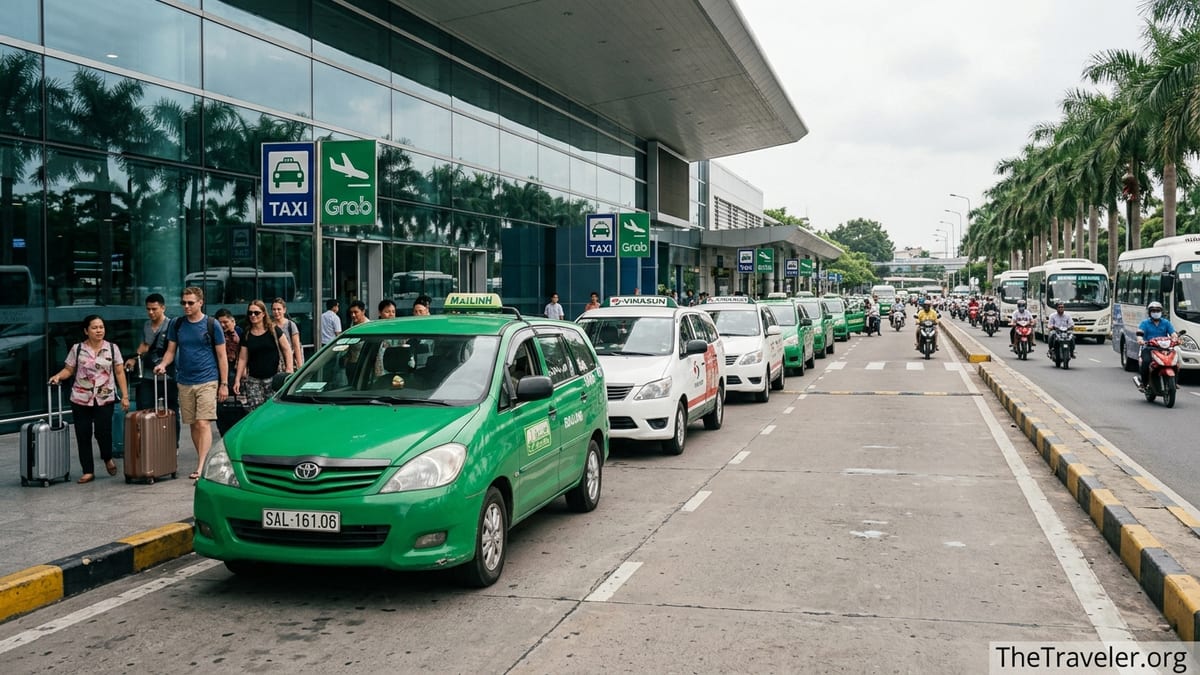
Understanding Tan Son Nhat Airport and Where Taxis Wait
Tan Son Nhat International Airport (SGN) sits about 6 to 8 kilometers from downtown District 1, depending on your hotel. That is a short drive in distance, but traffic can turn it into a 25 to 45 minute ride at busy times. The airport has multiple terminals: T2 currently handles most international flights, while T1 and T3 handle domestic routes. All of them share the same general road system outside, with dedicated lanes for private cars, app cars, and licensed taxis.
When you exit the customs area in the international terminal, you walk straight into the arrivals hall. Past the doors you will find a mix of currency exchange counters, mobile SIM kiosks, hotel representatives, and people holding name boards. The official taxi rank is a short walk further outside: you follow the “Taxi” signs, pass through the sliding doors, cross a small driveway, and queue where airport staff manage the line. This is where you find branded city taxis such as Vinasun and Mai Linh, along with some airport concession taxis.
The domestic terminal is busier with local travelers, but the system is similar. There is a dedicated lane and parking structure (often referred to as the TCP parking building) where taxis and app cars like Grab wait and circulate. Signage points you toward “Taxi” and “Car pick up,” but it can still be confusing in the crowds. The most important rule is that you walk to official ranks or the clearly marked app pick up zones rather than accepting offers from individuals who approach you inside the terminal or just outside the doors.
Because traffic flows around the terminals in several lanes, the airport authorities periodically adjust which lane is used for drop off and which for pick up. The detail that matters to you as a traveler is simple: vehicles that are allowed to pick up passengers will be waiting in marked lanes or parking areas, and drivers should not rush you or pull you away from those zones. If someone insists you follow them into a different area or side street, treat that as a warning sign.
Official Metered Taxi Brands and What a Normal Fare Looks Like
In Ho Chi Minh City, the two most widely recommended traditional taxi brands are Vinasun and Mai Linh. Their cars are easy to recognise: Vinasun vehicles are typically white with red and green stripes and a clear Vinasun logo on the doors, while Mai Linh taxis are a distinctive solid green with the brand name on the sides and roof sign. Both companies operate on meters, publish their approximate per kilometer rates, and are generally considered reliable by locals and long term residents.
From Tan Son Nhat Airport to central District 1, for example around Ben Thanh Market or Nguyen Hue walking street, a daytime ride in a Vinasun or Mai Linh taxi typically comes to around 120,000 to 180,000 Vietnamese dong, depending on traffic and the exact drop off point. That is roughly 15 to 25 minutes of driving in light traffic and up to 40 minutes in the evening rush. You may also pay a small airport surcharge and an electronic toll for the airport road or tunnel if the route uses it, usually another 10,000 to 20,000 dong combined. Many travelers round up to 200,000 dong for a straightforward, scam free trip to the city center.
For shorter hops, such as from the airport to nearby hotels in Tan Binh District or along Truong Son Street, you might see fares in the 40,000 to 80,000 dong range. For longer rides to districts further out, such as District 2’s Thao Dien area or District 7, a metered ride usually falls somewhere around 200,000 to 300,000 dong, again varying with traffic and route. If a driver quotes you 600,000 or 800,000 dong for a standard ride into central Ho Chi Minh City before even turning on the meter, you can safely assume it is not a fair price.
Inside the official taxi rank, an airport attendant will often ask for your destination, then signal the next taxi in line. You simply follow that vehicle, confirm the destination with the driver, check that the meter is on before leaving the curb, and note the company name and car number printed inside the cabin. Taking a quick photo of the license plate as you get in is common practice among frequent travelers, mainly as a precaution in case you forget something in the back seat or need to report an issue later.
Taxi Counters, Prepaid Rides and When They Make Sense
In the arrivals hall, especially in the international terminal, you will see several airport taxi counters or “transportation desks.” These are staffed booths that offer prepaid or fixed price rides to the city. They typically display a board with districts and approximate fares. You pay at the counter, receive a receipt or a slip with your destination, then a staff member leads you to a car outside. The car may be a regular taxi from a local company or a private transfer vehicle.
These counters are convenient for travelers who arrive late at night, feel tired after a long flight, or prefer to settle the price in advance without worrying about meters or route choices. For example, you might see a counter advertising a fixed fare of around 250,000 to 300,000 dong to District 1, inclusive of tolls and airport surcharge. That is higher than the average metered fare in light traffic, but still within a reasonable range and often worth it for peace of mind if you are unfamiliar with the city.
It is important to distinguish between official counters with clear signage and receipts, and informal touts who stand near the exit holding a laminated “Taxi” sign. A legitimate counter will have a company name, price list, and a cash register or card terminal in a fixed location. Staff will not walk you away from the counter area until after you have paid and been assigned a car. Someone who approaches you personally in the crowd and offers “cheap taxi, same price as Grab” is not part of these official services, even if they wear a reflective vest or carry what looks like a badge.
For many travelers, the best compromise is to use the official taxi rank if there is not a long queue, or a reputable counter if you prefer a fixed price or are arriving at a very late hour. Both options dramatically reduce the risk of scams compared with accepting offers from individuals inside the terminal or on the sidewalk.
Ride Hailing Apps at the Airport: Grab, Be, Xanh SM and Others
Ride hailing apps are deeply integrated into everyday life in Ho Chi Minh City. Grab is the best known service among visitors, but local competitors such as Be and the electric fleet Xanh SM are also widely used. All allow you to request a car from the airport to your hotel with the price shown in the app before you confirm, which many travelers prefer over traditional metered taxis.
At Tan Son Nhat, app based cars must follow airport rules about where they can pick up passengers. As of mid 2026, they are generally directed to specific pickup lanes or parking areas near each terminal, often within or next to the multi level parking garage by the domestic terminal and on designated lanes outside the international terminal. After booking, your app will show a meeting point description, such as “International Terminal, Column 12, Grab Pick Up.” It is worth taking a moment to match that description with the signs you see around you before you start walking.
The typical GrabCar fare from Tan Son Nhat to a mid range hotel near Ben Thanh Market might range around 150,000 to 220,000 dong depending on time of day, demand, and any promotions in the app. An economy car from Be or Xanh SM will usually be in a similar band. For a family with luggage heading from the airport to a serviced apartment in Thao Dien, you might see prices between 220,000 and 320,000 dong for a larger 7 seat vehicle. These figures are not guaranteed but give you a realistic sense of what looks normal on screen.
Scams involving apps tend to happen when someone pretends to be your driver or persuades you to cancel the app ride and take their vehicle for cash at a higher price. To protect yourself, always check the license plate, car model, and driver name in the app and make sure they match the vehicle in front of you. If a driver asks you to cancel the booking and pay cash, or tries to lead you away from the labeled pickup area, simply decline and wait for another car. You can also take advantage of airport staff assigned to the app pickup zones, who may wear branded vests and can help you match with your legitimate driver.
Realistic Fare Expectations, Tolls and Paying the Driver
Whether you choose a traditional taxi or an app based car, knowing roughly what you will pay makes arrival much less stressful. For most visitors staying in central Ho Chi Minh City, a fair fare from Tan Son Nhat Airport is typically between 150,000 and 250,000 dong all in for a standard four seat car. That includes the base fare, distance, time in traffic, and common airport related surcharges. If your hotel is right in the heart of District 1, such as along Le Loi or Dong Khoi, the cost toward the lower end of that range is common outside rush hour.
Some routes involve tolls, for example when using certain elevated roads or tunnels as your driver navigates congestion. In a metered taxi, these tolls may appear as small additional charges. In an app, the fare quote usually includes expected tolls unless stated otherwise. If a driver hands a toll ticket to you or shows a receipt, you can pay it in cash or let it be added to the final total, depending on how the service is structured. In either case, the amounts are modest compared to the main distance fare, often under 20,000 dong for airport related segments.
Cash remains the most commonly used payment method for traditional taxis in Ho Chi Minh City. Many drivers do not accept card payments, even if the company has experimented with card terminals. You should withdraw or exchange some Vietnamese dong at the airport, ideally in small denominations such as 20,000, 50,000 and 100,000 notes, before you head to the taxi rank. With ride hailing apps, you can pay either with a linked card or in cash, depending on what is available on your account in Vietnam.
Tips are appreciated but not required. Locals often simply pay the meter amount or round up to the nearest 10,000 dong. For example, if the meter reads 168,000 dong, paying 170,000 or 180,000 is common. For a smooth ride with help loading heavy luggage or late night service, you might round up a little more, but there is no obligation to add a set percentage as in some other countries.
How to Recognise and Avoid Unofficial or Problematic Drivers
The most persistent risk at Tan Son Nhat Airport is not violent crime but overcharging and dishonest drivers targeting disoriented new arrivals. These can take the form of unlicensed “taxi” drivers with private cars, drivers from minor companies who imitate big brand colors, or even individuals pretending to be app drivers. Their goal is usually to steer you away from the official ranks or app pickup areas to a quieter spot where they can set a much higher fare.
Common warning signs include drivers who approach you directly in the arrivals hall or just outside the sliding doors, calling “Taxi, where you go?” and following you as you walk. Some may hold a generic airport taxi sign or claim to be “same price as meter” while insisting you do not need to queue. Others might show you a blurry photo of the Grab or Be app on their phone and say they are your driver, even though the license plate and car model do not match what you see in your own app.
Real world reports from travelers describe being quoted 600,000 dong or more for a simple ride to District 1, or being driven on needlessly long routes through multiple districts before reaching the hotel. In some cases, a driver may cover the meter, reset it midway, or claim that the luggage in the trunk incurs a special fee on top of the fare. The simplest way to avoid these problems is to commit to one of three options: the official taxi rank for Vinasun and Mai Linh type cabs, a reputable prepaid taxi counter, or a ride booked and tracked through a mainstream app.
If you feel pressured, remember that you are under no obligation to follow anyone. You can walk back into the terminal, head toward the official signage, and ignore persistent offers by not making eye contact or responding. In the unlikely event that someone grabs your bag or tries to physically pull you toward a car, raise your voice, say “No” firmly, and move toward areas with uniformed airport staff. These situations remain the exception rather than the rule, but being prepared helps you react quickly.
Luggage, Group Travel and Practical Tips for a Smooth Exit
If you are traveling with large suitcases, sports equipment, or a family group, leaving the airport smoothly requires a bit more planning. Most standard taxis and app based economy cars in Ho Chi Minh City are compact sedans or hatchbacks that can realistically handle two adults with two check in bags and a couple of smaller backpacks. For three or four adults with multiple large bags, you will be more comfortable in a seven seat vehicle or minivan class, whether from a taxi company that offers larger cars or via an app option labeled for six or seven passengers.
When you reach the taxi rank, you can tell the attendant how many people and bags you have. They may wave forward a slightly larger car or minivan from the same company if one is available. If you are using an app, choose the larger car category from the start. It is better to wait a few extra minutes than to overload a small car to the point where the driver has to tie the trunk partly open with luggage secured by straps, which sometimes happens on busy days.
Vietnamese taxi drivers are generally accustomed to handling luggage, but levels of service vary. Some will hop out quickly to load bags into the trunk, while others may simply open it and wait. You are not charged a per bag fee in reputable taxis, and any such request should be treated as suspicious. Keep your most valuable items, such as passports, money and electronics, in a small bag that stays with you in the back seat rather than in the trunk. That way, if you ever feel uncomfortable partway through a ride and decide to get out early, you can do so without leaving essentials behind.
Families traveling with small children should also keep in mind that most taxis in Ho Chi Minh City do not carry child seats, and seat belts in the rear can be inconsistent. If you need a child seat, you may find it easier to arrange a private transfer through your hotel or a specialist service ahead of time and confirm that a suitable seat is included. For everyone else, simply double check that the rear seat belts are functional when you get in, and choose window seats for children if possible.
Staying Safe at Night and During Peak Travel Periods
Ho Chi Minh City is active late into the evening, and flights arrive at Tan Son Nhat well after midnight. At these hours, the airport is quieter inside but still busy outside with taxis, private cars, and buses. Official taxi ranks and app pickup zones continue to operate, though queues can be shorter or longer depending on late night arrivals. The basic guidance does not change: use formal queues and apps, avoid anyone who approaches you with unsolicited offers, and do not let the darkness or jet lag rush you into a poor decision.
During Vietnamese holidays such as Tet (Lunar New Year) and around major festivals, the airport can become extremely crowded, with longer queues for both immigration and ground transport. At these times, some travelers choose to pre book a private transfer through their hotel or a reputable company to avoid uncertainty. Fixed price transfers might cost more than a meter taxi on a normal day, for example 350,000 to 500,000 dong to District 1, but can be worthwhile when the demand for regular taxis and app cars exceeds the supply.
Peak congestion periods in the city are typically weekday mornings from around 7:30 to 9:30 and evenings from about 16:30 to 19:30. If your flight lands or departs during these windows, build in extra time and expect your taxi fare to lean toward the upper end of normal ranges due to slower traffic. Apps like Grab can give you a quick read on current conditions by showing estimated time and price for the ride before you book, which you can compare to your expectations.
At any time of day, one of the simplest safety habits is to share your ride details with someone else. In an app, use the share trip function if available. In a traditional taxi, send a quick message with the company name, car number, and license plate to a friend or family member. While incidents are relatively rare compared with the sheer number of daily rides, this small step adds an extra layer of reassurance if something does go wrong.
The Takeaway
Arriving at Tan Son Nhat International Airport can be intense, but getting a safe and fairly priced ride into Ho Chi Minh City is straightforward once you know what to look for. Focus on three reliable paths out of the airport: the official taxi rank with major brands like Vinasun and Mai Linh, reputable taxi or transfer counters inside the terminal, and well known ride hailing apps such as Grab, Be and Xanh SM with clear pickup points.
For a standard trip into central District 1, you can expect to pay somewhere in the 150,000 to 250,000 dong range in most situations, with slightly higher fares for longer journeys or heavier traffic. Always ensure the meter is running in traditional taxis, verify driver and vehicle details when using apps, and never feel obliged to follow individuals who approach you with unsolicited offers. With a small amount of preparation and confidence, your first ride from Ho Chi Minh City’s airport can be a smooth, low stress start to your time in Vietnam.
FAQ
Q1. How much should a taxi from Ho Chi Minh airport to District 1 cost?
A typical metered ride with a reputable company from Tan Son Nhat Airport to central District 1 usually falls between about 150,000 and 250,000 dong, depending on traffic, exact location, and any small tolls or surcharges.
Q2. Which taxi companies are safest to use at Tan Son Nhat Airport?
Most locals and frequent visitors recommend sticking to well known brands such as Vinasun and Mai Linh at the official taxi rank, since their cars are easy to recognize and they operate on standard meters with published rates.
Q3. Is it better to use Grab or a regular taxi from the airport?
Both options work well. Regular taxis are simple if you go straight to the official rank, while Grab and similar apps are helpful if you like seeing the price in advance and are comfortable finding the designated app pickup point.
Q4. How can I spot a taxi scam at Ho Chi Minh airport?
Warning signs include drivers approaching you inside the terminal, quoting very high fixed prices for short rides, asking you to cancel your app booking and pay cash, refusing to use the meter, or trying to lead you away from marked pickup areas.
Q5. Do airport taxis charge extra for luggage?
Reputable taxi companies in Ho Chi Minh City do not charge per bag, so you should not see a separate luggage fee on top of the meter. Any demand for a “bag fee” is a sign you should question the charge or choose another taxi.
Q6. Can I pay for a taxi by credit card at Tan Son Nhat?
Some taxis and private transfer services accept cards, but many ordinary taxis still operate on cash only. It is safer to assume you will need Vietnamese dong and withdraw or exchange some money before leaving the terminal.
Q7. Where exactly do I meet my Grab driver at the airport?
After booking, your Grab or similar app will show a specific pickup point near your terminal, often described by lane name or column number. Follow airport signs to the ride hailing area and match the car’s license plate and model with what appears in your app.
Q8. Is it safe to take a taxi from the airport late at night?
Yes, as long as you use official channels. The taxi rank and app pickup zones operate into the night, and the same rules apply: avoid unsolicited offers, confirm vehicle details, and share your ride info with someone if you are traveling alone.
Q9. What should I do if a taxi driver overcharges me?
If you suspect overcharging, you can calmly ask for a receipt showing the distance and fare, note the company name and car number, and speak with your hotel reception for help in contacting the company. In clear cases of fraud, you can also raise the issue with local authorities, although resolving disputes after the fact can be time consuming.
Q10. Are there child seats available in Ho Chi Minh airport taxis?
Standard taxis and most app based cars do not carry child seats. If you need one, the most reliable approach is to arrange a private transfer or hotel pickup in advance and confirm that an appropriate child seat will be provided.