


Landing at Ho Chi Minh City’s Tan Son Nhat International Airport can feel intense: humid air, packed arrivals halls, insistent taxi touts and a wave of motorbikes outside. Yet the journey into the city is surprisingly short. Ben Thanh Market in District 1 sits roughly 7 kilometers from the airport, making it a natural first waypoint for many visitors. This guide explains, in practical detail, how to get from the airport to Ben Thanh using Grab, regular taxis and buses 109 and 152, what to do with luggage, how traffic affects your choice, and whether Ben Thanh really works as your first stop in the city.
Get the latest updates straight to your inbox!
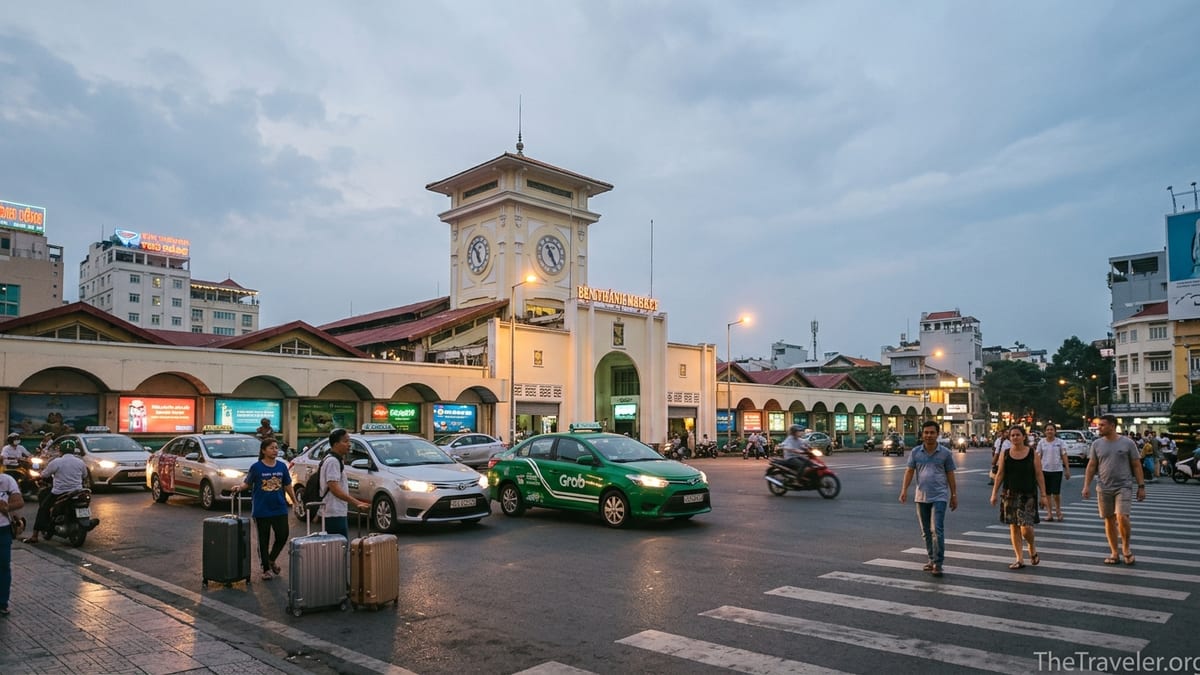
Understanding the Route from the Airport to Ben Thanh
Tan Son Nhat International Airport lies in Tan Binh District, northwest of central Ho Chi Minh City. Ben Thanh Market is in the heart of District 1, the area where most first-time visitors stay. The driving distance between the two is typically 6 to 8 kilometers, depending on the route. In light traffic that can be a 20-minute ride. In peak-hour congestion it can stretch closer to 40 minutes, particularly around key junctions such as Lang Cha Ca and along Nam Ky Khoi Nghia or Cach Mang Thang Tam, two of the main corridors into downtown.
Most road routes funnel into central District 1 near the New World Saigon Hotel and September 23 Park, a short walk from Ben Thanh’s clock tower. That is why Ben Thanh has long acted as an informal hub: buses terminate nearby, many airport taxis are familiar with hotels in the streets radiating from the market, and ride-hailing drivers typically default to this area when travelers type “District 1” rather than a specific hotel address.
The short distance can be deceptive. At certain times of day, especially from about 4:30 pm to 7:30 pm on weekdays, the roads outside the airport and the approaches to District 1 back up heavily. It is not unusual, for example, for a passenger who lands at 5:00 pm to spend almost as long getting to their hotel as they did flying from nearby countries such as Thailand or Singapore. Keeping this in mind when choosing between a taxi, Grab or bus can save both money and frustration.
Because the route is so well trodden, scams and overcharging do occur, particularly around the airport arrivals exit. The safest way to start is to know roughly what your journey should cost and what it should look like on a map before you exit the terminal. A typical metered or ride-hail car fare between the international terminal and a mid-range hotel one block from Ben Thanh, for instance, often falls in the range of 150,000 to 250,000 Vietnamese dong, depending on traffic and vehicle type.
Taking Grab: The Most Flexible Option
For many visitors, Grab is the most convenient way to go from the airport to Ben Thanh Market. Grab, Southeast Asia’s dominant ride-hailing app, functions in Ho Chi Minh City much as Uber does in many Western cities. You can choose between GrabCar for private cars, GrabBike for motorbike taxis and, at busy times, larger vehicles such as GrabCar 7 for groups or travelers with bulky luggage. For a typical couple with one checked suitcase each, a standard GrabCar is usually sufficient, as most drivers use compact sedans such as Toyota Vios or Hyundai Accent.
Grab cars are not allowed to pick up directly at the curb where friends and hotel cars wait. Instead, after you collect your bags and exit customs, you follow signs or app instructions to the designated pickup zones. At the domestic terminal, recent arrangements direct GrabCar rides to a specific lane marked for app-based cars. At the international terminal, you may be asked in the app to walk a few minutes to a parking area or pickup lane rather than waiting outside the glass doors. This feels confusing after a long flight but in practice is easier than it sounds: travelers routinely report that from stepping out of arrivals to meeting their Grab driver takes about 10 to 15 minutes on a normal evening.
Pricing on Grab is dynamic but transparent. On a quiet mid-morning, a GrabCar from Tan Son Nhat to a hotel facing Ben Thanh Market might be quoted at around 140,000 to 180,000 dong, including airport parking fees and any tolls. In heavy rain at 6:00 pm, the same route can spike notably higher, especially if surge pricing kicks in. The app shows the full fare before you confirm. Paying in cash is normal and widely accepted, though you can also register a card or other payment method if you prefer not to carry much cash on arrival.
Real-world experiences underline how Grab can smooth the first leg of your trip. A group of five arriving on a late evening flight, for example, might order a GrabCar 7 around 10:15 pm and reach a District 1 hotel near Ben Thanh before 11:00 pm, with a single large vehicle handling everyone and their luggage. Solo travelers with just a backpack sometimes opt for GrabBike, especially outside peak rain hours, and pay roughly the price of a coffee for the ride into town, though this is not comfortable with a large suitcase and does not suit every traveler’s risk tolerance.
Using Regular Taxis: What to Know and What to Avoid
Ho Chi Minh City still has a large fleet of regular taxis, many of which line up outside the airport terminals. Taking a meter taxi is straightforward if you know which companies to trust and what to expect. Locals and frequent visitors often recommend using reputable brands such as Vinasun or Mai Linh, which operate recognizable white or green vehicles with clear logos and meters. At the airport, there are official taxi queues and counters where staff direct you to these taxis in an orderly fashion.
For a standard sedan taxi from Tan Son Nhat to a hotel within a short walk of Ben Thanh Market, realistic meter fares in normal conditions often land in the range of 180,000 to 250,000 dong, including airport surcharges. In light traffic some travelers report paying a bit under this range, while a ride during the worst of the evening rush or in heavy rain can creep higher. Flat-rate airport transfer services booked through hotels or agencies can cost more, sometimes several hundred thousand dong, but incorporate meet-and-greet service and a driver waiting with your name on a sign in arrivals.
Taxi scams do occur, although they are not inevitable. Problems usually arise when visitors accept offers from drivers who intercept them inside the terminal or just outside the doors rather than walking to the official taxi queue. These drivers may quote a price in “hundreds” that sounds reasonable in the confusion of arrival but translates into far more than the meter would show. There are also occasional stories of unmarked taxis taking longer routes than necessary to District 1. A simple rule is to decline any driver who approaches you directly, look for clearly branded Vinasun or Mai Linh cars, and insist on using the meter. If the driver refuses, get out and choose another car.
Taxis remain a good choice if you do not yet have mobile data, cannot get the Grab app to work, or simply prefer to step into a waiting car rather than navigate a pickup point. They also suit travelers with mobility needs who want the shortest possible walk from the arrivals hall to their vehicle. Couples with two large suitcases can comfortably fit into a typical sedan taxi, though groups of four adults with four checked bags may find it tight and might prefer booking a larger vehicle through a hotel or an app.
Airport Buses 109 and 152: The Budget-Friendly Route
For budget-conscious travelers or those curious about local transport, the yellow airport bus 109 and the green bus 152 offer inexpensive links between Tan Son Nhat and central Ho Chi Minh City. Bus 109 is specifically set up to serve airport passengers and connects the terminals with the area around Ben Thanh. Bus 152, a regular city bus, runs between the airport and the city and can also bring you close to Ben Thanh, though it is less tailored to tourists and may involve more local-style boarding and payment practices.
Fares on these buses are a fraction of taxi prices. Recent guidance suggests airport bus tickets costing roughly what you might pay for a street snack rather than a sit-down meal, making them attractive if you are traveling light. The 109 bus typically uses modern vehicles with luggage space and air conditioning. Staff at the small ticket counter near the airport bus stop sell tickets and may speak basic English, enough to confirm “Ben Thanh” and point you to the correct bus. The journey time, however, can easily stretch to 45 minutes or more as buses stop at intermediate points on the way into the city and navigate the same traffic as cars.
Bus 152 is cheaper still but more of a local experience. It uses standard city buses that can be crowded at peak hours, and space for large suitcases is limited. Payment is usually made in cash directly to the conductor, and small notes are essential to avoid delays or confusion. The route passes through busy commercial streets before reaching the downtown area near Ben Thanh. Travelers who speak no Vietnamese may find communication more challenging on this bus compared with 109, although route numbers and destination boards are clearly displayed on the front and side of the vehicles.
Choosing the bus makes the most sense if you are arriving during daytime, carrying at most one small suitcase or backpack, and staying in or near District 1 within walking distance of where the bus drops you. A solo traveler landing at 11:00 am, for example, might buy a 109 ticket, enjoy a slow but cheap ride past local shops and cafes, and step off near Ben Thanh before checking into a nearby guesthouse. Late at night, with reduced bus frequency and tiredness after a long-haul flight, the savings often do not justify the added time and effort.
Luggage, Traffic and Hotel Drop-Off: Matching Transport to Your Situation
Your choice of transport from the airport to Ben Thanh should reflect three practical factors: how much luggage you have, what time you land, and where exactly your hotel is located. A solo traveler with just a carry-on bag landing at 10:00 am has very different needs from a family of four with multiple large suitcases arriving during the evening rush hour. Thinking through these details in advance helps you avoid unpleasant surprises at the curb.
For travelers with heavy or multiple pieces of luggage, GrabCar or a regular taxi offers the smoothest experience. You can load your bags directly into the trunk and be dropped at your hotel door. Some small boutique hotels in the streets behind Ben Thanh, such as those along Le Thanh Ton or Thu Khoa Huan, sit on relatively narrow lanes, so drivers may stop at the nearest corner rather than right at the entrance. It is reasonable in this case to expect to wheel your suitcase for one or two minutes. If you are carrying only a light backpack, you could theoretically use GrabBike or walk a short distance from a bus stop near Ben Thanh to a nearby hostel without difficulty.
Traffic is particularly relevant during afternoon and evening peak hours and after heavy rain. When a storm sweeps through the city, surface water can slow traffic, and demand on Grab and taxis often spikes at the same time as supply becomes stretched. A taxi journey that normally takes 25 minutes and costs under 200,000 dong might turn into a 45-minute slog at a significantly higher price if surge pricing is in effect on ride-hail apps. In such situations, travelers staying within an easy walk of Ben Thanh sometimes choose the 109 bus simply because its flat fare is unaffected by demand, accepting the longer ride as a trade-off for price certainty.
Hotel location matters because Ben Thanh is a landmark as well as a market. Many properties describe themselves as “near Ben Thanh Market” even when they are a 10 to 15 minute walk away, particularly those along Nguyen Thi Minh Khai or deep into the alleyways behind Bui Vien. When using Grab, entering your hotel name rather than just “Ben Thanh Market” helps ensure that you are dropped close to your actual bed for the night. For taxis, showing the hotel name written clearly, ideally with a Vietnamese address including street name and ward, lowers the chance of misunderstandings.
Is Ben Thanh Market a Good First Stop?
Ben Thanh Market is one of Ho Chi Minh City’s most recognizable landmarks. Its central clock tower, busy food court and maze-like interior make it a magnet for tour groups and independent travelers alike. The market’s location is undeniably convenient. From Ben Thanh, you can walk to many key attractions: the Saigon Central Post Office and Notre-Dame Cathedral of Saigon to the northeast, the Reunification Palace just up the boulevard, and the riverfront and Nguyen Hue walking street slightly further east. For this reason alone, basing yourself or at least pausing first around Ben Thanh can make sense.
Yet Ben Thanh is also an intense introduction to the city. Inside the covered market, stallholders call out to passersby, aisles are narrow, and prices for souvenirs, coffee and textiles are often quoted at levels that assume tourists will bargain down. For some travelers, this is part of the charm: an immediate immersion in the sights, sounds and smells of Saigon, with a bowl of pho or a plate of broken rice in the food area providing a first local meal. Others find it overwhelming straight off a long-haul flight, especially in the afternoon heat when the market feels particularly stuffy.
As a first stop, Ben Thanh works best when you treat it as a gentle orientation point rather than a full shopping mission. After checking into a nearby hotel, many visitors take a short walk around the market’s exterior, noting where the bus stops and taxi stands are, and perhaps stepping inside for a drink at one of the juice stands. They might then retreat to a nearby cafe with air conditioning to regroup, study a city map and plan the next day’s sightseeing. This way, Ben Thanh becomes an anchor from which to explore the city at your own pace rather than a single overwhelming destination.
Moreover, staying near Ben Thanh does not lock you into the market alone. From this area you can easily reach other neighborhoods that show different sides of Ho Chi Minh City, whether that is the backpacker streets of Bui Vien and Pham Ngu Lao, the cafe-lined avenues of District 3, or the newer high-rise developments along the Saigon River. In that sense, choosing Ben Thanh as your first base is practical: you are well connected, yet free to explore further once you have shaken off your jet lag.
Choosing the Best Option for Different Traveler Types
Different kinds of travelers will naturally gravitate toward different ways of getting from Tan Son Nhat to Ben Thanh. First-time visitors who feel anxious about scams and language barriers may favor ride-hailing or hotel-arranged transfers, even if they cost more, in exchange for predictability. For example, a couple arriving from Europe late at night might pre-book a private car through their mid-range District 1 hotel at a fixed price that is higher than Grab but includes someone waiting with their name on a sign in the arrivals hall, which can feel reassuring after a long journey.
Backpackers and budget-focused solo travelers are often happy to trade time for savings. A traveler landing at midday with a small backpack and a hostel bed booked near Bui Vien might ride bus 109 to the Ben Thanh area, walk 10 minutes to their hostel and spend what they saved on their first Vietnamese coffee. If they plan to use GrabBike heavily during their stay, they may hold off on larger luggage altogether, knowing that moving around the city is simpler with hands-free mobility.
Families and groups, especially those with children or older relatives, usually lean toward GrabCar or reputable taxis. The cost of a single large GrabCar 7 split between four or five people becomes competitive with multiple bus tickets while still delivering door-to-door convenience. Parents with young children in tow appreciate being able to put everyone and everything straight into one vehicle outside the terminal and roll up directly to their hotel entrance near Ben Thanh without needing to shepherd kids and bags on and off a bus.
Business travelers on tight schedules may choose whichever option gets them into the city fastest at the time they land. Early morning arrivals sometimes find that a GrabCar can whisk them to a meeting near Ben Thanh or a nearby office tower faster than a taxi queue moves, while at other times of day the reverse is true. Having both the Grab app installed and a willingness to use regular taxis as a backup offers flexibility: you can glance at the Grab fare and wait time as you exit customs and decide on the spot whether to head to the pickup point or walk straight to the taxi queue.
The Takeaway
Getting from Ho Chi Minh City’s Tan Son Nhat International Airport to Ben Thanh Market is less daunting than it first appears, provided you know your options. Ride-hailing services such as Grab combine transparent pricing with flexibility, regular taxis remain readily available if you choose reputable companies and insist on the meter, and the 109 and 152 buses offer extremely cheap, if slower, alternatives for light travelers who arrive during the day. All of these routes converge on the same compact downtown area, a short stroll from Ben Thanh’s famous clock tower.
Your best choice depends on what matters most to you: speed, comfort, price or simplicity. A jet-lagged couple with two suitcases landing in the evening might value the straightforward comfort of a GrabCar or official taxi direct to their hotel door near Ben Thanh. A solo backpacker arriving at noon might delight in the local flavor of bus 109 and a short walk through the streets around the market. A family of five could see a pre-booked van or large GrabCar as the best way to keep everyone and everything together.
As a first stop, Ben Thanh Market offers both convenience and intensity. Its central location makes it a logical base for your first nights in the city, with easy access to landmarks, cafes and onward transport. At the same time, pacing yourself, treating the market as an orientation point rather than your only target, and choosing the right transport from the airport can turn that first ride into an easy introduction rather than a trial by fire. With a little planning before your plane’s wheels touch down, your journey from the runway to Ben Thanh can be the smooth beginning of a memorable stay in Ho Chi Minh City.
FAQ
Q1. How long does it usually take to get from Tan Son Nhat Airport to Ben Thanh Market?
In light traffic the trip can be around 20 minutes by car, while in peak-hour congestion or heavy rain it can stretch closer to 40 minutes or slightly more.
Q2. What is a typical GrabCar fare from the airport to a hotel near Ben Thanh?
On a normal day many travelers see GrabCar fares in the range of roughly 140,000 to 200,000 dong, with higher prices possible during rush hour or surge periods.
Q3. Are regular taxis safe to use at Ho Chi Minh City airport?
Yes, if you stick to reputable companies such as Vinasun or Mai Linh, take a taxi from the official queue or counter and insist on using the meter rather than accepting a vague cash quote.
Q4. How much should a metered taxi from the airport to Ben Thanh cost?
Realistic metered fares to hotels a short walk from Ben Thanh often fall in the broad range of 180,000 to 250,000 dong, depending on traffic and any airport surcharges.
Q5. Is the airport bus 109 a good option for first-time visitors?
It can be, especially for solo travelers or couples arriving in daytime with light luggage, as it offers very low fares and stops close to Ben Thanh, though it is slower than a car.
Q6. What about bus 152 from the airport to the city?
Bus 152 is a regular city bus that is cheaper but more basic and can be crowded, with limited space for big suitcases, so it suits budget-conscious travelers used to local transport.
Q7. Can I use GrabBike from the airport if I only have a backpack?
Many travelers do, but it is best suited to those comfortable on motorbikes, traveling with minimal luggage and arriving in dry weather outside the heaviest traffic peaks.
Q8. Is Ben Thanh Market a good area to stay for my first nights?
Yes, it is very central and convenient for sightseeing, though busy and sometimes overwhelming, so it helps to choose a nearby hotel with good soundproofing and air conditioning.
Q9. What should I watch out for to avoid taxi or transport scams at the airport?
Avoid drivers who approach you directly inside or just outside arrivals, ignore vague offers quoted in “hundreds,” and either use Grab or join the official queue for clearly branded taxis.
Q10. If my flight arrives late at night, which transport option is best?
At night, GrabCar or an official taxi is usually the most practical choice, as buses run less frequently and walking unfamiliar streets with luggage after midnight is less comfortable.