


Daniel K. Inouye International Airport in Honolulu can feel sprawling and a little confusing, especially if you are connecting between mainland, international and interisland flights. The good news: once you understand how Terminal 1, Terminal 2 and Terminal 3 fit together, getting from your gate to baggage claim or your next flight is straightforward and often scenic, with open-air walkways, palm trees and views of the runway.
Get the latest updates straight to your inbox!
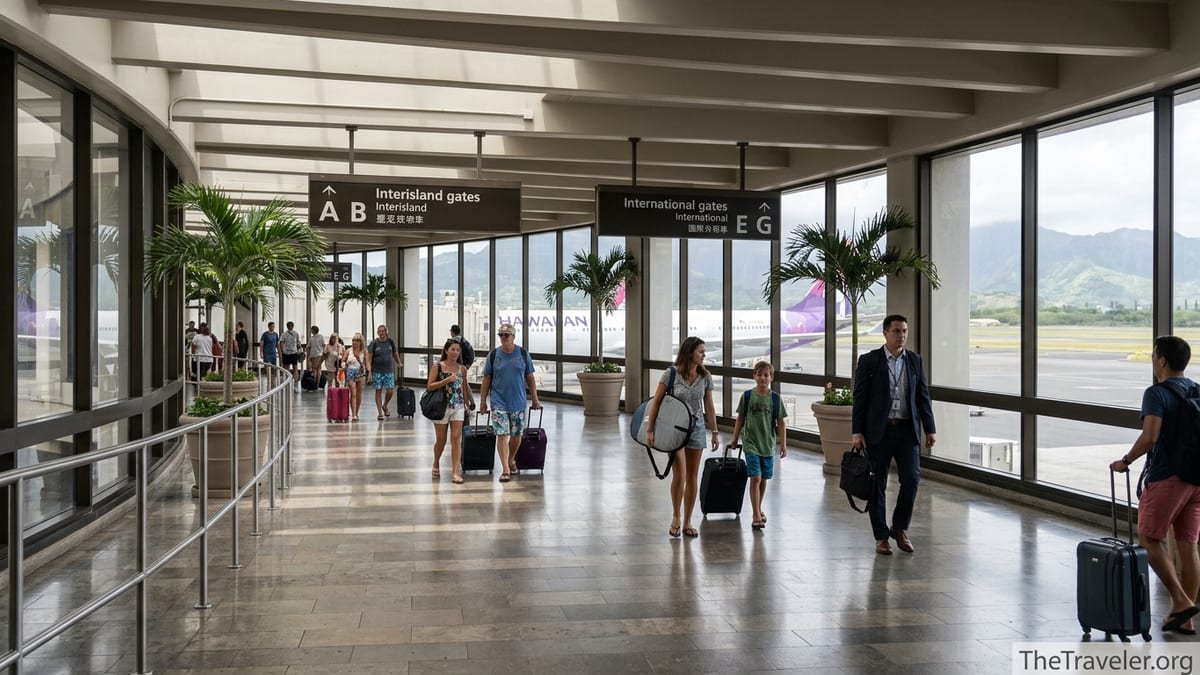
How Honolulu Airport Is Laid Out
Honolulu’s Daniel K. Inouye International Airport (HNL) has three main terminals: Terminal 1 on the Ewa (west) side, Terminal 2 in the center, and the much smaller Terminal 3 off to the Diamond Head (east) side. Terminals 1 and 2 are connected airside by walkways, so once you have cleared security in either one you can usually walk between their concourses without going through security again. Terminal 3, by contrast, operates more like a small commuter facility a short distance away along Aolele Street.
Think of the airport in layers. The second level is where most check-in lobbies and departure gates sit, while the ground level is for baggage claim and ground transportation. Above that, walkways and some lounges overlook lush courtyards and the runways. When you arrive from Los Angeles on Hawaiian Airlines, for example, you might park at an A or B gate in Terminal 1, then head down one level to pick up your bags and walk outside to meet a rideshare or taxi. If you are connecting to a flight on Japan Airlines, you may walk across into Terminal 2 without leaving the secure area at all.
HNL grew in phases, so you will notice older and newer sections blending together. Some gate areas, especially in Terminal 2, still feel retro, while others have been upgraded with new flooring, brighter lighting and clearer bilingual signage. The airport’s layout reflects its role as both Hawaii’s main international gateway and its central interisland hub, so understanding which types of flights use which spaces is the key to navigating efficiently.
Terminal 1: Hawaiian Airlines Hub and Interisland Heart
Terminal 1 is the home base of Hawaiian Airlines and the main focus for interisland flights. Concourses A and B radiate from this terminal, handling most Hawaiian Airlines services to neighbor islands such as Maui (Kahului), Kauai (Lihue), and the Big Island (Kona and Hilo), as well as many of the airline’s mainland routes. If you fly from San Diego to Honolulu on Hawaiian and then onward to Kauai on the same airline, there is a strong chance both flights will depart from Terminal 1, often within a few gates of each other.
Check-in for Hawaiian Airlines is organized into lobbies on the departures level. For example, Hawaiian typically uses specific lobbies for mainland versus international and neighbor island flights, so signage will direct you to the correct row of kiosks and bag drops. Once you clear security at Terminal 1, you can stay within the secure area for a connecting Hawaiian flight or walk into Terminal 2 if your next flight on a different airline departs from there.
The feel of Terminal 1 is busy but efficient during peak morning and late-afternoon interisland waves. You will see business travelers shuttling to Honolulu for the day from Hilo or Lihue, surfers heading to Kona with board bags, and families returning from outer-island vacations. Gate areas have the usual mix of quick-service food, coffee stands, and grab-and-go snacks, so if you land on an early flight from Maui you can usually grab a coffee and be at your next gate in under ten minutes.
For connections, one practical example is a traveler arriving from Hilo at Gate A16 with 55 minutes to connect to a Honolulu–Oakland flight at Gate B3. They can walk along the concourse, follow signs for B gates, and arrive at the mainland-gate area in around five to ten minutes. There is no need to re-clear security, making interisland to mainland moves within Hawaiian Airlines relatively smooth.
Terminal 2: International Hub and Major Mainland Airlines
Terminal 2 is HNL’s largest terminal and handles most international flights and many mainland US services. Airlines such as United, Delta, American, Alaska, Southwest and various international carriers typically operate from this central building. Its concourses include gates labeled C, D, E, F and G, with the longest walks usually occurring out toward the G gates used for some widebody international flights.
Arriving on an international flight, such as a Japan Airlines service from Tokyo or an ANA flight on an Airbus A380, you will enter Terminal 2’s Federal Inspection Services area for immigration and customs. After clearing passport control and collecting your bags, you exit into the arrivals hall on the lower level, where you will find car rental shuttles, hotel shuttles, tour buses and rideshare pick-up zones nearby. If you are connecting onward to a domestic or interisland flight, signs direct you up to the check-in lobbies and security checkpoints.
Terminal 2 is also where many mainland carriers operate, so a typical itinerary might see you fly from Seattle on Alaska Airlines into a C gate, collect your bags at the corresponding baggage carousel below and then walk across the roadway to the main parking garage or rideshare area. If you are instead connecting to an interisland flight on Hawaiian Airlines and you hold two separate tickets, you may need to carry your bags upstairs, walk across the central lobby area, and re-check them at Hawaiian’s desks in Terminal 1 before going back through security.
The feel of Terminal 2 is more international, with multilingual signage and a broader mix of shops and food options. You may see groups heading to cruise ships, honeymooners arriving from Tokyo, and US military personnel on leave. Because of the mix of carriers, departure times are spread throughout the day, making the terminal busy but less “peaky” than the intense waves of early-morning interisland departures in Terminal 1.
Terminal 3: Mokulele’s Commuter Outpost
Terminal 3 is a small, separate facility on the Diamond Head side of the airport primarily used by Mokulele Airlines for commuter flights to smaller islands and airports such as Molokai, Lanai and Kapalua on Maui. It sits along Aolele Street, near cargo facilities rather than the main passenger terminal complex. Travelers often describe Terminal 3 as feeling more like a small regional airfield than a big-city terminal, with fewer crowds and a more relaxed pace.
Getting to Terminal 3 from the main terminals usually involves a short drive. Most visitors either take a rental car, taxi, rideshare or a courtesy shuttle when available. For example, if you land from San Francisco in Terminal 2 and have a separate Mokulele ticket to Molokai, you would collect your baggage, exit the arrivals level, and then follow signs or your rideshare app to a pick-up zone. From there it is typically a five to ten minute ride along the airport perimeter roads to the commuter terminal entrance on Aolele Street.
Because Mokulele uses small turboprop aircraft and operates under different security procedures, the Terminal 3 experience can differ from standard TSA-screened terminals. Check-in times may be shorter, and you may find yourself walking out to your aircraft across the ramp, with staff personally checking boarding passes. For many travelers, this feels like stepping back into an earlier era of island aviation, which can be a memorable part of the journey.
If you are connecting from a Mokulele flight arriving at Terminal 3 to a mainland flight in Terminal 2 on a separate ticket, plan plenty of buffer time. In practice this means allowing time to collect bags from the commuter terminal, drive back around to the main terminal complex, check in again, and clear TSA security. For conservative planning, scheduling at least two to three hours between arrival at Terminal 3 and departure from Terminals 1 or 2 is wise.
Baggage Claim, Ground Level Layout and Real-World Scenarios
At HNL, baggage claim sits on the ground level beneath both Terminal 1 and Terminal 2. When you step off your aircraft, you will typically follow “Baggage Claim” signs down escalators or elevators. Carousels are grouped by terminal, and overhead monitors list arriving flights with assigned belt numbers. For example, a Hawaiian Airlines flight from Lihue might send you to Carousel 18 in the Terminal 1 baggage hall, while a United flight from Denver would use a different carousel in the Terminal 2 hall.
Ground transportation is directly outside these baggage areas. Once you collect your bag, sliding doors lead to curbside pick-up zones. There you will find separate areas for taxis, rideshares, hotel shuttles and tour buses. Many Waikiki hotels operate or share shuttle services that pick up at clearly marked zones. In practice, a family landing from Los Angeles on American Airlines in Terminal 2 might meet a pre-booked Waikiki shuttle just a few steps from Carousel 27, while a solo traveler heading to a vacation rental on the North Shore may walk across to the parking garage to pick up a rental car.
Oversized baggage such as surfboards, golf clubs or large strollers usually arrives at a special door or side belt near the main carousels. Staff often direct passengers who are waiting for surfboard bags from flights arriving from California or Australia to these areas. If your board or stroller does not appear, the first stop is your airline’s baggage service office, typically located just off the main baggage hall behind glass doors marked “Baggage Service” or “Lost and Found.”
For travelers connecting to interisland flights on separate tickets, a common scenario is collecting checked luggage at Terminal 2, then walking or taking an elevator up one level to the departures level and crossing into Terminal 1 to re-check bags. The indoor walk between the two terminals on the public side can take around ten to fifteen minutes at a relaxed pace, slightly more if you are pushing luggage carts or traveling with kids.
Walking Routes, Wiki Wiki Shuttles and the New Tram
One of the most distinctive features of Honolulu Airport is its network of open-air walkways and courtyards linking the concourses. Once you have passed security in either Terminal 1 or Terminal 2, you can usually walk between most A, B, C, D, E, F and G gates. The walkways are lined with tropical landscaping and occasional art pieces, giving your connection a more relaxed feeling than the typical enclosed airport corridor.
For longer connections or passengers with mobility challenges, the airport offers shuttle options known historically as the Wiki Wiki Shuttle. These vehicles circulate between key points, including gate areas and the central terminal zones. More recently, electric trams have been added to bolster the shuttle system, giving passengers a quieter, cleaner ride between distant concourses and terminals. This is particularly helpful for travelers arriving on a long-haul international flight at a far G gate and connecting to a domestic departure closer to the C or D gates.
In practical terms, if you have an hour to connect from a Hawaiian Airlines interisland arrival at an A gate to a Delta flight at an E gate, walking is usually the simplest choice. You would follow overhead signage toward Central Concourse, pass food outlets and restrooms along the way, and reach your new gate in around ten to fifteen minutes, depending on your pace. If you have less mobility or are traveling with small children, you can ask at an information desk about the next shuttle or use moving walkways where available.
Outside security, pedestrians can also move between Terminals 1 and 2 via covered sidewalks and elevated walkways. There are elevators and escalators between the ground-level baggage claim and upper-level ticketing halls, so you rarely need to use stairs. This design means that even if your flights are on separate tickets requiring re-checking bags, you can generally get from one check-in area to another without needing a car or bus, as long as you are staying within the main complex and not heading to Terminal 3.
Interisland Connections: Same-Carrier and Mixed-Carrier Itineraries
Honolulu is the primary hub for flights between the Hawaiian Islands. The majority of interisland services are operated by Hawaiian Airlines from Terminal 1, with frequent departures throughout the day to Maui, Kauai and the Big Island. If you book a through-ticket from, say, Portland to Lihue on Hawaiian, your bags are typically tagged through to your final destination, and you can often make a connection in under an hour, staying airside within Terminal 1.
On a typical same-carrier connection, such as Kona to Honolulu to San Jose on Hawaiian, your aircraft may park at an A gate from Kona, and your onward mainland flight may depart from a nearby B gate. You would step off the first flight, check the overhead screens to confirm your next gate and departure time, and then walk a few minutes to the connecting gate. Because you are staying within the same terminal and secure area, you do not have to pick up bags or go through TSA again.
Mixed-carrier or separate-ticket connections require more planning. If you arrive from Los Angeles on Southwest in Terminal 2 and then connect to a Hawaiian Airlines interisland flight on a separate reservation, you generally need to collect your checked bags, exit to the public arrivals area, walk or take an elevator up to the departures level, and head toward Terminal 1 for Hawaiian check-in. After re-checking bags, you pass through security again. Realistically, this process can take anywhere from 60 to 90 minutes, so many travelers plan at least a two-hour buffer.
For more remote islands served by Mokulele, such as Molokai or Lanai, you may need to connect between the main terminals and Terminal 3. In that case, you collect your bags from Terminal 1 or 2, then take a taxi or rideshare to the commuter terminal along Aolele Street. Once there, you check in with Mokulele and often wait in a small lounge area before boarding. Because there is road travel involved, many visitors schedule three or more hours between a mainland arrival and a Terminal 3 departure to avoid stress if there are delays.
International Arrivals, Customs and Connecting Onward
International arrivals at HNL, especially from Asia and Oceania, typically use Terminal 2. After disembarking, you follow signs for “Arrivals” and “Immigration.” Passport control areas are organized by citizenship and sometimes by airline or flight number, with staff directing passengers into the correct lines. Wait times vary by time of day and how many widebody flights arrive at once, but off-peak arrivals can move quickly.
Once through passport control, you collect your luggage from the assigned carousel in the customs hall. After that, customs officers may screen your bags, especially for agricultural items such as fresh fruit, plants or soil that are restricted by US and Hawaii regulations. You then exit into the public arrivals area. Travelers whose bags are checked through on a single ticket to a mainland US destination might re-check them immediately after customs at designated transfer counters, while others collect bags and walk upstairs to check in again.
If you are connecting from an international flight in Terminal 2 to a US domestic or interisland flight in Terminal 1, it is common to exit customs, follow signs for connecting flights or ticketing, then take an escalator or elevator up to the main departures level. From there you walk toward the check-in area for your next airline. A Tokyo to Honolulu to Kauai journey on a single carrier may include a transfer desk right after customs, but if you booked separate tickets with different airlines, you will likely check in at the public counters instead.
For international passengers staying on Oahu, the post-customs experience is straightforward. Many Waikiki-bound travelers simply walk out to the taxi or shuttle stands just beyond the arrivals doors. Those renting cars follow signs to the consolidated rental car facility or to shuttle pick-up points served by car rental brands. Because Honolulu’s tourist infrastructure is well developed, finding transportation from the airport to Waikiki, Ko Olina or the North Shore is rarely difficult once you reach the curbside.
The Takeaway
Honolulu’s Daniel K. Inouye International Airport rewards a bit of advance planning. Understanding that Terminal 1 is the Hawaiian Airlines and interisland hub, Terminal 2 is the primary international and mainland terminal, and Terminal 3 is a small commuter outpost used mainly by Mokulele Airlines helps you visualize how your own route will unfold. Most connections between Terminals 1 and 2 are walkable within the secure area, while anything involving Terminal 3 usually requires a short drive.
For smooth travel days, build realistic connection times, especially for mixed-airline or international itineraries that require claiming and re-checking bags. Use the ground-level baggage halls and clearly marked curbside zones to your advantage, whether you are meeting a Waikiki hotel shuttle, grabbing a rideshare to a vacation rental, or looping back around for an interisland hop. With these details in mind, the airport’s open-air walkways, tropical landscaping and views of the runway become part of the journey rather than a source of stress.
FAQ
Q1. Which terminal does Hawaiian Airlines use at Honolulu Airport?
Hawaiian Airlines primarily uses Terminal 1 for both interisland and many mainland flights, though a small number of operations may occasionally use adjacent gates in Terminal 2.
Q2. How long does it take to walk between Terminal 1 and Terminal 2?
The walk between the central areas of Terminal 1 and Terminal 2 typically takes about 10 to 15 minutes at a normal pace, slightly longer if you are using luggage carts or traveling with children.
Q3. Can I walk between all gates after security at HNL?
In most cases you can walk between A, B, C, D, E, F and G gates after clearing security in either Terminal 1 or Terminal 2, but you should always follow current signage in case of temporary closures or construction.
Q4. Where do I claim my baggage at Honolulu Airport?
Baggage claim for Terminals 1 and 2 is on the ground level beneath the main concourses, with carousels assigned by arriving flight and monitors showing the correct belt numbers.
Q5. How do I get from Terminal 2 to Terminal 3 for a Mokulele flight?
From Terminal 2 you collect your bags, exit to the curbside area, and take a taxi, rideshare or shuttle along Aolele Street to the small Terminal 3 commuter facility on the Diamond Head side of the airport.
Q6. Do I need to go through security again when connecting between interisland and mainland flights on Hawaiian?
If both flights are on Hawaiian Airlines and you remain within Terminals 1 and 2, you usually stay airside and do not need to clear TSA again, provided you do not exit to the public areas.
Q7. How much connection time should I allow for separate tickets at HNL?
For separate tickets, especially when changing airlines or moving between the main terminals and Terminal 3, planning at least two to three hours of connection time is a cautious and comfortable approach.
Q8. Where do international passengers go through customs at Honolulu?
International passengers typically arrive into Terminal 2, pass through immigration, collect bags in the customs hall, clear inspection, and then exit into the public arrivals area on the ground level.
Q9. Are there shuttles inside the airport to help with long walks?
Yes, HNL operates shuttle services, historically known as the Wiki Wiki Shuttle and now supplemented by electric trams, to help passengers move between distant gates and terminal areas.
Q10. Is Honolulu Airport easy to use for first-time visitors to Hawaii?
Although the layout is spread out, clear signage, walkable connections between Terminals 1 and 2, and plentiful ground transportation options make HNL manageable for first-time visitors who allow a bit of extra time.