


Landing at Honolulu’s Daniel K. Inouye International Airport and figuring out how to reach Waikiki should be the easy part of your trip. Yet many travelers step into the humid evening air, see a blur of taxis, shuttles and rideshare pick-up signs, and suddenly feel unsure about the best way to get to their hotel. This guide breaks down exactly how taxis work from the airport to Waikiki in 2026, what you can realistically expect to pay, where to find the official ranks, and how cabs compare with Uber and Lyft, especially if you are arriving late at night or traveling with kids, surfboards or a big family group.
Get the latest updates straight to your inbox!
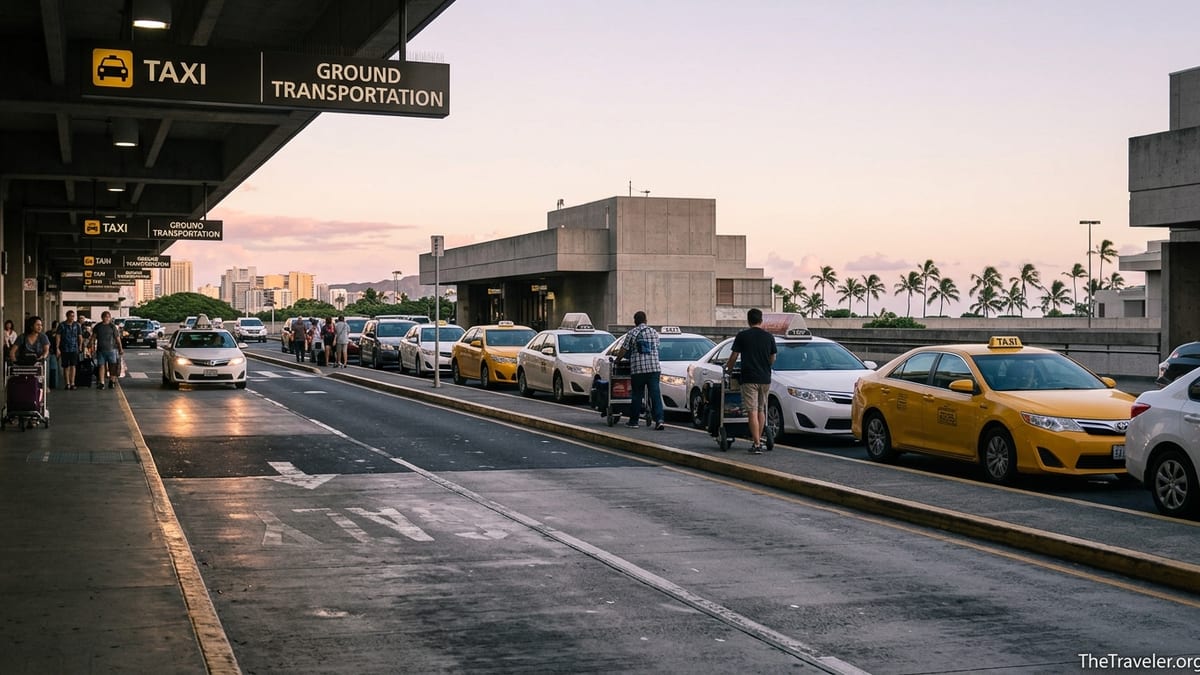
How Honolulu Airport Taxis Work Today
Honolulu’s Daniel K. Inouye International Airport (HNL) sits roughly 9 miles from Waikiki, the island’s main hotel district. In light traffic the drive can take around 20 minutes, but in the late afternoon or early evening it can easily stretch to 40 minutes or more. Taxis are still one of the most straightforward door-to-door options. Unlike some mainland US airports that use flat zones, most rides from HNL to Waikiki are charged by the meter unless you prebook a company offering a flat rate. The metered price typically ends up in the same ballpark as a standard rideshare, sometimes a little higher, sometimes a little lower depending on traffic.
In 2026, typical metered taxi fares from HNL to central Waikiki generally fall somewhere around 35 to 55 US dollars before tip, depending on where your hotel is located and how heavy traffic is on the H-1 freeway and Ala Moana Boulevard. Travelers regularly report paying around the mid 30s in off-peak periods and closer to the 50 dollar mark in rush hour or if staying at the Diamond Head end of Waikiki. This is for a standard sedan taxi carrying up to four passengers with normal luggage.
Several well-known Honolulu taxi companies operate at the airport. Charley’s Taxi, for example, promotes a flat rate of roughly the high 30 dollar range for HNL to Waikiki when prebooked, while Hello Cab lists flat rates in the high 30s to mid 40s depending on group size and direction. These prearranged rates can undercut the meter at busy times and give cost certainty, which many families appreciate after a long flight. If you simply walk up to the official taxi rank though, expect a metered fare in the ranges described above.
Unlike rideshare drivers, licensed airport taxis are regulated by the City and County of Honolulu and the state’s airport authority. This means inspections, insurance requirements and adherence to airport rules such as where they can queue and how they may solicit passengers. For travelers who like the reassurance of a traditional cab with a light on the roof and a company you can call if something is left behind, this structure is part of the appeal.
Finding the Official Taxi Ranks at HNL
Once you have collected your luggage at HNL, following the signs to the taxi rank is straightforward, but the layout of the airport can feel confusing because there are multiple terminals. Most mainland US and international flights arrive into the main overseas terminal areas. After baggage claim, you will see overhead signs directing you to “Ground Transportation” and “Taxi.” These lead to clearly marked taxi stands just outside the baggage claim areas on the ground level.
The main official taxi queues are on the median outside the baggage claim exits of each terminal section. For example, if you arrive on a domestic flight and exit baggage claim in the central terminal, you simply walk straight out through the sliding doors and cross to the center island where uniformed ground transport staff typically direct passengers to the next available cab. Late at night, you might not see staff, but you will still find taxis lined up with “Taxi” signs and roof lights on the central median area.
Unlike Uber and Lyft, which must pick up on the upper departures level in designated ride-app zones, taxis are allowed to wait and load right at baggage claim level. This can be a meaningful difference if you have multiple suitcases, surfboard bags, or a stroller. Instead of hauling everything up an escalator or elevator to the second floor, you wheel your luggage trolley directly to the median and the driver will usually help you load. For someone arriving on a long-haul evening flight, this small convenience can feel like a big win.
If you are ever uncertain whether a vehicle is part of the official taxi queue, look for a roof light, a meter inside, and company markings on the doors. Legitimate cabs at the HNL ranks do not approach you aggressively inside the terminal or try to hustle you into unmarked vehicles. If someone inside baggage claim offers you a “cheap taxi” and walks you away from the signed taxi area, it is safer to decline and use the clearly signed official rank instead.
What You Can Expect to Pay: Real-World Fare Examples
A metered taxi from HNL to the heart of Waikiki, such as the area around the International Market Place or the Royal Hawaiian Center, commonly comes in around 35 to 45 dollars in light to moderate traffic. Travelers frequently report specific trips such as a weekday afternoon ride from HNL to a mid-Waikiki hotel for roughly 38 dollars before tip, or a late-night run to the Hilton Hawaiian Village for just over 40 dollars when traffic is minimal but there is a small airport surcharge and luggage in the trunk.
In heavier traffic or if your hotel is further down Kalakaua Avenue toward Diamond Head or near Kapiolani Park, the fare can edge toward 45 to 55 dollars on the meter. For instance, a visitor arriving just after 5 p.m. on a Friday and heading to a hotel near the Honolulu Zoo might see a fare closer to the high 40s or low 50s after sitting in slow freeway and Ala Moana Boulevard traffic. The distance is not dramatically longer, but the time on the meter grows.
Several taxi companies offer prebooked flat fares that can be very competitive. Charley’s Taxi advertises a flat rate around 38 dollars from HNL to Waikiki when you reserve, which is especially attractive if you are landing during a busy afternoon when the meter might otherwise run higher. Hello Cab lists a flat airport-to-Waikiki rate in the high 30s for a sedan and mid 40s for a larger vehicle that can take up to six passengers. These published flat rates mean a couple or family of four can budget with more confidence and avoid the anxiety of watching a meter climb in traffic.
Compared with rideshare, the range is broadly similar. In 2026, UberX or a comparable Lyft service from HNL to Waikiki typically runs between about 25 and 45 dollars in normal conditions, but it is much more sensitive to surge pricing. Multiple recent fare snapshots show standard midday rides at roughly 30 to 40 dollars, while periods of high demand, such as when several flights land in the early evening or during major events in Waikiki, can push that closer to 50 or 60 dollars. That means a taxi can actually be cheaper than Uber or Lyft during a strong surge, especially if you have prebooked a flat-rate cab.
Luggage, Surfboards and Traveling With Groups or Kids
Most standard Honolulu taxis are sedans that comfortably seat up to four passengers and two or three large suitcases, plus smaller carry-ons. If you are traveling as a couple with a pair of checked bags and backpacks, a regular cab from the taxi rank will be fine. Drivers are accustomed to airport runs and typically help lift heavier bags into the trunk. Taxis in Honolulu do not usually charge per bag in the way some mainland airport shuttles do, though expect to pay the usual metered fare or published flat rate which already assumes normal vacation luggage.
If you are bringing bulkier items such as a full-size surfboard or multiple board bags, it is wise to pre-arrange a larger vehicle with a taxi company or consider a rideshare SUV. Many taxi fleets have minivans available, but they are not guaranteed at the front of the queue when you walk out. Calling ahead to a company like Charley’s Taxi or Hello Cab and requesting a van can avoid a scramble at the curb. In practice, families with strollers, car seats and multiple suitcases often find that booking a van taxi for a fixed price in the 45 to 60 dollar range feels like good value compared with booking two separate sedans or relying on chance at the rank.
For families traveling with young children, Honolulu’s taxi rules are similar to many US cities: taxis are generally exempt from child car seat laws, but using a child restraint is still strongly recommended for safety. Many locals traveling with toddlers bring a lightweight travel car seat and install it in the cab just as they would in any private vehicle. You can ask the dispatcher at the taxi rank to call up a vehicle with working rear seat belts and enough space for your gear, but it is your responsibility to provide and fit any child seats. Some private transfer services offer vehicles with car seats available for an added fee, though you usually need to reserve these well in advance.
Groups of five or more adults often face a choice between one large van taxi, two standard cabs, a rideshare XL, or a private shuttle. As a rule of thumb, if six adults with luggage can comfortably fit in a minivan, a prebooked flat-rate taxi van in the 50 dollar range can be more economical and straightforward than paying per person on a shared shuttle that might cost around 20 to 25 dollars each. For a mixed group of adults and kids, the simplicity of loading everyone into a single van at the curb after a long flight is often worth a small premium.
Late-Night and Early-Morning Arrivals: What Changes?
Honolulu’s airport sees flights arriving late into the evening, including West Coast services that land close to midnight. Travelers often worry that arriving after 10 p.m. will mean limited taxi availability or dramatically higher prices. In practice, taxis continue to serve the official ranks into the night and there is usually a steady, if thinner, line of cabs waiting for incoming flights. You may wait a few extra minutes compared with a midday arrival, but long queues are rare late at night.
Metered fares themselves typically do not double overnight in the way that rideshare surge pricing sometimes can. There may be modest night surcharges depending on the company, but broadly, a midnight taxi from HNL to Waikiki often costs a similar amount to a midday one, perhaps nudging into the low 40s rather than the high 30s if traffic is clear and the trip is slightly faster. Compare that to an Uber or Lyft at the same time: if there are fewer drivers online or a wave of late arrivals, the app may show a noticeably higher price than you would see during the afternoon.
If you are landing mine-after-midnight with small children or after a long international flight, the easiest approach is to walk directly to the official taxi rank on the ground level and take the next cab in line. There is no need to wrestle with the airport Wi-Fi to summon a rideshare or to figure out exactly where the rideshare pickup lot is in the dark. Many parents arriving with sleepy kids in 2025 and 2026 have described simply grabbing the first taxi in the queue at 11:30 p.m., paying around 40 to 45 dollars to a Waikiki hotel, and being checked in within half an hour of wheels-down.
For peace of mind, especially if you are arriving after midnight or during a busy holiday period, you can prebook a taxi or private transfer. Flat-rate services often monitor your flight arrival time and adjust pickup accordingly, so you do not need to worry if your plane is delayed. Knowing a driver will be waiting or on standby can be worth it if you are anxious about navigating a new airport in the early hours or if one member of your group has mobility challenges.
Taxi vs Uber and Lyft: Which Is Better from HNL to Waikiki?
In 2026, rideshare services like Uber and Lyft are firmly established at Honolulu Airport, but they operate differently from traditional taxis. Crucially, Uber and Lyft must pick up passengers from designated ride-app pickup zones on the second level (departures) of the terminal, not from the ground-level baggage claim curb. This means that once you have your luggage, you need to take an elevator or escalator up one level, walk to the signed rideshare pickup area, and then meet your driver among a cluster of vehicles. For solo travelers or couples with light luggage, this is usually no problem. For those with strollers or large suitcases, the extra movement can be tiresome.
Price is the main factor that pushes many travelers toward rideshare. Under normal, non-surge conditions, UberX or Lyft to Waikiki regularly falls in the 25 to 40 dollar range. This can be a clear savings over a 40 to 50 dollar metered taxi, especially for budget-conscious visitors. However, rideshare fares are highly dynamic. During peak arrival banks, major Waikiki events, sudden rainstorms or other spikes in demand, prices can jump to 50 or even 60 dollars for the same route. At these moments, a metered taxi or prebooked flat-rate cab may actually cost less than an on-demand Uber.
Service reliability is nuanced. In the mid-morning to early evening window on most days, Uber and Lyft coverage around HNL is generally strong and you can often get a car within 5 to 10 minutes. Very early in the morning or very late at night, there may be fewer rideshare drivers online, which can lead to longer wait times or noticeable surge pricing even when the airport is not very busy. Official taxis, by contrast, maintain a physical presence at the ranks driven by airport permits and contracts. They do not rely on app-based supply and demand mechanics, which some travelers find reassuring.
Customer experience can vary on both sides. Some visitors love the predictability of seeing an estimated fare and following their route on the app. Others prefer simply getting into an identifiable taxi, telling the driver their hotel, and paying in cash or card at the end. One practical tip is to check both options when you land. While waiting for your bags, open your rideshare app and get a real-time price estimate. If it shows 30 dollars and you are comfortable with the pickup process, rideshare could be the better value. If it shows 55 dollars during a surge, walking straight out to the taxi rank and taking a metered cab or a prebooked flat-rate taxi is usually the smarter choice.
Practical Tips for a Smooth Taxi Ride to Waikiki
A little preparation goes a long way in making your first ride on Oahu stress-free. Before you land, note down the exact name of your Waikiki hotel and, if possible, its street address. There are many hotels with similar names along Kalakaua Avenue, Kuhio Avenue and Ala Moana Boulevard. Having the address in your phone or written on paper prevents confusion at the taxi rank and reduces the chances of a wrong turn adding time to the meter. When you get into the cab, clearly tell the driver the hotel name and neighborhood, such as “Hilton Hawaiian Village in Waikiki” or “Hyatt Place on Kuhio.”
If you are concerned about cost, you can politely ask the driver for a rough estimate before departing. Most experienced Honolulu drivers can give a ballpark figure, such as “about 40 dollars plus tip to central Waikiki in this traffic.” This is not a binding quote, but it sets expectations. If the meter seems to be climbing unusually fast or the driver takes a route that feels very indirect, you can always and calmly ask about the route. That said, local traffic patterns and one-way systems mean the fastest path is not always obvious to visitors, so it is best to raise questions politely.
Payment is straightforward. Many Honolulu taxis now accept major credit cards in addition to cash, but not every single vehicle’s card terminal is flawless. If paying by card is important to you, confirm this at the taxi rank before you ride. Ask the dispatcher or the driver: “Can I pay with a card?” If there is any doubt, you can either choose another cab or withdraw some cash at an airport ATM before leaving. Tipping follows general US norms. A typical gratuity for a straightforward airport transfer runs around 15 to 20 percent of the fare, adjusted up if the driver provides extra help with heavy luggage or a car seat.
One final practical consideration is motion sickness and jet lag. The route from the airport to Waikiki is mostly freeway, but there can be stop-and-go traffic and a series of curves as you exit toward Ala Moana and into Waikiki’s hotel streets. If you or your kids are prone to car sickness, sit near a window, keep air flowing, and avoid heavy screen use during the ride. Having a bottle of water handy and a light snack can also help after a long flight across the Pacific.
The Takeaway
Getting from Honolulu Airport to Waikiki by taxi in 2026 is still one of the simplest and most predictable ways to start your Oahu vacation. Metered cabs from the official ranks reliably deliver you from the baggage carousel to your hotel lobby in 20 to 40 minutes, with typical fares falling in the mid 30 to mid 50 dollar range depending on traffic and your exact destination. Prebooked flat-rate taxis from companies like Charley’s Taxi and Hello Cab can shave a few dollars off the meter and remove uncertainty, particularly if you are arriving in the late afternoon or late at night.
Compared with Uber and Lyft, taxis win on curbside convenience at baggage claim and on price stability during periods when rideshare surge pricing kicks in. Rideshare, on the other hand, can be cheaper in off-peak periods and appeals to travelers who prefer app-based booking and route tracking. For families, groups, or travelers carrying surfboards and strollers, arranging a van taxi or private transfer with a fixed price is often the most comfortable, cost-effective option.
The real key is flexibility. When you land, check a live rideshare estimate on your phone, glance at the taxi rank outside baggage claim, and choose the option that best balances cost, convenience and timing for your situation. Whether you roll out in a traditional yellow cab or slide into the back of a rideshare, the short ride from HNL to Waikiki will soon deliver you to palm trees, ocean air and the start of your island stay.
FAQ
Q1. How much does a taxi from Honolulu Airport to Waikiki usually cost?
The typical metered fare from Daniel K. Inouye International Airport to central Waikiki is usually around 35 to 55 US dollars before tip, depending on traffic and your exact hotel location.
Q2. Are there flat-rate taxis from HNL to Waikiki?
Yes. Companies such as Charley’s Taxi and Hello Cab advertise flat fares in roughly the high 30 to mid 40 dollar range for a standard vehicle between the airport and Waikiki when you prebook.
Q3. Where exactly do I find the taxi rank at Honolulu Airport?
After baggage claim, follow signs for Ground Transportation and Taxi. The official taxi ranks are on the median just outside the ground-level baggage claim exits, with cabs lined up and often a dispatcher directing passengers.
Q4. Is a taxi or Uber cheaper from Honolulu Airport to Waikiki?
In normal conditions, UberX or a similar Lyft ride can be slightly cheaper at around 25 to 40 dollars. However, during surge pricing or busy periods, taxis or prebooked flat-rate cabs can come out cheaper than rideshare.
Q5. Can taxis at HNL handle surfboards or extra-large luggage?
Many taxis can take regular suitcases without issue, but for surfboards or bulky items it is best to pre-arrange a minivan or larger vehicle with a taxi company so you know there is enough space.
Q6. Are taxis available late at night or very early in the morning?
Yes. Licensed taxis continue to serve the official ranks late into the night and early morning. Wait times can be a little longer, but you can usually still find a cab without needing to prebook.
Q7. Do Honolulu taxis provide car seats for children?
Generally no. Taxis expect parents to bring and install their own child seats. Some private transfer companies offer car seats by request, but this must be arranged in advance.
Q8. Can I pay for a taxi from the airport with a credit card?
Many Honolulu taxis accept major credit cards, but not all. If paying by card is important, confirm with the driver or dispatcher before you depart, and carry some cash as a backup.
Q9. How long does the taxi ride from HNL to Waikiki take?
In light traffic the ride is often around 20 minutes. During rush hour or if there are incidents on the H-1 freeway, it can stretch to 35 or even 40 minutes or more.
Q10. Is it safe to use the taxi rank at Honolulu Airport?
Yes. The official ranks use licensed taxis regulated by local authorities and operating under airport rules. Stick to the signed taxi areas outside baggage claim and avoid unmarked vehicles to ensure a safe, legitimate ride.