


Landing at Honolulu’s Daniel K. Inouye International Airport and getting to Waikiki is easier than it looks, but the options can be confusing when you are jet-lagged and standing at baggage claim. From budget-friendly public transit to seamless private transfers, each option comes with trade-offs on cost, comfort, luggage space, and travel time. This guide breaks down the main ways to get from the airport to Waikiki, with current details and examples to help you pick the transfer that fits your travel style.
Get the latest updates straight to your inbox!
Understanding the Route from HNL to Waikiki
Daniel K. Inouye International Airport (HNL) sits roughly 9 to 10 miles west of Waikiki, depending on where your hotel is along the beach. In light traffic, the drive can be as quick as 20 minutes using Nimitz Highway or the H-1 freeway. In typical late afternoon traffic, expect 30 to 45 minutes, and at peak rush hours the trip can push past 45 minutes.
Most vehicles exit the airport complex onto Nimitz Highway, then continue toward downtown Honolulu before turning onto Ala Moana Boulevard and into Waikiki along Kalakaua Avenue or Kuhio Avenue. This means that almost every ground transport option shares the same congestion points around downtown and the Ala Moana area. Travel time estimates are therefore broadly similar across taxis, rideshares, shuttles, and private cars, with differences mostly due to waiting time, detours for other passengers, and how quickly you can find your driver.
Because HNL is the main gateway to Hawaii, arrivals are often bunched in waves, especially midday and early evening. That can mean queues for taxis, brief waits for shuttle dispatch, and occasional surge pricing for Uber and Lyft. If your plan is price sensitive or you have tight timing, it is worth thinking through a first and second choice for how you want to get to Waikiki before your plane lands.
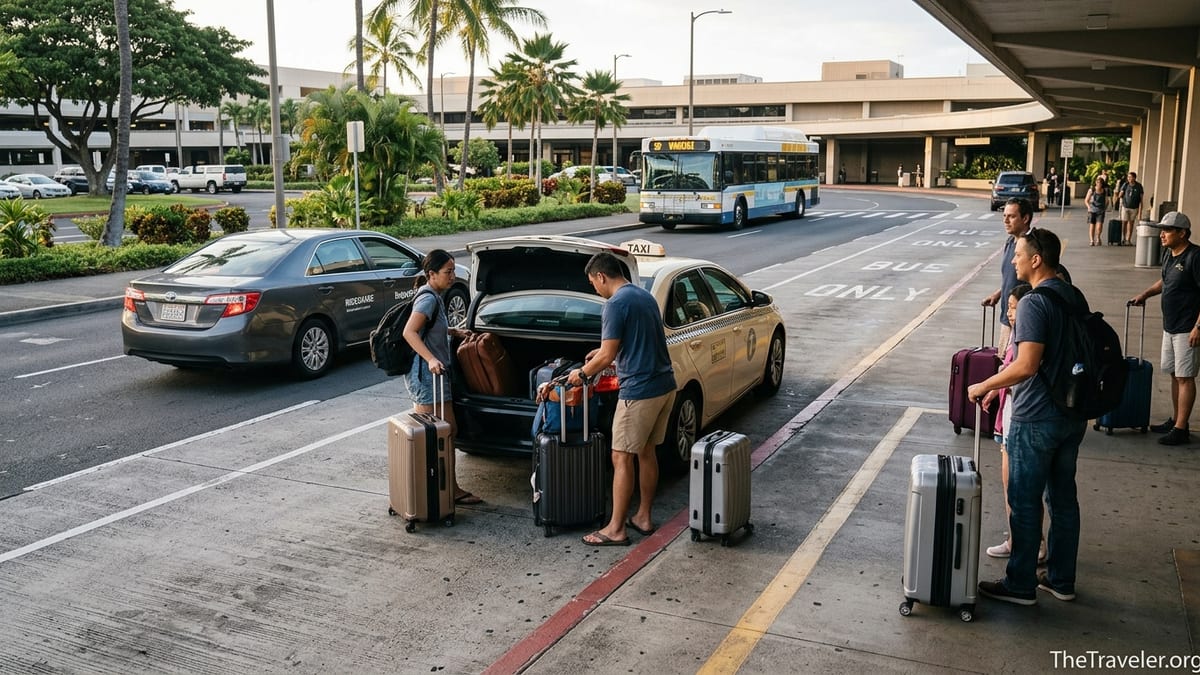
Importantly, all commercial ground transport pick-ups are regulated and must use designated areas outside the terminals. Whether you book a shared shuttle, call an Uber, or hop in a metered cab, follow airport signage for ground transportation rather than accepting any unofficial offers inside the terminal.
Airport Shuttles: Simple and Mid-Priced
Dedicated airport shuttles operate between HNL and Waikiki throughout the day and are one of the most straightforward options for visitors who prefer something organized yet reasonably priced. Several private companies run shared vans that circle through major Waikiki hotels. As of mid-2026, many advertise per-person fares in the approximate range of 20 to 25 dollars one-way for adults, often with discounts for children or round-trip bookings. Exact rates vary by operator and season.
In practice, a couple could expect to pay somewhere around 40 to 50 dollars total for a shared shuttle to a central Waikiki hotel like the Outrigger Waikiki Beach Resort or the Sheraton Waikiki. For a solo traveler, the per-person model can be cost effective compared with a taxi. For a family of four, shared shuttles can quickly approach or exceed the cost of a private ride when you multiply the per-person rate, especially once you factor in tips and possible baggage fees.
Travel time with shuttles is a trade-off. The actual driving time is similar to a taxi, but shuttles typically wait to fill seats and then make multiple hotel stops. On a good day you might be at your hotel in 35 minutes from leaving the airport. In busy periods, you could spend closer to an hour or more rolling through different Waikiki properties before reaching yours. If you are staying at a large hotel along Kalakaua Avenue, you are likely to be one of the earlier stops, while smaller properties on side streets might come later in the loop.
Shuttles are a comfortable choice for travelers with moderate luggage and those who like having a named service waiting with their details on file. However, travelers with very bulky items like surfboards or multiple large hard cases should check in advance whether those are accepted, and if extra fees apply. In high seasons such as late December and mid-summer, pre-booking a shuttle can remove uncertainty on arrival and is a good fit for first-time visitors who prefer a guided, low-stress start to their trip.
Uber and Lyft: Flexible for Small Groups
Rideshare services such as Uber and Lyft are well established in Honolulu and serve HNL with designated pick-up zones. For a typical mid-day ride from the airport to a hotel near Waikiki Beach, recent travelers report fares in the neighborhood of 30 to 45 dollars for a standard car, depending on traffic and demand. During busy times, such as late afternoon on Fridays or after large flight arrivals, surge pricing can push this closer to 50 dollars or more.
For a couple or group of three traveling with standard luggage, this can be a strong value compared with per-person shuttle prices. For example, two friends landing at HNL at noon might open their rideshare app in baggage claim, see an estimate around 35 dollars to a hotel like the Hilton Hawaiian Village, and be in the car within 10 to 15 minutes of walking to the pick-up area. Splitting that fare brings the personal cost to under 20 dollars each, with the convenience of going directly to their hotel with no en route stops.
UberXL or larger vehicles are available for groups with more people or extra luggage, though prices scale up accordingly. A family of five with several suitcases might see an UberXL quote in the range of 55 to 80 dollars, again depending on demand. During big events in Honolulu or at late-night hours, availability may tighten and wait times can increase. Students heading to the University of Hawaii at Manoa around campus move-in weeks, for example, have reported paying closer to 40 to 60 dollars when demand is high and traffic is heavy.
For luggage, most standard rideshare sedans handle two full-size suitcases plus carry-ons comfortably. If you are traveling with golf bags, dive gear, or surfboards, choose a larger category and note that some drivers may decline overly bulky items if they cannot be loaded safely. From a comfort and control perspective, Uber and Lyft are excellent for tech-comfortable travelers who like to see an upfront price estimate, track their car in the app, and go straight to their specific property without sharing space with strangers.
Taxis: Traditional and Predictable
Metered taxis are available at designated taxi stands outside each terminal, and attendants help match passengers with cars. For many years, the cost of a taxi from HNL to Waikiki has tended to fall into the same broad range as rideshares, typically somewhere around 35 to 50 dollars before tip, depending on traffic and the exact location of your hotel. Recent trip reports from visitors staying near central Waikiki mention paying around the low to mid-30s in normal traffic, not including gratuity.
The advantage of a taxi is simplicity and reliability. There is no need for an app, data connection, or pre-booking. You walk out to the curb, join the taxi line, and are usually on your way within minutes. During slower periods you may even be waved straight into a waiting car. At peak arrival times, a queue may form, but it usually moves steadily as taxis cycle through.
Taxis also tend to be more forgiving with luggage than standard rideshares. Many Honolulu taxi operators use sedans with sizable trunks or minivans that comfortably hold several large suitcases. This makes taxis a solid choice for families with children, older travelers, or anyone who does not want to experiment with a new app while juggling bags after a long flight.
One thing to keep in mind is that metered fares can creep up if traffic is very heavy, as the meter continues to run when the car is stopped or moving slowly. If you are arriving at the height of rush hour on a weekday and are concerned about cost, ask the driver for an approximate range before departing. Some companies may offer approximate flat-rate quotes to popular Waikiki hotels, so it can help to ask whether that is available when you reach the taxi stand.
Private Transfers: Seamless but Higher Cost
Private transfers are pre-arranged car or van services that meet you at the airport, often with a sign in the arrivals area. Many Waikiki hotels partner with third-party operators to offer this style of service, and numerous independent companies also accept direct bookings. These services prioritize comfort, predictability, and a smooth arrival experience, which can be especially appealing after a long overnight flight or for travelers celebrating a special occasion.
Pricing for private transfers varies widely based on vehicle type and extras, but a typical ballpark for a private sedan or SUV for up to three passengers can range from roughly 70 to 140 dollars one-way between HNL and Waikiki. Larger private vans for bigger families or groups can sit above that, especially if you request a lei greeting, child seats, or other add-ons. Many operators will present pricing upfront at the time of booking, which makes budgeting straightforward.
The experience is generally very smooth: you provide your flight details, the company tracks your arrival, and the driver waits in a designated meeting area. From there, you walk directly to the vehicle and head straight to your hotel with no stops. This door-to-door approach is especially helpful for people with mobility concerns, travelers with young children and strollers, or anyone carrying specialty items such as musical instruments or sports gear that they do not want to cram into a standard taxi trunk.
Private transfers are often the best value when cost is shared among several adults. For example, a group of four adults arriving from the mainland and staying at a Waikiki condo could split a 120 dollar private SUV, paying around 30 dollars each for a guaranteed, comfortable ride. Compared with four separate shuttle fares or juggling multiple rideshare vehicles in busy times, a pre-booked private car can provide both peace of mind and a touch of luxury.
TheBus: Cheapest Option if Time is Flexible
Honolulu’s public bus system, TheBus, connects the airport to Waikiki via the W Line, a limited-stop service running between Daniel K. Inouye International Airport and Waikiki through downtown Honolulu and Ala Moana. As of 2026, adult fares are around 3 dollars for a single ride using cash or a prepaid local card, with daily fare capping in place for riders who use the card and make multiple trips in one day. From a pure cost perspective, TheBus is by far the most economical way to reach Waikiki from the airport.
The W Line typically operates every 10 minutes during weekday peaks and about every 15 minutes during off-peak times and on weekends, though evening frequencies can drop to around every 30 minutes. After late evening hours, some service transitions to Route 42, which also connects the airport and Waikiki but runs less frequently. Buses serving the airport use a station area now integrated with Honolulu’s Skyline rail system at Lelepaua Station, and they carry visitors onwards to key points like Ala Moana Center and the main hotel strips.
In practice, taking TheBus from the airport to Waikiki is straightforward but slower and less convenient with heavy luggage. You will need to locate the bus stops at the airport, wait for the next bus, and then ride for roughly 45 to 60 minutes as the bus makes its way through downtown and Ala Moana. Buses can get crowded during commuter peaks or when several flights arrive close together. While buses are equipped with luggage racks to some extent, the system is primarily designed for everyday commuters, so rolling multiple large suitcases into a busy bus can be awkward.
TheBus is ideal for budget-conscious travelers, solo backpackers, students, or long-stay visitors who are comfortable using transit apps and do not mind extra time. For example, a solo traveler arriving mid-afternoon who is staying at a budget hotel near Kuhio Avenue might exit the terminal, find the W Line stop, pay around 3 dollars cash to the driver with exact change, and ride into Waikiki, saving 30 dollars or more compared with rideshare or taxi. For a family juggling tired children and multiple bags, however, the savings may not outweigh the added complexity and time.
Rental Cars: Freedom with Caveats
All major rental car brands operate at or near HNL with consolidated facilities and shuttles. Renting a car on arrival can be tempting if you plan to explore Oahu beyond Waikiki, visiting spots such as Hanauma Bay, the North Shore, or the windward coast. For some itineraries, picking up a car at the airport and driving straight to your Waikiki hotel seems efficient, as you combine airport transfer with trip transportation.
The main trade-off is cost and parking. Daily rental rates fluctuate based on season and demand, but even when base rates are reasonable, Waikiki hotel parking is often expensive, frequently running 40 to 60 dollars per night or more for valet or self-parking. Some condos and smaller hotels may charge slightly less, while a few budget properties rely on nearby public or private garages with comparable prices. When you add that to rental and fuel, keeping a car parked in Waikiki can quickly become more expensive than occasional rideshares or tours.
Driving from the airport to Waikiki is relatively straightforward, but traffic can be heavy, and first-time visitors may find the combination of unfamiliar road signs, exits, and city traffic stressful after a long flight. In addition, Waikiki’s one-way streets and narrow hotel driveways can make the final blocks of the journey more challenging than the main highway segments. Many travelers now choose a middle path: using a taxi, rideshare, or shuttle to get from the airport to Waikiki, then renting a car from a Waikiki-based rental office only on the specific days they plan to drive around the island.
Rental cars are most sensible for travelers determined to explore extensively on their own schedule. If you envision multiple full days visiting beaches and sights around Oahu, or you are staying outside central Waikiki in a vacation rental where parking is included, an airport rental can still be practical. Just be sure to check your hotel’s parking policies and fees before booking, and compare the overall cost to using transit, tours, or occasional rideshares instead.
Choosing the Best Option by Traveler Type
With so many ways to get from HNL to Waikiki, the best choice depends heavily on your budget, group size, luggage, and comfort level with transit or apps. For solo budget travelers and students, TheBus is the standout option. A single adult fare of around 3 dollars makes it feasible to reach Waikiki for the cost of a coffee, and daily fare capping can keep costs under control if you continue to use transit around Honolulu. This works particularly well if you are traveling light, staying at a hostel or budget hotel, and have time to spare.
Couples and small groups of two to three often find the best balance in rideshares or taxis. A 35 to 45 dollar rideshare split between two people offers good value, easy door-to-door convenience, and minimal hassle. For those who prefer not to use apps or do not have mobile data on arrival, walking straight to the taxi queue and paying a similar amount for a metered ride is a straightforward alternative. In this category, shared shuttles can be price competitive if you find a good deal or are traveling alone, but they are less attractive if per-person fares approach the cost of a private car for your group.
Families with young children, travelers with mobility concerns, and people celebrating a honeymoon or special occasion often benefit most from private transfers. The higher upfront cost buys a smooth, predictable experience with room for luggage and, in many cases, the ability to pre-request child seats or special handling for items like strollers. For a family of four, splitting a private SUV in the 100 to 120 dollar range can feel worthwhile when compared with juggling a stroller, car seats, and multiple suitcases on a busy bus or shuttle that makes several stops.
Rental cars and TheBus sit at opposite ends of the flexibility spectrum. A rental car is ideal if you plan intensive island exploration and can absorb hotel parking costs, while TheBus and Waikiki’s walkability are sufficient for many visitors who intend to stay mostly in the beach area and downtown. A common strategy is to avoid renting a car on arrival, use an airport transfer service to get to Waikiki, then pick up a car for a day or two mid-trip when you are rested and ready to drive the island.
The Takeaway
Getting from Honolulu’s airport to Waikiki does not have to be stressful, but the right choice can vary dramatically between a solo backpacker and a family of five. TheBus offers by far the lowest cost for those comfortable with public transit and lighter luggage, while taxis and rideshares hit a sweet spot of convenience and predictable door-to-door travel for most visitors. Shared shuttles provide a familiar, mid-priced option, especially for solo travelers who like having something pre-booked.
Private transfers shine for travelers prioritizing comfort, special occasions, and minimized logistics, and rental cars are best reserved for itineraries that genuinely need daily island-wide driving. Before you land, take a moment to weigh your budget, group size, and how much energy you will have after your flight. Knowing whether you will head straight to a taxi stand, a rideshare pick-up zone, a bus stop, or a pre-arranged driver means you can step out of the terminal and start your Waikiki stay with a calm, confident first ride.
FAQ
Q1. How long does it usually take to get from Honolulu Airport to Waikiki?
In light traffic the drive can be about 20 minutes, but most travelers should plan for 30 to 45 minutes, and potentially longer during rush hour or heavy congestion.
Q2. What is the cheapest way to get from HNL to Waikiki?
TheBus is generally the cheapest, with an adult fare of around 3 dollars one-way. It is slowest and less convenient with heavy luggage, but ideal for budget-conscious solo travelers or students.
Q3. How much does an Uber or Lyft cost from the airport to Waikiki?
Recent examples show standard rideshare fares often in the 30 to 45 dollar range in normal conditions, though prices can surge higher during busy periods or late at night.
Q4. Are taxis more expensive than rideshares in Honolulu?
Taxis and rideshares are broadly similar in cost for the airport to Waikiki route, with typical taxi fares landing around the mid-30s to 40s before tip, depending on traffic and exact hotel location.
Q5. Is it worth renting a car at the airport just to get to Waikiki?
For many visitors it is not, because Waikiki parking can add 40 to 60 dollars per night and the neighborhood is walkable. Renting a car later from a Waikiki location only on days you need it often makes better financial sense.
Q6. Can I bring large luggage or surfboards on TheBus from the airport?
TheBus allows reasonable carry-on items, but it is designed primarily for commuters. Very large or numerous bags and long items like surfboards can be awkward or may not be accepted if they block aisles or seats.
Q7. Do airport shuttles run late at night to Waikiki?
Some shuttle operators offer evening or late-night service, but schedules and availability vary. If you land very late, it is wise to confirm shuttle hours in advance or have a backup plan such as a taxi or rideshare.
Q8. What is the best option for a family with small children and strollers?
Many families prefer private transfers or taxis, which offer door-to-door service, space for strollers and bags, and the possibility of pre-arranging child seats with private operators.
Q9. Where do I meet rideshare drivers at Honolulu Airport?
Uber and Lyft use designated pick-up areas in the airport’s ground transportation zones. After you request a ride, your app will show the exact pick-up location, usually a signed area outside the terminal.
Q10. Should I pre-book my transfer to Waikiki or decide on arrival?
If you are arriving at a busy time, traveling with a large group, or want a private transfer, pre-booking is helpful. Flexible solo or couple travelers often decide on arrival, choosing between taxi, rideshare, or TheBus based on energy level and budget at the moment.