


The Acropolis Museum is one of Athens’ essential stops, but deciding how to experience it can feel surprisingly complex. Should you book a guided tour of the museum only, combine it with a guided Acropolis visit, hire a private guide, rely on an audio guide or simply wander at your own pace? The right choice depends on your budget, how much context you want and how you like to explore museums. This guide breaks down the real options on the ground in Athens today and helps you decide which format will make the Acropolis Museum come alive for you.
Get the latest updates straight to your inbox!
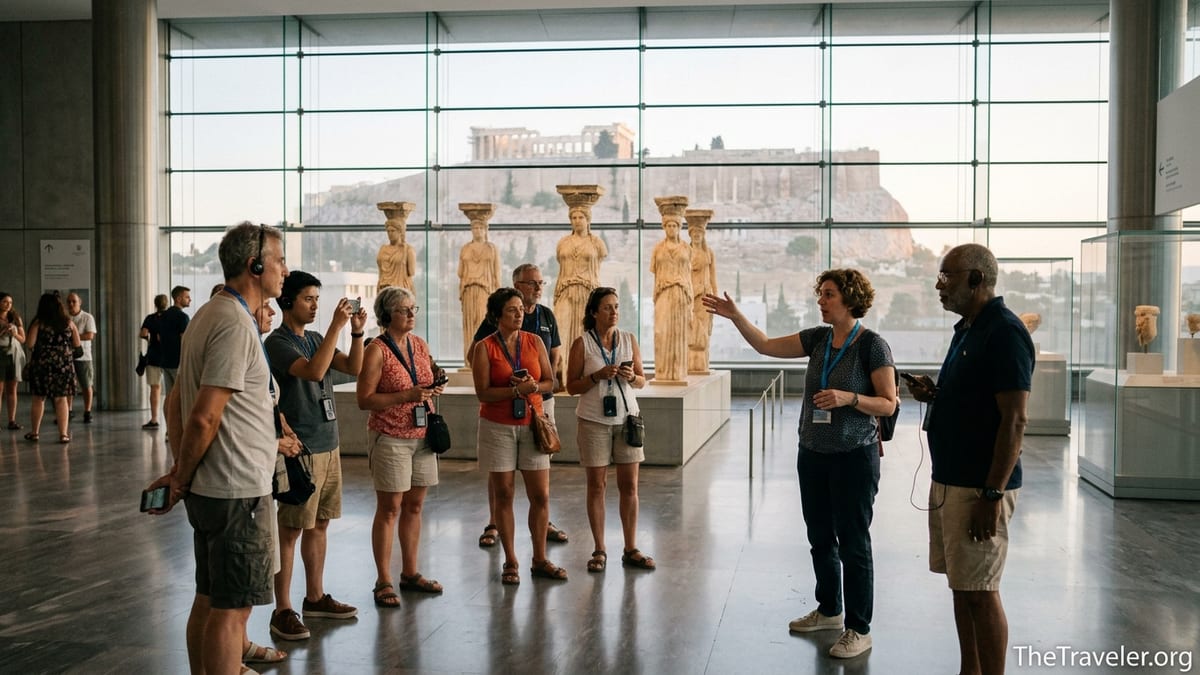
What You Are Really Choosing Between
For the Acropolis Museum, visitors tend to face six main choices: a guided museum tour only, a combined Acropolis plus museum tour, a fully private guide, a small group tour, an audio guide, or a completely self-guided visit. On top of that, you can book official museum programs, third party tours that start around the Acropolis metro station, or simply walk in with a pre-booked ticket and no guide at all.
Standard museum admission in 2026 is around 20 euros for adults in high season, with reduced tickets for eligible visitors. You buy that ticket whether you take a tour or not, so the real decision is how much extra you are willing to pay for interpretation on top of the entry fee. A typical small group “museum only” tour from a major platform during summer runs roughly 25 to 40 euros per adult, while a combined Acropolis and museum guided tour can range from about 55 to over 90 euros depending on group size and inclusions.
Each format changes how you move through the building. The Acropolis Museum is designed for self-guided flow, with glass floors revealing excavations, a long Archaic Gallery and a top-floor Parthenon Gallery aligned with the temple itself. A private guide or small group will lead you along a curated route that focuses on highlights. An audio guide lets you follow the same spaces, but you control how long you linger. Understanding these tradeoffs before you book matters more than the specific brand of tour company you choose.
You should also think about how the museum fits into your wider Acropolis day. Many travelers visit the Acropolis itself early in the morning, then head into the air conditioned museum for a late morning or afternoon visit. If you are already paying for a guide on the rock, it may or may not be worth extending that fee inside the museum when you could use the museum’s own digital guide or a low cost app-based tour instead.
Guided Museum Tours: When a Human Expert Is Worth It
A dedicated guided tour of the Acropolis Museum is most valuable if you love narrative and want someone to connect the dots between the artifacts and what you saw on the hill. Typical shared tours meet either outside the museum entrance or at a central landmark such as the Acropolis metro station, and last around 1.5 to 2 hours inside the galleries. Many are capped at 10 to 15 people, though cheaper options may go up to 20 or more participants.
Prices for museum only group tours in 2026 generally sit in the 25 to 40 euro range per adult, plus your separate entry ticket. For example, it is common to see late afternoon “Acropolis Museum highlights” group tours advertised around 32 euros per person for a group of up to a dozen people, led by a licensed guide with an archaeology background. This sort of tour usually covers key pieces such as the Caryatids, the Parthenon frieze and the Archaic kouroi, while leaving you free to re explore on your own afterward.
Travelers who tend to benefit most from a human guide include first time visitors with very limited time in Athens, people who describe themselves as “not really into museums” but want the essentials explained clearly, and families with older kids who respond better to stories than to text panels. A good guide can point out details you might never spot, like the traces of paint on a supposedly “white” marble statue or the subtle damage from the Persian sack of Athens.
On the other hand, if you already have a solid background in Greek history, or you dislike being paced by others, you may find a group tour restrictive. Guides have to pitch their explanations to an average level, which can feel slow if you are enthusiastic, or dense if you are jet lagged. Before booking, check reviews for comments about group size and pacing, and favor operators that state a clear maximum group size and use whisper headsets so you are not straining to hear in busy galleries.
Acropolis plus Museum Combos: One Long Story or Too Much for One Day?
Combined Acropolis and Acropolis Museum tours are widely offered and are very appealing if you want a single, coherent experience. A typical format has you meet near the Acropolis metro station around 8:00 am, climb the Acropolis with a guide for two to three hours, then take a short break before continuing into the museum for another 1.5 to 2 hours. These tours often last 4 to 5 hours in total, not including time you might spend lingering in the museum afterward.
Pricing in 2026 for such combos often falls between 60 and 90 euros per adult excluding entry tickets, depending on whether skip the line ticket handling is included and how small the group is. A mid range example is a small group “Acropolis & Museum” tour advertised around 75 euros per person with a maximum of 12 participants, while more budget oriented operators may charge closer to 55 euros for groups of 20 in the shoulder seasons. At the top end, some premium providers pair you with an archaeologist guide in a group of six or fewer for closer to 100 euros per person.
The big advantage of a combo is narrative continuity. You hear the story of Pericles’ building program on the rock, then immediately see the original sculptures inside the museum. When your guide takes you into the Parthenon Gallery and points out missing panels, you can directly link them to the weathered copies you just saw outside. Many travelers describe this as the moment when the Acropolis “clicks” emotionally.
The potential downside is fatigue. In high season heat, climbing the Acropolis and then concentrating in a museum for hours can be exhausting, especially for younger children or older travelers. Some visitors report dropping the museum portion mentally even if they physically complete the tour, simply because they are tired and overheated by the time they reach the glass galleries. If you choose a combo, consider starting as early as possible, carrying water and snacks, and perhaps scheduling a quiet, shaded lunch after the guided portion rather than more sightseeing.
Private Guides: Maximum Depth, Maximum Flexibility
If budget allows, a private guide is the most flexible and tailored way to explore the Acropolis Museum. A licensed guide in Athens typically charges a flat fee for a private tour, often in the region of 130 to 200 euros for a 2 hour museum visit for up to four or five people, not including tickets. For extended experiences that also include the Acropolis itself, private half day tours can range from roughly 250 to well over 400 euros for a couple or small family, again depending on the company and guide seniority.
With a private guide, you decide the emphasis. A family with two teenagers might ask to focus on myths and warfare, with the guide spending extra time on the Gigantomachy frieze and the stories behind Athena and Poseidon’s rivalry. An architect couple might spend longer on how the museum aligns with the Parthenon and on conservation techniques used on the Caryatids. If one member of your group needs frequent rest stops, the guide can adapt the route to use benches and quiet corners without anyone feeling rushed.
Private tours are also worth considering if you are traveling in shoulder periods when group tours run less frequently, or if your schedule in Athens is tight and you need precise timing. Some companies will arrange hotel pick up or synchronize your Acropolis climb and museum visit with pre booked ticket slots, minimizing your time in queues. For travelers with mobility limitations, a private guide who understands the museum’s elevators and accessible routes can make the visit significantly smoother.
The tradeoff is cost. For a solo traveler or couple on a strict budget, paying several times the price of a small group tour can be hard to justify. However, for a family or group of friends, a private guide may not be much more per person than joining a high quality small group tour. If there are four of you, a 180 euro private museum tour works out to 45 euros each, which is comparable to many premium small group options but with the benefits of personalization and privacy.
Audio Guides and Digital Tools: The Middle Ground
The Acropolis Museum has invested in digital interpretation, including a free digital guide in partnership with a mobile app provider that you access on your own phone by scanning QR codes inside the building. Content is available in Greek and English, with automatic translation into many other languages, and includes short and longer audio tours plus a family oriented route. Visitors are encouraged to bring fully charged phones and their own headphones, as the museum does not sell or rent headsets at the information desk.
Beyond the official digital guide, multiple third party audio tours are sold through ticketing platforms and app stores. These typically cost between 7 and 15 euros for a downloadable Acropolis Museum audio tour that you keep on your device, sometimes bundled with an Acropolis audio tour as well. Some operators advertise coverage of 30 to 60 key objects, with total audio running time around 1.5 to 2.5 hours and offline maps to help you navigate the galleries.
Audio guides are a strong choice for independent travelers who want context without the social dynamic of a group, or for those on a mid range budget. You can pause for coffee on the museum terrace with its Acropolis view, skip sections that do not interest you and replay explanations that did not sink in the first time. They are also helpful if you are visiting during a very busy time when popular guided tours are sold out or more expensive than usual.
However, audio tours require a tolerance for managing your own tech. You need a reasonably charged phone, headphones that sit comfortably for a couple of hours and a willingness to glance at your screen from time to time. Couples sometimes find that wearing headphones creates a slightly isolated feeling compared to listening to a guide together. And while the best audio guides are curated by historians, they cannot answer follow up questions or adjust if you suddenly become fascinated by a side gallery the script does not cover in detail.
Self-Guided Visits: Best for Slow Travelers and Budget Purists
The Acropolis Museum is unusually well suited to a completely self guided visit. Its architecture leads you chronologically from finds from the slopes of the Acropolis, through the Archaic period and into the classical Parthenon sculptures on the top floor. Labels are clear and available in Greek and English, and you can pick up printed leaflets or occasional themed brochures from the information desk when available.
For budget focused travelers, this is the default choice: you pay your 20 euro general admission, visit at your own pace and rely on the museum’s signage, perhaps supplemented by a free digital guide or a downloadable PDF map on your phone. Many visitors choose to first walk the museum once quite briskly to get an overview, then circle back to sections that particularly interest them, such as the Caryatid Hall or the Athenians’ everyday objects.
Self guided exploration also suits repeat visitors and those who prefer unstructured time to absorb atmosphere. You may want to sit by the glass facade in the Parthenon Gallery and simply look back and forth between the sculptures and the real Parthenon outside, without the pressure to move on. Or you might decide to focus entirely on one theme, such as representations of Athena, ignoring everything else. Without a guide or audio track, you are free to be as selective or as contemplative as you like.
The lack of external structure can be a downside if you are jet lagged, visiting with young children or someone in your party does not enjoy museums. In those cases, having at least a basic audio tour or short highlights plan can prevent the visit from turning into a tiring wander through what feels like “just more marble.” Consider setting a simple time frame, such as aiming to spend 90 minutes on a highlights circuit, with an optional extra hour if everyone still has energy.
How to Match Tour Types to Different Travelers
For a first time visitor to Athens with one full day around the Acropolis, a combined small group Acropolis and Acropolis Museum tour is often the most efficient choice. You get a coherent story, skip much of the logistical guesswork and can spend the rest of your day at leisure. For example, a couple arriving in June for their first ever trip might book an 8:00 am small group Acropolis plus museum tour capped at 12 people, priced around 75 euros each, then stay on in the museum for an extra hour on their own before a late lunch nearby.
Families with school age children often do best with either a private guide or a shorter, family focused museum tour. Some Athens based operators offer private Acropolis and museum experiences where guides adapt content to kids, turning the Caryatids into “superhero sisters” and using myth and storytelling to keep attention. While this might cost a family of four around 280 to 320 euros for a half day private tour, parents frequently report that the children retain far more than they did from longer, cheaper group tours.
Solo travelers and couples on a moderate budget are usually well served by pairing a guided Acropolis visit with a self guided or audio guided museum experience. One common pattern is to take a morning small group Acropolis tour, priced roughly 40 to 55 euros, and then visit the museum later that afternoon with just a 10 euro app based audio guide. This way you enjoy expert explanation on the outdoor site, where signage is minimal, and then control your own pace in the more structured museum environment.
For repeat visitors, budget backpackers or those who simply dislike organized activities, the best approach is often to pre book your museum admission slot through the official channels, arrive in the late afternoon when crowds thin out, and rely on the museum’s free digital guide or your own research. Spending two or three unhurried hours walking the galleries, with breaks on the café terrace, can be as rewarding as any formal tour if you are comfortable reading labels and forming your own connections.
Is a Guide Really Worth It for the Acropolis Museum?
Whether a guide is “worth it” depends on what you are comparing against: the baseline is your 20 euro museum ticket. Adding a 30 euro small group tour effectively doubles the cost of your visit. For many travelers, that feels justifiable when they leave with a clear narrative of the Persian Wars, Pericles’ building program and the later history of the Parthenon instead of a vague impression of statues and friezes.
As a rule of thumb, a human guide is most worth the extra cost if the Acropolis and its museum are central to your motivation for visiting Athens, if you have little prior knowledge, or if this might be your only trip to Greece for many years. In these cases, the marginal cost of a good guide is small compared with your total travel budget and the long term value of understanding what you are seeing. Travelers who later visit other classical sites often say that the Acropolis Museum tour became the foundation they kept referring back to.
If, on the other hand, you are on a very tight budget, or you are the type of traveler who happily spends hours reading plaques, you may not need a paid guide at all. The museum’s architecture, labels and digital tools already do more than many similar institutions. In that situation, consider allocating your money to a guided tour on the Acropolis hill itself, where context is harder to glean independently, while keeping the museum as a self guided or audio guided experience.
Finally, think about your travel style and energy. If you dislike moving in lockstep with a group, are easily distracted when listening for long periods or simply find social interactions draining, forcing yourself into a guided tour may reduce your enjoyment. In that case, a high quality audio tour, combined with a short pre visit read about the Acropolis, may be the perfect compromise between cost, flexibility and depth.
FAQ
Q1. Do I need to book a guided tour of the Acropolis Museum in advance?
It is strongly recommended in peak months such as June through September, especially for small group or private tours, as popular time slots can sell out days ahead. In the quieter winter months you may be able to join a tour on shorter notice, but advance booking still helps you align your museum visit with your Acropolis plans.
Q2. Are guided tours of the Acropolis Museum suitable for children?
Yes, but shorter and more focused options work best. Look for tours of 90 minutes to 2 hours, and operators who mention family friendly content or kid oriented guides. A private guide can tailor stories and pace to your children, which many families find worth the extra cost compared with a long standard tour.
Q3. Is it better to visit the Acropolis Museum before or after the Acropolis itself?
Both sequences work, but many travelers prefer climbing the Acropolis early in the morning to avoid heat and crowds, then visiting the museum afterward for context and cool air. If you are particularly interested in the sculptures and want strong background before seeing the ruins, visiting the museum first and the Acropolis the next morning is also a good strategy.
Q4. How long should I plan for an Acropolis Museum visit?
A focused highlights visit with a guide or audio tour typically takes around 90 minutes to two hours. If you like to read labels, take photos and have a drink on the terrace, plan for about three hours. Serious archaeology enthusiasts can easily spend half a day or more in the galleries.
Q5. Are audio guides available at the Acropolis Museum?
The museum offers a digital guide accessible on your own smartphone via QR codes, with audio tours in Greek and English and machine translated text for many other languages. There are also several paid third party audio tours you can download in advance, usually costing between 7 and 15 euros, which you can pair with your regular admission ticket.
Q6. Do guided tours include the museum ticket?
Some do and some do not. Many tour listings quote a price for guiding only and clearly state that the 20 euro museum ticket is extra, to be bought separately or added as an option. Others offer “all included” pricing that bundles admission, which raises the headline price but simplifies logistics. Always read the inclusions carefully before booking.
Q7. Is a private guide worth it compared with a small group tour?
A private guide is generally worth the extra cost for travelers who want a customized experience, have specific interests or are traveling as a family or small group that can share the fee. For a solo traveler on a budget, a well reviewed small group tour usually offers better value, but for four people the per person price gap between private and small group can be smaller than it first appears.
Q8. Can I just visit the Acropolis Museum without any guide at all?
Absolutely. Many visitors have a rewarding experience simply walking through the museum using the signage and free digital guide. This is the most budget friendly option, and the building is designed to help you understand the evolution of the Acropolis even without a tour. If you later decide you want more depth, you can still purchase an audio tour on your phone.
Q9. Are guided tours accessible for visitors with mobility issues?
The Acropolis Museum itself is modern and equipped with elevators and accessible routes, so most private and small group tours can accommodate visitors with limited mobility. If you have specific needs, contact the tour operator in advance and consider a private tour so the guide can fully adapt the pace and route inside the museum.
Q10. When is the best time of day to take a tour of the Acropolis Museum?
Late morning and mid afternoon are popular, but mid to late afternoon on weekdays often feels slightly calmer than the late morning peak. On certain days the museum stays open later into the evening, and visiting in the last few hours can be a pleasant way to avoid the largest crowds and enjoy views of the illuminated Acropolis.