


More news on this day
Air travelers across the United States faced hours of disruption after a severe operational breakdown at Houston’s main airport hub triggered extensive delays and cancellations for United Airlines and American Airlines, creating ripple effects that spread through already strained summer schedules.
Get the latest news straight to your inbox!
System Strain at a Crucial Gulf Coast Hub
Houston’s George Bush Intercontinental Airport serves as one of the country’s key Gulf Coast gateways, with United operating a major hub and American running competitive domestic and connecting services. When operations began to buckle under a combination of staffing challenges, heavy demand and convective summer weather, the impact on flight schedules was rapid and far reaching.
Publicly available flight-tracking data for recent weeks shows that Houston has repeatedly appeared among the top U.S. airports for congestion and disruption, particularly on storm-affected days. That pattern set the stage for a sharp spike in same-day cancellations and rolling delays as storms, airspace flow constraints and crew-availability issues converged.
Travel-waiver postings from major carriers earlier this spring indicated that Houston required special flexibility windows for rebooking when weather and staffing conditions aligned. Those waivers signaled how vulnerable the hub had become to operational shocks, especially at the height of peak-hour departure banks.
On the latest day of disruption, a surge of delayed departures quickly translated into missed connections and aircraft mismatches, putting added pressure on United and American as they attempted to reposition planes and crews around the network.
United and American Absorb the Brunt of Cancellations
United, which relies on Houston as a primary connecting node for domestic, transborder and Latin American routes, experienced a particularly sharp impact as ground delays and weather holds stacked up. Recent federal transportation data shows United’s broader network has already been contending with a higher cancellation rate than several peers this year, which magnified the effects once Houston’s schedules began to fracture.
American, though smaller in Houston than United, was also pulled into the disruption as shared airspace constraints and regional feeder issues rippled through its Texas operations. In earlier severe-weather events this year, including at Washington Reagan National and Dallas Fort Worth, American’s reliance on tight aircraft rotations and digital-first customer service tools left passengers facing long waits to be rebooked when storms forced mass cancellations.
According to published coverage from aviation-focused outlets, American has recently led major carriers in same-day cancellation rates during several storm-related events, and United has faced heightened scrutiny over reliability at its largest hubs. The Houston problems arrived against that backdrop, turning what might otherwise have been a localized weather episode into a more substantial system shock.
As flights were scrubbed or heavily delayed, both airlines leaned on automated rebooking, mobile apps and text notifications to redistribute passengers, but the sheer volume of disrupted itineraries left many travelers struggling to find same-day alternatives out of Houston or onward through other hubs.
Nationwide Ripple Effects and Secondary Airport Gridlock
The meltdown at Houston did not remain a local issue for long. Once United’s and American’s Houston departures began to fall behind schedule, downline hubs across the country started registering late-arriving aircraft and missing crews. Airports with large concentrations of those carriers, including Chicago, Denver, Dallas Fort Worth and Charlotte, reported mounting waves of late flights and rolling gate changes as the day progressed.
Recent aviation analyses of earlier shock events this year, from winter weather disruptions in the Midwest to lightning-related ground stops at London and the East Coast, highlight how quickly a problem at one hub can cascade through a carrier’s network. Aircraft scheduled to operate multiple legs in a day become unavailable, crew duty-time limits are reached, and spare capacity is thin during peak travel periods.
Passengers connecting through Houston on their way to vacation destinations or business centers were among the most exposed. Missed onward flights to smaller regional airports left some travelers stranded overnight without realistic alternative routings, particularly where United’s regional partners or American’s feeder carriers had limited remaining seats.
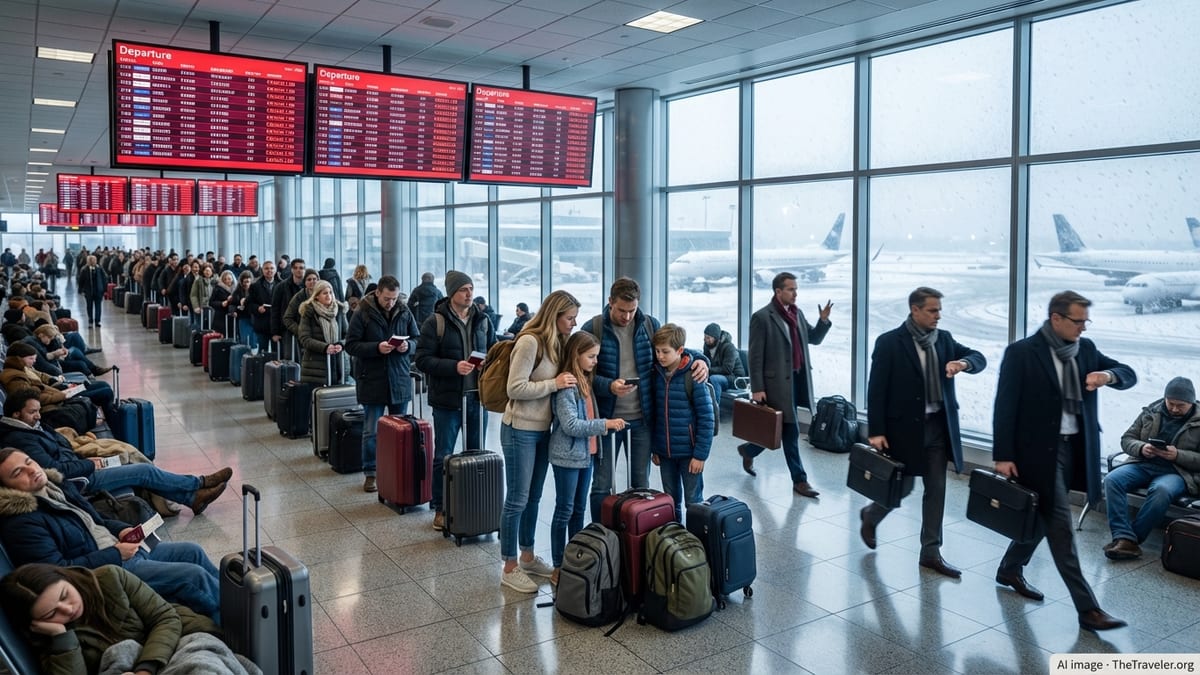
Reports from social media and traveler forums described crowded gate areas, long customer-service lines and departure boards dominated by red and yellow delay markers at several airports that depend on Houston feed. Those accounts underscored how a disruption centered on a single hub can quickly manifest as a nationwide slowdown when schedules are already operating close to maximum capacity.
Structural Vulnerabilities in the U.S. Airline Network
Industry data gathered across recent months points to deeper structural vulnerabilities that make events like the Houston meltdown more likely and more damaging. Federal statistics for the first part of 2026 show cancellation rates rising for several carriers, with United’s network among those recording some of the highest proportions of scrubbed flights and American frequently topping daily cancellation rankings during severe-weather episodes.
This trend has been accompanied by a broader tightening of airline staffing and aircraft utilization. Airlines have sought to capitalize on strong demand by keeping planes full and schedules dense, leaving less slack in the system to absorb shocks. At the same time, regional carriers that feed major networks have been operating under pilot- and crew-supply constraints, amplifying the effect when a single airport’s operations seize up.
Earlier disruptions at other U.S. hubs, including New York’s LaGuardia and Indianapolis, have produced similar contagion effects, where a relatively limited number of cancellations in one city triggered wider instability as aircraft and crews failed to reach their next scheduled flights. Analysts note that Houston’s role as both a domestic connector and an international gateway increases the complexity of recovery when a disruption begins.
Observers also point to changes in how airlines handle customer service during irregular operations. A shift toward app-based assistance and reduced staffed counters may streamline normal-day operations but can struggle under the strain of mass cancellations when thousands of passengers seek help simultaneously.
What Travelers Can Expect in the Coming Days
With Houston’s schedules under pressure and major carriers still working through backlogs from the latest meltdown, travelers across the United States are being urged by consumer advocates to treat upcoming itineraries through large hubs with caution. Aviation tracking services show that when a hub experiences a day of major disruption, knock-on effects can linger for at least another 24 to 48 hours as airlines reposition aircraft, reopen crew schedules and clear standby lists.
For United and American passengers in particular, travel experts advise monitoring flight status frequently, checking for updated waivers, and considering earlier or alternative routings where possible. Recent travel alerts from both carriers indicate a willingness to offer fee-free changes during periods of concentrated disruption, but available seats on alternate flights can disappear quickly once a meltdown is underway.
Houston’s latest turmoil also arrives amid a broader season of global aviation instability, with European hubs and other major North American airports recently reporting their own periods of heavy congestion and cancellation spikes. That context suggests that even after operations at Houston stabilize, the wider network may remain fragile during peak summer demand.
For now, the Houston episode serves as another reminder of how a single day of compounded weather, staffing and infrastructure strain at a major hub can trigger nationwide travel chaos, leaving United, American and their passengers scrambling to recover.