


More news on this day
Royal Caribbean’s newly delivered Legend of the Seas is reshaping expectations of what a cruise ship can be, with dimensions and capacity that now place it at the very top of the global passenger-ship rankings.
Get the latest news straight to your inbox!
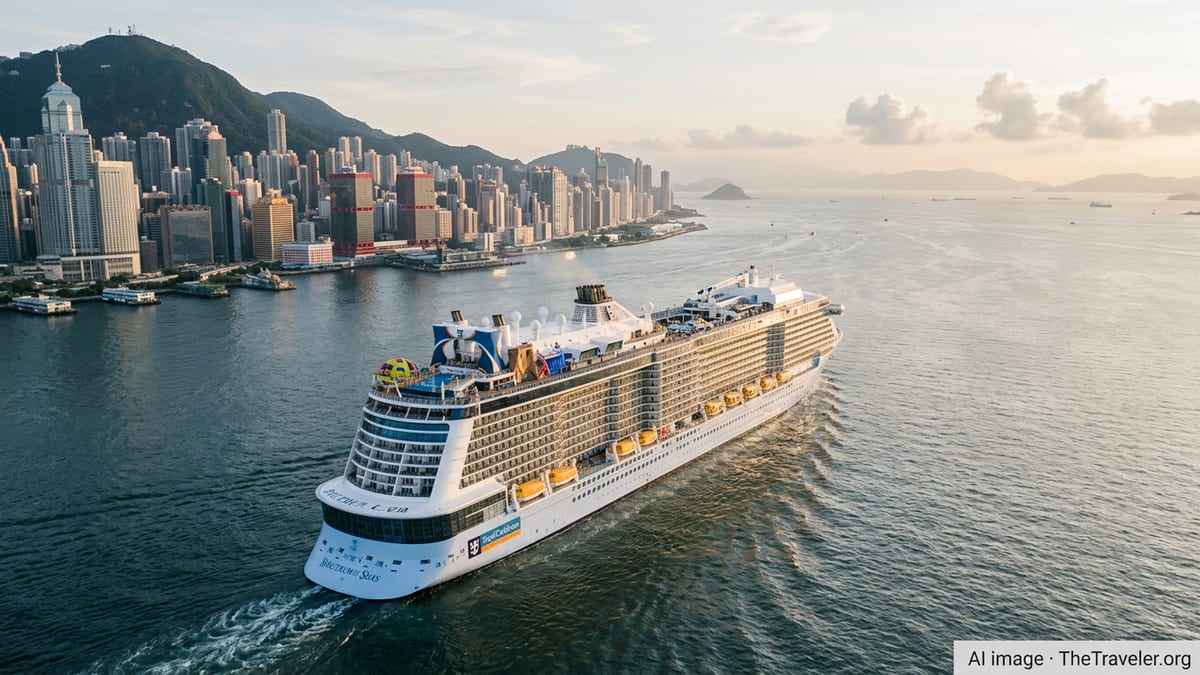
A New Flagship for the Era of Mega-Cruise Ships
Legend of the Seas is the third vessel in Royal Caribbean’s Icon class and, by most recent public measurements, edges ahead of its sisters to become one of the largest cruise ships ever built. Industry data and cruise line fact sheets put the ship’s gross tonnage in roughly the 248,000 to 250,800 range, a figure that places it above Royal Caribbean’s earlier Oasis-class giants and on par with the latest generation of Icon-class vessels.
Length is another headline figure. Legend of the Seas measures about 365 meters, or just under 1,200 feet, from bow to stern, according to port and technical listings. That makes it marginally longer than previous record holders in the fleet and comparable in size to a mid-rise city block laid end to end.
Passenger capacity underscores how that sheer volume is used. Investor materials and cruise-selling platforms describe Legend of the Seas as accommodating around 5,610 guests at double occupancy, with a maximum capacity reported near 7,600 when every berth is filled. This scale places the ship among the highest-capacity passenger vessels in service worldwide.
The numbers also reflect a crew contingent of more than 2,300 people, bringing the total number of individuals on board, at full load, to around 10,000. The ratio underlines the logistical complexity of operating what is effectively a floating resort city.
Putting Legend of the Seas in Fleet and Industry Context
Within Royal Caribbean’s own lineup, Legend of the Seas represents a clear escalation in size over earlier generations. The average Royal Caribbean ship comes in at about 163,000 gross tons with a length near 1,085 feet, according to ship-comparison services that track fleet statistics. Legend of the Seas outpaces those averages by a wide margin in both volume and length.
Compared with the Oasis-class ships that once dominated the size rankings, the new Icon-class design adds tens of thousands of gross tons and hundreds of additional passengers. That extra space has allowed the line to introduce more neighborhoods, expanded water parks and larger entertainment venues, turning the vessel into a testbed for densely packed amenities at sea.
The contrast with Royal Caribbean’s earlier ship that carried the same name is even more stark. The original Legend of the Seas, launched in the mid-1990s as part of the Vision class, measured under 70,000 gross tons and carried around 2,000 passengers. Today’s vessel is more than three times larger by volume and can host well over double the guest count, illustrating how cruise ship design has scaled over three decades.
Across the wider cruise industry, Legend of the Seas joins a small group of vessels that exceed 220,000 gross tons, a category that did not exist until the last 15 years. The ship’s emergence underscores how the arms race in size has shifted from incremental to symbolic, with each new Icon-class hull slightly surpassing its predecessors in length or tonnage.
Inside the Numbers: What “Huge” Means at Sea
Gross tonnage, the measure most often cited for Legend of the Seas, refers to internal volume rather than physical weight. One gross ton equates to 100 cubic feet of enclosed space, meaning the ship’s roughly quarter-million gross tons translate into an immense amount of interior area devoted to cabins, restaurants, theaters and technical spaces.
Length and height amplify the impression of scale. With a length around 365 meters and nearly 20 passenger-accessible decks reported by some booking platforms, Legend of the Seas rises to the equivalent of a high-rise tower laid on its side. Viewed dockside next to smaller ships in the 70,000 to 100,000 gross ton range, the difference is often visually dramatic, with the Icon-class profile towering above neighboring vessels and terminals.
Capacity figures also help explain how that space is used. At a maximum of about 7,600 guests, the vessel carries more people than can fit into many small sports arenas. Beyond passengers, storing fuel, food, water and other supplies for voyages that can exceed a week requires extensive dedicated volume, much of it below the waterline and hidden from view.
Operationally, this size affects everything from port selection to onboard crowd management. Ports need deep water, long berths and expanded terminal infrastructure to accommodate a ship with this footprint. On board, designers rely on multiple themed neighborhoods, wide promenades and distributed dining venues to disperse guests, so that the vessel’s capacity does not translate directly into congestion.
Design Evolution From Vision-Class Roots
The decision to reuse the name Legend of the Seas highlights how far Royal Caribbean’s hardware has evolved since the 1990s. Where the original ship focused on ocean views and traditional cruise layouts, today’s namesake leans heavily into resort-like experiences, anchored by top-deck water attractions, multi-level entertainment districts and family-focused neighborhoods.
Analysts and specialist cruise publications note that Icon-class ships, including Legend of the Seas, concentrate more activities into vertical spaces, stacking venues around large interior atriums and outdoor promenades. This approach allows the line to increase capacity without relying solely on added length or beam, effectively building upward as well as outward.
Technical advances have also enabled the larger footprint. The Icon class is powered by a combination of liquefied natural gas and other energy systems, with exhaust treatment and hull-optimization technologies designed to improve efficiency relative to the ship’s size. While a vessel in the 250,000 gross ton range inevitably uses significant resources, these engineering changes represent the cruise sector’s attempt to balance growth in capacity with environmental and regulatory pressures.
The shift from the original Legend to the current one mirrors a broader industry trend toward ships that serve as all-inclusive, stand-alone destinations. For many travelers, the sheer magnitude of Legend of the Seas is part of the draw, offering the appeal of a large-scale resort combined with changing views outside the portholes and balconies.
What Travelers Can Expect From a Ship This Large
For prospective passengers, the scale of Legend of the Seas translates into a notable variety of experiences on board. Early reviews and preview reports point to an expansive water park, a central family neighborhood, multiple theaters and a wide range of dining options that span quick-service venues to specialty restaurants. The large footprint allows these spaces to be spread across the ship, making it possible for different age groups and interests to occupy distinct zones.
Cabin inventories on a ship of this size tend to be diverse, from interior studios to suites overlooking open-air neighborhoods or the sea. The volume on Icon-class ships has supported the introduction of new cabin layouts and multi-room family accommodations that would be harder to fit on smaller vessels.
However, the ship’s size also influences the travel experience in practical ways. Embarkation and disembarkation can involve thousands of people moving through terminals in compressed timeframes, and popular features such as headline shows or water slides may require advance reservations or queuing. Cruise guides recommend that travelers on these megaships plan itineraries and dining times more carefully than they might on smaller vessels.
As Legend of the Seas begins regular service in Europe and the Caribbean, its performance will be closely watched by the industry. The ship’s dimensions place it on the frontier of what current ports and regulations can handle, making it a test case for how much larger mainstream cruise vessels are likely to become in the coming decade.