


Modern travelers expect their bank to keep up with their passport. Bunq, a Dutch-born neobank, positions itself as a borderless account built for people who live, work and spend across countries. Understanding exactly how bunq handles foreign payments, exchange rates and cash withdrawals is essential if you plan to rely on it for your next trip, whether that is a weekend in London or a month in Thailand.
Get the latest updates straight to your inbox!
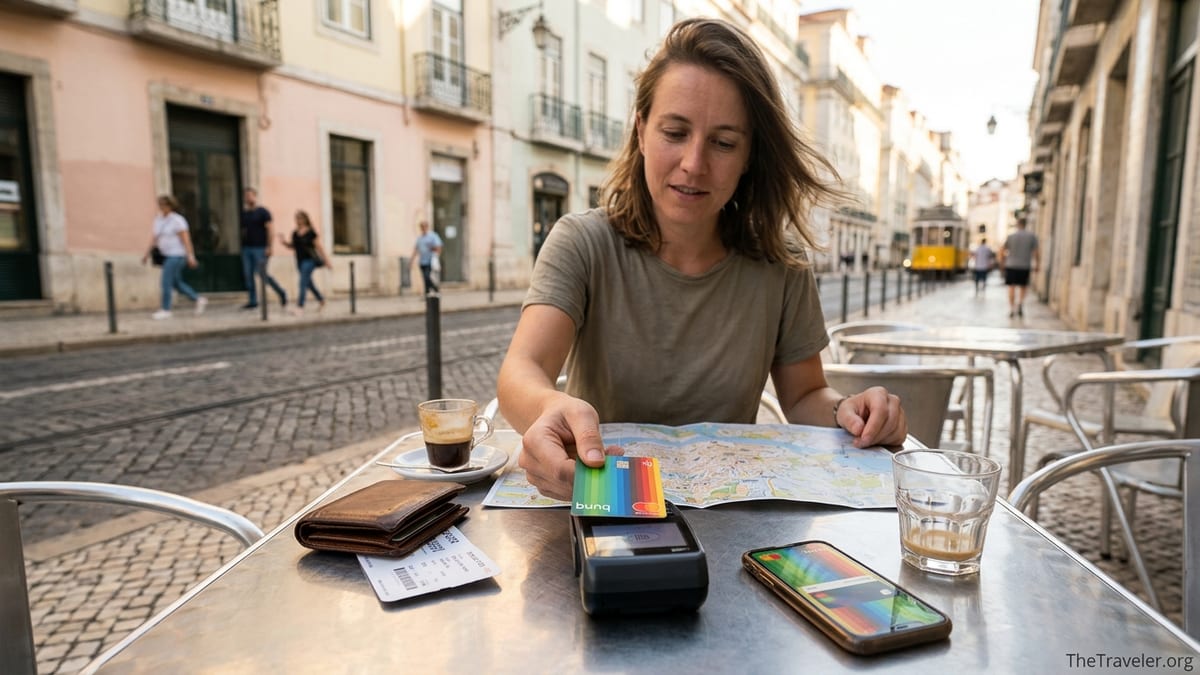
What bunq Is and Where It Works Best for Travelers
Bunq is a fully licensed European bank based in the Netherlands that operates primarily through its mobile app. It offers several personal plans, including Easy Bank, Easy Money and Easy Green, all built around Mastercard debit or credit-style cards. For travelers, the key promise is simple: predictable foreign exchange, clear fees and cards that are widely accepted around the world.
In practice, bunq is most useful if you are a resident of the European Economic Area who travels abroad frequently. For example, a French freelancer who spends a month each quarter working from Lisbon, Berlin or Bali can use the same bunq account to pay for an Airbnb in euros, a coworking space in Indonesian rupiah and an Uber in dollars, all from the same app. The account comes with a European IBAN, and depending on your plan, you can even choose an IBAN from several countries such as the Netherlands, Germany, France, Spain or Ireland, which can be helpful if you receive local payments while you travel.
Bunq is available through the Mastercard network. In day-to-day travel scenarios, that means you can use your card at most major hotel chains, airlines, restaurant terminals and online booking platforms worldwide. The card functions as a debit card for you, but it is processed by many merchants as a Mastercard credit card, which matters at places like car rental counters or automated fuel pumps that often refuse regular debit cards.
Where bunq is less suitable is for travelers who are not based in Europe, or who mainly need a local account in countries outside bunq’s licensing area. A traveler from the United States visiting Europe can use bunq only if they already meet bunq’s residency requirements and open an account beforehand. Likewise, if you plan to be paid in local currencies in destinations such as Thailand or Vietnam, bunq can receive transfers but will usually rely on international payment partners and SWIFT, which can mean additional fees.
How bunq Handles Exchange Rates and FX Fees
The heart of bunq’s travel proposition is how it converts foreign currencies. When you pay in a currency different from your account, bunq uses the Mastercard exchange rate and then applies what it calls ZeroFX. Instead of the typical 2 to 3 percent foreign transaction fee many traditional banks charge, bunq adds a smaller 0.5 percent network fee to cover currency fluctuations and costs. For many travelers, that alone can mean meaningful savings over the course of a long trip.
Consider a German student visiting New York for two weeks. She books a hotel for 1,000 dollars and pays with her bunq card. If the Mastercard rate on that day values 1 euro at around 1.10 dollars, the base cost would be roughly 909 euros. With a conventional bank adding a 3 percent foreign transaction fee, she might pay another 27 euros in surcharges. With bunq and ZeroFX, the additional fee would be around 4.50 euros, a tangible difference on a single booking.
Those savings become clearer when you add up everyday payments. Imagine a typical travel day in Tokyo: a 4 euro equivalent metro ride, an 8 euro lunch, a 12 euro museum ticket and a 20 euro dinner. The total of 44 euros in spending would generate about 1.32 euros in fees at 3 percent with a traditional card, versus around 0.22 euros at bunq’s 0.5 percent network fee. Over a two week holiday, with hundreds of small payments, the difference can easily reach tens of euros.
One important detail is that bunq’s free or entry-level tiers usually include a fair-use limit for discounted FX, such as a yearly allowance of foreign currency payments up to a certain amount at the lower 0.5 percent fee, after which a higher percentage applies. Paying subscribers on plans like Easy Money or Easy Green typically benefit from the lower ZeroFX rate on all their foreign spending. Before a long trip, it is wise to open the bunq pricing sheet inside the app and check your plan’s current FX limits to avoid surprises.
Card Types, Acceptance and Real Travel Scenarios
Bunq issues cards over the Mastercard network that behave slightly differently depending on your plan and how you configure them. For many years its flagship for travelers was the Travel Card, which looked and acted like a Mastercard credit card from the merchant’s perspective while still being funded directly from your bunq balance. Today, similar functionality is built into the cards included with Easy Bank, Easy Money and Easy Green subscriptions, so most users will simply see them as their main bunq debit or credit-style cards inside the app.
This distinction matters in real life. Some car rental companies at major airports, such as those in Los Angeles or Rome, routinely refuse prepaid debit cards and insist on a credit card that can be pre-authorized for a security deposit. Because bunq cards are recognised by many terminals as Mastercard credit products, they are often accepted where regular debit cards are not. Travelers report using bunq successfully for car rental deposits around 400 to 800 euros, for hotel holds at large chains and at self-service petrol stations along European motorways.
However, acceptance is not universal. Certain off-line or older payment terminals, such as vending machines in office buildings or isolated petrol pumps without live network connections, may not authorize a bunq card properly. In practice, this means you might be able to pay at a staffed petrol station in rural France, but a particular unmanned machine on the same road could decline your card. As with any modern fintech card, you should carry a backup from a more traditional bank when driving in remote areas or when you know offline payment is common, such as on some toll roads.
Online, bunq works as any other Mastercard. You can save it as a payment method with large travel platforms, from airlines to train operators and hotel booking sites. A frequent flyer based in Spain might link a bunq card to a low-cost airline account and pay for flights in British pounds when hopping over to London, trusting the bunq exchange rate instead of letting the airline or an intermediary convert the currency at a worse rate.
Using bunq at ATMs and Dealing With Cash
Even in highly digital regions, travelers still need cash. Bunq allows ATM withdrawals worldwide, but these are one of the few areas where fees can add up. Depending on your plan, the first several cash withdrawals each month may cost a modest fixed fee per withdrawal, with higher charges once you exceed that monthly quota. Premium tiers, such as Easy Money or Easy Green, often offer a more generous allowance for cash or even fee-free withdrawals up to a certain number, which can justify their subscription cost if you use a lot of cash.
Imagine a month-long backpacking trip across Southeast Asia starting in Bangkok, continuing to Chiang Mai and then moving on to Laos and Vietnam. Many small guesthouses, market stalls and minivan companies will still insist on cash. If you withdraw the equivalent of 200 euros at the start of each week, a 0.99 euro fee for the first five withdrawals might feel acceptable. But if your plan charges several euros per withdrawal after that, it could become expensive. In that scenario, you might decide to take out slightly larger amounts less frequently to stay within the cheaper tier.
Local ATM operators can also add their own charges, completely separate from bunq. For instance, a traveler using bunq to withdraw the equivalent of 150 euros from an ATM in Bali might see a local fee of 3 to 5 euros imposed by the Indonesian bank, on top of any bunq fee. In many countries, including Thailand and parts of Latin America, almost every foreign card is charged a local fee, whether it is issued by bunq or a traditional bank. It is sensible to compare ATMs from different banks in the same street, as fees can vary, and to withdraw fewer but larger amounts when safe to do so.
When withdrawing money in a foreign currency, watch for Dynamic Currency Conversion at the ATM. Many terminals will ask whether you want to be charged in your home currency, often euros, rather than in the local currency. Always choosing to be charged in local currency lets bunq apply the Mastercard rate and its 0.5 percent fee. Allowing the ATM to convert for you often means paying 4 to 8 percent more than necessary. In practical terms, withdrawing 200 dollars in the United States might cost you around 185 euros through bunq’s own conversion, but closer to 195 euros if you accept the ATM’s proposed euro rate.
Managing Multiple Currencies and Accounts While Abroad
One of bunq’s distinctive features is the ability to hold multiple sub-accounts with separate IBANs and, for some users, local currency accounts in up to around twenty plus currencies. For a frequent traveler, this can be a powerful way to separate travel money from daily expenses and to organize budgets for different trips or countries.
For example, a Dutch digital nomad who spends winters in Portugal and summers in Eastern Europe might create three bunq accounts inside the app: one for regular home bills, one for travel and one specifically for Portugal. She could fund the travel account with 1,500 euros before a three-week road trip, assign her physical bunq card to that account, and know that her day-to-day rent and utilities at home will not be accidentally debited by a surprise car rental hold or a delayed hotel charge.
If you receive payments in foreign currencies, bunq’s local currency accounts can also play a role. A British graphic designer living in Spain but working for clients in the United States might open a dollar account within bunq, receive dollar transfers via SWIFT or specialized partners, and then convert to euros when the exchange rate looks favorable. There are usually network and conversion fees for these currency accounts, but they give you more control compared with letting every incoming payment be auto-converted at the moment it arrives.
The multi-account system is particularly practical when sharing travel costs. A group of four friends planning a skiing week in Austria can open a shared bunq sub-account and each transfer a fixed amount, say 500 euros, into it. They then link one bunq card to that shared account at any given time. When paying for the apartment rental, ski passes or a large supermarket run, the group member whose card is linked to the shared account taps to pay, and bunq immediately updates the shared balance in the app. Everyone can see the spending and settle up later without back-of-the-envelope calculations.
Sending and Receiving International Transfers
Beyond card payments, many travelers and expats use bunq for cross-border transfers. Within the euro area, bunq supports SEPA transfers that are usually fast and low-cost, ideal for paying rent in another EU country or transferring money to a friend. For payments beyond SEPA, such as sending money to a bank in the United Kingdom or the United States, bunq relies on international partners and local currency accounts, and fees can vary depending on route and amount.
Consider a Spanish engineer who works remotely for a company in London and keeps a bunq euro account as his main bank. If the employer insists on paying his salary to a UK account in pounds, he could open a local pound account within bunq, receive the transfer, and then convert to euros in the app. He would pay network and conversion fees, but in return he avoids the sometimes poor exchange rates and additional fees that traditional banks impose when receiving foreign currency into a euro-only account.
On the other hand, a European freelancer who needs to pay a supplier in the United States in dollars might find that sending a SWIFT transfer from bunq involves both a bunq fee and potential intermediary bank charges on the receiving side. For amounts under a few hundred euros, services specialized in small international transfers may sometimes offer cheaper routes. Bunq works best when the majority of your inflows and outflows stay within Europe or at least within currencies that bunq supports natively.
Some users also notice that certain incoming foreign payments, such as small confirmation credits for online platforms in dollars, may attract fixed fees that seem disproportionate to the tiny amounts involved. Before you share your bunq details for recurring international transfers, especially in non-euro currencies, it is sensible to check the latest fee table inside the app and, if possible, test with a small payment first to understand exactly how much arrives.
Practical Tips to Get the Most From bunq While Traveling
To use bunq comfortably as your main travel card, preparation matters. First, verify that your card is fully activated and run a few small test payments at home, both online and in person. This avoids the rare but frustrating situation of discovering a configuration issue, such as an incorrect PIN or payment limit, when you are already abroad. The bunq app lets you adjust card limits for contactless, online and ATM transactions. Before a big purchase, like a 1,200 euro hotel bill at check-in, temporarily raising your payment limit in the app helps ensure the charge goes through smoothly.
Second, carry at least one backup card from a different bank. Even if bunq is your primary travel account, a second Mastercard or Visa from a traditional bank provides redundancy. This is particularly important in regions where connectivity is unreliable or where fringe terminals may have compatibility quirks. For example, a traveler driving through the Balkans might rely on bunq for most fuel stops, but keep another card in the glove compartment for the occasional unmanned petrol station that does not recognize the bunq card correctly.
Third, pay attention to how merchants process your card. At some hotels in the United States, staff will first place a pre-authorization hold for incidentals, sometimes 100 to 200 dollars per stay, then charge the final bill a few days later. With bunq, that hold temporarily reduces your available balance in the linked account. If you are on a tight budget, consider keeping your main spending account separate from the one you use for hotel deposits, so a delayed release of funds does not disrupt your daily spending on food and transport.
Finally, keep an eye on notifications and security controls. The bunq app notifies you in real time about every transaction, in both the local currency and your home currency. If your card is lost or skimmed, you can freeze or delete it from the app and immediately create a new virtual card for continued use with mobile wallets like Apple Pay or Google Pay. For a traveler whose physical wallet is stolen on a crowded tram in Rome, that ability to keep paying with a phone within minutes can turn a major mishap into a manageable inconvenience.
The Takeaway
Bunq offers a compelling package for European-based travelers who value flexible accounts, strong app control and transparent foreign spending. Its use of the Mastercard rate with a relatively low network fee can significantly reduce the cost of paying in foreign currencies compared with traditional banks that routinely levy 2 to 3 percent surcharges. The option to hold multiple sub-accounts and, in some cases, local currency balances also makes it easier to manage budgets across trips, currencies and shared travel groups.
At the same time, bunq is not a universal solution. ATM withdrawals still attract fees, especially beyond the basic monthly allowance, and local ATM operators can add their own surcharges. International transfers outside Europe may involve partner fees, and card acceptance can occasionally be patchy in offline or legacy terminals. For many modern travelers, the sweet spot is to use bunq as the main day-to-day card for contactless payments and online bookings, while keeping a traditional bank card and perhaps a specialist transfer service for occasional edge cases.
If you live in Europe, travel several times a year and are comfortable managing your finances through an app, bunq can meaningfully streamline your international spending. With a bit of planning around limits, withdrawals and backups, it becomes a powerful tool for making the practical side of travel feel as smooth as the experiences you set out to enjoy.
FAQ
Q1. Is bunq a good main bank for long-term travel?
For many European residents, bunq can serve as a main bank while traveling long term, especially if most income and bills are in Europe. However, because ATM fees and some international transfer charges still apply, many long-term travelers keep at least one additional bank account or card for redundancy and for occasional cheaper transfers outside Europe.
Q2. How much does bunq charge for paying in foreign currencies?
When you pay by card in a foreign currency, bunq typically uses the Mastercard exchange rate and adds around a 0.5 percent network fee, compared with the 2 to 3 percent often charged by traditional banks. Exact conditions depend on your plan, and entry-level tiers may apply higher fees after a yearly limit, so you should always check the current pricing in the app before a big trip.
Q3. Are ATM withdrawals abroad free with bunq?
ATM withdrawals are usually not completely free. Depending on your plan, you may get a limited number of low-cost or free withdrawals each month, after which higher per-withdrawal fees apply. Local ATMs can also charge their own fee. In practice, withdrawing slightly larger amounts less frequently can help reduce the total cost of cash while traveling.
Q4. Will my bunq card work for car rental deposits?
In many cases, yes. Bunq cards run on the Mastercard network and often appear to merchants as credit cards, which means they are more likely to be accepted for security deposits at car rental counters and hotels than typical prepaid debit cards. Acceptance policies vary by company and country, so it is still wise to check with the rental agency in advance and carry a backup card for peace of mind.
Q5. Can I use bunq outside Europe, for example in the United States or Asia?
You can generally use bunq cards worldwide wherever Mastercard is accepted. Travelers commonly use bunq in destinations such as the United States, Japan or Thailand for everyday payments and withdrawals. That said, some offline or older terminals may not recognize the card properly, so it is prudent to have an alternative payment method in more remote areas.
Q6. How do I avoid bad exchange rates when withdrawing cash with bunq?
When an ATM offers to charge you in your home currency instead of the local currency, always choose to be charged in the local currency. This lets bunq apply the Mastercard exchange rate plus its usual small network fee. Accepting the ATM’s conversion, known as Dynamic Currency Conversion, often results in paying several percent more than necessary.
Q7. Does bunq support local currency accounts for frequently used currencies?
Yes, higher-tier bunq plans allow you to hold separate local currency accounts in a range of currencies beyond the euro, such as US dollars or British pounds. You can receive and send money from those accounts and convert between currencies in the app, paying a network and conversion fee. This can be useful if you are often paid in foreign currencies or regularly spend in a specific non-euro country.
Q8. Is it safe to rely on the bunq app while I am abroad?
From a security perspective, bunq offers real-time notifications, the ability to instantly freeze or delete cards and strong identity checks in the app. If your physical card is lost or stolen while traveling, you can quickly block it and continue using a virtual card with Apple Pay or Google Pay on your phone. As with any banking app, you should protect your phone with a strong passcode and avoid using public Wi-Fi for sensitive actions when possible.
Q9. Can I share a bunq account for group travel expenses?
Yes. Bunq lets you create shared sub-accounts that multiple users can access. A group of friends can each contribute money to a shared account and then link one bunq card to it to pay for common expenses such as accommodation or fuel. The app tracks all spending in real time, which simplifies settling up at the end of the trip.
Q10. What are the main limitations of using bunq for international payments?
The main limitations are ATM and some transfer fees, occasional card acceptance issues at offline or legacy terminals and potential extra costs for incoming or outgoing SWIFT transfers in exotic currencies. Bunq works best when most of your activity stays within Europe and when card payments dominate your spending. Keeping a backup bank card and checking bunq’s current pricing and limits before leaving home will help you avoid most issues.