


Like many travelers, I arrived in Copenhagen assuming I already understood Scandinavian travel. I pictured a neat circuit of capitals, expensive everything, and a whirl of major sights before catching the next train north. A few days in the Danish capital quietly dismantled that script. Between harbor swims, late-night bike rides, and conversations with locals about overtourism and everyday life, Copenhagen reshaped how I think about not only Denmark, but the whole idea of "doing Scandinavia" in one efficient sweep.
Get the latest updates straight to your inbox!
From Capital Checklist to One-City Deep Dive
My original plan looked like a typical first-timer’s Scandinavian itinerary: two days in Copenhagen, then a fast hop to Oslo, on to the fjords, and a finale in Stockholm. On paper it was tidy and impressive, the kind of route you might proudly post on social media. In reality, Copenhagen made me question the whole premise before I even reached the Central Station to leave.
Part of the shift came from the simple act of slowing down. Instead of racing through Nyhavn for a quick photo and dashing off to Tivoli Gardens, I spent a morning lingering over coffee in Vesterbro, then walked aimlessly along Sønder Boulevard watching parents push prams and cyclists roll past with crates of groceries. By the time I reached the Meatpacking District that evening, I cared less about ticking off sights and more about understanding how the city actually functions for the people who live there.
That sense of immersion is what I had been missing in my mental picture of Scandinavian travel. I had imagined a sequence of postcard moments, not a place that rewards repetition and routine. Copenhagen’s compact size, cohesive design, and walkable neighborhoods encourage you to return to the same bakery twice, recognize faces at the local wine bar, and notice how the light shifts on the lakes between morning and late evening. It is the opposite of a capital you “do” in 24 hours.
By the end of my stay, the idea of squeezing Copenhagen into a single night on a longer loop felt almost absurd. Instead of a quick taste before moving on to Norway’s fjords or Sweden’s archipelago, I began to see the city as a destination that could easily justify an entire week, reshaping my broader expectations for how long is “enough” anywhere in Scandinavia.
The Real Cost of Copenhagen Compared With Its Neighbors
Before arriving, I had mentally filed Copenhagen under the same vague label as Oslo and Stockholm: beautiful but punishingly expensive. Walking into a central café and paying the equivalent of around 45 to 55 Danish kroner for a flat white confirmed part of that assumption. A basic lunch around Nørreport or Nyhavn can still run 120 to 180 kroner without drinks. If you focus only on those first impressions, it is easy to conclude that all of Scandinavia sits in the same price bracket.
But Copenhagen also forced me to notice the ways in which costs are more nuanced than the stereotype suggests. Staying in the city longer revealed patterns: bakeries in residential areas selling excellent kanelsnegle or tebirkes for around 20 to 30 kroner, budget-friendly smørrebrød counters near the Central Station, and takeaway noodle spots where a filling dinner costs less than a beer in Nyhavn. The difference between eating every meal in tourist corridors and seeking out neighborhood venues in places like Nørrebro or Amager is the difference between a trip that feels ruinous and one that feels manageable.
Public transport is another reality check. A single metro ticket from the airport into the city can cost roughly the price of a small meal, while a 24-hour City Pass or similar day ticket quickly becomes worthwhile if you move around a lot. The all-inclusive sightseeing pass that bundles metro, buses, harbor buses, and entry to major attractions looks steep at first glance, but the math shifts once you factor in places like Tivoli Gardens, Rosenborg Castle, and the National Museum, each of which normally charge separate admission. When you realize that individual attraction tickets can easily add up to several hundred kroner in a single day, the combined pass starts to feel less like a luxury and more like a tool to tame Copenhagen’s costs.
Compared with Norway’s fjord towns, where accommodation and dining can spike sharply, Copenhagen’s price structure feels high but predictable, especially if you base yourself in a single neighborhood instead of bouncing between cities. That predictability changed how I thought about budgeting for Scandinavia as a whole: instead of distributing costs thinly across three or four destinations, I began to consider anchoring a trip in one or two hubs, using passes and local knowledge to make the most of each place.
Pedaling Into a Different Kind of City
Nothing altered my expectations of Scandinavian travel more than the first time I joined Copenhagen’s morning bike rush. I rented a city bike in Vesterbro and found myself in a smooth river of commuters flowing toward the city center. Children rode in cargo bikes, office workers in suits pedaled while balancing umbrellas in drizzly weather, and older cyclists effortlessly outpaced me on my wobbly rental. It took about ten minutes to realize this was not a tourist experience added on for visitors. This was the city’s circulatory system.
Compared with other Scandinavian capitals, Copenhagen leans harder into everyday cycling as a default mode of transport. Wide, separated bike lanes trace nearly every major street, traffic signals are timed specifically for cyclists, and even nonchalant details like bike-friendly curb cuts and dedicated bridge ramps tell you that two wheels are not an afterthought. You can feel it on routes like the Dronning Louise’s Bridge over the lakes, where the density of bikes during rush hour rivals car traffic in many other European cities.
Renting a bike for a few days did more than save on metro tickets. It rewired how I related to the city’s geography. Suddenly, the distance between the leafy streets of Frederiksberg and the harbor at Refshaleøen, where repurposed shipyard buildings host food halls, art spaces, and summer events, felt comfortably close. A place that had first appeared as a cluster of names on a map turned into a network of lived-in routes: past the lakes, around Fælledparken, across low bridges where swimmers climb down ladders straight into the harbor.
This experience nudged me to rethink my assumptions about transport across Scandinavia. Where I once assumed the train would be my main lens on the region, Copenhagen showed how much character and nuance you gain from adopting the local mode of movement, whether that means renting a bike in Denmark, using ferries like commuter buses in Stockholm’s archipelago, or relying on local buses in Norway’s smaller coastal towns.
Living With the Water, Not Just Looking at It
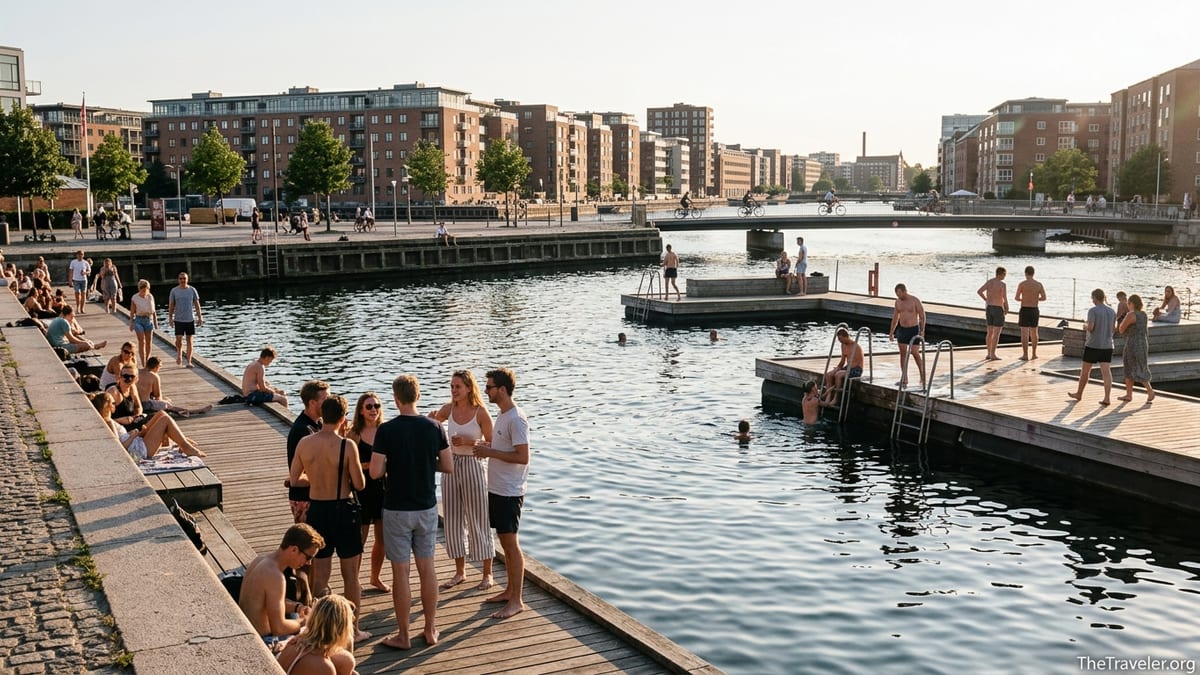
I expected the Copenhagen harbor to be a scenic backdrop: pretty for photos, maybe pleasant for a canal tour, but essentially a view. What I did not expect was how fully the city has reclaimed its waterfront as a public living room. Walking along Islands Brygge on a warm afternoon, I watched office workers stripping down to swimsuits and dropping into the harbor from floating platforms, families picnicking in Havneparken, and teenagers lining up to leap from diving towers at the harbor baths.
The concept of cleaned-up urban harbors is not unique to Copenhagen, but the way it is woven into daily life feels distinct. Harbor baths like those at Islands Brygge and Fisketorvet function as neighborhood swimming pools, with lifeguards, marked lanes, and dedicated areas for children. On hot days, queues at the diving boards and clusters of towels spread across the quayside make the scene feel more like a beach resort than a capital city center. For visitors, the shock is not just that you can swim there, but that almost everyone seems to accept this as normal.
Participating in this ritual changed how I thought about waterfronts across Scandinavia. In Oslo, the redevelopment around the Opera House and Munch Museum has created inviting boardwalks and harbor pools of its own, while Stockholm’s islands offer countless spots where locals slide straight into the water after work. Copenhagen helped me recognize these not as isolated attractions but as part of a broader regional pattern: a culture that treats clean water as an everyday asset, not a luxury reserved for remote fjords.
Once you have floated in the middle of Copenhagen’s harbor with the skyline rising around you, a canal tour becomes less about sightseeing and more about understanding how infrastructure, environmental policy, and daily habits intersect. It reframes Scandinavian travel away from a series of postcard fjords and seaside villages and toward the question of how ordinary people in these countries live with their environments year-round.
Beyond the “Perfect” Scandinavian City Image
From abroad, Copenhagen is often presented as an almost impossibly polished city: pastel waterfronts, designer furniture, happy cyclists, and perfectly poured cortados. On the ground, the picture is more textured. Graffiti-covered walls in Nørrebro, construction cranes reshaping entire districts, and late-night crowds spilling out of bars in the Meatpacking District add grit to the polished image. The city is orderly, but it is not a showroom.
Staying in a residential neighborhood rather than a hotel zone made this clear. From my window I saw trash trucks at dawn, kids practicing trumpet, and apartment balconies strung with laundry and potted herbs. At the local supermarket, shelves mixed organic Danish dairy products with budget-friendly house brands and imported goods. The reality is neither utopian nor bleak. It is simply a functioning city that happens to photograph exceptionally well.
This grounded my understanding of other Scandinavian destinations. In travel media, Stockholm’s Gamla Stan or Bergen’s Bryggen often appear as frozen, picture-perfect scenes. Copenhagen reminded me that behind every historic facade is a live debate about housing, tourism pressure, and the balance between preserving character and making space for those who actually live there. Hearing locals talk candidly about crowds in peak summer or the rising cost of central apartments made it harder to romanticize the region uncritically.
For travelers, this is liberating. It invites you to engage with Scandinavian cities as complex places rather than flawless backdrops. Instead of chasing the most iconic view, you might spend a wet Tuesday afternoon in a neighborhood library, linger in a local bar where the bartender switches effortlessly between Danish and English, or ride the metro out to a less photographed suburb to see how ordinary life unfolds beyond the postcards.
Rethinking the Classic “Scandi Loop” Itinerary
Before Copenhagen, my idea of a Scandinavian trip looked like a geometric problem: how many countries could I connect by train and ferry in two weeks without backtracking? Typical routes string together Copenhagen, Oslo, Bergen, and Stockholm in a tight arc, promising a highlights reel of canals, fjords, and old towns. On forums and in guidebooks, success often seemed measured in the number of borders crossed.
Copenhagen disrupted that logic. After a few days of actually living in the city rather than passing through, the prospect of rushing off after two nights felt wrong. It made me question how much value there is in spending a single full day in Oslo or Stockholm if the result is a blur of hurried museum visits and a quick walk through the historic center. The more I talked with other travelers in cafés and on walking tours, the more stories I heard of people feeling exhausted by their own ambitious itineraries.
This realization does not mean abandoning multi-country trips altogether. It means rebalancing them. Instead of equal slices of time in three capitals, you might give five or six days to Copenhagen and use one or two long side trips to see another part of Denmark, such as the castle at Kronborg in Helsingør or the Louisiana Museum of Modern Art north of the city. If you still want to connect countries, a train to Gothenburg and onward to Stockholm can add Sweden without reducing each stop to a checkbox.
Ultimately, Copenhagen taught me to treat Scandinavia less as a region to be “completed” and more as a set of distinct cultures and landscapes worth revisiting. A first trip might revolve around Denmark and southern Sweden, a second around Norway’s fjords and northern lights, and a third around Sweden’s forests and archipelagos. Instead of racing to do everything, you give yourself permission to come back.
Everyday Sustainability, Not Just Green Marketing
From abroad, Scandinavia is often invoked as a shorthand for sustainability, and Copenhagen in particular is frequently cited in stories about green cities. I expected lots of messaging and marketing, perhaps a sustainability-themed walking tour or a museum exhibition. What I did not expect was how much of the environmental story is built into mundane details you only notice once you slow down.
Small hotel rooms equipped with water-saving fixtures, widespread recycling points, and default vegetarian options in many cafés quietly reinforce the idea that more sustainable choices should be easy rather than exceptional. Supermarkets stock plant-based alternatives but also emphasize local produce and dairy, reflecting a balance between innovation and tradition. Even the way locals embrace cycling and public transit as default modes, rather than lifestyle statements, tells you that lower-impact living here is not reserved for a niche.
Standing on one of the harbor swimming platforms, it is tempting to see Copenhagen’s clean water as a single impressive project. In reality, it is the visible result of decades of investment in wastewater treatment and harbor cleanup, the kind of long-term thinking that has also influenced how other Scandinavian cities approach their waterfronts and urban planning. Conversations with locals often drift toward topics like rising sea levels, climate adaptation projects, and debates about how much tourism the city can comfortably absorb.
For travelers, the lesson is subtle but powerful: the most meaningful sustainability stories in Scandinavia are often found in how everyday life is structured, not in special eco-branded attractions. Copenhagen encourages you to look for similar patterns elsewhere in the region, from district heating systems in Swedish cities to public transit networks in Norwegian towns that make it easier to forego a rental car.
The Takeaway
By the time I left Copenhagen, my carefully plotted Scandinavian circuit had unraveled in the best possible way. The city had revealed itself not as a quick stop on a multi-country checklist but as a place worth returning to, a laboratory for rethinking how we move, spend, and experience destinations in the north.
Instead of reinforcing clichés about Scandinavia as uniformly expensive, flawlessly designed, and best sampled rapidly across borders, Copenhagen showed me a different model: slower, more grounded, and focused on understanding one city deeply before adding another. It reframed the region as somewhere to inhabit for a while, not just to cross off a list.
For anyone planning a first trip to Scandinavia, the unexpected lesson from Copenhagen is simple. Choose fewer bases, stay longer in each, and pay closer attention to how people actually live. The stories you bring home will be quieter, but they will also be truer, and far more likely to draw you back to the north again.
FAQ
Q1. How many days should I spend in Copenhagen on a Scandinavian trip?
For a first visit, three full days is an absolute minimum, but four to six days allows you to explore multiple neighborhoods, try the harbor baths, visit major museums, and still have time for unplanned wandering.
Q2. Is Copenhagen more expensive than other Scandinavian capitals?
Copenhagen is definitely not cheap, but many visitors find everyday costs broadly comparable to Stockholm and slightly below what they encounter in Norway’s fjord regions, especially if they eat and drink away from the most touristy streets.
Q3. Do I need a public transport pass, or can I walk everywhere?
The central areas are walkable, but a transport pass becomes good value if you are arriving from the airport, visiting attractions spread across the city, or staying several days, since it covers metro, buses, and often harbor buses.
Q4. Is renting a bike in Copenhagen safe for visitors?
Yes, provided you are comfortable on a bike. Copenhagen’s separated bike lanes and clear signage make cycling feel natural, but you should follow local etiquette, signal turns, and avoid stopping suddenly in busy bike traffic.
Q5. Can you really swim in Copenhagen’s harbor?
Yes, swimming is allowed in designated harbor baths and bathing zones, which are monitored for safety and water quality. Locals treat these spots like neighborhood pools during summer.
Q6. Is it better to visit several Scandinavian capitals or focus on just one or two?
If your time is limited, focusing on one or two cities, such as Copenhagen and Stockholm or Copenhagen and Oslo, usually leads to a more relaxed and immersive trip than trying to rush through three or four capitals.
Q7. Do I need cash in Copenhagen?
Most visitors never use cash at all. Cards and mobile payments are accepted almost everywhere, from supermarkets and cafés to public transport ticket machines and museums.
Q8. What is the best neighborhood to stay in for a first visit?
Areas like Indre By, Vesterbro, and Nørrebro all work well. Indre By is most central, Vesterbro mixes convenience with local life, and Nørrebro offers a younger, more eclectic feel.
Q9. How does Copenhagen compare to the Norwegian fjords or Swedish countryside?
Copenhagen offers dense urban life, cycling culture, and harborside living, while the fjords and countryside are about dramatic landscapes and quieter villages. Many travelers enjoy combining one city base with a nature-focused side trip.
Q10. When is the best time of year to visit Copenhagen?
Late spring and summer offer long days, outdoor dining, and swimming in the harbor, while early autumn is calmer and often still mild. Winter trips are moodier and colder but can be appealing if you enjoy cozy indoor spaces and festive lights.