


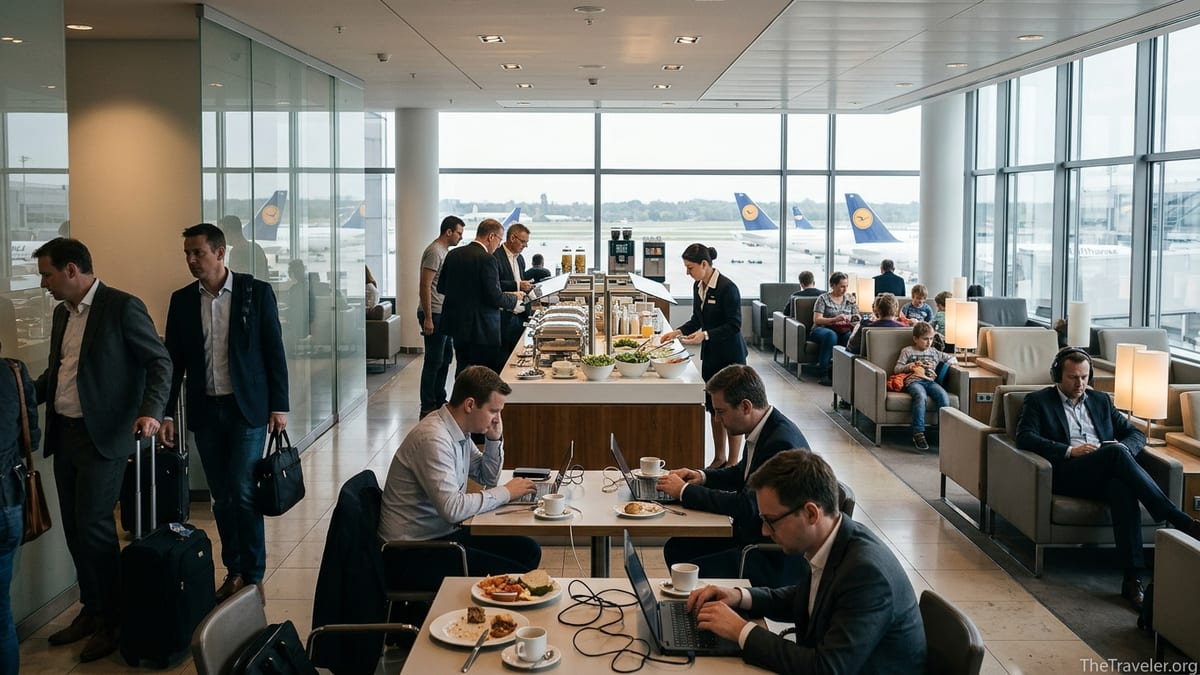
Lufthansa’s lounge network in Frankfurt, Munich and across Europe is a major selling point in the airline’s marketing. Comfortable seating, hot food and showers can turn a stressful connection into something close to a hotel stopover. In practice, though, Lufthansa lounges are not always the best use of your time or money. For some travelers they are crowded, poor value or simply the wrong fit compared with alternative options in the same terminal. Knowing when to skip Lufthansa’s own facilities can save cash, reduce frustration and even improve your journey.
Get the latest updates straight to your inbox!
Understanding How Lufthansa Lounge Access Really Works
Lufthansa operates several lounge types: First Class, HON Circle, Senator, Business and the Frankfurt Welcome Lounge. Access is based primarily on your cabin, your frequent flyer status and whether your flight is on Lufthansa or another Star Alliance airline. Business and First Class passengers on same-day Lufthansa or Star Alliance flights usually receive complimentary access to a corresponding lounge, while Star Alliance Gold members can access Senator or Business lounges even when flying economy, with some airport-specific exceptions.
For most casual travelers, the details that matter are more basic. An economy passenger on a Frankfurt to Rome ticket, for instance, will not receive automatic lounge access, even on a high “Economy Flex” fare. They would need either paid access where it is sold, a Miles & More status level, or a Star Alliance Gold card from a partner such as United MileagePlus or Air Canada Aeroplan. Premium Economy passengers are in a similar situation: the upgraded seat and meal do not normally include free access and they may only be able to enter by paying a fee or using elite status.
Lufthansa has also sold walk-up or prebooked lounge access at select hubs, typically at German and a few major European airports, with prices around the high 30s to 40s euro range per person for Business Lounges. Availability varies by day and location, and at busy times the airline quietly restricts paid access to avoid overcrowding. This inconsistency is one of the reasons some travelers find Lufthansa lounges unreliable as a core part of their travel plan.
On top of this, partner arrangements are in flux. For example, American Express Platinum cardholders have been able to use certain Lufthansa Business and Senator lounges in Frankfurt and Munich on qualifying same-day tickets, although that partnership is set to end around late 2026. Travelers who build their airport strategy around a credit card perk can suddenly find themselves shut out and hunting for alternatives at the last minute.
When Paid Lufthansa Lounge Access Is Poor Value
The first group that should often avoid Lufthansa lounges are economy and Premium Economy passengers considering a paid visit purely for food and a seat. If you are offered access to a Lufthansa Business Lounge at Frankfurt or Munich for around 39 euros, that can seem attractive during a long layover. Yet in practice, what you get may not justify the cost, especially at peak times when seating is scarce and the buffet is under constant pressure.
Take a typical three-hour layover in Frankfurt Terminal 1. A traveler paying roughly 40 euros for lounge entry might find standard hot dishes such as pasta, basic salads, soup and a modest dessert selection, plus self-serve beer and wine. In the same terminal, several casual restaurants serve decent hot meals in the 15 to 25 euro range. Combine a restaurant meal with a coffee and perhaps a quieter public seating area near the gates and you may still spend less than the lounge fee, without needing to hunt for a free armchair among dozens of other passengers.
Paid access looks even weaker if you already carry a premium card that opens independent lounges. A traveler connecting through Munich on a Lufthansa economy ticket, for example, might use a Priority Pass membership tied to a Capital One or Chase card to enter an Airport Lounge World or Europe facility in Terminal 1, where the entry value is built into the card’s annual fee. In that case, paying separately to enter a Lufthansa Business Lounge in Terminal 2 rarely makes sense, unless you have a specific need such as proximity to a particular gate or access to a known quiet corner during a peak bank of departures.
Another real-world example: a family of four flying Lufthansa economy from Hamburg to Athens via Frankfurt. If they were all to buy Lufthansa lounge access at roughly 39 euros each, the total would approach 160 euros. For that cost they could book a day room at an airport hotel during a long connection, or have a restaurant meal, snacks for the flight and still keep a cushion. Unless all four absolutely need showers and workspace in the same place at the same time, Lufthansa’s paid lounge option is usually the least efficient way to buy comfort.
Overcrowding, Inconsistent Quality and Who Should Steer Clear
Even when access is complimentary, several categories of travelers may find Lufthansa lounges more frustrating than relaxing. The most obvious issue is crowding. At Frankfurt and Munich, especially during morning and late-afternoon departure waves, Business and Senator lounges can be near capacity, with guests circling for seats, queueing for showers and hovering by power outlets. Travelers report scenes where nearly every table is occupied, and where staff need to periodically halt entry until people exit.
If your priority is a quiet place to work or take calls, this environment can be worse than a relatively calm public seating area. Many modern concourses feature quiet zones, semi-enclosed work pods or even pay-per-use co-working spaces that are less busy than the nearest airline lounge. For example, a consultant passing through Frankfurt on a tight deadline might find more reliable bandwidth and fewer distractions in an airport business center or a paid co-working booth near the gate than in an oversubscribed Business Lounge full of families and large tour groups.
Quality inconsistency is another factor. Lufthansa has invested heavily in its flagship First Class facilities, but Business and Senator lounges can vary significantly between airports. A Senator Lounge in Munich or Frankfurt might offer a full hot buffet, showers and a staffed bar, while a smaller outstation lounge in a regional European airport may have a more basic spread. For a traveler who has specifically chosen Lufthansa over a competitor because of lounge expectations, this mismatch can lead to disappointment, especially on routes where competitors like SWISS in Zurich or Turkish Airlines in Istanbul maintain higher-average standards.
Frequent flyers who have already experienced premium independent lounges may also find Lufthansa’s product underwhelming. A traveler used to the calm, high-quality food and seating at a Plaza Premium or high-end Priority Pass lounge in Vienna or Copenhagen might walk into a crowded Lufthansa Business Lounge in Frankfurt and decide the free access that comes with their ticket is not worth their time. For these flyers, the alternative is sometimes as simple as leaving the lounge and finding a quiet gate area with natural light and more comfortable individual chairs.
Credit Card Loyalists and Star Alliance Gold: When Alternatives Win
Another category that should think carefully about Lufthansa lounges are travelers whose main access path is via credit cards or Star Alliance Gold status rather than a Business Class ticket. American Express Platinum holders, for example, have historically been able to access select Lufthansa lounges in Frankfurt and Munich when flying Lufthansa or Swiss, even in economy. But that partnership has a clear end date: access is currently expected to continue only until late September 2026, after which cardholders will need to rely on other lounge networks included with their card such as Centurion, Plaza Premium or Priority Pass.
In real terms, that means a traveler connecting through Munich in November 2026 with an Amex Platinum and an economy ticket on Lufthansa might find no access at all to Lufthansa’s own lounges, but perfectly acceptable alternatives in Terminal 1 or in other terminals along the airport’s people-mover routes. For someone planning future trips, it may be smarter to focus flight choices around airports where their card unlocks multiple independent lounges rather than Lufthansa hubs where access is narrowing.
Star Alliance Gold members also face a strategic choice. A traveler with Gold status via United, Air Canada or ANA, flying economy on Lufthansa, is nominally eligible for access to Lufthansa Senator or Business lounges. On paper that looks generous. In reality, in the most crowded periods these lounges can be among the least pleasant spaces in the terminal. The same traveler may have access to quieter contract lounges at some airports, or may be better off spending a moderate sum on a high-quality independent lounge with capped capacity and stricter time limits.
Consider a United MileagePlus Gold member flying economy from London Heathrow to Frankfurt and then onward to Warsaw. In London, they could use a Star Alliance lounge in Terminal 2, which is often well regarded. In Frankfurt, however, they may arrive to find long queues at the Senator Lounge near their departure gate. Rather than invest time walking across the concourse and waiting just to grab a quick snack, they might find more value in a quick café stop and a quieter seating area near the new departure gate, especially when the layover is shorter than two hours.
Families, Short Connections and Early Morning Flights
Families with young children are another group that should not automatically head for a Lufthansa lounge. While some Business Lounges feature small kids’ corners or play areas, these spaces can be limited and quickly overwhelmed during school holiday peaks. If your primary goal is to let toddlers move around and burn energy, a landside or airside play zone, often found near major departure gates in Frankfurt and Munich, may be more suitable and less stressful than trying to keep children quiet in a busy lounge full of business travelers.
Real-world example: a family connecting from a long-haul Lufthansa flight from Chicago to Frankfurt and onward to a Mediterranean holiday route. After an overnight flight the parents might assume the lounge is the ideal place for breakfast and regrouping. In reality, a crowded Business Lounge at 8 a.m. may offer limited space, queues for showers and a breakfast buffet that is no better than what is available in a terminal café. A dedicated family zone near the gates, plus a decent sit-down breakfast at a mid-range restaurant, can be both cheaper and more relaxed.
Short connections are another situation where Lufthansa lounges can be counterproductive. Frankfurt and Munich are both large airports with multiple piers, security checkpoints and passport control points between Schengen and non-Schengen areas. If your layover is under 90 minutes, and especially if you are connecting between Schengen and non-Schengen flights, the time spent walking to a lounge, checking in, finding a seat and then retracing your steps may not be worth it. More than one traveler has missed or nearly missed a connection after losing track of time in a Lufthansa lounge located a long walk or an extra security check away from their gate.
Early morning and late-night flights also reduce lounge value. At 5:30 a.m., for instance, some lounges may offer a limited breakfast spread while many airport coffee shops already serve fresh pastries, barista coffee and hot food. For a 6:30 a.m. Lufthansa departure in economy from a regional German city, paying for lounge access to sit in a dim space with basic rolls and cereal may feel like poor value compared with simply heading straight to the gate after picking up a decent breakfast elsewhere.
Better Alternatives at Lufthansa Hubs and Beyond
For travelers who decide to pass on Lufthansa lounges, practical alternatives exist at most major hubs. In Frankfurt, Terminal 1 alone has several independent lounges that participate in programs like Priority Pass or offer direct paid entry at the door. These facilities often include showers, hot food and alcohol, yet have smaller crowds because access is tied to specific memberships or capacity controls. A traveler arriving on a long-haul flight who needs a shower before continuing to a regional Lufthansa connection could use such a facility instead of walking to a packed Lufthansa Business Lounge.
Munich offers a similar pattern. While Lufthansa controls much of Terminal 2, Terminal 1 features independent lounges such as Airport Lounge Europe and Airport Lounge World that welcome Priority Pass and pay-in guests. A traveler with a longer connection and a Schengen-to-Schengen itinerary might find it worthwhile to allow extra time, move through passport control where needed and use one of these lounges instead, enjoying natural light, a wider food choice and sometimes rooftop or panoramic views.
Beyond Lufthansa’s German hubs, Star Alliance and independent lounges often match or exceed Lufthansa’s own standards. In Zurich, travelers connecting between Lufthansa Group airlines can use SWISS lounges, which are generally regarded as high-quality, particularly in Concourse E. In Vienna, Austrian Airlines lounges provide solid food and decent workspaces for Star Alliance elites and premium passengers. In Istanbul, Turkish Airlines lounges stand out for extensive buffets and multiple relaxation zones, making them preferable to many contract lounges.
Outside of lounges entirely, travelers can buy comfort à la carte. Airport hotels in Frankfurt’s terminal complex, for example, sell day rooms, giving long-haul passengers a private bed, shower and quiet work area for roughly the cost of lounge access for two people. Some airports offer spa-style shower facilities or nap pods that can be booked by the hour. For those who simply want a guaranteed seat and power outlet, many terminals now feature paid quiet zones or co-working spaces with transparent hourly pricing, often more affordable and predictable than a one-size-fits-all lounge fee.
The Takeaway
Lufthansa’s lounges can be valuable, especially for long-haul Business and First Class travelers departing from or connecting through Frankfurt and Munich. Yet they are not a universal solution. For many passengers, especially those in economy or Premium Economy considering paid access, the combination of high entry cost, periodic overcrowding and inconsistent quality makes them a questionable investment. When you add the shifting landscape of credit card partnerships and alliance rules, it becomes clear that relying on Lufthansa lounges as the centerpiece of your airport strategy can lead to disappointment.
Instead, think about what you actually need at the airport. If your priority is a quiet corner to work, a high-quality shower, or a place for children to play, independent lounges, day rooms, kids’ zones and even well-chosen cafés can serve you better than a packed Business Lounge. Credit card lounge networks and Star Alliance partner facilities broaden your options further, often with more predictable access rules.
Before your next journey on Lufthansa, take a few minutes to map the alternatives in your departure and transit airports. Compare the actual cost of paid lounge access to restaurant meals, hotel day use or independent lounges available through your cards. By making deliberate, informed choices rather than automatically heading for the closest Lufthansa lounge, you are more likely to get the comfort and value you want from your time on the ground.
FAQ
Q1. Do Lufthansa Economy passengers get free lounge access?
Generally no. Economy tickets on Lufthansa do not include free lounge access. You need eligible status, a Business or First Class segment, or paid access where available.
Q2. Is paying around 39 euros for Lufthansa lounge access in Frankfurt worth it?
It can be on a long layover if you value showers and workspace, but many travelers find a restaurant meal plus quiet gate seating better value for the money.
Q3. Are Lufthansa lounges usually crowded?
At hubs like Frankfurt and Munich they are often very busy during morning and late-afternoon peaks, with limited seating and queues for showers and food.
Q4. Can my American Express Platinum card get me into Lufthansa lounges?
Some Amex Platinum products currently grant access to selected Lufthansa lounges in Frankfurt and Munich on eligible same-day tickets, but that partnership is scheduled to end around late 2026.
Q5. Should families with young children use Lufthansa lounges?
Not automatically. Small play areas can be crowded, and dedicated airport play zones or family-friendly restaurants are often more relaxed and comfortable for kids.
Q6. Do Star Alliance Gold members always get Lufthansa lounge access?
Star Alliance Gold members usually get access to Lufthansa Business or Senator lounges when flying Star Alliance, but local restrictions and crowding can limit practical usefulness.
Q7. Are independent lounges at Frankfurt and Munich better than Lufthansa lounges?
They can be. Some Priority Pass and pay-in lounges offer similar or better food and calmer spaces, especially when Lufthansa lounges are at or near capacity.
Q8. Is it worth visiting a Lufthansa lounge on a short connection?
Often no. At large hubs with long walking distances and extra security checks, a layover under about 90 minutes can make lounge visits risky or stressful.
Q9. Do Premium Economy passengers get automatic access to Lufthansa lounges?
Usually not. Premium Economy is a cabin upgrade but does not normally include lounge access, so you still need status, a paid pass or a higher cabin segment.
Q10. What is the best alternative if I skip a Lufthansa lounge on a long layover?
Consider a day room at an airport hotel, a high-quality independent lounge via a card program, or a combination of a good meal, shower facility and quiet work area in the terminal.