


For many travelers, Plaza Premium Lounge is the first brand name they see when they start exploring airport lounges beyond airline clubs. With more than 250 locations worldwide and a mix of pay-per-use and card-based access, Plaza Premium has become a global default option for anyone who wants to upgrade their airport time without flying business class. Understanding how these lounges work in practice can help you decide when they are worth the money, how to get in smartly, and what to expect once you step inside.
Get the latest updates straight to your inbox!
What Plaza Premium Lounge Actually Is
Plaza Premium is a global network of independent airport lounges. Unlike airline-branded lounges that mainly serve a single carrier or alliance, Plaza Premium partners with multiple airlines and credit card companies while still allowing walk-in paid access. That means you might see a mix of economy passengers, business travelers on different airlines, and premium cabin flyers sharing the same space. For travelers, the appeal is flexibility: you do not need elite status or a business class ticket to get in at most locations, only some form of eligible access or a paid visit.
The network has grown to cover major hubs in Asia, Europe, the Middle East, and North America. You will find Plaza Premium lounges at airports such as London Heathrow, Hong Kong International, Kuala Lumpur, Vancouver, Dallas Fort Worth, and Orlando. In some terminals, they effectively function as the default pay-per-use lounge, so if your airline does not have its own club, Plaza Premium is often your most realistic option for a quieter seat, a proper meal, and a shower before a long flight.
Plaza Premium operates several sub-brands under the same umbrella. Standard Plaza Premium lounges are the workhorse option most travelers encounter, with buffet food, a bar where permitted by local law, and basic business amenities. In some airports, you will also see Plaza Premium First, a more upscale product with higher entry fees and enhanced dining, and specialized spaces such as arrival lounges or VIP rooms. All of these run on the same basic principle: pay or qualify for access, then enjoy a timed stay with inclusive services.
Because Plaza Premium is not tied to a single airline, the atmosphere can be more varied than in a traditional carrier lounge. At a location like Heathrow Terminal 2, for example, you might see long-haul leisure passengers fresh off a red-eye sharing space with regional business travelers and families passing through on short European hops. That mixed demographic influences both the design and the rules, from family zones to quiet areas and shower capacity.
How Access Works: Walk-In, Passes, and Credit Cards
There are three main ways travelers typically get into a Plaza Premium Lounge: paying directly at the door or online, using a Plaza Premium Lounge Pass product, or entering through an eligible credit card or lounge membership program. In practice, many locations support a combination of all three at once, which is why staff often ask to see both your boarding pass and any card or QR code you are using for entry.
Walk-in access is the simplest method. At some lounges, particularly in North America, posted day-pass prices often fall in the range of roughly 40 to 60 US dollars for around three hours of access. For example, a Plaza Premium-operated lounge at Minneapolis–St. Paul has recently advertised walk-in day passes around 40 dollars for up to three hours, subject to space. At London Heathrow, reports of pay-at-door rates around the equivalent of 55 to 60 US dollars for a two or three hour block are common, while in parts of Asia a shorter shower-only visit can be significantly cheaper. Exact prices vary by airport, time of day, and local currency, and they are regularly updated.
The second route is through a Plaza Premium Lounge Pass, sometimes branded as a PPL Pass. These are multi-visit products sold by Plaza Premium, typically in bundles of two, five, or ten visits that are valid for 12 months once activated. A current Global 2-Visit Pass is priced around 99 US dollars, while a Global 5-Visit Pass is about 199 dollars and a Global 10-Visit Pass around 379 dollars, with each visit usually allowing up to three hours inside. Regional passes can be cheaper: a Canada 5-Visit Pass is advertised at roughly 155 dollars, and an Australia-focused 2-Visit Pass around 66 dollars. For frequent travelers who do not have the right premium credit card, these passes can bring the effective cost per visit well below typical walk-in rates.
The third and increasingly important access channel is through premium credit cards and membership schemes. Holders of certain American Express Platinum and Centurion cards, for instance, can access Plaza Premium as part of the American Express Global Lounge Collection, subject to specific guest rules and time limits. Many locations also participate in lounge networks such as Priority Pass and DragonPass under evolving agreements, so a traveler might get in with a Priority Pass digital card at one airport, but need to rely on an American Express card or a paid visit at another. Because these partnerships change over time, it is always wise to check the most recent access rules for your departure airport before you travel.
Pricing, Time Limits, and Real-World Value
Plaza Premium pricing is not one-size-fits-all. Instead, each lounge sets its own walk-in and prebook rates based on demand and local costs. In practice, most paid visits are sold in time blocks of roughly two to three hours, with options to extend if capacity allows. For example, a Plaza Premium lounge in Hong Kong has historically priced three-hour visits above 60 US dollars for adult travelers, while some European locations have used a two-hour base with a surcharge for additional hours. Shorter, shower-only visits can be much cheaper, sometimes under 15 US dollars in certain Asian airports, though these rates vary widely.
This timed model means value depends on how you use your stay. A solo traveler with a long layover might extract excellent value from three hours of comfortable seating, a hot meal, drinks, and a shower compared with buying separate restaurant meals and coffee in the terminal. A family of four paying individual walk-in fees, however, might find total costs approach what they would spend on a midrange sit-down meal in the main concourse, especially at airports with expensive day-pass pricing. In that case, a multi-visit pass or a credit card benefit that includes complimentary guests can change the equation significantly.
Premium variants such as Plaza Premium First charge more but include elevated offerings. At Dallas Fort Worth, for instance, Plaza Premium operates a dual-concept lounge in Terminal D where the First side commands a flat entry fee in the region of 115 US dollars. That rate covers full bar service and an a la carte dining menu beyond the typical buffet, positioned as an alternative to upscale airport restaurants. These higher-tier spaces mainly target travelers who value restaurant-quality dining and quieter service above pure cost-per-hour calculations.
Because lounge access is capacity-controlled, one important value factor is whether you can actually get in when you arrive. At busy hubs like Heathrow or Hong Kong, it is not unusual for Plaza Premium to implement a waiting list at peak times, meaning even eligible cardholders might face delays. Some travelers choose to prebook paid access through the Plaza Premium website to improve their odds, but even then, fine print typically notes that entry is not guaranteed if the lounge is full. Planning your arrival time with some buffer before peak departure waves can make your pass or membership far more valuable.
What You Get Inside: Seating, Food, and Showers
Once you swipe in, most Plaza Premium lounges follow a familiar pattern of offerings, though quality and design vary by airport. At a standard location you can expect a reception desk, a mix of seating types, a buffet or food station, self-serve drinks where regulations allow, and essential business amenities such as Wi-Fi and power outlets. Many lounges add at least a few shower rooms, especially at long-haul hubs, along with family or quiet zones.
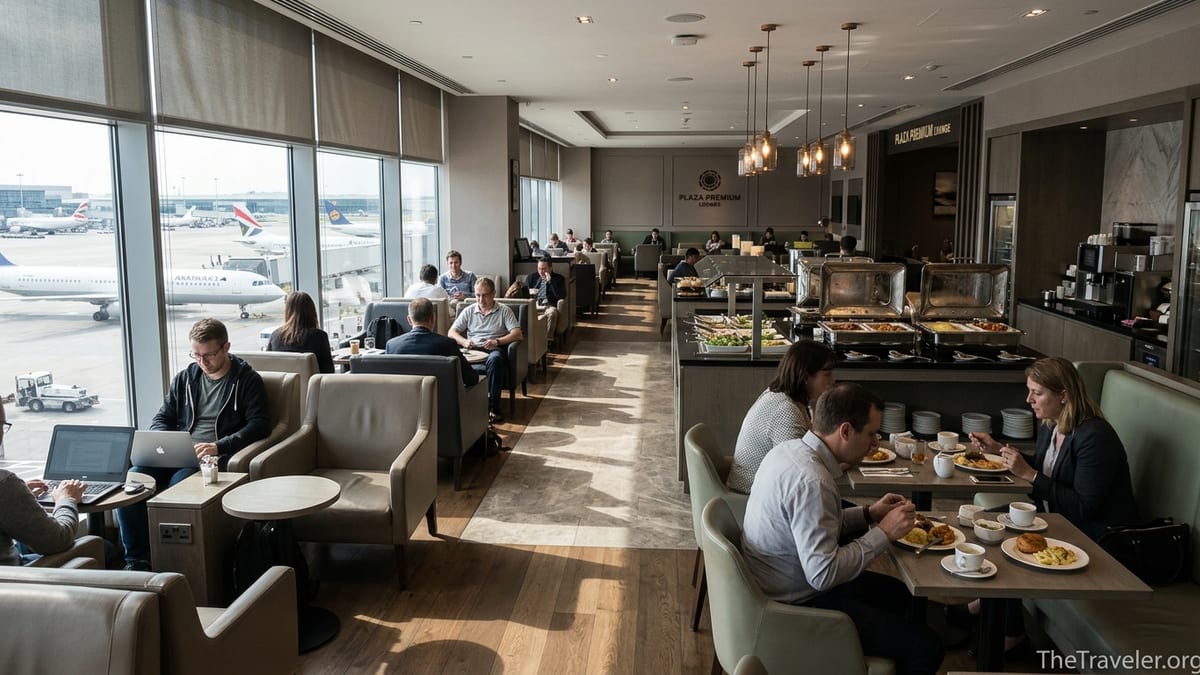
Take the Plaza Premium lounge in Heathrow Terminal 2 as a concrete example. Guests enter via a reception area and then walk through a corridor into a series of zones with armchairs, banquette seating, and more private nooks. Even though the space is windowless, the design uses warm lighting and finishes to feel brighter and more premium than the public gate areas. There is a buffet with hot and cold dishes, typically including items like eggs and pastries at breakfast or pasta, curries, and salads later in the day, along with a staffed bar for alcoholic beverages where permitted.
In Asia, lounges often incorporate more local flavor. At Kuala Lumpur International Airport’s Plaza Premium Lounge in Terminal 1, for instance, travelers can find Malaysian dishes such as curry laksa or fish sambal alongside international comfort food, plus artwork from local artists integrated into the decor. Hong Kong’s Plaza Premium spaces emphasize a clean, contemporary design with clear zoning: guests might see a main dining area, quieter work corners, and a dedicated section for families, all arranged in an open-plan layout that avoids the maze-like feel of some older lounges.
Showers are an important feature for many travelers. Long-haul passengers transiting through London or Hong Kong frequently head straight to Plaza Premium for a quick wash before moving on to meetings or sightseeing. At some locations, shower access is bundled into the standard visit, while others sell shower-only packages or charge a modest supplement. Facilities typically include towels, basic toiletries, and a private cubicle with lockable door. Availability can be tight during morning and evening peaks, so staff may run a waiting list or issue pagers to manage demand.
Airport Examples: Heathrow, Hong Kong, Dallas, and Beyond
Looking at specific airports shows how Plaza Premium adapts its model to different markets. London Heathrow is one of the network’s flagship hubs, with multiple Plaza Premium lounges across terminals. In Terminal 2, the lounge serves a broad mix of Star Alliance and non-alliance passengers, including those entering with premium credit cards. Travelers report that mid-afternoon can be particularly busy, sometimes resulting in a short queue at the entrance. Terminal 4 features a newer Plaza Premium space positioned near other premium airline lounges, with decor aimed at long-haul passengers connecting through the Middle East and Asia.
Hong Kong International Airport is another key stronghold. Plaza Premium operates several lounges in Terminal 1, including options near different gate areas. Travelers generally find the wayfinding straightforward: once you clear security, you follow signs toward your gate, then look for Plaza Premium signage near the main concourse. Food tends to be a mix of Asian and Western dishes, reflecting Hong Kong’s role as a connecting hub. For travelers arriving on red-eye flights, the combination of showers, breakfast, and quiet seating can justify even relatively high walk-in prices, especially if they need to be functional on arrival.
In North America, newer openings continue to shift expectations of what an independent lounge can be. At Dallas Fort Worth, Plaza Premium has added a dual-concept lounge in Terminal D, with one side focused on premium dining and another on more traditional lounge service. The First side’s higher entry fee covers an all-inclusive menu and cocktails, deliberately pitched to travelers who might otherwise have booked a high-end airport restaurant. Elsewhere on the continent, locations at airports such as Vancouver, Toronto, Orlando, and Minneapolis demonstrate how Plaza Premium adapts the template to regional tastes, from more substantial hot dishes in Canada during winter to lighter fare in leisure-heavy terminals.
These examples also highlight a practical point: not all Plaza Premium lounges are created equal. Some, like certain Heathrow and Hong Kong locations, are large, well-appointed spaces that can rival airline-branded clubs. Others, especially in smaller terminals or secondary airports, are more compact and may feel crowded at peak times. Before counting on a Plaza Premium lounge as the cornerstone of your airport plan, it is worth checking basic details such as opening hours, seating capacity, and whether your specific terminal has one at all.
Cards, Memberships, and Evolving Partnerships
One of the more confusing aspects of Plaza Premium is how it partners with different banks and lounge programs. For travelers based in the United States, the most significant relationship is with American Express. Many Platinum and Centurion cardmembers can enter Plaza Premium lounges by presenting their card and a same-day boarding pass, often with limited complimentary guests. The exact rules depend on the card variant and region, and guest privileges are subject to change, so reading the latest benefit guide before your trip is critical.
Plaza Premium has also had a complex history with Priority Pass, the subscription lounge network included with many travel credit cards. Several years ago, Plaza Premium largely exited the Priority Pass network, only to return under renewed agreements that now cover a subset of lounges. Recent announcements indicate that Plaza Premium is once again part of the Priority Pass Select offering at many locations, but availability can still vary city by city. A traveler might find that their Priority Pass grants access in Hong Kong or Dallas, for example, but not at every Plaza Premium-branded space in a given country.
Beyond Priority Pass, Plaza Premium has long-standing ties with DragonPass and various airline partners. DragonPass members can access a large number of Plaza Premium lounges, particularly in Asia and Europe. Some airlines also contract Plaza Premium as their third-party business class or frequent flyer lounge at airports where they lack their own facility. In that scenario, a business class ticket on a partner airline can be enough to unlock entry even if you do not hold any relevant credit card at all.
Because these arrangements shift as contracts are renewed, travelers should avoid relying on outdated assumptions. The most prudent approach is to check two sources before each trip: the official Plaza Premium Lounge website for your departure airport and any lounge locator tools from your bank or membership program. That way you can confirm whether your access will be via a bank card such as an American Express Platinum, a Priority Pass QR code, a DragonPass membership, an airline boarding pass, or a paid visit. A few minutes of research can be the difference between walking straight in and discovering that a once-eligible lounge has left your program.
How to Use Plaza Premium Smartly on Your Trip
Using Plaza Premium effectively is less about memorizing every rule and more about matching the offering to your specific itinerary. On a short domestic hop with a tight connection, paying for lounge access rarely makes sense. On a long international journey with multi-hour layovers or early-morning departures, Plaza Premium can turn awkward airport time into something closer to a hotel lobby experience. The key is to think in terms of effective hourly cost, stress reduction, and how much you would otherwise spend on food and drink in the terminal.
For occasional travelers flying two or three times a year, buying individual day passes or a small PPL Pass can be a sensible choice, especially for big trips. A couple flying from New York to London via a connecting hub, for instance, might buy a Global 2-Visit Pass for around 99 US dollars, use one visit on departure and another during a long layover. Compared with buying à la carte meals, coffee, and perhaps a separate shower facility, they may find the bundled experience both cheaper and more comfortable, particularly if they value Wi-Fi, charging points, and a quieter environment.
For frequent travelers, pairing Plaza Premium with the right credit card is usually more efficient. A traveler who takes monthly international trips and holds an American Express Platinum or a high-end travel card that includes Priority Pass or DragonPass could realistically use Plaza Premium lounges multiple times a year at no additional per-visit cost. In that scenario, the decision is less about whether to pay for access and more about choosing between competing lounges, such as a Plaza Premium lounge versus an airline-branded club or a Centurion Lounge in the same terminal.
Practical habits also matter. Arriving at the lounge with a clear sense of your boarding time, choosing a seat near a departure screen, and checking whether you need to register for a shower wait list right away can all help you get more value from your stay. At crowded hubs, it can be worth walking a few extra minutes to a less popular Plaza Premium location near a different gate cluster if your airline allows easy access back to your departure gate. Ultimately, the travelers who get the most out of Plaza Premium are those who treat the lounges as a flexible tool rather than an entitlement, adjusting their plans based on how busy the airport is on the day.
The Takeaway
Plaza Premium Lounge occupies a distinctive niche in modern air travel: more accessible than most airline clubs, more consistent than many one-off pay-per-use lounges, and increasingly integrated into the world of premium credit cards and membership programs. For travelers without status or business class tickets, it often represents the simplest way to buy a slice of comfort, privacy, and decent food in an otherwise crowded terminal. For frequent flyers with the right card in their wallet, it can be a default backup option when airline lounges are full or inconveniently located.
At the same time, Plaza Premium is not a guaranteed shortcut to peace and quiet. Time limits, capacity controls, and variable quality across locations mean that you still need to make informed choices. A carefully chosen PPL Pass or a well-used American Express or Priority Pass benefit can deliver excellent value, especially at hubs like Heathrow, Hong Kong, and Dallas where Plaza Premium operates high-quality spaces. That value shrinks if you pay high walk-in rates for short visits or arrive at peak times expecting an empty lounge and find a waiting list instead.
Ultimately, understanding how Plaza Premium works is about knowing your own travel patterns. If you regularly endure long layovers, land from overnight flights needing a shower, or prefer to work from a quiet table rather than a crowded gate, then building Plaza Premium into your travel toolkit makes sense. By checking access rules before you fly, comparing pricing options, and setting realistic expectations for what you will find inside, you can turn a generic airport experience into something far closer to a relaxed departure or a productive transit stop.
FAQ
Q1. Do I need to fly business class to use a Plaza Premium Lounge?
You generally do not need a business class ticket. Most Plaza Premium lounges accept economy passengers who either pay a day pass, use a PPL Pass, or enter with an eligible credit card or lounge membership. Some lounges also serve as business class lounges for partner airlines, in which case premium cabin passengers may receive complimentary entry.
Q2. How much does a Plaza Premium Lounge typically cost if I pay at the door?
Walk-in prices vary by airport, but many lounges charge in the ballpark of 40 to 60 US dollars for around three hours of access. Premium concepts such as Plaza Premium First can cost significantly more, sometimes over 100 dollars, while short shower-only visits in some regions may be cheaper. Always check the specific lounge’s current rates before your trip.
Q3. What is a Plaza Premium Lounge Pass and how does it work?
A Plaza Premium Lounge Pass, often called a PPL Pass, is a multi-visit product sold directly by Plaza Premium. You buy a bundle such as a Global 2-Visit, 5-Visit, or 10-Visit Pass, then use those visits at eligible lounges within a set validity period, typically 12 months from activation. Each visit usually allows up to three hours, and many passes can be shared with traveling companions.
Q4. Can I use Priority Pass or DragonPass to access Plaza Premium Lounges?
At many locations, yes, but coverage is not universal and has changed over time. Some Plaza Premium lounges participate in Priority Pass, others in DragonPass, and some in both or neither. You should check the lounge locator for your membership program and the Plaza Premium website for your departure airport to confirm whether your pass is currently accepted.
Q5. Which credit cards get me into Plaza Premium Lounges?
Many premium travel cards include Plaza Premium access as a benefit. American Express Platinum and Centurion cards are notable examples, with access granted through the American Express Global Lounge Collection at many locations. Some bank-issued cards that bundle Priority Pass or DragonPass may also unlock Plaza Premium access where those networks are accepted. Exact eligibility, guest rules, and time limits depend on the card issuer and region.
Q6. Are food and drinks free inside Plaza Premium Lounges?
In most standard Plaza Premium lounges, buffet food, soft drinks, and basic coffee or tea are included in your entry, whether you paid directly or entered via a card or pass. Alcoholic beverages are often complimentary up to a point, subject to local laws and lounge policy, though some premium brands or cocktails may cost extra. Premium lounges like Plaza Premium First may include a wider selection of à la carte dishes and drinks in the entry fee.
Q7. How long can I stay in a Plaza Premium Lounge?
Time limits are usually tied to your type of access. Paid visits and PPL Pass entries often cover up to three hours, with the option to extend for an extra fee if space allows. Card-based access may have similar soft limits based on same-day departure, and staff can enforce shorter stays during busy periods. Always check the posted terms at the entrance and keep an eye on your boarding time.
Q8. Do Plaza Premium Lounges have showers, and do I have to pay extra?
Many Plaza Premium lounges, especially at major international hubs, offer shower facilities. In some locations, showers are included in standard lounge access, while in others you can purchase a shower-only visit or pay a small supplement. Because showers are limited, you might need to add your name to a waiting list at reception during peak times.
Q9. Can families with children use Plaza Premium Lounges?
Yes, families are generally welcome, and many lounges provide high chairs, family seating zones, and kid-friendly food options. Entry rules and pricing for children vary by location: some lounges admit young children for free up to a certain age, while others charge a reduced fee. If you are entering via a credit card or membership, check how many complimentary guests you can bring and whether children count toward that allowance.
Q10. Is Plaza Premium always better than staying in the main terminal?
Not always. If you have a very short connection, paying for lounge access may not be worthwhile, and a crowded lounge at peak time can feel little better than the gate. Plaza Premium works best for longer layovers, early arrivals, or situations where you value a guaranteed meal, Wi-Fi, power outlets, and the option of a shower. Comparing the walk-in or pass cost with what you would otherwise spend on food and drinks in the terminal can help you decide whether it is the right choice for a particular journey.