


For years, the Arctic existed in my mind as a white space on the map: a place of northern lights tours, glass igloos, and huskies racing through the snow. It was only when I began meeting people connected to Sámi culture across northern Norway, Sweden, and Finland that this blank, frozen canvas filled with stories, sovereignty struggles, and everyday routines. The Arctic stopped being a remote backdrop and became what it has always been for the Sámi: home.
Get the latest updates straight to your inbox!
From Empty Wilderness to Sápmi, a Lived Homeland
The first time a Sámi guide drew a map in the snow outside Tromsø, I realized how flat my version of the Arctic had been. With a gloved hand, he traced a rough outline that cut across four countries: Norway, Sweden, Finland, and Russia. “This is Sápmi,” he said. It was not a national border but a cultural one, the traditional homeland of the Sámi people. In that moment, the region I had always called “the Arctic” suddenly had an Indigenous name, and with it, a sense of continuity that long predated the borders on my passport.
Until that trip, I had mostly encountered the north through tourism brochures promising reindeer sledding, ice hotels, and aurora “safaris.” On the ground around Tromsø, the reality was more layered. Outside the city, a 25-minute drive brought me to a reindeer camp run by a Sámi family that has herded for generations, where snowmobiles and quad bikes were parked next to traditional sleds, and the herd circled quietly against a backdrop of the Lyngen Alps.
Standing there, listening to the herder explain how reindeer husbandry is legally protected as a Sámi livelihood in Norway and Sweden, my mental picture shifted again. This was not a frozen theme park; it was a grazing landscape, an economic system, and a family business under pressure from wind farms, mining projects, and shifting snow conditions. The Arctic, I understood, is not empty. It is intensely lived in, argued over, and loved.
Listening by the Fire: Stories Inside the Lavvu
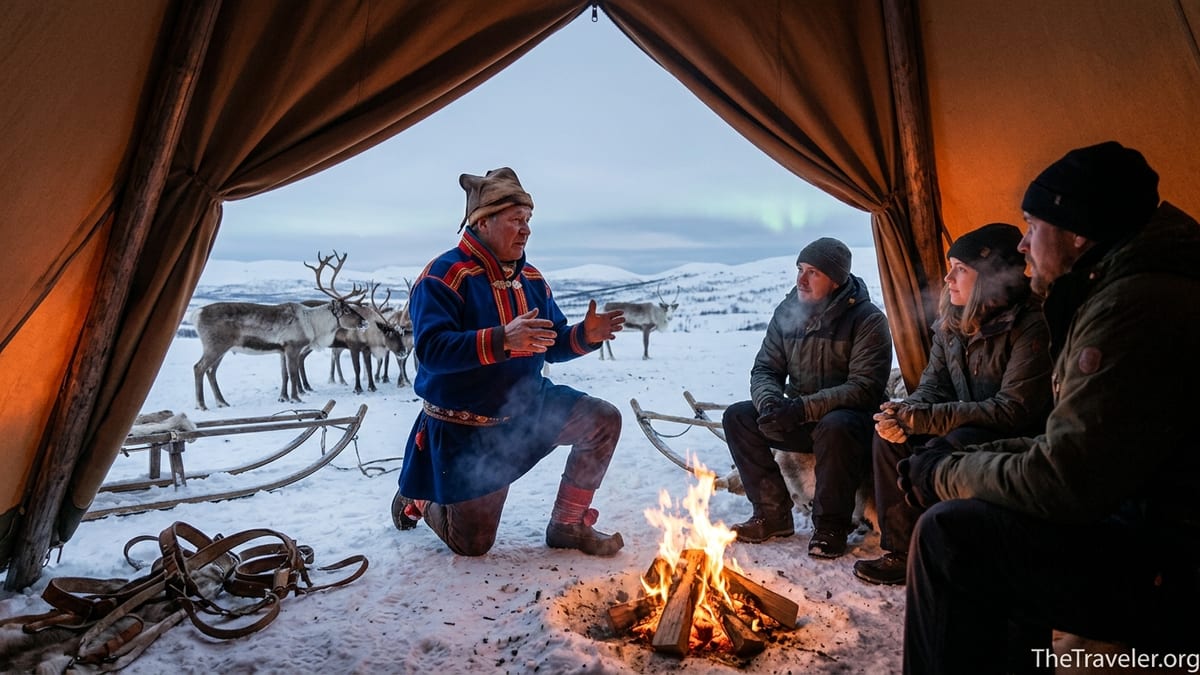
If there is a single place where my view of the Arctic changed most, it was inside a lavvu, the traditional Sámi tent. Near Tromsø, tour operators like Tromsø Lapland and Chasing Lights bring visitors to reindeer camps in winter for evenings that typically include feeding reindeer, a hearty stew, and storytelling sessions inside a warm, firelit lavvu. For many travelers, it is their first close contact with Sámi culture, and it was for me too.
After feeding the reindeer and watching a short sled ride across the snow, our group ducked into the tent. Reindeer skins lined the benches, a cast-iron pot simmered over the open fire, and the only light came from flames and a few candles. Our host, wearing a gákti, the colorful traditional dress, began to talk about eight Arctic seasons instead of four: from the spring migration to calving time and the brief, frantic summer when the sun never sets.
He spoke about his grandparents being punished for speaking Sámi at school and about how his own children now learn the language in a dedicated Sámi classroom. Then he sang a joik, the distinct Sámi form of song that often evokes a person, an animal, or a place rather than telling a linear story. The sound was low and looping, at once intimate and vast, and it echoed in the tent long after he stopped. Tour descriptions might sell this as “entertainment,” but in that space it felt closer to confession and cultural continuity.
Those hours around the fire changed how I saw all the tourist activities that followed. A reindeer sled was no longer a cute photo opportunity but a fragment of an older transport system; the smoked meat on my plate was part of a livelihood that depends on stable grazing land, fair compensation for lost pastures, and the right to move herds across ancient routes.
Tromsø, Karasjok, Inari: Meeting Sámi Communities in Different Places
My next encounters with Sámi culture took me further inland, where tourism feels less packaged and more intertwined with local life. In February, Tromsø hosts a Sámi Week alongside the celebration of the Sámi National Day on 6 February. In the city square, I watched reindeer sprint races along the snow-covered street, stalls selling handicrafts known as duodji, and families in gákti chatting in Northern Sámi, Norwegian, and English. What had felt “exotic” a few days earlier now read simply as urban life with a strong Indigenous presence.
From Tromsø, an overnight bus journey carried me toward the Finnmark Plateau and into what is often described as the heartland of Sámi culture in Norway: Karasjok and Kautokeino. In Karasjok, the modern building of the Sámi Parliament stands near the RiddoDuottarMuseat Sámi Museum, where exhibits on traditional clothing, siida community structures, and reindeer herding tools sit alongside contemporary political history. Walking between the parliament’s curved wooden chambers and displays of old boarding school photographs, the continuity between past and present felt uncomfortably clear.
On the Finnish side, the lakeside town of Inari offers its own window into Sámi life. The Siida museum and nature center, which received a major European museum award in 2024, combines exhibits on Sámi culture with detailed displays on the fragile ecosystems of northern Lapland. That pairing is intentional; for local guides, talking about reindeer migration or fishing rights is inseparable from talking about changing snow conditions, hydroelectric dams, and tourists walking off marked trails on fragile tundra.
What struck me in all these places was the range of Sámi identities and livelihoods on display. I met reindeer herders who spend long stretches on remote winter pastures, artists who split their time between Oslo and Sápmi, civil servants working in Sámi-language administration, and young guides who juggle university studies with seasonal tourism work. Any lingering idea I had of the “typical Sámi lifestyle” quickly dissolved.
Reindeer, Rights, and the Realities Behind the Postcard
For many travelers, meeting Sámi people happens in one specific setting: a reindeer camp. Operators in northern Norway and Swedish Lapland offer half-day excursions that typically include bus transport from the city, reindeer feeding, a short sled ride, a traditional meal such as reindeer stew or salmon soup, and a storytelling or joik session. Prices often hover around the equivalent of 180 to 240 euros for adults, which can feel steep until you see the work that goes into maintaining herds and infrastructure through a subarctic winter.
Yet even as I enjoyed hand-feeding reindeer and hearing how each animal is marked and tracked, it became obvious that these camps are a carefully curated slice of a much larger reality. Herders described how winter ice crusts caused by rain on snow can block access to lichen pastures, forcing them to buy supplemental feed to keep animals alive. Others mentioned conflicts with large wind power projects, like those at Fosen in Norway, where courts found that turbines built on reindeer pastures violated Sámi herders’ rights. Behind the postcard image of a lone sled against snowy hills is a web of legal cases, compensation negotiations, and climate stress.
Watching visitors jostle for selfies with reindeer, I also noticed how easy it is to reduce a complex culture to a single animal. One herder in Swedish Lapland put it bluntly as we shared coffee in a wooden cabin outside Jokkmokk: “Reindeer are important, yes. But Sámi culture is not a costume, a sled ride, and a stew. We are not props for your Arctic fantasy.” It was a sentence that stayed with me every time I saw traditional clothing or a joik performance framed purely as a marketing hook.
At the same time, several Sámi guides pointed out that tourism can be a vital way to share their own narratives directly, rather than having outsiders speak for them. When you book tours owned and led by Sámi people, your ticket can support language revitalization, craft production, and legal advocacy. In northern Norway and Finnish Lapland, I heard variations of the same hope: that travelers might arrive for the reindeer, but leave with questions about land rights and Indigenous self-determination.
Ethical Travel in Sápmi: What Sámi Voices Ask of Visitors
My changing view of the Arctic was not just emotional; it translated into a different way of choosing and behaving on trips. In recent years, Sámi institutions have published guidelines for culturally responsible tourism, emphasizing that Sámi communities should define and benefit from how their culture is presented to visitors. Reading those principles alongside conversations around campfires clarified what “ethical travel” actually looks like in Sápmi.
One recurring theme is consent and control. Sámi-run tours, such as reindeer experiences in Troms, Swedish Lapland, and around Inari, usually make it clear who owns the business and how traditional knowledge is used. They avoid sacred sites or sensitive ceremonies and ask guests not to photograph certain elements. On a visit near the Finnish border, for example, our guide requested that we keep joik recordings off social media, explaining that some songs are deeply personal and not meant for global circulation.
Another point is authenticity without stereotyping. Responsible operators avoid dressing staff who are not Sámi in traditional costumes and do not stage “tribal” performances purely for spectacle. Instead, they might invite guests to join ordinary activities like checking fishing nets, learning a few phrases in Northern Sámi, or trying knife carving under supervision. When I compared these experiences with more generic “Lapland” packages I saw advertised elsewhere, the difference in tone was striking.
Practical choices matter too. Paying fair prices, even when a short camp visit seems expensive, helps cover veterinary care, feed, staff wages, and the cost of keeping herds near tourist hubs instead of distant winter pastures. Opting for small-group tours, sticking to marked trails, and asking before posting close-up photos of people in traditional clothing are simple acts that signal respect. Little by little, these habits shifted my sense of the Arctic from playground to shared, fragile space.
Beyond Northern Lights: Everyday Arctic Life Through Sámi Eyes
Many visitors arrive in the Arctic with one overriding goal: to see the northern lights. I was no different, checking aurora forecasts before I had even stepped on the plane to Tromsø. But once I began spending time with Sámi hosts, the conversation rarely started with the sky. Instead, it revolved around snow, ice, and the delicate timing of seasonal work.
One evening near Nordkjosbotn, after a short sled ride organized by a Sámi-owned company, our guide explained how winter rain events can freeze the top layer of snow into a crust that reindeer cannot dig through, forcing herders to truck in pellets or move animals across long distances to find open pastures. On another day near Inari, a young fisherman pointed to the erratic freeze-up dates on local lakes, which complicate both traditional ice fishing and winter tourism operations that rely on stable ice roads.
These stories reframed the famous “Arctic wilderness” as a place of constant calculation and adaptation. Far from being timeless and unchanging, the landscape is in motion, and Sámi livelihoods are often on the front line of that instability. When a guide casually mentioned that his family now spends more time checking forecast models and satellite images than his grandfather ever did, my romantic idea of the north as a simple refuge from technology felt absurd.
Daily life details also punctured my stereotypes. In Kautokeino, I saw teenagers in gákti scrolling through their phones outside a modern supermarket, snowmobiles parked next to electric cars, and a brand-new school where the local curriculum includes both coding classes and lessons in traditional duodji handicrafts. The Arctic here is not frozen in time; it is negotiating modernity on its own terms.
How These Encounters Changed the Way I Travel
After a few seasons of moving through Sápmi, I can trace a clear before and after in my approach to the Arctic. Before, I focused on checklists: sled dogs, aurora, reindeer, glass igloos. I booked whatever tour ranked highly on global platforms and saw landscapes as backdrops for my photos. After spending evenings in lavvus, museum galleries in Karasjok and Inari, and kitchen tables in small villages, I started planning trips around people rather than attractions.
Now, when I return to the region, I look first for Sámi-owned companies and cultural institutions. I build time into my itinerary for events like Sámi National Day in Tromsø or the Easter Festival in Kautokeino, where reindeer races, concerts, and political debates share the same program. I pay more attention to local news, from court rulings on wind farms to language policy debates, understanding that these stories shape the landscapes I photograph at sunset.
Perhaps the biggest shift is internal. Meeting people connected to Sámi culture made me see that traveling in the Arctic is not a neutral act. my presence in a reindeer pasture, my choice of tour operator, even my social media posts all participate in ongoing narratives about whose north this is and how it should be used. That realization did not stop me from visiting, but it did slow me down, making space for questions I might once have ignored.
If the Arctic was once a canvas of empty white in my imagination, it is now densely layered with names, histories, and unfinished struggles. It is Sápmi as much as it is “Lapland,” a lived homeland rather than a winter playground. And it is filled with hosts who, if we listen carefully by the fire, are more than willing to tell us what they need from the guests who come north.
The Takeaway
Meeting people rooted in Sámi culture across Norway, Sweden, and Finland fundamentally reoriented the way I see the Arctic. It transformed distant lights on a map into a patchwork of communities whose futures are tied to land rights, climate shifts, and the stories told to visitors each winter. For travelers, the lesson is clear: the most meaningful Arctic trips do not just chase the aurora. They seek out Sámi-led experiences, respect local guidelines, and leave room for uncomfortable truths alongside beautiful photographs.
If you are planning a journey to Sápmi, consider your itinerary an invitation to listen. Spend an extra night in Karasjok or Inari to visit cultural centers, choose a reindeer experience where the herders speak for themselves, and learn a few words of Northern Sámi before you go. The Arctic you encounter will be more complex and, at times, more challenging than the brochures promise. It will also be more honest, and infinitely more alive.
FAQ
Q1. Where can I have an authentic Sámi cultural experience in the Arctic?
In Norway, towns like Tromsø, Karasjok, Kautokeino, and Alta offer Sámi-run reindeer experiences and cultural programs. In Finland, Inari and the Siida museum are key hubs, while in Sweden, Jokkmokk and areas of Norrbotten host Sámi-owned tours and craft workshops.
Q2. How can I tell if a Sámi experience is run by Sámi people?
Responsible operators usually state clearly that they are Sámi-owned or Sámi-led, introduce guides by name and background, and explain how income supports local communities. If this information is vague or missing, you can email and ask who owns the business and designs the cultural content.
Q3. Are reindeer sledding tours respectful of Sámi culture?
Reindeer sledding can be part of respectful tourism when designed and led by Sámi herders who decide how their culture is presented. Look for tours that limit group sizes, focus on education rather than just photos, and prioritize animal welfare, and be prepared to pay fair prices that reflect the costs of caring for herds.
Q4. What should I avoid doing when visiting Sámi areas?
Avoid treating people in traditional clothing as props, stepping off marked trails on fragile tundra, entering sacred or private sites without permission, or copying joik recordings without consent. Be cautious about buying souvenirs that mimic Sámi designs without being made by Sámi artisans.
Q5. Is it okay to use the term “Lapland” when I travel?
The term “Lapland” is widely used in tourism, but many Sámi prefer the word “Sápmi” for their homeland. In conversation with Sámi people, it is respectful to use “Sápmi” and to refer to specific regions by their local names, such as Finnmark, Norrbotten, or Inari.
Q6. How is climate change affecting Sámi communities?
Climate change affects snow and ice conditions, making grazing and migration more unpredictable for reindeer herders. Rain-on-snow events can seal off lichen pastures, while unstable ice impacts winter travel and fishing. These shifts add to existing pressures from land development and infrastructure projects.
Q7. Can I visit Sámi festivals as a tourist?
Yes, many festivals welcome visitors, including Sámi Week in Tromsø, winter markets and cultural days in Jokkmokk, and Easter celebrations in Kautokeino and Karasjok. As a guest, follow local guidance, ask permission before taking close-up photos, and remember that for locals these events are not shows but important cultural and political gatherings.
Q8. What are some respectful ways to support Sámi culture when I travel?
Choose Sámi-owned tours and accommodations, buy certified Sámi handicrafts, visit cultural centers and museums, and learn basic phrases in a Sámi language. Listening carefully to the stories you hear and sharing them accurately with others is also a meaningful form of support.
Q9. Are Sámi people only reindeer herders?
No. While reindeer herding is an important traditional livelihood, many Sámi work in education, politics, the arts, tourism, fishing, and other fields. Reducing Sámi identity to herding alone overlooks the diversity of contemporary Sámi life.
Q10. How can I prepare before meeting Sámi hosts in the Arctic?
Reading a short introduction to Sámi history, learning key dates like Sámi National Day on 6 February, and practicing a few greetings in Northern Sámi can help. Arriving curious, open to learning, and willing to adjust your expectations is the best preparation of all.