


Stretching across northern Norway, Sweden, Finland and Russia’s Kola Peninsula, the traditional homeland of the Sámi people, known as Sápmi, is one of Europe’s most captivating Indigenous regions. For travelers, this is a rare opportunity to encounter a living Arctic culture where language, land, and seasonal rhythms still shape daily life. Understanding Sámi history and traditions before you go will help you move beyond postcard stereotypes of reindeer and Northern Lights, and toward a more respectful, meaningful experience of Indigenous heritage in the far north.
Get the latest updates straight to your inbox!
Who Are the Sámi and Where Is Sápmi?
The Sámi are the Indigenous people of northern Fennoscandia, with communities spread across Arctic and subarctic areas of Norway, Sweden, Finland and the Kola Peninsula in Russia. This vast cultural region is known as Sápmi, and it includes destinations many travelers already recognize, such as Tromsø and Karasjok in Norway, Kiruna and Jokkmokk in Sweden, and Inari in Finnish Lapland. Wherever you encounter Sámi culture, it is tied to a deep relationship with the land, from coastal fishing settlements to inland forest and mountain plateaus.
Estimates of the total Sámi population vary, but many sources suggest roughly tens of thousands of Sámi people live across these four countries today, with the largest number in Norway. In practice, this means you might meet Sámi reindeer herders on winter tours outside Tromsø, artisans selling traditional duodji handicrafts in Jokkmokk, or language activists working at the Sámi cultural center in Inari. Sápmi is not a single political state. It is a continuous Indigenous homeland that crosses modern borders, and that fact shapes much of the history and contemporary politics you will encounter when you travel there.
Several Sámi languages are still actively spoken, though all are considered vulnerable to varying degrees. You may see North Sámi on road signs in Norway and Finland, or hear a guide using South or Lule Sámi in Swedish Lapland. Learning a few basic words, such as “buerie beaivi” (good day, South Sámi) or “buorre beaivi” (good day, North Sámi), is a small gesture that signals respect. Keep in mind that many Sámi are bilingual or trilingual, switching fluidly between Sámi, the national majority language, and English when guiding visitors.
For travelers, the key starting point is to understand that Sámi culture is contemporary and diverse. Some Sámi families herd reindeer full time on the tundra, while others work in universities, design studios or city councils in Oslo, Stockholm or Helsinki. When you plan your trip, look for experiences that show this breadth instead of reducing Sámi identity to a costume and a reindeer photo.
A Brief History: From Nomadic Livelihoods to Political Recognition
Sámi communities have lived in northern Scandinavia for thousands of years, developing livelihoods that combined hunting, fishing, small-scale agriculture and the seasonal movement of reindeer herds. Archaeological evidence in coastal Finnmark and inland Lapland points to continuity of settlement long before the modern Norwegian, Swedish, Finnish and Russian states consolidated control over the north. For centuries, Sámi families moved freely across what are now international borders, following migration routes that matched the needs of reindeer and other natural resources.
By the early modern period, Sámi lands were caught between competing state interests. Taxation systems were imposed by different crowns, and later industrialization intensified pressure on land and resources. Mining, hydropower and large-scale forestry all reshaped traditional territories, often without meaningful consent from Sámi communities. In many areas, especially in the nineteenth and early twentieth centuries, state policies pushed assimilation. Children were placed in boarding schools where they were punished for speaking Sámi languages, and traditional spiritual practices were targeted as backward or improper.
The late twentieth century saw a shift toward recognition and Sámi self-determination. In Norway, protests around the planned damming of the Alta River in the 1970s and early 1980s became a watershed moment that drew national attention to Sámi rights. Out of that era came institutional reforms, including the establishment of the Sámi Parliament in Norway in 1989, housed today in a distinctive, timber-clad building in Kárášjohka (Karasjok) that many travelers visit on guided tours. Sweden and Finland later created their own Sámi parliaments, with the Finnish Sámi Parliament based in the Sajos cultural and political center in Inari.
Recognition has not solved every issue. Land rights, resource extraction and climate impacts on reindeer pastures remain sensitive topics. Travelers who choose Sámi-led tours often hear firsthand perspectives on these questions, whether staying in a lavvu tent during a spring migration in Finnmark or visiting a family-run reindeer farm near Kiruna. Listening to these contemporary stories is as important as learning about the past, and it will deepen your understanding of what Indigenous heritage means in northern Europe today.
Core Cultural Traditions: Reindeer, Duodji and the Eight Seasons
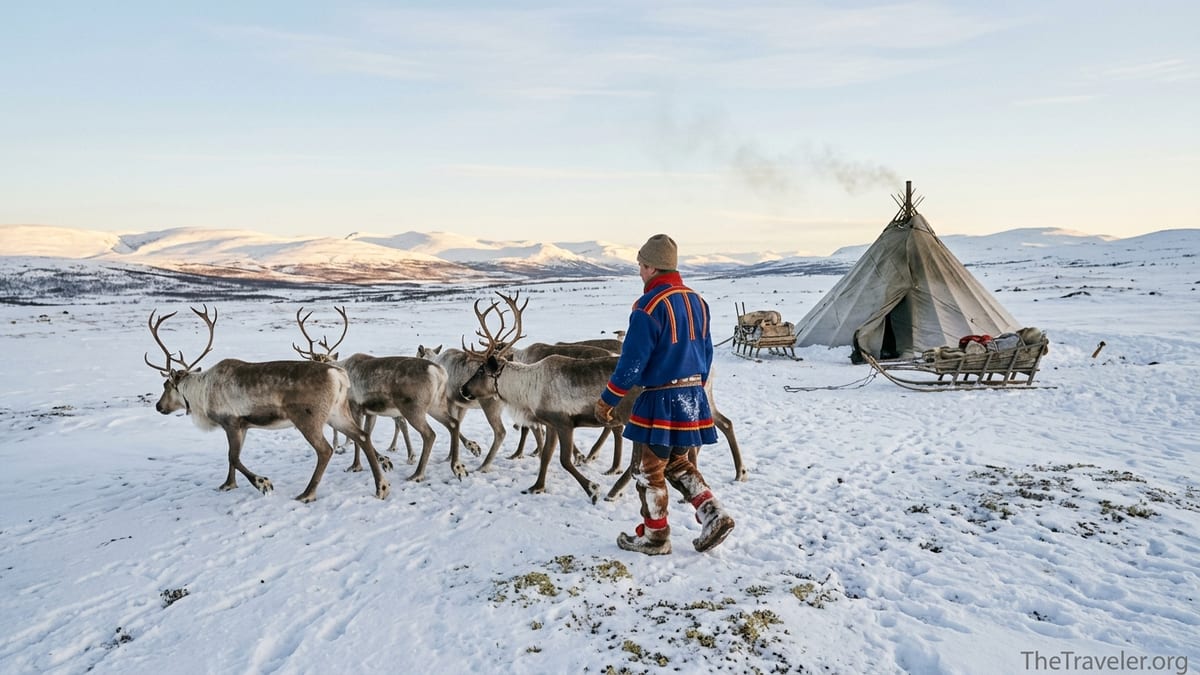
Reindeer husbandry is one of the most visible symbols of Sámi culture, and it remains central to identity even though only a minority of Sámi today are active herders. In many parts of Norway and Sweden, reindeer herding rights are restricted to Sámi siidas or herding districts, and families move animals between inland winter forests and coastal or mountain summer pastures. On winter excursions outside Tromsø or Alta, you may join herders to feed their animals, listen to stories about migration routes and predators, and sometimes try a short reindeer sled ride on frozen ground.
Travelers quickly learn that Sámi culture is organized around more than four seasons. In northern Norway, for example, you may hear guides describe eight distinct Sámi seasons that mark key natural and pastoral transitions, from the intense calving period in spring to the autumn rut and winter darkness. A multi-day migration trip in Finnmark in April, where guests accompany a family as they move reindeer toward summer grazing, gives a direct sense of how these seasonal rhythms still shape daily decision-making.
Duodji, the Sámi tradition of practical handicraft, shows another facet of Indigenous knowledge. In markets such as the long-running February winter market in Jokkmokk, you will see knives with intricately carved reindeer antler handles, tin-embroidered leather bracelets, wooden kuksa cups and brightly woven belts. These objects are beautiful, but their designs are rooted in utility and landscape. A reindeer-skin shoe, for example, is shaped for warmth and ease of repair in deep snow. When shopping, look for stalls or studios run by Sámi artisans themselves, and expect to pay more for authentic work than for mass-produced souvenirs in hotel gift shops.
Food is equally revealing. On Sámi-led experiences in Swedish Lapland or Finnish Lapland, it is common to sit inside a lavvu around an open fire and share a meal based on local ingredients. Dishes might include smoked or slow-cooked reindeer, Arctic char from nearby lakes, cloudberries from the mires, or flatbread served with coffee boiled directly over the flames. Many tours cost from roughly the equivalent of 120 to 200 US dollars per person for a half-day experience that combines storytelling, a meal and hands-on interaction with reindeer. While prices fluctuate by season and operator, you can expect higher costs in peak winter months when demand is strongest.
Living Heritage: Language, Music and Contemporary Sámi Life
Like other Indigenous cultures, Sámi identity is carried not only through visible traditions but also through language, song and spirituality. Yoik (often written as joik or yoik in English) is one of Europe’s oldest vocal traditions, characterized by chant-like melodies that evoke a person, animal or place rather than describing it. On many reindeer experiences near Tromsø, Alta or Inari, guides conclude the visit by performing a short yoik around the fire, explaining how certain melodies belong to specific individuals or landscapes.
Music festivals and cultural events offer a window into contemporary creativity. The Riddu Riđđu festival in Kåfjord, northern Norway, for instance, gathers Indigenous artists from across the Arctic and beyond every July, and programs often include Sámi musicians who blend traditional yoik with electronic, rock or folk influences. In Swedish Lapland, winter festivals in Kiruna and Jokkmokk typically feature concerts, fashion shows with modern interpretations of gákti (traditional clothing), and talks on Sámi language revitalization. For visitors, attending these events is a chance to see Sámi culture on its own terms, not as a performance created solely for tourists.
Urban Sámi life is part of this picture too. In Tromsø, the Arctic University Museum of Norway includes exhibits on Sámi history and religion, while in Inari, the Siida Sámi Museum and Nature Centre combines outdoor reconstructions of turf huts and storehouses with modern galleries that explain environmental change in the north. Karasjok’s RiddoDuottarMuseat network connects several museums across Finnmark that present both coastal and inland Sámi history. Travelers can plan day trips to these institutions, often paying modest entry fees comparable to other Nordic museums, and gain a structured overview before or after spending time in smaller communities.
Everywhere you go, you will meet Sámi people who live firmly in the present. Young guides in their twenties may be studying at universities in Oulu or Umeå while spending peak tourism seasons back home guiding visitors. Elders might share memories of language repression or boarding schools, while also managing online bookings for their reindeer farm. When you listen to these layered experiences, it becomes clear that Sámi heritage is not a static relic but a living, sometimes contested field of identities, careers and political struggles.
Where and How to Experience Sámi Culture on the Ground
For many travelers, first contact with Sámi culture happens through organized tours. In the Tromsø region, for example, companies work with local herding families to offer half-day and evening experiences that combine feeding reindeer, a short sled ride, a hot meal in a lavvu and storytelling. Guests are usually picked up in central Tromsø and driven 30 to 45 minutes to winter pastures. These tours are popular and can book out weeks in advance during the Northern Lights season, so advance planning is sensible.
Elsewhere in Sápmi, experiences are often smaller scale. Around Jokkmokk in Swedish Lapland, guiding companies take small groups by snowmobile into the forest to meet herders at their winter feeding grounds. Visitors may help spread lichen, listen to explanations of ear-marking systems used to identify reindeer, and learn how modern technology like GPS collars mixes with traditional knowledge of terrain. In Finnish Lapland, around Inari and the broader Sámi homeland area, Sámi-run cultural centers and reindeer farms welcome guests for day programs that combine museum visits with outdoor activities.
If you are more interested in in-depth immersion than in short excursions, look for multi-day stays. Some operators in Finnmark and Swedish Lapland arrange spring migration trips where you sleep in simple tents or cabins and travel with a family and their herd for several days. These journeys are expensive by most standards, often running into the equivalent of several thousand US dollars when factoring in guiding, equipment, transport and food. In return, they offer a rare opportunity to observe daily work, from setting fences to preparing meals, in landscapes far beyond the reach of ordinary day tours.
Whatever format you choose, prioritize Sámi ownership and leadership. Look for companies clearly run by Sámi individuals or families, with guides who share personal stories rather than repeating generic scripts. Ask questions about herd welfare, group size and how tourism fits around the reindeer’s seasonal needs. In destinations like Tromsø, some experiences are more theatrical, designed for visitors who only have a few hours. Others, particularly in inland communities such as Karasjok, Kautokeino or Inari, may be quieter and more focused on everyday life. Both can be valuable, but transparency about what you are booking helps set realistic expectations.
Responsible and Respectful Sámi Cultural Tourism
Engaging with Indigenous culture as a visitor comes with responsibilities. In Sápmi, that begins with understanding that reindeer are working animals and a cornerstone of livelihood, not props. When you participate in sled rides, follow your guide’s instructions on weight limits and routes. If conditions are poor, be prepared for cancellations. In recent winters, fluctuating snowfall and warmer temperatures have occasionally forced operators to replace sledding with static visits to feeding grounds. Ethical companies will always prioritize the animals’ welfare and the herders’ needs over a fixed tourist schedule.
Photography is another area where sensitivity matters. While most guides are comfortable with visitors taking photos of landscapes, reindeer and general scenes around the camp, always ask before photographing individuals, especially children or elders in gákti. In some situations, yoik and certain spiritual practices may be considered intimate, and your guide might request that you listen without filming. Respecting those boundaries is part of being a good guest.
Shopping and souvenirs also have an ethical dimension. Authentic duodji is time-consuming to produce and is often made from locally sourced materials such as reindeer leather, antler and birch wood. A hand-sewn knife sheath or tin-thread embroidered bracelet will naturally cost more than factory-made imitations. When in doubt, ask where and by whom an item was made. Purchasing directly from Sámi artisans at markets in Jokkmokk, Kautokeino or Inari, or at dedicated Sámi design shops in regional centers, helps support community economies instead of channeling money to anonymous wholesalers.
Finally, consider where your money goes beyond the tour itself. Staying overnight in smaller Sámi-majority communities, visiting local museums, and eating at cafés run by local families all help diversify income sources. When you return home, you can continue your engagement by following Sámi news, music and designers, and by sharing what you learned about Indigenous rights in northern Europe. Responsible travel is not just about a single experience in the snow, but about recognizing the broader context of Indigenous self-determination and choosing to stand on the side of respect.
Planning Your Trip: Seasons, Practicalities and Budget
The best time to engage with Sámi culture depends on what you hope to experience. Winter, from roughly December through March, is the most popular period for visitors who want reindeer sledding, snowshoeing and Northern Lights. In Tromsø, Alta, Kiruna or Rovaniemi, Sámi experiences fit easily into broader winter programs that might also include dog sledding, northern light chases and snow hotels. Daylight is limited at the darkest point of the year, but the combination of blue twilight and snow-covered landscapes creates a memorable atmosphere around the campfire.
Spring, especially April, is a special time in many inland herding areas. Longer days and more stable weather make it possible for multi-day migrations and field-based activities. Some Finnmark and Swedish Lapland operators specifically schedule their most immersive programs at this time, when reindeer are on the move toward summer pastures. Summer in Sápmi, from June through August, has a different feel: midnight sun, fishing, hiking and cultural festivals become the main attractions. Riddu Riđđu in Kåfjord, summer Sámi weeks in Inari, and various regional markets draw visitors interested in music, art and seminar programs rather than snow-based activities.
From a budget perspective, travelers should plan carefully. In northern Norway and Swedish Lapland, half-day Sámi experiences that include transport, a hot meal and reindeer interaction often run in the range of the equivalent of 120 to 220 US dollars per adult. Multi-day programs are significantly more expensive, reflecting the logistics of guiding in remote Arctic environments. Accommodation in smaller towns like Karasjok, Kautokeino, Jokkmokk or Inari can be more modestly priced than in larger hubs, but availability is limited during festivals and peak holiday weeks, so bookings well in advance are recommended.
Reaching Sámi regions is relatively straightforward thanks to regional airports and rail connections. Travelers often fly from Oslo to Alta or Lakselv for access to Finnmark, from Stockholm to Kiruna or Luleå for Swedish Lapland, or from Helsinki to Ivalo for Inari. From there, local buses or pre-arranged transfers with tour operators bridge the final distance to small communities and reindeer camps. Winter weather can disrupt schedules, so building in an extra buffer day at either end of your trip is wise.
FAQ
Q1. What is the difference between Sámi culture and generic “Lapland” tourism?
Many winter packages marketed as “Lapland” focus on Santa-themed attractions and mass sledding. Sámi culture is an Indigenous heritage rooted in specific languages, livelihoods and political struggles. Choosing Sámi-owned, small-scale experiences gives you a chance to meet people who live that culture year-round rather than seeing a generic snow show.
Q2. Can I visit a real reindeer herding family, not just a tourist farm?
Yes, but it requires planning and often higher costs. Multi-day migration trips in Finnmark or forest visits near Jokkmokk and Inari are usually run by active herding families who integrate tourism into their seasonal work. These experiences are more demanding and less predictable than short visits near big towns, but they offer a deeper look at daily life.
Q3. Is it respectful to wear gákti, the traditional Sámi clothing, as a visitor?
Gákti is strongly connected to identity, family and region, so it is generally not appropriate for non-Sámi visitors to wear a full outfit. Some experiences may offer simple accessories, such as a borrowed shawl or hat for warmth, but it is best to enjoy gákti visually and support makers by purchasing smaller duodji items instead.
Q4. How can I tell if a Sámi experience is ethical and Sámi-led?
Look for clear information about the owners and guides, and whether they identify as Sámi. Ethical operators explain group sizes, how the animals are treated, and how tourism fits around herding seasons. They are honest about what you will and will not see, instead of promising guaranteed Northern Lights, unlimited sled rides or constant close contact with animals.
Q5. Are Sámi museums and cultural centers worth visiting if I am short on time?
Yes. Places like the Siida Museum in Inari, the RiddoDuottarMuseat network in Finnmark or exhibitions on Sámi life at the Arctic University Museum in Tromsø give concise overviews that can be absorbed in one to two hours. They are particularly valuable if you cannot travel to smaller communities but still want a grounded understanding of history and contemporary issues.
Q6. Do I need to learn any Sámi language before visiting?
You can travel comfortably with English and the national languages, but learning a few words is a meaningful gesture. Simple greetings or thanks in North Sámi, such as “buorre beaivi” for good day or “giitu” for thank you, are often appreciated. Many guides enjoy sharing more phrases during tours for those who are interested.
Q7. What should I wear for winter Sámi experiences outdoors?
Expect Arctic conditions. Dress in layers with a thermal base, insulating mid-layer, and windproof outer shell, plus insulated boots, hat, mittens and a neck gaiter. Many operators provide additional outer clothing, such as thick overalls or boots, but it is wise to arrive already well dressed for sub-zero temperatures and time spent sitting still on sleds.
Q8. How are climate and environmental change affecting Sámi culture?
Changing snow and ice patterns are already disrupting reindeer grazing, migration routes and travel safety. Rain-on-snow events can create ice layers that make it difficult for reindeer to reach lichen, forcing herders to bring in supplementary feed. Responsible tours often discuss these challenges, giving visitors a firsthand view of how global climate trends translate into local realities.
Q9. Is it appropriate to ask guides about historical discrimination and current politics?
It is fine to ask respectful, open-ended questions and to listen carefully to the answers. Remember that guides are individuals, not spokespeople for all Sámi people, and some may prefer to focus on other topics. Avoid pressing for personal trauma stories or debating rights issues. If someone shares difficult history with you, treat that trust with care.
Q10. How can I continue supporting Sámi culture after my trip?
You can follow Sámi artists, musicians and writers, buy duodji or music directly from Sámi creators, and stay informed about Indigenous rights debates in the Nordic countries. Sharing accurate information with friends and correcting stereotypes about Sámi people is another small but meaningful way to extend the impact of your visit.